Guerrilla Marketing Company NYC: Who Actually Does This Work
We are a guerrilla marketing company based in New York City. We have worked on the streets of every major borough. This is what real NYC guerrilla marketing looks like.
New York City is not the easiest city to run a guerrilla marketing campaign in. The competition for wall space is intense. The audience is sophisticated and difficult to impress. The logistical demands of operating at scale across five boroughs are significant. And the expectations for creative quality are higher than in most other markets because the baseline visual environment is already extraordinary.
We know this because we have been running guerrilla marketing campaigns in New York for years. We know the walls in SoHo that deliver the best impression volumes. We know which intersections in Williamsburg draw the right audience for which brand categories. We know how to navigate the logistics of a multi-neighborhood New York campaign without losing days to field complications. That field knowledge is the primary thing a guerrilla marketing company in NYC can offer. If they do not have it, the rest of their pitch does not matter.
This guide explains what a guerrilla marketing company in New York City should be able to do, how to evaluate whether a company actually has the field knowledge it claims, what kinds of campaigns work best in the New York market, and what the process looks like when you hire a company that genuinely knows what it is doing.
What a Guerrilla Marketing Company in NYC Actually Does
A guerrilla marketing company plans and executes non-traditional, street-level advertising campaigns. In New York City, that means working with the physical environment of one of the most complex cities in the world: a city of distinct neighborhoods with wildly different demographics, visual cultures, and pedestrian patterns, compressed into a relatively small geographic footprint and served by an extraordinary public transit system that moves millions of people through specific corridors every day.
The practical work of a NYC guerrilla marketing company includes:
Identifying the specific neighborhoods and intersections where the target audience is most concentrated
Selecting and executing the right format or combination of formats for the campaign goal
Managing production, installation, and field operations across multiple boroughs at the same time if required
Documenting every campaign element with high-quality photography and GPS-tagged location records
Providing impression estimates based on actual foot traffic data at each placement location
Analyzing campaign performance and providing strategic input for subsequent campaign planning
The companies that do this work well are the ones that treat New York as a collection of distinct micro-markets, not a single city-scale target. The approach that works for a streetwear brand in Williamsburg does not work for a luxury skincare brand in the Upper East Side. The neighborhood understanding that makes a campaign effective in Harlem does not automatically transfer to the Bronx. City-level generalizations fail at the level of execution that determines campaign quality.
The NYC Neighborhoods Where Guerrilla Marketing Works Best
New York has dozens of valuable guerrilla marketing neighborhoods. The right ones for any specific campaign depend entirely on the target audience. Here is how the major ones break down.
SoHo and the Lower East Side
SoHo is the canonical guerrilla marketing neighborhood for fashion, beauty, lifestyle, and entertainment brands targeting the young urban consumer. The wall inventory is dense and the foot traffic is extraordinary: the intersection of Broadway and Spring Street alone sees pedestrian volumes that rival major transit hubs. The Lower East Side extends the zone with a slightly younger, more countercultural audience that is equally photo-active on social media.
Williamsburg and Bushwick
Williamsburg is the center of Brooklyn’s creative class and one of the most culturally influential neighborhoods in the country relative to its geographic size. Bedford Avenue and the streets branching from it deliver an audience of trend-forward, culturally engaged consumers in the 22 to 38 demographic. Bushwick extends this territory with a stronger arts and nightlife identity and an even younger audience mix.
Harlem and Washington Heights
125th Street in Harlem is the most commercially active street in upper Manhattan and the primary destination for brands targeting the Black and African American consumer demographic. The foot traffic here is enormous, the community’s relationship with brands is highly engaged, and a brand that shows up authentically in Harlem earns credibility that reverberates through broader cultural conversations. Washington Heights adds a large Dominican and Latino community with its own distinct consumer culture.
Long Island City and Astoria
Queens neighborhoods including Long Island City and Astoria deliver younger, growing populations with strong purchasing power and significantly less competitive advertising environments than Manhattan. These neighborhoods are increasingly relevant for brands that want to reach an urban audience without paying Manhattan premiums or fighting for wall inventory in already saturated markets.
NYC Neighborhood
Primary Demographic
Best Brand Categories
Wall Inventory
SoHo / Lower East Side
Urban consumers, 20-38
Fashion, beauty, food, entertainment
Excellent
Williamsburg
Creative class, 22-38
Music, food, consumer tech, streetwear
Good
Bushwick
Arts community, 21-34
Music, art, fashion, nightlife
Very Good
Harlem
African American community, all ages
Music, fashion, beauty, food
Good
LIC / Astoria
Young professionals, 25-40
Consumer goods, food, fitness
Growing
Meatpacking District
Fashion-forward, 25-42
Luxury, fashion, entertainment
Limited, premium
Formats We Use for NYC Guerrilla Marketing
New York supports the full range of guerrilla marketing formats. Each has specific applications and specific advantages in the NYC context.
Large-Format Poster Placements
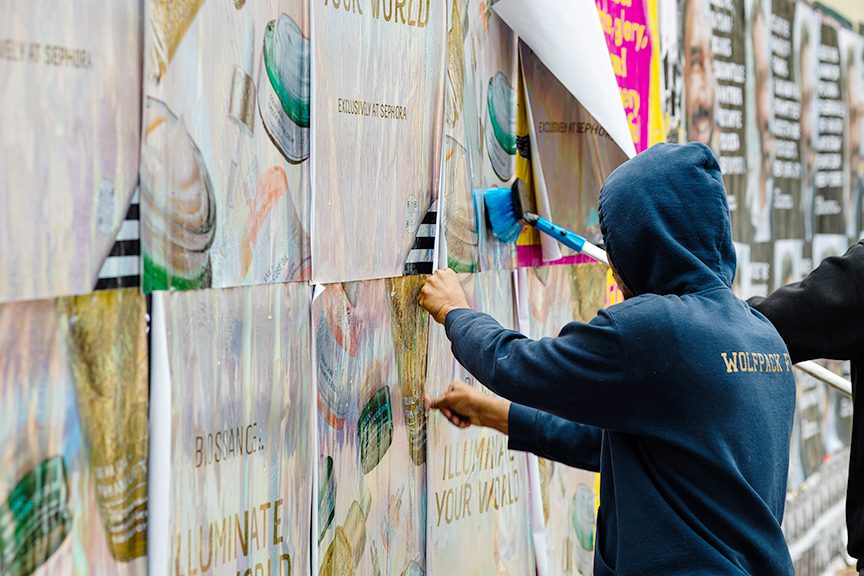
The workhorse format for NYC guerrilla marketing. The city has a strong tradition of large-format paper posters on permitted walls in commercial neighborhoods, and the audience is accustomed to engaging with street-level poster content as a legitimate visual medium. Quality of print and design quality matter enormously because the audience’s baseline expectation is high.
Street Projections
New York’s dense commercial architecture makes building projections extremely effective. Evening projections in SoHo, Williamsburg, and the Meatpacking District reach audiences in a high-engagement after-dark context and generate strong organic social documentation. We have managed projection campaigns that generated tens of thousands of organic social exposures from consumer photography within the first hour of activation.
Brand Ambassador Programs
New York’s transit network delivers concentrated audiences at specific subway exits and bus stops at predictable times. Ambassador programs positioned at the right transit entrances at the right times can reach thousands of exactly targeted consumers with direct human interaction in a single day. We staff and manage ambassador teams in New York regularly and know which station exits deliver which audiences at which times.
Custom Installations
Custom guerrilla installations in high-foot-traffic New York locations generate the strongest organic social amplification of any format we use. When the installation is visually unexpected and clearly branded, the organic photography from the audience in the space creates a second wave of exposures that can far exceed the direct foot traffic at the installation site.
What separates NYC guerrilla marketing from everywhere else: New York audiences are harder to surprise because they have seen more. The bar for what constitutes a genuinely interesting street-level brand encounter is higher. This means that the concepts that work in secondary markets often need to be elevated to work in New York. We design for the NYC audience specifically, not for a generic urban consumer.
How We Plan NYC Guerrilla Marketing Campaigns
Our planning process for NYC campaigns starts with the audience question: who are we trying to reach, and where in New York are they most concentrated? We use a combination of location intelligence data, demographic research, and field knowledge to map the specific neighborhoods, corridors, and intersections where the target audience is physically present in meaningful numbers.
From that audience geography, we identify the format or format combination that most effectively intercepts that audience in their specific environment. A fashion brand targeting the SoHo shopping audience needs a different format approach than a music label targeting the Williamsburg nightlife audience, even though both campaigns are in the same general city.
Creative review is part of our planning process. We assess whether the creative assets the client has or is developing will perform at street scale in the specific environment where we plan to place them. We give direct feedback when we think creative decisions will reduce campaign effectiveness, and we work with clients to resolve those issues before they go to production.
Field operations in New York require experienced, reliable installation teams that know the city’s physical environment and can solve the logistical problems that inevitably arise during a complex field operation. Our NYC field team is composed of people who have done this work in the city for years. They know the specific challenges of different neighborhoods and how to handle them without losing campaign time.
What NYC Guerrilla Marketing Costs
New York City is one of the more expensive US markets for guerrilla marketing because wall inventory premiums, production costs, and field labor rates all reflect the city’s cost structure. A realistic budget range for different campaign types looks like this:
Single neighborhood poster campaign, 2-4 weeks: $8,000 to $20,000
Multi-neighborhood poster campaign, Manhattan + Brooklyn: $20,000 to $45,000
Projection event, single location, 2-3 nights: $25,000 to $55,000
Custom installation, SoHo or comparable: $35,000 to $80,000
Ambassador program, 5-day campaign at transit locations: $15,000 to $30,000
Full multi-format NYC campaign: $60,000 to $150,000
These ranges reflect genuine New York market conditions. Proposals that come in significantly below these ranges for the same deliverables warrant careful scrutiny about what has been cut to reach that price point.
Documentation and Campaign Reporting in NYC
Every campaign we run in New York City is documented fully. This is not optional. It is a core deliverable. You get photo documentation of every installation at every location. You get GPS coordinates and timestamp records. You get impression estimates based on measured foot traffic data at each placement. You get a campaign summary report that accounts for every element of the field execution.
Documentation matters in New York for a specific reason: the nature of the city means that placements get covered, torn down, or tagged faster than in most other markets. A comprehensive record of what was placed when and where is your evidence that the campaign happened as planned. It is also the starting point for planning the next campaign, because you can see exactly which locations held up and which did not.
We also document the organic social response to campaigns when it is measurable. When a campaign in SoHo or Williamsburg generates organic social photography and posts, we track that activity and include it in the campaign report. That organic amplification data is increasingly important for brands that want to understand the full value their street campaign is generating beyond the direct impression counts at placement sites.
Campaign reports are delivered within five business days of campaign completion. They include everything you need to assess performance, present the campaign internally, and plan next steps. That documentation standard is something every guerrilla marketing company in New York should be held to, and it is the standard we hold ourselves to.
How We Actually Run NYC Guerrilla Marketing Campaigns
The campaign planning process at AGM starts with a briefing call where we ask the client three things: who exactly are you trying to reach, where do those people physically spend time in New York, and what do you want them to think or do as a result of seeing the campaign. Those three questions determine everything that follows. Format comes after audience and goal, not before.
From the briefing, we build a location strategy. Our team uses foot traffic data, transit ridership numbers, event calendars, and neighborhood demographic information to identify the specific blocks and intersections where the target audience is most concentrated at the times of day when the campaign will be most visible. That analysis takes one to three days depending on complexity and produces a prioritized location list that ranks sites by estimated target audience exposures, not total foot traffic.
Location approval happens next. We walk the priority locations with the client when they want to see them, or send location documentation with photographs and foot traffic context when a walk is not practical. This stage often produces adjustments to the initial list as the client identifies specific locations that align strongly with their brand positioning or conflict with places they need to avoid.
Production runs parallel to location finalization. We review the client’s creative for format suitability, flag any issues with scale, color contrast, or legibility, and move into production once the creative is approved. We handle all print production, fabrication, and field material preparation in-house or through vetted production partners we have worked with repeatedly.
Field installation runs overnight for most formats. Our crews are briefed on the location list, the installation protocol, the documentation requirements, and the timeline before deployment. GPS-tagged photographs go out within 24 hours of each installation night. Post-campaign reports include location documentation, estimated impression counts, and social monitoring data from the campaign window.
What Makes New York Different from Every Other US Market
New York is not simply a larger version of other cities. It is a fundamentally different operating environment for guerrilla marketing, and companies that import their approach from other markets without adjustment consistently underperform.
The density is the first difference. Manhattan’s population density, approximately 70,000 people per square mile in the busiest residential areas, means that a single installation in the right location generates impression volumes that would require dozens of placements in a sprawling Sunbelt city. The concentration of exposures is an advantage, but it also means that location selection is extremely high-stakes. The difference between the right block and the wrong block in New York is measured in thousands of exposures per day.
The audience sophistication is the second difference. New Yorkers are exposed to more advertising than residents of almost any other city on earth. They are also more likely to be early adopters, cultural influencers, and social media creators who amplify what they encounter in the physical environment. A campaign that earns genuine attention from a New York audience has potential reach far beyond the city because that audience is connected to networks that span the country and internationally.
The borough complexity is the third difference. The five boroughs are not interchangeable markets. Williamsburg and Bushwick are not just Brooklyn. Harlem and Washington Heights are not just Manhattan. Long Island City is not just Queens. Each neighborhood has a specific demographic character, a specific set of physical environments, and a specific cultural moment that shapes how advertising is received. A company that treats New York as a single market rather than a collection of distinct neighborhoods runs campaigns that are off-target in ways that never show up in planning but always show up in results.
AGM Field Note: The single most common mistake we see from companies entering New York for the first time is over-investing in Manhattan and under-investing in Brooklyn. The Bedford Avenue corridor in Williamsburg and the Wyckoff Avenue zone in Bushwick are where the most culturally influential young consumers actually live and spend time. Manhattan is where they commute. If your target is the creative class under 35, Brooklyn is the primary market.
NYC Campaign Budgets: What Different Levels Actually Buy
Budget determines scope in New York guerrilla marketing more precisely than in any other US market, because every element of a campaign carries a New York cost premium. Field labor, production quality, and installation in a city where competition for wall inventory is intense all affect what a specific budget can accomplish.
Budget Range
What It Covers in NYC
Expected Reach
Best For
$5,000 to $12,000
Single-format, single-neighborhood stencil or poster run
50,000 to 150,000 exposures
Local launches, neighborhood-specific events
$12,000 to $30,000
Two-format campaign in two to three neighborhoods
200,000 to 600,000 exposures
Product launches, city-wide awareness
$30,000 to $70,000
Multi-format campaign with stencils, posters, street team
500,000 to 1.5 million exposures
Major launches, sustained brand building
$70,000+
Full campaign with projection, mural, multi-borough coverage
1 million+ exposures
National brand launches, major campaigns
These ranges are estimates based on typical campaign scopes. Every campaign is quoted individually based on the specific format mix, neighborhoods, timeline, and production requirements. Brands that come to us with a clear brief and realistic budget expectations get accurate proposals. Brands that ask us to fit a multi-borough campaign into a single-neighborhood budget get an honest conversation about what is achievable at their investment level.
Frequently Asked Questions About Guerrilla Marketing Companies in NYC
Frequently Asked Questions
What does a guerrilla marketing company in NYC actually do?
A guerrilla marketing company in NYC plans and executes street-level brand campaigns in New York City’s neighborhoods. This includes large-format poster placements, building projections, brand ambassador programs, guerrilla installations, vehicle wraps, and other non-traditional advertising formats that reach consumers in the physical urban environment.
How do I choose the right guerrilla marketing company in NYC?
Choose a company with proven NYC field experience, a portfolio of completed campaigns in the specific neighborhoods relevant to your target audience, transparent pricing, and a planning process that starts with audience research before format selection. Avoid companies that pitch a fixed service without understanding your specific campaign goals and audience geography.
What neighborhoods in NYC does AGM run campaigns in?
We run campaigns across all five boroughs, with primary experience in SoHo, the Lower East Side, Williamsburg, Bushwick, the Meatpacking District, Harlem, Astoria, Long Island City, and numerous other neighborhoods. We select neighborhoods based on where your target audience is, not on which ones are most convenient for us.
How much does guerrilla marketing cost in NYC?
NYC guerrilla marketing campaigns typically range from $8,000 for a focused single-neighborhood activation to $100,000 or more for a comprehensive multi-borough campaign with custom installations. NYC-specific costs including venue relationships, production, and field team labor affect pricing at every budget level.
Does a NYC guerrilla marketing company need to be based in New York?
Not necessarily, but they need genuine NYC field presence and local relationships. Companies without actual field operations in the city will not know the block-level details that determine campaign quality: which walls are best, which intersections have the right foot traffic, which neighborhoods match which audiences.
What formats does AGM offer for NYC guerrilla marketing?
We offer large-format poster placements, street projections, brand ambassador programs, custom guerrilla installations, vehicle wraps, stencil campaigns, and sampling or flyering programs. We recommend format combinations based on the specific campaign goal, target audience, and budget.
How long does a NYC guerrilla marketing campaign take to plan?
Simple poster placement campaigns can be planned and executed in two to three weeks. More complex campaigns with custom fabrication, projection events, or multi-format executions typically require six to ten weeks. Rush timelines are possible for straightforward formats with sufficient budget for expedited production.
How do I contact AGM for a NYC guerrilla marketing campaign?
Call us at (646) 776-2770 or email [email protected]. We are based in New York and our team is available to review your campaign brief, discuss your audience and geography, and recommend a specific approach for your NYC campaign.