
July 20, 2026
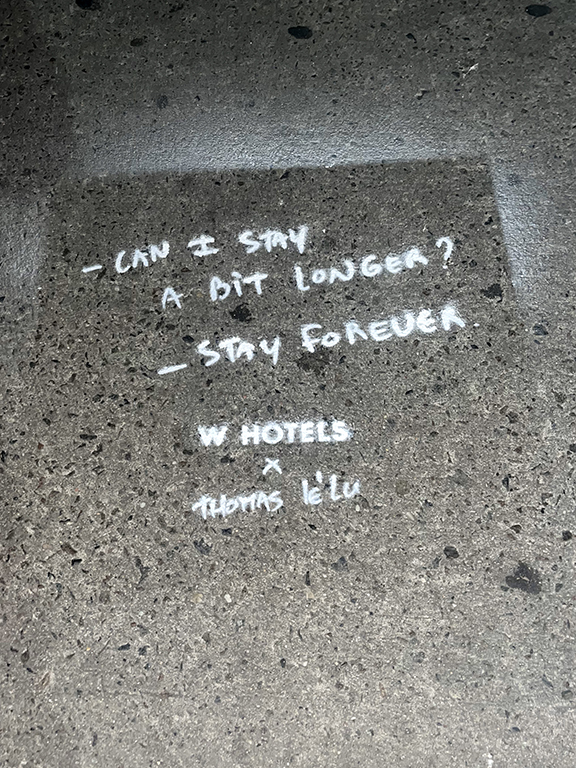
From 5 locations at $2,855 to 200 locations at $22,112, here is the complete pricing breakdown for sidewalk stencil campaigns in 2026.
Sidewalk stencil advertising puts your brand directly in the path of foot traffic. It works at street level, in the moments before someone walks into a store, passes a venue, or turns toward your activation. When it is designed well and placed in the right locations, it stops people mid-stride.
At American Guerrilla Marketing, we run sidewalk stencil campaigns across New York, Los Angeles, Chicago, Miami, Austin, and other markets. Every week we quote campaigns ranging from a handful of locations to large multi-city deployments. The question we hear most is: what does this actually cost?
This guide gives you the full answer. We cover our complete pricing table from 5 to 200 locations, explain what drives cost up or down, break down the materials we use, and walk through a real campaign scenario so you can see how the numbers translate into a real budget. We also compare stencils against decals at the same quantities so you can make an informed choice between the two formats.
Questions on your specific campaign? Call us at (646) 776-2770 or email [email protected].
These are our standard 2026 rates. All pricing includes custom stencil fabrication, installation labor, geo-tagged photography, and a field report delivered after the campaign. AGM manages all site coordination before installation.
| Number of Locations | Campaign Price | Cost Per Location |
|---|---|---|
| 5 locations | $2,855 | $571 |
| 10 locations | $3,231 | $323 |
| 15 locations | $3,608 | $241 |
| 20 locations | $3,989 | $199 |
| 30 locations | $4,976 | $166 |
| 40 locations | $5,795 | $145 |
| 50 locations | $6,982 | $140 |
| 60 locations | $7,957 | $133 |
| 70 locations | $8,946 | $128 |
| 80 locations | $9,935 | $124 |
| 90 locations | $10,924 | $121 |
| 100 locations | $11,999 | $120 |
| 150 locations | $16,944 | $113 |
| 200 locations | $22,112 | $111 |
The per-location cost drops significantly as volume increases. At 5 locations you are paying $571 per location. At 200 locations that drops to $111 per location. If you are on the fence between 40 and 50 locations, the marginal cost of the additional 10 drops well below the average unit cost, making scaling up almost always the right call when budget allows.
We include the following in every stencil campaign, at every quantity tier:
Every campaign starts with a custom-cut stencil made from your artwork or brand mark. We do not use generic templates. Your logo, wordmark, tagline, or custom illustration is cut into a durable stencil material that can be used across all locations in the campaign. The stencil fabrication is part of your campaign price — there is no separate setup fee.
Our field crews install every stencil at the agreed locations. Crews are briefed on placement precision — we are not slapping stencils wherever is convenient. Every location is scouted in advance and pre-mapped by our team. AGM manages all site coordination before installation so your brand appears exactly where it is supposed to appear.
After installation, every location is photographed with geo-tagged metadata. This creates an auditable record of exactly where each stencil appeared and documents the quality of the installation. You receive these photos as part of your field report.
At campaign close, we deliver a structured field report covering all installed locations with photos, GPS coordinates, and installation notes. This is your proof of performance and a useful document for client reporting or internal campaign review.
The pricing table above assumes standard conditions. Several factors can push your campaign cost above or below the standard rate.
This is the most direct cost driver. More locations mean more materials and more crew time. But because stencil fabrication is largely a fixed cost and crew efficiency increases with larger batches, the per-unit price drops meaningfully from 5 to 200 locations. The sweet spot for most brand campaigns is 20 to 50 locations — enough saturation to create a visible presence across a neighborhood or district, at a cost that fits most marketing budgets.
New York, LA, and Chicago are our most-traveled markets. Secondary cities like Miami, Austin, and Nashville may carry modest travel and logistics premiums depending on the campaign scope. Surface type also matters — a smooth concrete sidewalk takes paint cleanly and quickly. Rough asphalt, textured brick, or aged concrete requires more material and more application time to produce a clean result.
A simple logo stencil with two elements cuts and applies faster than a complex multi-color design with fine detail. Highly detailed designs may require multiple stencil layers applied in sequence, which adds installation time per location. If your design is complex, discuss it with us before finalizing your location count so we can scope accurately.
Standard turnaround from booking to installation is five to ten business days. If you need a campaign installed within 72 hours of booking, the rush fee is 50 percent of the total campaign price. Rush work compresses stencil fabrication, crew scheduling, and location mapping into a very tight window. It is available, but plan for it in advance if you think your campaign may land on a compressed timeline.
A 20-location standard campaign is $3,989. The same campaign on a 72-hour rush is $5,984. A 50-location rush campaign goes from $6,982 standard to $10,473. Factor this into your planning timeline and you avoid paying the rush premium entirely.
Campaigns running in multiple cities simultaneously require parallel crew teams and additional logistics coordination. We do multi-city campaigns regularly — a single creative executing across New York, LA, and Chicago in the same week is something we handle frequently. Multi-city campaigns are scoped individually based on location counts per city and the coordination complexity involved.
Not all sidewalk stencils are created from the same material. The material you choose determines how long the stencil stays visible, how it interacts with the surface, and how it reads at street level. We offer three primary material options.
Latex paint stencils are our standard offering. Paint is applied directly through the stencil onto the sidewalk surface using a roller or brush depending on surface texture. Latex paint in exterior-grade formulas holds for four to eight weeks on most urban sidewalk surfaces. Foot traffic, weather, and surface material all affect how quickly it fades. Latex gives you the clearest, sharpest impression and the longest-lasting result of the three material types.
Most brand campaigns running more than two weeks use latex. If you want a stencil campaign that is still visible and legible three weeks after installation, latex is your material.
Chalk stencils use water-soluble chalk paint that reads vividly when fresh but fades quickly with foot traffic and weather exposure. Duration is typically three to seven days. Chalk is ideal for event activations, pop-up announcements, and time-specific campaigns where you want the stencil visible for a defined short window. Some brands specifically want the short-term nature of chalk — it creates urgency and reads as intentionally temporary.
Chalk is also often the right call for campaigns in locations where you want a lighter footprint. The material disappears naturally and completely within a week, leaving no lasting impression on the surface.
Reverse stencil, sometimes called clean graffiti or pressure washing art, works by cleaning the sidewalk around the stencil shape rather than applying any material. The result is your brand mark appearing as a clean shape against the naturally dirty or aged surface. It requires no paint and leaves no residue.
Duration is typically two to four weeks, depending on how quickly the surrounding surface re-accumulates dirt and grime. In high-traffic areas of New York or Chicago, the contrast can fade in as little as a week. In lower-traffic areas with slower dirt accumulation, it holds closer to four weeks.
Reverse stencil produces a distinct visual quality — the brand appears as if it was always there, revealed rather than painted. That quality resonates strongly with audiences who respond to understated creative. It is particularly effective in arts districts, creative neighborhoods, and markets where the audience is highly attuned to advertising formats and appreciates something that does not feel like an ad.
Budget calculation for a sidewalk stencil campaign is straightforward once you have answered four questions:
Once you have answered those four questions, look up your location count in the pricing table above and you have your base budget. Add the rush fee if applicable. Add any multi-city premium if scoped. That is your campaign number.
A mid-size music festival client came to us needing sidewalk presence in the Lower East Side of Manhattan for a weekend festival. Their goals: drive foot traffic from the surrounding neighborhood to the festival entrance on Delancey Street, and create social-friendly street-level moments along the walk from the Essex Street station to the venue.
| Item | Cost |
|---|---|
| 20-location stencil campaign (standard rate) | $3,989 |
| Custom stencil fabrication (included) | $0 |
| Geo-tagged photography and field report (included) | $0 |
| Rush fee (not applicable — standard timeline) | $0 |
| Total | $3,989 |
The campaign installed 10 days before the festival. The stencils ran from Essex Street station south through the festival corridor, creating a clear path-marking effect for attendees arriving from the subway. The client used the geo-tagged photos as Instagram Stories content in the week before the event, framing the stencil trail as a “follow the signs” campaign that generated several hundred thousand organic impressions at no additional media spend.
Total cost: $3,989 for 20 locations. Total organic reach from the content campaign built on top of the stencil documentation: estimated at 400,000 impressions across owned and earned channels over the two-week window. That is a cost per thousand impressions of under $10 before factoring in any direct foot traffic driven to the event.
Stencils and decals accomplish similar things — putting a brand mark at foot level in pedestrian environments. But they are different products with different cost structures, different durability profiles, and different visual qualities. Here is how they compare at equivalent location counts.
| Quantity | Stencil Price | Decal Price (Est.) | Stencil Duration | Decal Duration | Visual Quality |
|---|---|---|---|---|---|
| 10 locations | $3,231 | $2,800 – $3,500 | 4-8 weeks (latex) | 1-3 weeks | Stencil generally sharper on rough surfaces |
| 20 locations | $3,989 | $3,800 – $4,800 | 4-8 weeks (latex) | 1-3 weeks | Stencil better in high-foot-traffic zones |
| 50 locations | $6,982 | $7,500 – $9,500 | 4-8 weeks (latex) | 1-3 weeks | Comparable at this scale |
| 100 locations | $11,999 | $13,000 – $16,000 | 4-8 weeks (latex) | 1-3 weeks | Stencil more durable at high volume |
| 200 locations | $22,112 | $23,000 – $28,000 | 4-8 weeks (latex) | 1-3 weeks | Stencil wins on longevity at scale |
Stencils and decals are priced comparably at most quantity tiers. At 20 and 50 locations, stencils frequently come in at or below decal pricing. At higher quantities (100 and 200 locations), stencils show a clear cost advantage while also lasting significantly longer. For campaigns where the media window is four weeks or longer, stencils almost always make more financial sense than decals.
Decals have a place — they are the faster production option for extremely tight timelines, and they can be useful on surfaces where paint application is not practical (metal grates, treated surfaces). For most standard sidewalk campaigns on concrete or asphalt, however, stencils outperform on durability and cost efficiency at scale.
New York is our home market and our highest-volume stencil deployment city. The density of foot traffic in Manhattan, Brooklyn, and Queens means that even a 10 to 20 location campaign reaches meaningful pedestrian numbers. We have done campaigns concentrated in neighborhoods like SoHo, the Lower East Side, Williamsburg, Astoria, and Bushwick. The sheer volume of daily pedestrian traffic in NYC makes stencils exceptionally cost-efficient on a per-impression basis.
NYC surfaces are generally consistent sidewalk concrete or asphalt — good conditions for latex stencil applications. Our field crews know the city extremely well and can identify optimal placement spots within any neighborhood based on pedestrian flow data and brand objective.
LA is a car-dominated city with significant foot traffic concentrated in specific neighborhoods — Melrose, Silver Lake, the Arts District, Venice, and West Hollywood. Stencil campaigns in LA work best when location mapping is tight to the specific corridors where your target audience actually walks. We map LA campaigns against walkability data to make sure every location is in genuine pedestrian flow, not just technically on a sidewalk.
Pricing in LA for standard stencil campaigns follows our base rate table. Travel and logistics costs for production crews in LA are factored into our standard rates for that market.
Chicago has excellent urban neighborhoods for stencil campaigns — Wicker Park, Logan Square, the West Loop, and River North all deliver strong foot traffic in concentrated, walkable areas. Chicago sidewalks are generally in good condition for paint applications. Weather is the main variable — campaigns running through Chicago winters need to account for the impact of snow, ice, and salt on stencil longevity. Summer and fall are peak stencil season in Chicago for that reason.
After running hundreds of stencil campaigns, we have a clear sense of what separates campaigns that perform from campaigns that just exist. A few things that consistently matter:
A tight cluster of 20 well-placed stencils in one neighborhood creates more perceived brand presence than 20 stencils scattered across five neighborhoods. Saturation within a defined area makes your brand feel ubiquitous in that space. People start noticing it because it keeps appearing in their path. That perceptual effect disappears when you spread too thin. When budget is limited, go deep in one area before spreading across the city.
Stencils are seen from three to six feet away by people looking down or walking past. Designs that work well on a screen do not always work well on a sidewalk. High contrast is your friend. Simple, bold marks read better than detailed illustrations. Text should be large enough to read in passing — if someone has to stop and stare to read it, the design needs to be simplified. We review every design before fabrication and flag anything that will lose legibility at street level.
Our geo-tagged photography captures every location, but you can extend the value of that documentation significantly by planning additional content around the installation day. Send a photographer or your own social content team to walk the stencil route after installation, shoot lifestyle-style content of people interacting with or walking past the stencils, and capture the brand at street level in a way that works for social and press. This requires no additional cost from us and dramatically increases the total content output from the campaign.
Rush fees are avoidable with early planning. If you know your campaign will need to launch in under 72 hours from booking, build that premium into your budget from the start. The situation where the rush fee becomes painful is when a campaign that should have been planned three weeks ahead gets approved at the last minute and the team has to absorb a 50 percent premium that was never in the budget. Plan ahead and the rush fee is never a factor.
Our minimum campaign size is 5 locations at $2,855. This covers custom stencil fabrication, installation at all five sites, geo-tagged photography, and a field report. For most brands, 5 locations functions as a test or proof-of-concept before scaling to a larger campaign.
It includes custom stencil fabrication from your artwork, installation at all 20 agreed locations, geo-tagged photography of every installed site, and a structured field report delivered after the campaign. AGM manages all site coordination before installation. There are no hidden fees at the standard rate.
Duration depends on material. Latex paint stencils last four to eight weeks on standard sidewalk surfaces. Chalk stencils last three to seven days. Reverse stencil (clean graffiti) lasts two to four weeks. Exact duration within those ranges depends on weather, foot traffic volume, and surface material at each location.
The rush fee is 50 percent of the total campaign price and applies when you need the campaign installed within 72 hours of booking. A 20-location campaign at the standard rate of $3,989 becomes $5,984 on a 72-hour rush. A 50-location campaign at $6,982 standard becomes $10,473 on a rush timeline. Plan at least five to ten business days ahead to avoid the rush premium.
Yes. We run stencil campaigns in Los Angeles, Chicago, Miami, Austin, Nashville, Denver, Atlanta, Seattle, Boston, and other markets. Standard pricing applies for our primary markets. Secondary cities may carry modest travel or logistics premiums depending on campaign size. Contact us at (646) 776-2770 for a quote in any market outside our primary three.
We work best with vector files — AI, EPS, or high-resolution PDF. If you only have a rasterized logo (PNG or JPG), our design team can vectorize it for fabrication, typically at no additional charge for straightforward brand marks. Complex illustrations may require a small vectorization fee — we will flag this during the scoping process.
At 20 locations, stencils come in at $3,989 versus an estimated $3,800 to $4,800 for decals, putting them at roughly comparable cost. The key difference is duration: latex stencils last four to eight weeks, while decals typically fade or peel in one to three weeks on outdoor sidewalk surfaces. For campaigns running longer than two weeks, stencils deliver better value on both cost and longevity.
Yes. We coordinate multi-city campaigns regularly, including simultaneous deployments across New York, LA, and Chicago in the same week. Multi-city campaigns are scoped individually based on location counts per city and logistics requirements. Call us at (646) 776-2770 or email [email protected] to discuss your multi-city scope and get a consolidated quote.
Reverse stencil (also called clean graffiti or pressure washing art) creates your brand mark by cleaning the sidewalk around the design rather than applying any paint. The cleaned area appears as your brand mark against the naturally aged or dirty surrounding surface. It requires specialized equipment and more time per location than standard latex stencils. Pricing for reverse stencil campaigns is scoped individually based on surface type and location count — contact us for a specific quote if this is the format you want.
Ready to Run Your Campaign?
Call us or email us. We’ll tell you exactly what we can do in your market and what it costs.
American Guerrilla Marketing — Los Angeles
Street-level campaigns in Los Angeles and nationwide. Wheatpasting, LED trucks, street teams, and more.
(646) 776-2770
Related Services
Explore similar advertising solutions offered by American Guerrilla Marketing.
July 20, 2026
July 20, 2026
July 20, 2026
July 20, 2026
July 20, 2026
