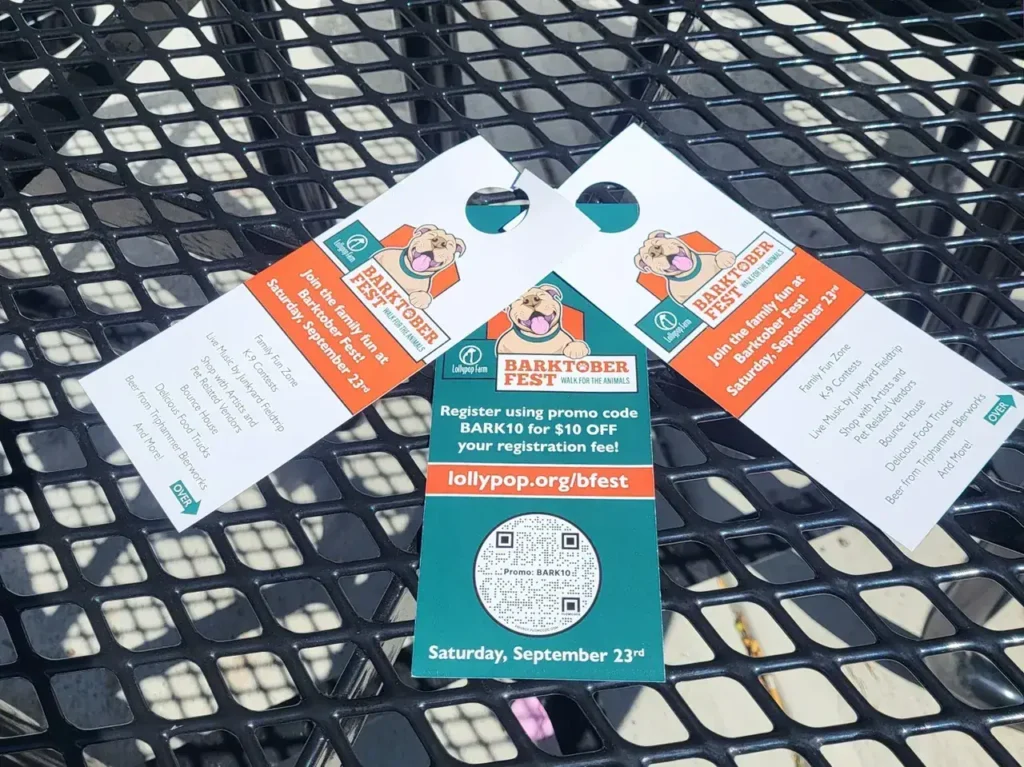
Door hanger marketing is one of the most underappreciated local advertising formats available. In an era when brands compete obsessively for digital attention, the simple act of placing a piece of print marketing directly on the door handle of someone’s home cuts through every piece of digital clutter with a blunt physical fact: someone came to your door. That is attention-getting by definition.
The good news is that this kind of direct, physical marketing does not have to cost much. Door hanger printing has become remarkably affordable, with online print vendors competing aggressively on price for standard formats. What does cost money — and where smart brands invest — is design quality and distribution strategy. A cheap print job with great design and smart targeting outperforms an expensive print job with generic creative and random distribution every time.
This guide is for local businesses, regional brands, and national companies running neighborhood-level campaigns who want to use door hanger marketing effectively without wasting budget on overpriced printing or under-targeted distribution. We cover printing economics, design principles, distribution strategy, and how door hangers integrate with broader guerrilla marketing programs.
The Economics of Door Hanger Printing
Understanding the true cost of a door hanger campaign requires looking at the full picture: printing, design, and distribution. Most brands focus too heavily on printing costs and not enough on the total cost per qualified contact. Getting that math right is what makes door hanger campaigns cost-effective.
Print Pricing Benchmarks
Online print vendors have made door hanger printing extremely competitive. Standard 3.5×8.5 inch door hangers with a die-cut hole, printed in full color on 100lb cover stock, typically cost between $30 and $75 per 500 units from vendors like GotPrint, PrintingForLess, or Vistaprint. At quantities of 5,000 units, per-piece costs drop to the $0.05 to $0.08 range, making the print production cost of a neighborhood campaign genuinely minimal.
The factors that increase cost include: heavier paper stock, UV coating, printing on both sides, custom die-cut shapes, and faster turnaround. Of these, double-sided printing and heavier stock are worth the premium because they significantly improve perceived quality. Custom shapes add cost without proportional benefit for most campaigns — the standard 3.5×8.5 format works well and keeps costs low.
Total Campaign Cost Per Contact
The true measure of door hanger campaign economics is cost per qualified contact delivered to the target area. At $0.08 per piece for printing plus $0.50 to $1.00 per piece for professional distribution, a door hanger campaign in a target neighborhood costs approximately $0.60 to $1.10 per home contacted. Compare this to direct mail ($0.50 to $3.00 per piece depending on format and postage), digital display advertising, or outdoor formats — and door hangers compete favorably, particularly for hyper-local campaigns where geographic precision matters.
Design Principles for High-Response Door Hangers
Door hanger design is a discipline that rewards simplicity and punishes complexity. The consumer encounter with a door hanger is brief — they grab it, give it a second or two, and decide whether to read further or discard it. The design must win that two-second battle before anything else can happen.
The Headline Does All the Work
Your headline is the most important element on the door hanger. It should communicate a specific benefit or offer in plain language that any reader can understand in a glance. Headlines that work: “Get 20% Off Your First Order.” “We Service Your Neighborhood This Week.” “Free Estimate — Call Today.” Headlines that do not work: “Experience the Difference.” “Quality You Can Trust.” “Welcome to Our Brand.”
The headline must answer the reader’s instinctive question: “Why should I care about this right now?” If it does not answer that question in the first reading, the door hanger goes in the trash.
One Offer, One Action
The most common design mistake in door hanger campaigns is trying to communicate multiple offers or multiple calls to action. Door hangers work best when they carry a single, clear offer and a single call to action. Multiple offers create decision paralysis. A single compelling offer creates a simple decision: act or do not act. Simple decisions get acted on more often than complex ones.
The Back Side as Secondary Real Estate
The back of a door hanger is often underused. Good design uses the back for secondary messaging — product or service details, testimonials, a schedule, a map, or a QR code linking to more information. The front must win the initial attention; the back can provide the additional information that convinces the reader to act. Design both sides with intention.
Contact Information and Urgency Triggers
Every door hanger should include clear contact information — phone number, website, and address if relevant — and a deadline or urgency trigger that encourages immediate action. “Offer valid through [date]” or “Limited spots available this month” both create the time pressure that moves people from “I’ll think about it” to “I should call today.” Campaigns without urgency triggers consistently underperform those that include them.
Distribution: Where Door Hanger Campaigns Win or Lose
Distribution is where most door hanger campaigns either succeed or waste their investment. The best-designed, best-printed door hanger delivered to the wrong neighborhoods, by unreliable distributors, generates nothing. Getting distribution right is worth more than saving money on printing.
Targeting the Right Neighborhoods
Geographic targeting for door hanger campaigns should be built on data, not intuition. Census data, customer address records, and demographic mapping tools enable precise identification of the neighborhoods most likely to contain your target consumer. A plumbing company should target neighborhoods with older housing stock where service calls are more frequent. A tutoring service should concentrate near schools and in neighborhoods with school-age children. A restaurant should target within a reasonable drive radius and weight density areas more heavily.
Professional vs. DIY Distribution
DIY door hanger distribution — business owners or employees walking routes themselves — is appropriate for very small campaigns in very specific target areas. For campaigns above 500 to 1,000 pieces, professional distribution through a canvassing service is almost always more cost-effective when you account for the time value of the people doing the walking. Our street team programs include door hanger distribution as a standard service, with GPS-tracked route coverage and photo documentation.
Route Planning and Coverage Verification
Professional door hanger distribution should always include route planning and coverage verification. Routes should be mapped in advance to ensure efficient coverage without gaps. GPS tracking and photo documentation provide clients with evidence that distribution was completed as promised — which is unfortunately not a given with all distribution providers. Our team provides complete GPS-logged documentation for every distribution campaign we execute.
Door Hangers as Part of an Integrated Local Campaign
Door hangers work best as part of a broader local marketing strategy that creates multiple touchpoints with the target consumer. A consumer who receives a door hanger from your business, then sees your brand in a digital ad, then encounters a poster campaign in their neighborhood, is far more likely to convert than a consumer who only received the door hanger.
Coordinating with Digital Geo-Targeting
Pairing door hanger distribution with geo-targeted digital campaigns in the same ZIP codes creates a multi-channel local presence that significantly improves brand recall and conversion rates. The digital campaign captures consumers who did not act immediately on the door hanger. The door hanger gives the digital campaign a physical anchor that improves brand credibility. Together, they are more effective than either would be alone.
Door Hangers and Event-Based Campaigns
Door hanger campaigns timed to local events — neighborhood festivals, school year starts, seasonal service periods — benefit from the heightened consumer attention that event contexts create. A landscaping company distributing door hangers in early spring, or an HVAC company distributing them before the first hot week of summer, is reaching consumers at the moment when their need is highest. Timing precision dramatically improves response rates for service businesses.
Choosing the Right Print Vendor for Cheap Door Hanger Printing
Not all print vendors are equal, even when prices appear similar. Evaluating print vendors requires looking beyond price to print quality, turnaround reliability, and customer service. A vendor that delivers late or prints inaccurate colors costs more in delayed campaigns than it saves in per-unit pricing.
Online Print Vendors vs. Local Printers
Online print vendors typically offer the lowest per-unit pricing for standard formats due to gang-run production that groups multiple clients’ jobs together. This efficiency comes with less flexibility on customization and potentially longer turnaround times. Local printers charge more per unit but offer faster turnaround, greater flexibility on custom specifications, and the ability to see press proofs before the full run is committed.
For most standard door hanger campaigns with standard formats and reasonable lead times, online vendors are the cost-effective choice. For urgent campaigns, premium materials, or highly customized formats, local printers are worth the premium.
Ordering Quantities and Pricing Tiers
Print pricing follows a steep quantity curve — the per-unit cost drops significantly as quantities increase. The most cost-effective ordering strategy is to print at the quantity level that matches your distribution capacity within a reasonable campaign window. Printing more than you can distribute within 60 to 90 days is wasteful because door hangers lose relevance as offers expire and campaigns become stale. Print for what you can deploy, not for the lowest possible per-unit cost.
Frequently Asked Questions
How cheap can door hanger printing get?
At quantities of 1,000 to 5,000 units, full-color single-sided door hangers can cost as little as $0.05 to $0.15 per piece from online print vendors. Double-sided printing on heavier stock adds cost but significantly improves perceived quality.
What size should door hangers be?
The standard door hanger size is 3.5 inches wide by 8.5 inches tall with a die-cut hole for the door handle. This format is universally accepted across printing vendors and fits standard residential and commercial door handles.
Are door hangers an effective marketing tool?
Yes. Door hangers have higher read rates than direct mail because they cannot be ignored — the recipient must physically handle the piece to enter their home. Well-targeted campaigns consistently generate response rates of 1% to 5% or higher for local service businesses.
How many door hangers should I print?
For neighborhood-level local marketing, 500 to 2,000 units targeting a specific ZIP code is appropriate. For broader local campaigns, 5,000 to 25,000 units distributed across multiple target areas is more common.
Does American Guerrilla Marketing do door hanger distribution?
Yes. We offer door hanger distribution as part of our street team and neighborhood canvassing programs with GPS-tracked delivery and full documentation. Contact us at (646) 776-2770.
What should be on a door hanger for maximum response?
A high-response door hanger should include a compelling headline, a clear offer or call to action, a deadline to create urgency, contact information, and one primary visual. One offer per door hanger outperforms multi-message designs every time.