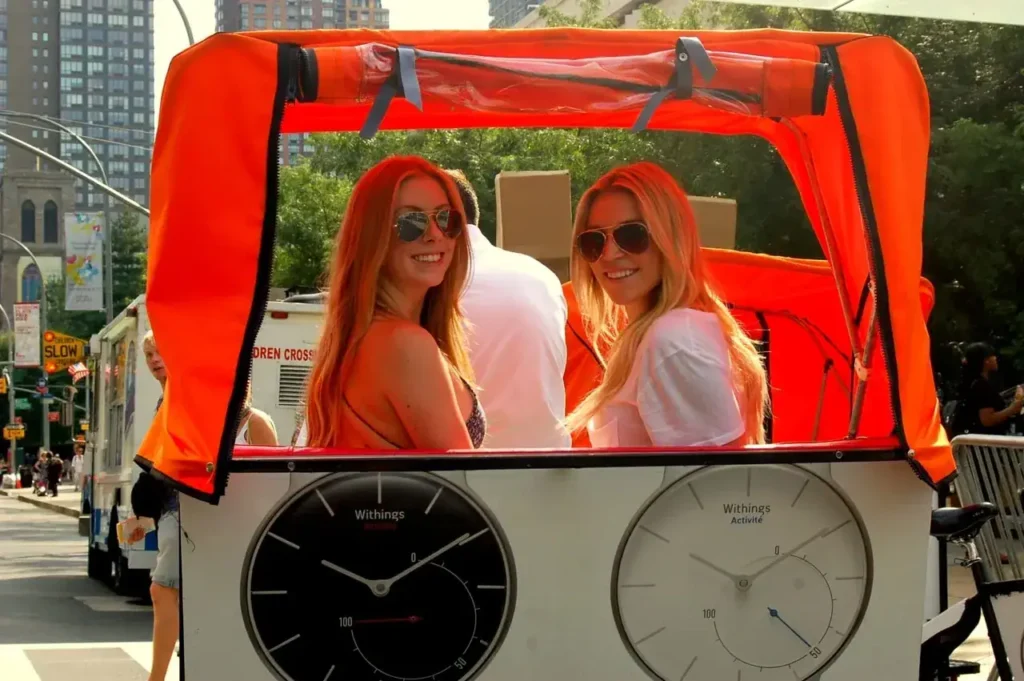
In cities where attention is the scarcest commodity, the brands that win are not necessarily the ones with the biggest budgets — they are the ones that show up where people are actually looking. Pedicab advertising puts your brand at eye level, in motion, in the middle of the highest-density pedestrian and tourist corridors in any major city. It is mobile, unmissable, and inherently human in a way that a static board or a digital ad simply is not.
The green marketing dimension is not secondary. As brands face increasing pressure from consumers and investors to demonstrate environmental commitment, the zero-emission pedicab format provides a genuine, visible proof point. Your brand is not just sponsoring a pedicab — it is choosing a format that aligns with values around sustainability, urban livability, and human-scale commerce. That alignment communicates something about your brand before a rider reads a single word of your messaging.
This guide covers pedicab advertising as a serious marketing tool: where it works, how campaigns are structured, what brands get the most value from it, and how to integrate it into a broader guerrilla marketing program that drives real results.
What Pedicab Advertising Actually Delivers
Pedicab advertising is a unique hybrid format. It is outdoor advertising because your brand is displayed on a moving vehicle in a public space. It is experiential marketing because the pedicab rider is a human brand representative who interacts with passengers and bystanders. It is event marketing when deployed at concerts, festivals, or sporting events. And it is street-level guerrilla marketing because it operates in exactly the dense urban environments where guerrilla tactics thrive.
The Impressions Advantage of Mobility
A static billboard generates impressions from the traffic that passes it. A pedicab generates impressions from every person who sees it as it moves through a city — pedestrians, other cyclists, people sitting at outdoor cafes, passengers in slow-moving traffic, tourists taking photos. In a dense urban environment, a single branded pedicab can generate thousands of impressions per hour while simultaneously creating a branded experience for every passenger it carries.
The Human Interaction Element
What separates pedicab advertising from all other outdoor formats is the human interaction layer. Every passenger who rides a branded pedicab spends several minutes in direct, physical contact with your brand. The rider can be trained as a brand ambassador — delivering brand messaging, offering promotional materials, answering questions, and creating the kind of personal brand connection that no passive advertising medium can manufacture.
This is the same principle that drives our brand ambassador programs — the recognition that human-to-human brand interactions generate significantly stronger recall and emotional connection than any form of passive advertising. Pedicabs deliver this at scale, in the public space, with the added amplification of being visually interesting to everyone who sees them.
Best Markets for Pedicab Advertising Campaigns
Not every city is equally suited to pedicab advertising. The format works best in markets with specific geographic and demographic characteristics — high pedestrian density, active street life, limited vehicle access, and a culture of outdoor activity and tourism.
New York City
New York City is the premier market for pedicab advertising. Midtown Manhattan, Times Square, the High Line, Central Park, and the Lower East Side all offer pedicab-friendly environments with massive pedestrian traffic. NYC’s pedestrian density means that a single pedicab operating in Midtown can generate more impressions per hour than most static outdoor formats in secondary markets. Tourist and convention traffic adds a national and international audience dimension that most local outdoor formats cannot reach.
Chicago, San Francisco, and Washington DC
Chicago’s Navy Pier, Millennium Park, and the Magnificent Mile are premium pedicab advertising environments. San Francisco’s Fisherman’s Wharf and waterfront corridors attract heavy tourist traffic. Washington DC’s Mall area and downtown corridors see high foot traffic from both residents and the millions of visitors who come to the city’s monuments and museums annually. All three cities offer strong pedicab advertising opportunities for the right brand.
Event Environments
Music festivals, outdoor concerts, sporting events, and city-wide conventions create temporary high-density pedestrian environments that are ideal for pedicab advertising. At events where official advertising inventory is expensive and contested, pedicabs offer a way to create significant brand presence in and around the event footprint without requiring official sponsorship. This is one of the most effective tactical applications of pedicab advertising for brands with limited event marketing budgets.
Designing a Pedicab Advertising Campaign
Effective pedicab advertising campaigns require attention to both the physical branding of the vehicles and the operational execution of the campaign. Neither element alone is sufficient — great design on a poorly operated pedicab delivers fraction of the results of a well-executed campaign.
Vehicle Branding and Wrap Design
Pedicab wraps need to work at the speeds and distances that urban pedestrians encounter them. The brand identity must be immediately recognizable from 20 to 30 feet away, the message must be readable at a glance, and the visual design must be striking enough to attract attention amid the visual noise of a busy urban environment. High-contrast colors, large typography, and simple visual compositions outperform complex, information-dense designs in this format.
The design should also accommodate the three-dimensional nature of the pedicab vehicle. Different viewing angles reveal different parts of the wrap, so the design needs to work from front, side, and rear perspectives. We work with experienced wrap designers who understand the specific requirements of pedicab vehicle formats.
Route Planning and Timing
Where pedicabs operate and when they operate directly determines campaign reach and audience quality. We plan pedicab routes based on target audience location data, event schedules, and the specific neighborhoods where brand presence will generate the most value. A pedicab campaign targeting a sports fan demographic will operate near stadiums and sports bars during game windows. A campaign targeting tourists will concentrate near major attractions during peak tourism hours.
Rider Training and Brand Messaging
Pedicab riders who are trained as brand ambassadors dramatically improve campaign performance. Training covers brand messaging, product knowledge, how to handle questions from curious passersby, and how to distribute promotional materials appropriately. Our team coordinates rider training as part of every pedicab campaign, ensuring that the human interaction element consistently reinforces the brand message rather than detracting from it.
Integrating Pedicab Advertising with Street-Level Campaigns
Pedicab campaigns deliver maximum impact when they are part of an integrated street-level strategy that creates brand touchpoints across multiple environments and formats. A consumer who encounters your brand on a pedicab, then sees a flyposting board nearby, then receives a sample from a street team member, has experienced a campaign that creates durable brand memory through repetition and varied context.
Coordinating with Flyposting and Stenciling
Flyposting and sidewalk stenciling in the neighborhoods where pedicabs operate creates a brand environment that surrounds the consumer from multiple angles. The pedicab delivers moving brand presence; the wall posters and stencils deliver stationary brand presence. Together, they create the impression of a brand that truly inhabits a neighborhood — which is one of the most powerful signals of brand legitimacy for urban consumers.
Product Sampling from Pedicabs
Pedicabs can be configured to carry and distribute product samples, promotional materials, or branded merchandise. This combination of mobile brand presence and product sampling is particularly effective for beverage launches, food brand promotions, and app downloads. The physical product delivery creates a tangible brand interaction that extends the impact of the campaign beyond visual exposure.
The Sustainability Story in Pedicab Marketing
The green marketing dimension of pedicab advertising is not a gimmick — it is a genuine brand signal that matters to a growing segment of urban consumers. Brands that choose pedicabs over diesel-powered mobile billboards are making a tangible environmental choice that resonates with consumers who care about climate, urban air quality, and sustainable business practices.
Aligning Brand Values with Format Choice
For brands with explicit sustainability commitments, the pedicab format creates a visible, lived demonstration of those values. It is not a press release about environmental policy — it is a brand operating in the world in a way that reflects its stated values. That authenticity is more valuable than any amount of green marketing copy.
Brands in food and beverage, consumer goods, technology, and retail have all used pedicab campaigns specifically because the format aligns with their sustainability positioning. The format becomes part of the brand story, not just a media buy.
Urban Mobility and Community Connection
Pedicabs are also deeply integrated into the social fabric of the urban environments where they operate. They are associated with human connection, exploration, and the kind of unhurried urban experience that many city dwellers aspire to but rarely get. Brands that associate themselves with pedicabs inherit some of that cultural positioning — which is particularly valuable for brands trying to build genuine urban credibility rather than just urban presence.
Frequently Asked Questions
What is pedicab advertising?
Pedicab advertising involves branding pedicabs with marketing messages and operating them in high-traffic urban areas to deliver mobile, human-scale brand exposure. It combines outdoor advertising with a direct human interaction element.
How much does pedicab advertising cost?
Pedicab advertising campaigns typically range from $3,000 to $25,000 depending on the number of pedicabs, duration, geography, and whether a rider-interaction component is included. Event-specific activations may have different pricing structures.
Why is pedicab advertising considered green marketing?
Pedicabs are human-powered and produce zero emissions. Brands that align with sustainability values benefit from the environmental positioning that pedicab advertising naturally provides, particularly among eco-conscious urban consumers.
Where does pedicab advertising work best?
Pedicab advertising works best in dense urban cores with high pedestrian traffic, limited car access, and active street life — cities like New York, Chicago, San Francisco, and Washington DC. Event environments like festivals, concerts, and sporting events are also highly effective.
Does American Guerrilla Marketing offer pedicab campaigns?
Yes. We coordinate pedicab advertising and experiential pedicab programs in major U.S. markets. Our team handles branding, logistics, rider coordination, and campaign documentation. Contact us at (646) 776-2770.
Can pedicab campaigns be integrated with other guerrilla tactics?
Absolutely. Pedicab campaigns work powerfully when combined with street team activations, product sampling, and flyposting in the same geographic area. The layered presence creates a saturation effect that drives strong brand recall.