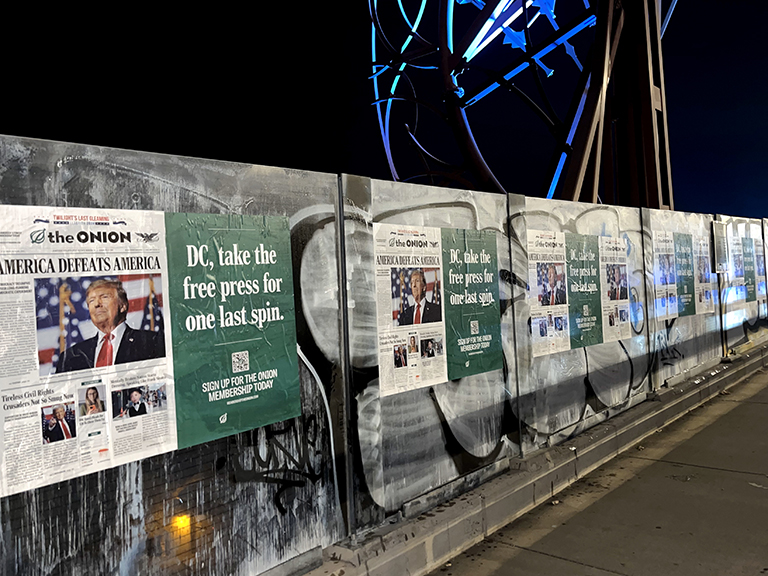
Washington DC’s street poster culture is shaped by the city’s dual identity: a government and policy center with one of the most politically engaged populations in the country, and a vibrant, youthful urban community with a distinct music scene, arts culture, and creative industry presence. Wheatpaste campaigns in DC work across both dimensions — reaching the engaged professional demographic that characterizes the city’s neighborhoods as much as reaching the political audience that national media identifies DC with.
American Guerrilla Marketing executes wheatpasting campaigns across DC’s key neighborhoods — Adams Morgan, U Street, Shaw, H Street NE, Columbia Heights, Capitol Hill, Georgetown, and Dupont Circle. Our team handles location scouting, overnight installation, and GPS-tagged documentation so every DC campaign is accountable and verifiable.
Washington DC Neighborhoods: Where Wheatpaste Campaigns Work
DC’s neighborhoods have distinct cultural identities that determine which campaigns belong where. Mismatched placement is the most common cause of campaigns that run but don’t connect — the creative is right, the market is right, but the neighborhood is wrong for the specific audience.
U Street Corridor
The U Street Corridor is the heart of DC’s music and nightlife culture, with deep historical roots in African American cultural history and a contemporary scene that encompasses jazz, go-go, indie rock, and hip-hop. The corridor’s concentration of music venues — 9:30 Club, Black Cat, Songbyrd — and the residential and commercial street life surrounding them makes U Street the mandatory first-tier neighborhood for any music campaign in DC. Concert promotion, album launches, streaming music releases, and entertainment campaigns all belong on U Street walls.
Adams Morgan
Adams Morgan is DC’s most ethnically diverse and culturally eclectic neighborhood, with a concentration of independent restaurants, international retail, and the kind of foot traffic that comes from 18th Street’s status as one of the city’s prime nightlife corridors. For campaigns targeting a diverse young adult audience with broad cultural engagement, Adams Morgan provides both the demographic quality and the foot traffic volume that makes wheatpaste campaigns effective. The neighborhood’s international character also makes it a strong choice for campaigns with global or multicultural dimensions.
Shaw
Shaw has emerged as one of DC’s premier arts and independent culture neighborhoods, with a concentration of galleries, independent restaurants, and creative businesses that draw the city’s arts community. The Howard Theatre area and the blocks along 7th and 9th Streets NW are active posting zones with high-quality foot traffic of the arts-engaged young professional audience. For campaigns in arts, culture, entertainment, and independent brand categories, Shaw is a priority zone.
H Street NE
H Street NE’s rapid development over the past decade has created one of DC’s most active young professional neighborhoods, with a dense concentration of bars, restaurants, and independent retail along the corridor. The Atlas Performing Arts Center anchors the neighborhood’s arts identity. For campaigns targeting DC’s millennial professional community with music, entertainment, and lifestyle brand content, H Street offers growing foot traffic and a receptive audience in a neighborhood that’s still developing its poster culture — meaning less competition for wall space than more established zones.
Columbia Heights
Columbia Heights is one of DC’s most densely populated and diverse neighborhoods, with a strong Latino community presence alongside a significant young professional and creative population. The commercial strips along 14th Street and Columbia Road NW are active pedestrian corridors with excellent posting inventory. For campaigns with broad demographic reach or specifically targeting DC’s Latino community, Columbia Heights is an essential zone.
Georgetown
Georgetown’s combination of university presence (Georgetown University), upscale retail along Wisconsin Avenue and M Street, and the well-established professional residential population make it appropriate for campaigns targeting the upscale consumer and university-adjacent audience. Campaigns in premium lifestyle, fashion, hospitality, and consumer goods categories perform well in Georgetown’s commercial corridors.
Dupont Circle
Dupont Circle concentrates DC’s LGBTQ+ community, professional and diplomatic residents, and the independent arts and restaurant culture that has characterized the neighborhood for decades. For campaigns in LGBTQ+ marketing, lifestyle, hospitality, and cultural categories, Dupont Circle is a primary zone with strong foot traffic and a culturally engaged resident audience.
Capitol Hill
Capitol Hill’s residential streets and the Barracks Row commercial corridor on 8th Street SE serve campaigns targeting the politically engaged professional community that the neighborhood concentrates. For policy organizations, advocacy campaigns, and brands with messaging relevant to the government and policy professional audience, Capitol Hill placements reach a self-selecting community of engaged decision-makers.
DC as a Conference and Convention Market
Washington DC hosts a significant volume of professional conferences and government-adjacent industry events that create targeted wheatpaste campaign opportunities. The Walter E. Washington Convention Center in Shaw is one of the largest convention facilities in the Mid-Atlantic, hosting everything from tech trade shows to healthcare conferences to policy sector events.
Conference perimeter campaigns in DC work through the same mechanism as in other major markets: attendees walk the same corridors repeatedly between the convention center, the primary conference hotels, and the lunch and evening dining destinations nearby. Our team scouts conference geographies in advance to identify the highest-frequency pedestrian routes and build campaign plans that concentrate placements on those corridors.
For B2B campaigns targeting the government contractor, policy, and government technology communities that are uniquely concentrated in DC, the geographic precision of a conference perimeter campaign combined with business district placements in the corridors where those communities work creates a targeting environment that no digital channel can replicate.
Campaign Types That Perform Well in Washington DC
DC’s specific cultural and professional character creates campaign opportunities that are unique to the market or significantly stronger here than in equivalent-size markets elsewhere.
Entertainment and Music Launch Campaigns
DC’s music scene — anchored by the 9:30 Club, Black Cat, the Anthem at the Wharf, and a dense infrastructure of smaller venues — supports a strong concert promotion wheatpaste tradition. For touring artists, DC is a mandatory market stop, and the U Street and Adams Morgan corridors are where show awareness is built among the city’s engaged music community. We execute concert promotion campaigns in DC across the full range of venue sizes, with neighborhood selection calibrated to the specific artist and genre.
DC also has a strong go-go music tradition and a significant hip-hop community with deep local roots. For artists with ties to these traditions, neighborhood selection that honors the cultural geography of the communities those genres come from — Southeast DC, Prince George’s County corridor, Columbia Heights — generates more authentic response than generic city-wide posting.
Advocacy and Policy Campaigns
Washington DC is uniquely positioned as the center of U.S. policy and advocacy activity, which creates a category of wheatpaste campaign that barely exists in other markets: issue advertising and advocacy campaigns targeted at the press and policy professional community concentrated in the city. For organizations running campaigns around legislative moments, election cycles, or public interest issues, DC street presence reaches the journalists, congressional staff, and policy professionals who determine how issues get covered nationally.
Advocacy wheatpaste campaigns in DC typically target the corridors between Capitol Hill and the restaurants and coffee shops where legislative staff gather, the neighborhoods around major press institutions, and the business corridors where policy-adjacent organizations are concentrated. The goal is not mass awareness but precise reach to the relatively small but extremely influential audience that shapes national policy conversation.
Tech and Government Contractor Campaigns
DC’s technology sector has grown significantly in the past decade, driven by government contracting, national security technology, and the tech-adjacent policy community. The Rosslyn-Ballston corridor in Northern Virginia, the Navy Yard area in DC, and the broader professional community around federal agencies represent a B2B audience for enterprise technology, data, and analytics companies that is uniquely concentrated in this geographic area.
For B2B technology brands targeting government technology buyers, a DC campaign around major government technology conferences — AFCEA, ACT-IAC, and other government IT sector events — reaches decision-makers in a concentrated physical environment with the same precision that consumer campaigns achieve in music venue corridors.
Nonprofit and Social Impact Campaigns
DC’s concentration of nonprofit organizations, advocacy groups, foundations, and social impact-focused businesses creates a market for campaigns in the social sector that doesn’t exist at the same scale in other cities. For nonprofits building public awareness, foundations launching new initiatives, and social enterprise brands building community presence, DC’s engaged, cause-oriented residential population in neighborhoods like Columbia Heights, Shaw, and Takoma Park is a receptive audience for campaigns with genuine social purpose.
Creative Considerations for DC Campaigns
DC’s highly educated, politically aware, and culturally sophisticated audience sets a high standard for campaign creative. The city’s residents are accustomed to sophisticated visual communication across multiple domains — entertainment, political advocacy, museum marketing — which means that generic or undifferentiated creative registers as low-effort in a market where high-quality visual communication is the norm.
For advocacy and policy campaigns, creative clarity is paramount. A campaign message that requires explanation or context won’t survive the two-second encounter that street advertising generates. The most effective DC advocacy creative states a single clear position with enough specificity to communicate genuine knowledge of the issue, not just surface-level messaging. “The infrastructure vote is next week” performs better than “Let’s fix America’s roads.”
For entertainment campaigns, DC’s audience rewards authenticity. A campaign that references the city’s actual cultural geography — the venues, the neighborhoods, the specific cultural reference points that Washingtonians identify with — generates stronger response than national campaign creative deployed without local adaptation. Our team advises on creative localization for DC campaigns when clients are adapting national campaign assets for the market.
What Makes DC a Distinct Wheatpaste Market
DC’s compactness relative to its population density creates a different dynamic than markets like Los Angeles or Chicago. The city’s geography concentrates the most active neighborhoods in a relatively small area, which means campaigns can cover multiple high-quality zones without the extended logistics of a geographically sprawling market. A well-designed DC overnight can cover Adams Morgan, U Street, Shaw, and H Street in a single crew operation.
The city’s political culture also creates specific campaign opportunities that don’t exist in equivalent volume in other markets. Advocacy campaigns, issue advertising, and brand messaging with policy dimensions find audiences in DC that are more engaged with those dimensions than audiences in other markets. The concentration of journalists, policy staff, and engaged political professionals creates an earned media environment where striking campaigns get noticed by people whose coverage reaches national audiences.
Working with AGM in Washington DC: Execution Standards
American Guerrilla Marketing operates in Washington DC through an established crew network with active location agreements across the District’s major neighborhoods. Here is what clients working with our DC team should expect in terms of timeline, documentation standards, and campaign management:
Campaign Planning and Timeline
Standard DC campaign planning follows the same five to seven business day lead time as other markets: brief and location plan on days one to two, creative review and print coordination on days two to three, print production and delivery on days three to five, scouting confirmation on day six, overnight installation on day six to seven. Documentation is delivered by end of business the day after installation.
For conference-adjacent campaigns where the event date is fixed, we work backward from the installation date to establish print production and approval deadlines that the client’s internal process needs to meet. Conference campaign planning should ideally begin four to six weeks before the event date to accommodate internal approvals, print production, and logistical coordination without rush premiums.
Location Network in DC
Our DC location network covers Adams Morgan, U Street, Shaw, H Street NE, Columbia Heights, Georgetown, Dupont Circle, Capitol Hill, and the convention center district around New York Avenue NW. For campaigns targeting specific conference venues, we’ve scouted the approach corridors and hotel-to-venue paths for the Walter E. Washington Convention Center, the Marriott Marquis conference facilities, and other major DC conference and event venues.
DC-Specific Regulatory Navigation
Washington DC’s posting regulations are navigated by our team as part of campaign planning. The District’s combination of federal property (where no posting is permitted), historic district restrictions, and neighborhood-specific permit requirements creates a more complex regulatory landscape than most markets. Our team knows which neighborhoods and surfaces require specific handling and plans campaigns that operate entirely within legal permitted parameters in every zone.
DC Campaign Cost Ranges
Washington DC campaign pricing is competitive with Boston and Chicago markets, reflecting the city’s scale and the cost structure of the District’s posting environment.
Single-neighborhood DC campaigns (U Street or Adams Morgan) with 50 to 80 placements run $2,500 to $5,000 all-in. Multi-neighborhood campaigns covering three to four zones — U Street, Adams Morgan, Shaw, and Columbia Heights — run $7,000 to $18,000 depending on volume and format mix. Conference perimeter campaigns, which often require premium location selection and rush timelines aligned to conference dates, are priced as custom projects based on the specific conference geography and campaign scope.
All campaign quotes include location scouting, print production coordination, overnight installation labor, and GPS-tagged documentation. There are no hidden fees; the campaign quote is the campaign cost unless scope changes are initiated by the client after briefing.
Overnight Installation in DC
Our DC crews install overnight, operating between midnight and 5 AM to ensure campaigns are fresh for the morning commute in target neighborhoods. The overnight window is particularly important in DC’s denser posting zones like U Street and Adams Morgan, where wall inventory competition is highest and early-morning installation secures the best placements before competing campaigns are added during business hours.
For campaigns coordinated alongside national multi-market launches, DC installation operates on the same overnight timeline as crews in New York, Chicago, and other markets, ensuring simultaneous city-wide rollout that creates the perception of national ubiquity from a single installation window.
Documentation and Reporting for DC Campaigns
Every DC placement receives GPS-tagged photo documentation with installation timestamps and location addresses. Post-campaign reports are organized by neighborhood with photographs of every placement. For advocacy and policy organizations with specific reporting requirements, and for corporate clients with marketing department documentation standards, we format reports to match the templates provided.
Integrating Wheatpaste with Other DC Street Campaign Tactics
- Street team activations on U Street and Adams Morgan the morning after installation for direct audience engagement
- Sidewalk stencil campaigns at Convention Center approaches and U Street pedestrian corridors
- Mobile LED billboard trucks routing through the 14th Street corridor, H Street, and downtown DC for event-day amplification
- Integrated guerrilla campaign strategy combining multiple formats for major DC launches and event campaigns
Frequently Asked Questions
Which DC neighborhoods are best for wheatpaste campaigns?
Adams Morgan and U Street Corridor for music, nightlife, and creative community audiences. Shaw for the arts and independent culture scene. H Street NE for the growing young professional and nightlife community. Columbia Heights for a diverse, vibrant residential audience. Georgetown and Dupont Circle for professional and upscale lifestyle campaigns. Navy Yard for tech and government contractor demographics.
Is wheatpasting legal in Washington DC?
Legal wheatpasting in DC requires property owner permission. AGM operates exclusively on permitted posting locations across DC’s neighborhoods. We maintain active relationships with wall owners and posting networks across the District.
How much does a wheatpaste campaign in Washington DC cost?
Single-neighborhood DC campaigns run $2,500 to $6,000. Multi-neighborhood campaigns covering Adams Morgan, Shaw, U Street, and additional zones run $7,000 to $20,000 depending on volume and format. We provide itemized quotes for every project.
Can AGM run wheatpaste campaigns near DC conference venues?
Yes. The Walter E. Washington Convention Center, the DC Convention Center area, and the surrounding hotel and restaurant corridors are among our established campaign zones for conference perimeter campaigns in DC. We execute B2B and event-adjacent campaigns at all major DC conference venues.
What types of brands run wheatpaste campaigns in DC?
Entertainment brands (music, streaming, film), advocacy and political organizations, tech and policy-adjacent companies, lifestyle and consumer brands targeting DC’s young professional population, and conference marketers running event perimeter campaigns are all active users of DC wheatpaste campaigns.
How do I get documentation for my DC campaign?
Every placement receives GPS-tagged photo documentation with timestamps. Your post-campaign report includes photographs and location addresses organized by neighborhood for complete campaign accountability.