
November 11, 2026
Wheatpasting & Poster Campaigns in Birmingham, AL
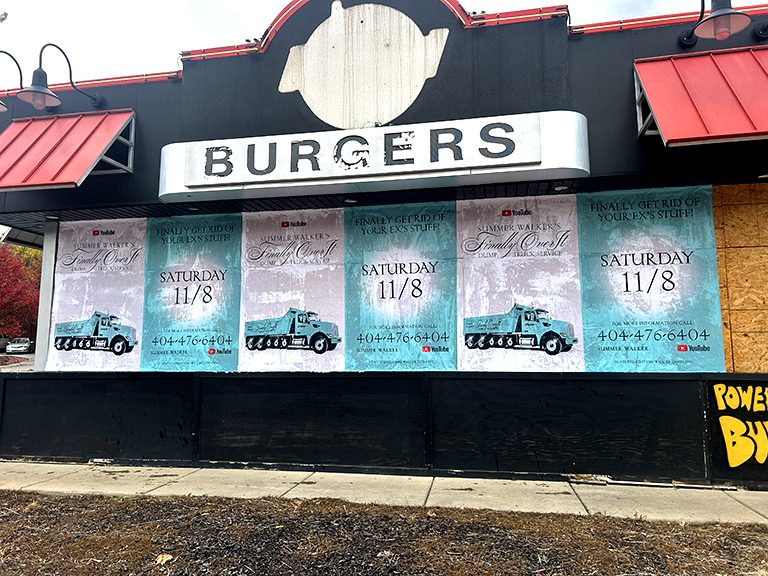
Most people who call us about posters in Birmingham have the same mental picture in their head, and it is usually borrowed from somewhere else. They have seen a paste wall in Brooklyn or a long run of posters along a boarded block in Los Angeles, and they assume Birmingham works the same way with fewer walls.
It does not. Birmingham is a pocket city. The postable energy here does not spread evenly across the street grid the way it does in a dense coastal market. It clusters into a small number of named, walkable districts separated by drives, and almost everything that matters about running a poster campaign here follows from that one fact.
The second thing that shapes the work is the air. Birmingham sits in a humid subtropical climate, and rainfall is spread fairly evenly across all twelve months rather than concentrated into a wet season you can plan around. There is no safe dry window on the calendar. Every run gets a genuine weather read, not a seasonal assumption.
The third thing is permission. Birmingham's zoning sign regulations speak directly to signs attached to trees, utility poles and streetlights, or placed on public property, except where authorised by ordinance of the city council. That written posture is not ambiguous, and anyone telling you the poles are open ground here is not reading the same document we are.
This page is about how we actually plan and run wheatpasting and Poster Campaigns in Birmingham: which districts earn a pass, what the humidity does to cure time, how we handle permission, and the things we talk clients out of in this market specifically.
I write this as an operator, not a strategist. The details below are about buckets, brushes, nights and walls.
Birmingham is four walking loops with drives between them
If you take one planning idea away from this page, take this one. Birmingham is not a single continuous walk. Downtown, Lakeview, Avondale and the UAB edge are each individually walkable, but they are separate pockets with car trips in between.
That means a Birmingham poster run is built as three or four tight on-foot loops with vehicle hops between them, not as one long linear pass. It changes the crew maths, the paste logistics and the timing. A crew walking a continuous dense grid can carry a single bucket and refill from the vehicle twice a night. A Birmingham crew stages from the vehicle at the head of each loop, works the loop out and back, breaks down, drives, and sets up again.
Avondale is the most efficient district in the city for this format. The Avondale Entertainment District runs along historic 41st Street South between 5th Avenue South and 2nd Avenue South, and the whole of it is a short stretch. Avondale Brewing, Saturn and Firehouse all sit inside it. The density of footfall per metre walked is the best in Birmingham, and a crew can cover the district properly in a fraction of the time a downtown loop takes.
Lakeview is the established nightlife quarter and behaves differently. The bars and restaurants are concentrated tightly enough that crowds move between venues on foot through the evening, which is exactly the audience behaviour posters depend on. People walking between two places read walls. People driving between two places do not.
Downtown's spine is 2nd Avenue North, running through the Central City and Fountain Heights neighbourhoods between I-65 and 26th Street. It carries an 80-foot right of way and runs one-way with three traffic lanes. Wide frontage, steady vehicle throughput, and the alley-and-loft character that makes the avenue the default downtown walking route. For crew planning, the one-way grid matters more than it sounds: a wrong turn costs a full block loop, and in a city where you are already hopping between pockets, those loops add up across a night.
Pepper Place, on Second Avenue South, is the daytime counterpart. The converted Dr Pepper syrup plant now runs to over 350,000 square feet of open-air retail, chef-led restaurants and workspace. The audience there is daytime and weekend-market, not night crowd, which changes what a poster in that area is for. It is a different buyer in a different mood at a different hour.
What Birmingham humidity does to wheatpaste
This is the part of the job that out-of-town clients have the least feel for, and it is the part most likely to cost them a run.
Wheatpaste cures by losing moisture into the air. The drier the air, the faster the bond sets and the sooner the poster is resistant to peeling, rain and hands. Birmingham's winter relative humidity sits around 79%. High ambient moisture slows that cure dramatically. A poster that would be set hard in two hours in a dry climate can stay vulnerable for most of a damp Birmingham night.
The practical consequence is that the posting window has to be chosen for the drying hours that follow it, not for crew convenience. This is the reverse of how most people assume night work is scheduled.
In the warm months the pre-dawn hours carry the heaviest dew load in this city. A crew that starts at 3am to be invisible is putting paste up into the wettest air of the night and then walking away. A late-evening start that gives the paste several hours of falling humidity before dew point is often the better call, even though it means working while there are still people on the street. We will trade a bit of visibility for a bond that actually sets.
Substrate moisture is the other half of it. Birmingham's winters are mild and rainy with short cold spells, so this is a shallow freeze-thaw city rather than a northern one. The damage pattern is not deep ice heave lifting material off a wall. It is repeated wet-and-dry soaking of porous substrate. Brick and older masonry downtown holds that moisture well after the visible surface looks dry, and a damp substrate is the single most common cause of adhesion failure in this market.
So we touch walls before we paste them. A wall that rained two days ago can still be wet inside. If a downtown brick face reads cold and damp to the hand, it gets skipped or it gets a different prep, and a crew that does not know to check that will lose a third of a wall by morning and never understand why.
Summer is the opposite problem. Heat plus humidity accelerates ink fade on anything facing south or west, and uncoated paper stock goes soft faster here than it does in a dry-heat market. For summer-facing placements we plan refresh cycles into the campaign from the start rather than pretending a single build will hold for the full run.
Spring is typically the wettest stretch of the year, and it is also the convective storm season. The National Weather Service office covering Birmingham runs dedicated severe weather and storm spotter programmes for the area. That is not a detail you can ignore when scheduling. We do not build a spring Birmingham campaign against a single irreplaceable weather window, because the odds of that window holding are not good enough to bet a launch on.
Permission in Birmingham, and why we push private walls
Legal framing is a grey area in every market and Birmingham is no exception. I am not going to tell you what is lawful here, and nobody running posters should be taking that read from a vendor's blog.
What I can tell you is the written posture and the enforcement character, which are two different things.
The written posture is clear on public infrastructure. Birmingham's zoning sign regulations explicitly address signs attached to trees, utility poles and streetlights, or placed on public property, except where authorised by ordinance of the city council. That is about as unambiguous as municipal sign language gets. It means a crew treating poles and public fixtures as open ground is working against a stated position, not into a vacuum.
The enforcement character is better described as episodic than constant. Posted roadside signage has been a recurring public complaint in Birmingham, and at least one city councillor has publicly campaigned against signs going up along roadways without permitting or notification, with the framing in that coverage being that it had been an issue for a long time.
Two useful things follow from that. First, posting clearly happens here widely enough to generate political attention. Second, that attention arrives in waves driven by individual officials and news cycles, not through steady patrol. Episodic enforcement is the worst kind to gamble on, because the quiet months teach you a lesson that the loud month then unteaches, usually in the middle of your campaign.
Birmingham's sign ordinance also defines Areas of Special Aesthetic Concern with tighter restrictions. Aesthetic-sensitivity zoning of that kind is the usual signal that historic and showcase corridors receive more scrutiny than ordinary commercial frontage. In practice that means the downtown theatre blocks and the designated historic fabric deserve more caution than a working commercial stretch three streets over, even when they look equally postable at 11pm.
Our route through all of this is boring and it works: private wall permission, negotiated with the property owner, documented in writing, and preferred over anything attached to public infrastructure. We would rather run a smaller Birmingham build on twelve permissioned private walls than a larger one on surfaces nobody has agreed to.
Construction hoarding and scaffolding get the same treatment. Plywood hoarding looks like a public surface and is not. It belongs to a contractor and a property owner, and it needs the same conversation and the same written yes as a brick side wall. We have walked away from very good hoarding in this city because the general contractor would not put a yes in writing, and that is the correct outcome.
Removal is part of the permission conversation, not an afterthought. When we ask an owner for a wall, we tell them what comes down, when, and who does it. Owners say yes more often when the ask includes an end date.
Timing a Birmingham campaign around the real calendar
Birmingham's calendar is unusually legible once you know it, and it should drive campaign dates more than the client's internal launch schedule does.
Sidewalk Film Festival is the single best-defined downtown build window of the year. It runs in late August in the downtown Historic Theatre District, anchored by the Alabama Theatre and the Lyric, across a full week. The 28th edition ran 24 to 30 August 2026. It is nationally ranked and it concentrates a cultured, out-of-town audience into a small number of downtown blocks for seven days.
That concentration is the opportunity and the trap at the same time. Sidewalk week makes the theatre district simultaneously the most valuable and the least accessible part of the city. Streets are busier, staging is harder, and a crew trying to work those blocks during the festival is fighting crowds for ladder space. The answer is to install ahead of the event and let the festival walk into finished work.
The rest of the year has its own shape. Sloss Music & Arts Festival runs on the Sloss Furnaces site. The Magic City Classic is a major autumn football fixture and one of the largest crowd draws Birmingham produces. The Regions Tradition golf tournament brings a visiting demographic that is distinct from the music crowd and should be targeted differently or not at all. Moss Rock Festival and the Bluff Park Art Show are autumn arts draws in the metro. Autumn overall is the city's densest festival stretch, and the local press routinely counts thirty-plus fall festivals across the metro.
The Mercedes Marathon is a winter road event, and it matters to us mostly for access rather than audience. Route closures change where a vehicle can stage and which loops are reachable on a given morning.
UAB drives the downtown-south audience, and Birmingham is unusual here. The campus sits immediately south of downtown rather than in a detached suburban ring, so student movement and downtown movement overlap. The academic calendar affects central footfall directly, not just a peripheral student zone. A build timed into a term break loses more downtown audience in Birmingham than the same timing would lose in a city where the campus sits apart from the core.
What we talk Birmingham clients out of
Every market has a specific bad idea that clients arrive with. Birmingham has several.
The first is the sprawl build. A client looks at Birmingham's metro population, assumes the poster plan should be proportionate to it, and asks for coverage across the whole city. That build fails here. The walkable core is small and the rest of the metro is car-dependent, which means posters outside the pockets are being read at 40 miles per hour by people who are not walking anywhere. We would rather go deeper in Avondale, Lakeview, downtown and the UAB edge than spread the same effort wider into places where nobody is on foot.
The second is the pole run. Someone always suggests it, usually because they saw it somewhere else. Given what Birmingham's written sign posture says about trees, utility poles, streetlights and public property, we will not build a Birmingham campaign on that foundation, and I would be suspicious of any crew that offers to.
The third is the historic-block vanity placement. Clients love the theatre district because it photographs beautifully. But the Areas of Special Aesthetic Concern framing in the ordinance signals exactly where scrutiny concentrates. If a client wants presence near those blocks, we look for permissioned private frontage a short walk away rather than the showcase face itself. The audience is walking in both directions anyway.
The fourth is the 3am start. It feels professional and it is often wrong in Birmingham for the dew reasons above. We push for a late-evening window in the warm months and accept that a few people will watch us work.
The fifth is the single-night build during a festival week. Install ahead. Always.
When posters are the wrong format for the brief
Sometimes the honest answer in Birmingham is that paste is not the tool.
If the target is Pepper Place weekend-market traffic, a daytime crowd moving through an open-air site, posters on surrounding frontage are doing less work than something that meets people inside the flow. That is a street team conversation, not a paste conversation.
If the brief is a single high-impact night tied to an event, and the client wants to own the visual moment rather than hold presence over weeks, projection does that better than paper does. Paste is a duration format. It earns its keep over a run, through repeated exposure to the same people walking the same three blocks of 41st Street South night after night.
And if the real requirement is reaching the car-dependent parts of the metro that posters cannot serve, the answer is a mobile format rather than a wider paste footprint. Our LED Trucks & Mobile Billboards work exists partly because cities like Birmingham have an audience that is simply not on foot, and pretending otherwise with more paper is how a campaign quietly underperforms.
The pairing we recommend most often in this market is a tight permissioned paste build across the walkable pockets plus a mobile run for the corridors between them. The paste holds the districts, the truck covers the drives.
What goes wrong on Birmingham runs
Adhesion failure from damp substrate is the number one issue, and it is almost always preventable. The wall looked fine. The wall was not fine. Brick and older masonry downtown holds water internally after rain, and the only reliable test is contact.
Dew-load failure is second. Posters pasted into the heaviest pre-dawn moisture of a warm Birmingham night can still be soft at sunrise, and soft paper tears on the first hand that touches it.
Third is access misjudgement on the one-way downtown grid. Crews who have not worked 2nd Avenue North lose real time to loop-backs. We scout the drive, not just the walls.
Fourth is seasonal fade on south and west faces through the summer. This one is not a failure so much as an unplanned refresh, and it only becomes a problem when nobody planned the second pass into the schedule.
Fifth is scheduling a spring build against one weather window. Spring is the wettest stretch and the convective storm season here. We build in alternates.
Sixth is assuming the quiet enforcement months are the permanent condition. Episodic attention means the absence of scrutiny is not evidence of safety. Written permission from the property owner is what makes a campaign defensible, in any month.
Frequently asked questions
Which Birmingham districts are worth posting in?
Avondale along 41st Street South, Lakeview, the 2nd Avenue North downtown spine and the UAB edge do most of the work. Pepper Place on Second Avenue South serves a daytime and weekend-market audience rather than a night crowd. Those pockets are individually walkable but separated by drives, so a build covers loops rather than one continuous stretch.
Does Birmingham humidity really change the schedule?
Yes. Winter relative humidity around 79% slows wheatpaste cure badly, and in warm months the pre-dawn hours carry the heaviest dew load. We choose the posting window for the drying hours that follow it, which often means a late-evening start rather than the 3am start most clients expect us to work.
Is poster advertising allowed in Birmingham?
This is a grey area and it varies by surface ownership and local ordinance. Birmingham’s zoning sign regulations address signs on trees, utility poles, streetlights and public property except where authorised by the city council. We reduce risk by working permissioned private walls, documenting the owner’s yes in writing, and committing to removal.
How long does a poster hold on a Birmingham wall?
It depends on substrate and aspect more than on paper. Damp brick and older downtown masonry is the main cause of early failure here, because porous substrate holds water after rain. South and west faces fade faster through the humid summer, so we plan refresh passes into the schedule for those placements rather than assuming one build lasts.
When should a Birmingham campaign avoid the theatre district?
During Sidewalk Film Festival week in late August. Those downtown blocks become the most valuable and the least accessible part of the city at the same time. Installing ahead of the festival gets finished work in front of the crowd without a crew fighting for ladder space on busy pavement.
What does AGM refuse to do in Birmingham?
We will not build on utility poles, streetlights or public fixtures given the city’s written sign posture. We also push back on spreading a build across the car-dependent metro, because posters outside the walkable pockets get read at speed by people who are not walking. Depth beats coverage here.
Request a campaign quote
If you are planning a Birmingham poster build, the useful conversation starts with three things: which of the walkable pockets your audience actually moves through, what dates you are tied to, and whether anything on your calendar collides with Sidewalk week or the autumn festival stretch.
From there we scope surfaces, permission conversations, crew nights, the weather read and removal, and we tell you plainly which parts of your plan we think will not work here.
Request a campaign quote and tell us the district, the dates and the audience. We will come back with a build we would actually stand behind on a wet Birmingham wall.

Ready to Run Your Campaign?
Call us or email us. We’ll tell you exactly what we can do in your market and what it costs.
Related Service
Explore similar advertising solutions offered by American Guerrilla Marketing.
American Guerrilla Marketing — Los Angeles
Street-level campaigns in Los Angeles and nationwide. Wheatpasting, LED trucks, street teams, and more.
(646) 776-2770
Related Articles
-
Album Rollout Poster Strategy: How It Works
November 11, 2026
-
Wheatpasting & Poster Campaigns in Tacoma, Washington
November 11, 2026
-
Snipe Posters: How They Work on the Street
November 11, 2026
-
Wheatpasting & Poster Campaigns in Richmond, Virginia
November 11, 2026
-
Wheatpaste vs Adhesive for Posters: How to Plan
November 10, 2026