
November 11, 2026
Snipe Posters: How They Work on the Street
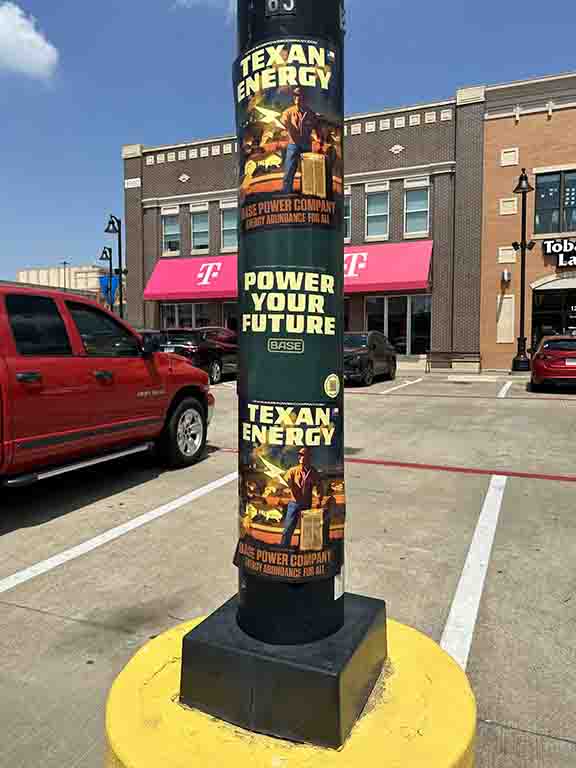
A snipe poster is a small format printed poster placed on street level infrastructure rather than on a rented advertising face. Construction hoardings, utility poles, barrier fencing, plywood over a vacant storefront. The surfaces nobody is renting out.
Buyers find the term after they have seen the thing. Someone walks a block in a dense neighbourhood, sees the same poster six times on six poles, and wants to know what that is called and who does it.
Then they call and ask for snipe posters, and what they usually mean is different from what they are going to get, because the format is defined by its surfaces and those surfaces do not care about your layout.
This post is about the poster itself. What stock survives, what size works, what the design has to do in the glance you get, how long paper holds on a pole versus a hoarding, and why the same artwork performs completely differently two blocks apart.
The campaign operations side, routing, market selection, crew scheduling, is a longer subject. Here I want to stay on the object: the printed sheet, where it goes, and why it either works or ends up curling off a pole by Thursday.
I have put up a lot of these and taken a lot of them down. The thing I would tell any first time buyer is that snipe posters reward repetition and punish precision. They are not a billboard. They are a drumbeat.
What a snipe poster is physically
Paper, mostly. Uncoated or lightly coated stock, printed on one side, sized to be carried in a stack and applied by one person with one hand free.
Uncoated paper is the workhorse for pasted positions. It takes paste on both faces, it conforms to irregular surfaces, it dries down tight, and it ages in a way that looks intentional rather than sad. Heavily coated glossy stock resists paste, traps moisture between the sheet and the wall, and lifts at the corners within days. It also throws glare under streetlights, which kills legibility exactly when foot traffic peaks.
Weight is a balance. Too light and the sheet tears while wet, especially on textured brick where the paste catches and the paper drags. Too heavy and it will not conform to surface irregularity, so it bridges across texture and air gets trapped underneath. Mid weight uncoated is where most street work lives.
For positions that are not pasted, the physical object changes. A poster zip tied to a fence or banded to a pole needs either a rigid backer or enough weight to resist flapping, because a loose sheet in wind destroys itself in a day and looks like litter while doing it.
Printing method matters less than ink behaviour outdoors. The question to ask is how the inks hold under UV. Reds, oranges and some purples fade first. If the brand's primary colour is in that family and the hold is long, the campaign will look faded and neglected while the posters are technically still up, which is worse than them being gone.
Size, and why bigger is not better
Buyers almost always want the poster bigger than it should be.
The constraint is the surface, not the ambition. A utility pole has a usable flat width measured in a single hand span. A barrier fence panel has a frame around it. A hoarding bay has vertical supports behind the board at regular intervals, and a poster spanning a support will bubble along that line forever.
Small format works because it fits the architecture of the street. A poster sized to the pole wraps cleanly and sits flat. A poster sized to the designer's preference wraps past the curve, develops a vertical crease, catches wind at the overlap and starts peeling from that edge.
The other reason to stay small is repetition. Given a fixed quantity of paper, smaller posters mean more positions, and more positions in a tight corridor is what makes the campaign register. Someone who sees one large poster has seen an ad. Someone who sees the same small poster nine times between the station and the office has registered a presence.
Larger formats absolutely have their place, and on big flat hoardings we go large and build multi sheet arrangements. That is a different job with a different rhythm. For snipe work specifically, I would rather have three modest posters on three poles than one oversized one fighting a curve.
Design, honestly
You have about two seconds, at walking or driving pace, from a few metres away, often at night under orange or white street lighting that was not chosen to flatter your palette.
What survives that:
One idea. A single image or a single short line. Not both competing.
Enormous type. Whatever size you think is big, on a laptop at full zoom, is smaller than it looks on a pole from across a sidewalk.
High contrast. Mid tone on mid tone disappears under street lighting. Dark on light or light on dark, with real separation.
Brand mark legible but not dominant. The job of the poster is recognition, not explanation.
What dies:
Body copy. Nobody reads a paragraph on a pole.
Thin elegant typefaces. They vanish at distance and they vanish faster when the paper gets a little dirty, which it does within a week.
QR codes placed low. A code at knee height, on a pole, on a busy sidewalk, is a code nobody is going to crouch in front of. If a code is essential, it goes high on the sheet and it is big.
Gradients and subtle photographic detail. Street dirt, rain spotting and UV flatten them.
We test layouts by printing them and looking at them from across the shop floor. It is crude and it catches most problems in thirty seconds.
How a snipe poster goes up
Pasted positions are the core. The method is old and it works.
Paste goes on the surface first. The sheet goes on wet. Then paste goes over the top of the sheet. That top coat is the part amateurs skip and it is the part that does the work, sealing the fibres and locking the edges down. A poster pasted only underneath lifts at the corners within days.
The application runs from the centre outward, flattening as you go, pushing air and excess paste to the edges. Trapped air becomes a bubble, the bubble dries, the dry bubble takes a rain soaking, and the sheet tears there.
Edges and corners get extra attention and extra paste. Everything that fails, fails at an edge.
Surface prep is quick but not optional. Loose grit, flaking paint, old torn paper and posters from a previous campaign all have to come off or be pressed flat first. Pasting over a lifting corner from somebody else's old sheet means you have inherited their failure.
Non pasted positions use ties or banding. Four fixing points minimum on anything with area. Even tension so the sheet presents flat. Grommets or reinforcement at the holes, because paper and thin substrate tear at a tie hole under repeated wind load.
A crew of two moves through a route far faster than two people working separately, because one applies while the other carries, preps the next position, spots the sidewalk and shoots the completion photo. Every position gets photographed with enough surrounding context to identify it later. That is the proof of placement the client gets, and the map we work from at removal.
Most of this work happens late. Late evening through the small hours in dense cores, before street cleaning and deliveries start. The window is shorter than clients imagine, and in cities with early street cleaning it closes abruptly.
One detail that separates a crew that has done this from one that has not: paste consistency is adjusted to the weather, not mixed once and used all night. On a cold damp night the mix wants to be thicker, because a thin mix will not set before the surface moisture gets into it. On a hot dry evening in a southern market the mix wants to be looser, because the surface pulls water out of the paste so fast that a thick mix skins over before the sheet is flat. Crews who ignore this get inconsistent results across one route and then blame the paper.
The other quiet skill is reading the position before committing. The crew member walking ahead is deciding, in a few seconds, whether a surface will hold: is it porous or sealed, is the paint sound or flaking, is it in the sight line of people walking or hidden behind a parked van, will a delivery truck idle in front of it every morning. A technically perfect paste job on a position nobody can see is wasted paper.
What holds, what fails, and for how long
Hold time is a surface question first and a weather question second.
Plywood hoardings are the best paste surface in the city. Porous, flat, absorbent, and usually at the perfect height on a busy sidewalk. Paper bonds hard and can hold for weeks.
Raw masonry and unsealed brick hold well, though heavy texture means the sheet bridges across the high points and the contact area is lower than it looks.
Sealed, painted or coated surfaces are unreliable. The paste bonds to the coating and the coating decides whether it stays attached to the wall. It often does not.
Metal and plastic do not take paste in any durable way. Those positions want ties or they want a different format entirely.
Utility poles vary wildly. Old weathered wood takes paste beautifully. Smooth composite or metal poles do not.
Weather does the rest. Light rain after full cure is mostly harmless and can even tighten the sheet. Rain within the first hours, before the paste has set, ruins the position. Cold slows cure time substantially, so a winter run in Chicago or Boston needs longer between application and the first weather. Heat and direct sun fade print and embrittle paper, so a south facing position in Phoenix or Houston looks tired long before a north facing one on the same street.
Realistic expectations: a well pasted sheet on a good porous surface, in moderate weather, commonly holds for a few weeks. High traffic positions at hand height get torn at by passers by. Positions near venues get covered by the next campaign within days, because everyone wants the same wall. Hoardings disappear when the construction does.
Nothing lasts the way a client hopes. The format works through refresh, not through permanence.
Permission, ordinance and the grey area
This is the question every serious buyer asks, and the answer is genuinely not a yes or a no.
Poster placement on street level surfaces sits in a grey area. What applies depends on who owns the surface, what the local ordinance says about posting and temporary signage, and how actively that ordinance is enforced in that area. All three vary by municipality, and enforcement varies block to block inside one city.
I will not tell you that a given run is legal or illegal. That is not a claim I am in a position to make, and anyone who makes it casually is not being straight with you.
What I will describe is how we reduce risk, because that part is concrete.
We ask. Where a position matters, we go to the property or hoarding owner and get permission, and we keep the record of it. Private surfaces with a named owner are always preferable to ambiguous public infrastructure.
We document. Every placement is photographed and logged.
We commit to removal. Removal is scheduled into the campaign, not left as an intention. Paper that is taken down cleanly keeps a position available for next time. Paper left to shred off a wall over six months is how a neighbourhood turns against the format and how a property owner stops saying yes.
We use methods that come off. Paste and paper remove with water and effort. Mounting systems on non pasted positions are chosen so nothing is damaged on the way out.
And we move when asked. No arguing on the street, ever.
What we talk clients out of
Thin spread. A small quantity of posters distributed across an entire metro produces nothing measurable and feels like nothing on the ground. I would rather concentrate everything into two or three corridors where the target audience actually walks. Frequency on one street beats presence on twenty.
Chasing specific addresses. Clients sometimes arrive with a list of exact positions they want, usually pulled from maps. Streets change. The hoarding in the image is a finished building, the pole has been replaced with a smooth composite one, the wall has been repainted with a coating paste will not hold. We survey in person and plan corridors, not coordinates.
Dense artwork. Covered above, but it is the most common fight and the one most worth having.
Long campaigns with no refresh. A snipe campaign is a maintenance commitment. Positions get covered, torn and weathered. A campaign that runs for weeks needs revisits, and a client who plans for placement but not for refresh gets a campaign that looks strong for one week and abandoned for the rest.
Unrealistic measurement. If the brief is built on a precise impression number, we are going to have a conversation. This format produces repetition and neighbourhood presence. It does not produce an audited count, and I am not going to invent one.
Using paper where paper cannot bond. If the target corridor is all metal fencing and coated panel, pasting is the wrong answer and we will say so before production rather than after a wasted night.
Where snipe posters sit next to everything else
Snipe posters are the ground layer. They are fast in effort per position, they scale with crew hours, and they make a neighbourhood feel like something is happening.
For a saturation push on flat porous walls, the natural companion is Wheatpasting & Poster Campaigns at larger format. Big paper on hoardings anchors the corridor, and the snipes carry the same message down the poles and fences between those anchors. Same walk, same message, two scales, and the repetition does the work that neither does alone.
If the campaign has a launch date attached, that is when adding motion pays. An LED truck or a street team on the one key evening turns a month of quiet repetition into an event, because the audience already recognises the artwork before the truck arrives.
The sequencing I would argue for most often: paper first, for two weeks of build, then the loud thing. Not the reverse.
Frequently asked questions
What exactly is a snipe poster?
A snipe poster is a small format printed poster placed on street level infrastructure rather than a rented advertising face. Typical surfaces include construction hoardings, utility poles, barrier fencing and boarded storefronts. The format is defined by its surfaces, which means size, paper stock and mounting method all follow from where the poster is going rather than from design preference.
What paper stock holds up best outdoors?
Mid weight uncoated stock is the workhorse for pasted positions. It absorbs paste on both faces, conforms to surface texture and dries down tight. Heavily coated glossy stock resists paste, traps moisture, lifts at the corners and throws glare under street lighting at night. Ink behaviour under UV matters too, since reds and oranges fade first.
How long do snipe posters stay up?
On a good porous surface such as a plywood hoarding, in moderate weather, a few weeks is a realistic expectation. Hand height positions get torn at, positions near venues get covered by other campaigns quickly, and hoardings vanish when construction finishes. The format works through scheduled refresh rather than through any single poster lasting.
Is putting up snipe posters allowed?
It is a grey area that depends on surface ownership, local ordinance and enforcement that varies by municipality and even by block. We reduce exposure by getting permission from property and hoarding owners, favouring private surfaces, documenting every placement, scheduling removal into the campaign and taking posters down immediately when asked.
How should artwork be designed for this format?
Assume two seconds, several metres away, at night under coloured street lighting. One idea, very large type, high contrast, minimal body copy. Thin typefaces, gradients, subtle photography and low placed QR codes all fail on the street. Printing the layout and viewing it from across a room catches most problems before production.
Do I need a lot of posters for it to work?
Density matters more than quantity. A concentrated run across two or three corridors where your audience actually walks will outperform the same number of posters scattered across an entire metro. The effect comes from someone encountering the same artwork repeatedly on a single journey, which only happens when placements are tight together.
Request a campaign quote
Tell us the neighbourhoods, the dates and what the campaign has to achieve, and we will tell you what the surfaces there will actually hold and where the paper should concentrate.
We print, place, photograph and remove, in a single city or across a national route, and we will say plainly if we think the plan is spread too thin to register.
Request a campaign quote and we will start with the corridors.

Ready to Run Your Campaign?
Call us or email us. We’ll tell you exactly what we can do in your market and what it costs.
Related Service
Explore similar advertising solutions offered by American Guerrilla Marketing.
American Guerrilla Marketing — Los Angeles
Street-level campaigns in Los Angeles and nationwide. Wheatpasting, LED trucks, street teams, and more.
(646) 776-2770
Related Articles
-
Wheatpasting & Poster Campaigns in Brooklyn, New York
November 12, 2026
-
Poster Campaign Proof of Posting: Common Mistakes
November 12, 2026
-
Poster Campaign Scope by Market Size vs Alternatives
November 12, 2026
-
Wheatpasting & Poster Campaigns in Houston, Texas
November 12, 2026
-
Wheatpasting & Poster Campaigns in Virginia Beach
November 12, 2026