Wheatpaste Poster Printing: Paper, Sizes, and Production Guide | AGM
Printing a poster for a wheatpaste campaign is different from printing a poster for a frame. The paper, the weight, the coating, and the size all need to be matched to the paste application and the outdoor surface.
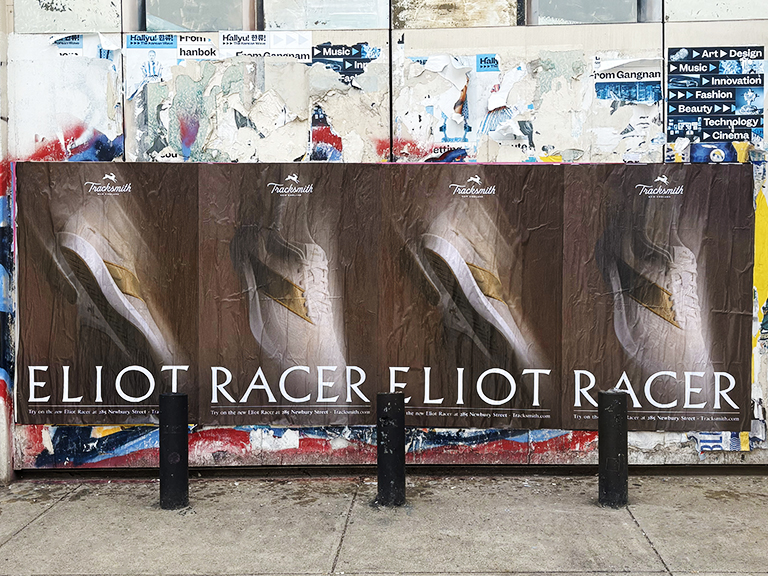
We’ve been printing and pasting posters in cities across the United States for years. New York, Los Angeles, Chicago, Atlanta, Miami, Austin, Seattle. We know what paper holds up overnight in the rain and what disintegrates the moment the brush hits it. We know which printers can run the paper weight we need, which sizes tile cleanly on a construction wall, and what coating makes the difference between a poster that looks good on day one and one that still reads clearly two weeks later.
Wheatpaste poster printing is a specific discipline. It’s not the same as ordering a glossy print for a frame. The paper needs to absorb paste, bond to the surface, and survive outdoor conditions without the structural support of a backing. Get the spec wrong and you’ve wasted both your print budget and your install time.
This guide covers everything we’ve learned about printing for wheatpaste applications. Paper type, weight, coating, sizes, file specs, and what we look for when evaluating print quality before a run goes to the field.
The paper is the most important variable in wheatpaste poster printing. It has to do three things: absorb paste from the back, stay dimensionally stable while wet, and adhere to the surface without lifting or bubbling. These are competing requirements that not every paper can satisfy.
Paper Weight (GSM)
The right weight for wheatpaste posters is in the 60 to 80 gsm range (approximately 40 to 54 lb text weight in the US system). This may feel light compared to the 90 to 120 gsm papers used for indoor posters. There’s a reason for the lower weight: lighter paper absorbs paste and conforms to surface irregularities better. Heavy coated paper or card stock sits on top of the paste instead of absorbing into it. The result with heavy paper is lifting edges and air pockets.
Very thin paper (under 55 gsm) tears when wet. The adhesive expands the paper fibers and the paste application itself puts stress on the sheet. Papers under 55 gsm are also prone to tearing during the installation process, especially when working at scale with large sheets.
Paper Finish: Matte, Uncoated, or Lightly Coated
We use uncoated or lightly coated matte paper for outdoor paste-up applications. Uncoated paper absorbs paste from the back and allows the adhesive to penetrate the paper fibers, bonding the sheet to the surface. Heavily coated papers (gloss, high-gloss, or UV-coated stock) resist paste absorption on the back side. The poster may look applied but the adhesive layer is surface-level and peels under the stress of temperature change and moisture.
Some light-coated or satin papers work acceptably when the coating is only on the face side (print side) and the back is relatively porous. Always test with a small proof sheet before committing to a full run with a new paper.
Porosity and Grain Direction
Paper with a more porous surface bonds more reliably. When we evaluate a new paper for wheatpaste applications, we test it by applying a small amount of paste to the back side and observing how quickly it absorbs. Paste that sits on the surface and beads indicates a poorly suited substrate. Paste that absorbs within 15 to 20 seconds indicates a paper with good porosity for our application.
Grain direction matters for larger poster sizes. Paper with the grain running parallel to the long edge of the poster is more dimensionally stable when wet. Grain running perpendicular to the long edge causes the poster to curl and buckle as it absorbs paste. For posters 24 inches wide or larger, confirm grain direction with your printer before ordering.
Printing Methods for Wheatpaste Posters
The printing method affects which paper you can use and what the finished poster looks like in the field.
Large-Format Inkjet (Our Standard)
Large-format inkjet printing is what we use for the vast majority of our poster campaigns. Printers in the 44 to 60 inch roll width range can output any size within their maximum dimension from roll stock. The advantage is flexibility in size and the ability to run uncoated or lightly coated papers that work for paste-up. Inkjet on uncoated stock produces a matte, slightly textured surface that photographs well on brick and concrete.
The limitation of inkjet on uncoated stock is color vibrancy. Colors print slightly less saturated on uncoated paper compared to coated stock. For campaigns where color accuracy is critical, test a proof print before approving the full run. The difference is usually acceptable and sometimes actually enhances the aesthetic of a street-level print.
Offset Printing
For very high-volume runs (10,000 or more posters), offset printing on newsprint or uncoated text stock becomes cost-effective. Newsprint is an excellent substrate for wheatpaste applications. It’s porous, absorbs paste readily, and is thin enough to conform to surface irregularities. The downside is lower image quality compared to inkjet on coated stock and less color fidelity. For typographic or simple graphic designs, newsprint is fine. For photographic campaigns, inkjet on better stock produces superior results.
Digital Offset (Short-Run Offset)
Digital offset printing on uncoated text stock is an option for medium-volume runs (500 to 5,000 posters) where per-unit cost matters. Several commercial print shops in New York and Los Angeles run digital offset specifically for poster campaigns. This method works well for simple designs with limited color. It struggles with high-resolution photographic content because the dot pattern at standard commercial resolutions is visible at close viewing distance.
What we actually use in the field: For most campaigns, we run 60 to 70 gsm uncoated matte paper on large-format inkjet printers. We’ve tested dozens of paper types over years of campaigns. This spec consistently produces the best combination of print quality, paste adhesion, and durability across the range of surfaces we work with.
Standard Sizes for Wheatpaste Poster Printing
Size selection for wheatpaste poster campaigns depends on the mounting location and the campaign format. Here are the sizes we most commonly produce:
Poster Size
Dimensions
Campaign Application
Notes
Half-sheet
11 x 17 in
Telephone poles, kiosk columns, small wall panels
Lowest cost per unit; high distribution volume
Quarter sheet
8.5 x 11 in
Interior venue walls, door backs, tight spaces
Standard printer format; widely available
Small one-sheet
18 x 24 in
Construction walls, wide flat surfaces
Good visibility without requiring large format printer
One-sheet
24 x 36 in
Primary outdoor placements, construction walls, hoarding
Our most-used format for outdoor campaigns
Double sheet
24 x 48 in or 27 x 41 in x2
Large wall sections, major visual impact locations
Two one-sheets tiled vertically
Bleed poster
Custom
Large wall murals via tiled printing
Multiple sheets printed and aligned on-site
The 24 x 36 inch one-sheet is our standard campaign format. It’s large enough to be seen from across a street, small enough to handle and apply without a crew of three people, and it prints at a manageable cost per unit. We typically order these in runs of 200 to 2,000 for a single-market campaign.
File Specs for Wheatpaste Poster Printing
Submitting correctly spec’d print files is essential. Errors in the file cause errors in the print, and there’s no fixing a poster once it’s on the wall.
Resolution
Design at 300 DPI at the actual output size for standard paste-up poster formats (18 x 24 and 24 x 36 inches). For larger tiled installations, 150 DPI at the tile size is acceptable since viewing distance increases. Never submit screen-resolution files (72 DPI) for print.
Color Mode
Design in CMYK. Inkjet printers convert RGB to CMYK at output, and the conversion shifts colors in ways you can’t fully predict. Design in CMYK from the start. If you’re working with brand colors, convert them to CMYK values and confirm against a proof print before approving the run.
Bleed
For posters that will be trimmed, include 0.125 inch bleed. For posters that will be used full-bleed on a wall without trimming (which is common in paste-up), bleed is less critical but still good practice. Keep important content (logos, headlines, phone numbers) at least 0.5 inches from any edge to account for paste overlap and edge lift during application.
File Format
Submit print-ready PDF/X-1a files. This format embeds fonts and color profiles and is the industry standard for commercial print production. TIFF files at the correct resolution and color mode are also acceptable for most large-format printers. Avoid sending layered Photoshop or Illustrator native files unless your printer specifically requests them.
Color tip from our production team: On uncoated paper, CMYK colors print slightly less saturated and slightly darker than they appear on screen. Add about 5 to 10 percent more saturation to your CMYK values when designing for uncoated stock. A proof print confirms this adjustment before your run hits the field.
Paste Formulas and Their Effect on Print Requirements
The paste formula you use interacts with the paper you choose. Different paste mixes have different consistencies, different dry times, and different adhesion profiles. Here’s how paste choice affects print requirements:
Flour-Based Wheatpaste
Traditional flour-based paste (made from wheat flour and water) is the classic street posting adhesive. It has a medium viscosity when properly made, absorbs well into porous paper, and dries to a rigid finish that bonds the poster to most surfaces. It works best with uncoated or lightly coated papers. With heavily coated paper, the paste sits on the paper surface and doesn’t penetrate. The bond is weaker and the poster lifts at edges faster.
Commercial Paste Concentrate
Commercial poster paste concentrates (diluted according to manufacturer instructions) often have higher tack and shorter dry times than flour-based formulas. They work across a wider range of paper types but are more expensive per batch. On smooth, non-porous surfaces like painted brick, commercial concentrates often outperform flour paste for initial bond strength.
Methyl Cellulose
Methyl cellulose paste is clear, mixes easily with water, and has a longer open time (the window between application and final set) than flour-based mixes. The longer open time is useful for repositioning large sheets during installation. It works on most uncoated papers and bonds well on concrete and painted surfaces.
Surface Compatibility and What It Means for Printing
The surface where a poster goes up affects the print spec you need. Rough surfaces (exposed brick, textured concrete, weathered wood) require more flexible paper that can conform to surface irregularities. Smooth surfaces (painted metal, smooth concrete, glass where permitted) allow slightly heavier paper because the surface is uniform.
In New York, we regularly apply posters to the corrugated steel hoarding around construction sites on blocks like West 34th Street near the Madison Square Garden area, the plywood construction walls on the south side of the High Line in Chelsea, and the painted brick walls in Williamsburg along Bedford and Metropolitan avenues. Each surface has different texture and porosity. The 65 gsm uncoated paper we use handles all of them consistently.
In Los Angeles, the painted concrete and stucco walls along Melrose, Fairfax, and Sunset Blvd require slightly different paste ratios than the painted brick in New York. The surface is smoother, so we sometimes apply a base coat of paste to the wall before pressing the poster. Thinner paper handles this double-paste application better than heavy stock.
Wheatpaste posters are printed on lighter, more flexible paper than display posters. That makes them more susceptible to damage in storage and transport. Handling them correctly from the moment they come off the press protects your print investment.
Rolling vs. Flat Storage
For 24 x 36 inch or smaller posters, rolling is the standard storage method. Roll printed-side-out in groups of 25 to 50 sheets, securing with a rubber band or tape tab at each end. Avoid rolling too tightly. Tight rolls crease the paper and create memory that causes the poster to curl back when installed. A roll diameter of 3 to 4 inches for a 24 x 36 sheet is fine. Anything tighter causes handling problems in the field.
For large runs, flat storage in banker boxes is more practical. Stack flat in groups of 50, alternating orientation every 25 sheets to distribute pressure evenly. Mark boxes with the campaign name and quantity. Flat storage is slower to access in the field but reduces creasing for paper that will be applied to smooth surfaces where creases would show.
Temperature and Humidity
Store wheatpaste posters in a cool, dry environment. High humidity causes uncoated paper to absorb ambient moisture, which pre-expands the paper fibers. Posters stored in a humid environment then applied with paste can over-expand and buckle. We store campaign stock in our climate-controlled production facility and deliver to the field in sealed plastic bags when rain or high humidity is in the forecast.
Transport to Installation Sites
For field deployment, we transport rolled posters in sealed poly bags or rigid tubes to protect from rain and handling damage. Never leave poster stock in an open truck bed during transit in wet weather. Even brief rain exposure causes uncoated paper to absorb moisture and becomes difficult to handle during installation.
Frequently Asked Questions
What paper is best for wheatpaste posters?
Uncoated matte paper in the 60 to 80 gsm range is best for wheatpaste poster applications. This weight absorbs paste and bonds to wall surfaces better than heavy coated stock.
The most common size for outdoor wheatpaste poster campaigns is 24 x 36 inches. The size should match the physical scale of the mounting location and the viewing distance.