Wheatpaste Poster Art Campaigns NYC 2026 | American Guerrilla Marketing
We have watched wheatpaste poster art evolve from the province of independent street artists into one of the most effective brand campaign formats in cities like New York, Los Angeles, and Chicago. The format works because it does not look like an ad. It looks like something worth photographing. When a campaign lands right, people stop on the sidewalk, pull out their phones, and share it without any prompting from the brand. That earned amplification is what separates a well-executed wheatpaste art campaign from a standard poster run.
Our team has spent years building campaigns at this intersection of street art and brand strategy. We know which artists resonate with which neighborhoods. We know how to brief a creative team so the final design reads as authentic street art rather than a corporate poster with a thick black border. We know the surfaces in Bushwick that have held major installations, the walls on Orchard Street that draw photographers, and the scaffolding on Bedford Avenue that sees the right eyes every single morning.
This guide covers the art side and the strategy side of wheatpaste poster campaigns: how we approach the creative, which neighborhoods we work in, how we execute installations, and what brands should expect from a campaign built around this format.
Understanding Wheatpaste Poster Art as a Marketing Format
Where the Format Comes From
Wheatpaste poster art has roots in both political organizing and fine art. Printmakers used it to distribute political messages in the early twentieth century. Concert promoters used it to cover cities in band imagery before digital printing existed. Street artists like Shepard Fairey, Swoon, and JR brought the format into the fine art conversation in the late 1990s and 2000s, elevating the aesthetic of paste-up work and building global audiences for artists who worked at street scale.
Brands noticed. The first sophisticated brand wheatpaste art campaigns started appearing in fashion and streetwear in the mid-2000s. Labels like Supreme used paste-up art to build the kind of street credibility that no media buy could manufacture. The formula was simple: work with artists the target audience already respected, put the work in the neighborhoods where that audience lived, and let the artwork do the talking.
That formula still works in 2026. The execution has gotten more sophisticated, the documentation has gotten sharper, and the link between street placements and social media amplification is better understood. But the core principle is unchanged. An artwork that belongs on the wall of a Bushwick building will be treated differently by the neighborhood than a corporate poster that clearly does not.
What Separates Wheatpaste Art Campaigns from Standard Poster Runs
Standard wheat paste poster campaigns prioritize coverage and frequency. A hundred placements across a borough creates brand recognition through repetition. Wheatpaste poster art campaigns prioritize impact at specific, carefully chosen locations. A single large-scale installation on a corner building in Williamsburg can generate more social media exposures than a hundred standard posters in less visible locations.
The difference is in the creative approach and the location strategy. Art campaigns require a creative direction that reads as culturally credible, more than commercially polished. They require location selection that prioritizes visibility and photographic context over raw coverage numbers. And they require installation quality, alignment, surface preparation, and topcoat application, that holds up to the scrutiny of an audience that notices when street art is done poorly.
We execute both types of campaigns. For clients whose objective is neighborhood saturation and brand frequency, we recommend the standard poster run. For clients whose objective is cultural credibility, social media amplification, and press coverage, we design wheatpaste art campaigns with an artist collaboration component and a precise location strategy built around the city’s most photographed and trafficked walls.
The Neighborhoods Where Wheatpaste Poster Art Performs Best
Bushwick and East Williamsburg
Bushwick is the center of New York City’s outdoor mural and street art culture. The streets around the Jefferson Avenue L train station, the Flushing Avenue corridor from Wyckoff to Irving Avenue, and the blocks immediately east of the Morgan Avenue L stop carry some of the most photographed street art in the world. Our crews know every wall in this zone.
Wheatpaste poster art placements in Bushwick benefit from the neighborhood’s visual culture. Residents and visitors photograph and share street art here constantly. A strong installation at the right location on Wyckoff Avenue or Flushing Avenue can generate Instagram pickup from hundreds of local accounts within days of installation. That organic reach is not something you can buy on a media plan. It happens when the creative is right and the location is right.
We run art-oriented brand campaigns in Bushwick for music labels, footwear brands, streetwear lines, and cultural organizations. The neighborhood’s visual appetite is broad but discerning. Work that does not fit the aesthetic culture of the area gets ignored. Work that does gets embraced.
Williamsburg’s Bedford Avenue and North Side
The Bedford Avenue corridor from the L train stop north to McCarren Park carries a different visual culture than Bushwick. This strip is more retail-forward, more fashion-conscious, and draws a higher volume of weekend visitors from outside the neighborhood. Wheatpaste poster art placements here get seen by the local creative base and by the weekend tourist traffic that flows through Williamsburg from across the city and from out of town.
The scaffolding along Bedford Avenue between North 6th and North 10th Streets is among our most requested location sets in the entire city. Brands that want presence in Williamsburg’s creative heartland consistently prioritize these blocks. We maintain relationships with property owners along this strip that allow us to schedule installation times and secure longer hold durations for high-value placements.
The blocks immediately around the North 7th Street and Bedford intersection, including the storefronts and plywood barriers on Kent Avenue between North 6th and North 9th Streets, are also productive for art-forward campaigns targeting the Williamsburg gallery and design audience.
The Lower East Side and Orchard Street
The Lower East Side has been a home for street art and counter-culture visual work since the 1970s. Orchard Street between Houston and Broome, Rivington Street between Ludlow and Clinton, and the blocks around the Essex Street Market carry a long history of street-level artistic production. Wheatpaste poster art in this neighborhood benefits from a built-in cultural context that gives brand work a legitimacy it has to earn in other Manhattan neighborhoods.
Orchard Street in particular is heavily photographed. The combination of vintage storefronts, street art, and weekend foot traffic from across the city makes it one of Manhattan’s highest-social-media-pickup locations for outdoor campaigns. We have run installations here for fashion brands, music labels, and cultural institutions whose target audience spends time in the Lower East Side gallery and nightlife scene.
Long Island City and the Queens Waterfront
Long Island City has emerged as one of the city’s strongest locations for large-scale outdoor art, driven by the concentration of gallery spaces, arts organizations, and the visual culture that has grown around the 5 Pointz legacy and the continued mural activity in the neighborhood. The blocks around the 21st Street Queensbridge G/N/W train station and the Jackson Avenue corridor between 44th Drive and 46th Avenue carry significant artistic presence that makes wheatpaste art campaigns feel at home.
The Queens waterfront facing the East River along Vernon Boulevard, between 44th Road and 50th Avenue, provides wide wall surfaces and strong visibility from the waterfront park used by both LIC residents and visitors from Manhattan. We have executed large-scale multi-panel wheatpaste art installations on this corridor for clients whose campaigns benefited from the proximity to the Manhattan skyline as a photographic backdrop.
How We Approach Creative Direction for Wheatpaste Poster Art Campaigns
Artist Collaboration and Selection
The most effective wheatpaste art brand campaigns involve artists whose existing work resonates with the target audience. We maintain relationships with a roster of New York-based and nationally recognized artists who work across a range of styles: graphic illustration, portraiture, typographic abstraction, and large-scale figurative work. When a brand brief calls for an art-forward campaign, we match the brief to artists whose aesthetic aligns with the brand’s visual identity and the cultural sensibility of the target neighborhood.
Artist briefing is a careful process. The best outcomes happen when the artist has genuine creative latitude within a defined set of brand parameters, color palette, logo placement, message or theme, rather than a tight execution spec that reduces the collaboration to a production task. Artists who feel ownership over the final work produce better work, and better work gets more social media pickup and press attention.
We also run wheatpaste art campaigns with brand in-house or agency creative teams who do not require an external artist collaboration. When the creative direction is strong and the design sensibility matches the target neighborhoods, brand-produced creative can perform as well as artist-collaborated work. We review every creative submission with the location strategy in mind and give direct feedback when we see design decisions that will underperform at street level.
Scale and Format Decisions
Wheatpaste poster art campaigns generally work at larger scales than standard poster runs. The visual impact of the art-forward approach depends on the artwork commanding attention from a distance. Small-format posters in artistic campaigns tend to get lost among other street-level visual content. Our standard recommendation for art-oriented campaigns starts at 27×40 inches and moves up from there.
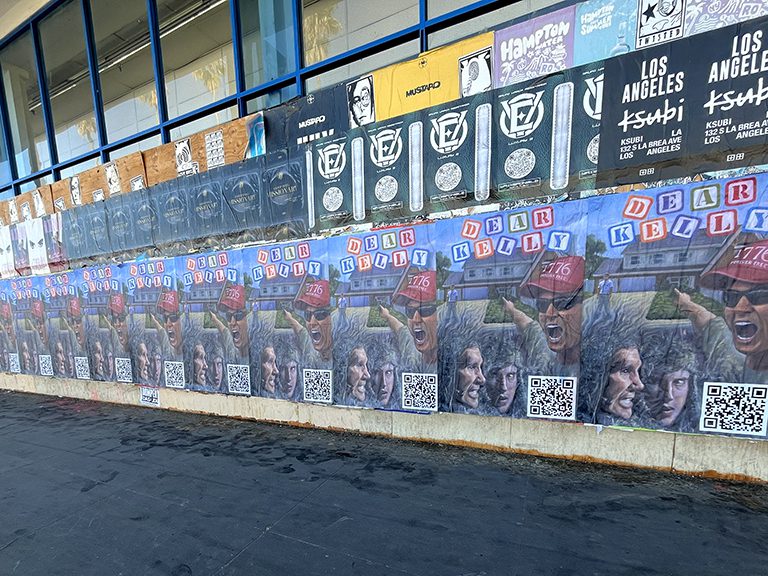
For anchor placements, the high-visibility corners and scaffolding sections that anchor each campaign zone, we build multi-panel configurations that create a single unified image across eight to twenty feet of wall space. A ten-panel build on a Bushwick scaffolding run can produce a mural-scale presence at a fraction of the cost and lead time of a painted wall. The visual effect at street level is comparable to a commissioned mural, and the campaign can be refreshed or updated with new creative without the permanence of paint.
Typography and Text Strategy
Text-heavy layouts underperform in wheatpaste art campaigns. The format works best when the visual carries the message and text is minimal. A brand name and a single phrase, or a brand name and a web address or social handle, is the appropriate text load for most wheatpaste art installations. Full sentences and fine-print
When typography is the primary creative element, which works well for certain brand identities and campaign concepts, the letterforms need to be large enough to read from 30 feet and bold enough to hold their own against the visual competition of a busy street. Hand-rendered or textured typography styles tend to perform better in art-oriented neighborhoods than clean sans-serif layouts, which can read as corporate rather than cultural.
Installation Process and Quality Standards
Surface Preparation
The quality of a wheatpaste art installation depends as much on surface preparation as on print quality. Our crews clean the target surface before applying paste, removing loose material and surface debris that would compromise adhesion. For anchor locations with high visibility and social media potential, we take additional prep steps including sanding rough edges and priming problem surfaces to ensure the printed artwork bonds cleanly and the topcoat applies evenly.
Multi-panel builds require precise surface measurement before production so that panels align correctly during installation. We measure every anchor location with the installation crew before the print run is finalized. A multi-panel build that goes to production without accurate surface measurements will have alignment problems that are visible to anyone who stops to look. We do not let that happen.
Paste Formula and Application Technique
Our paste formula is wheat flour, water, and a small percentage of white glue, mixed to a consistency that gives our crews adequate working time in the temperature conditions of the installation night. Summer installations use a thinner mix with more working time before the paste begins to set. Cold-weather installations use a thicker mix with slightly more glue content to compensate for the slower drying conditions.
Application technique matters as much as paste formula. Paste is applied to the surface first, then the poster is laid into the wet paste, then a second paste coat goes over the top. Bubbles are worked out from the center toward the edges. The topcoat is applied to seal the edges and protect the face of the print. An improperly applied topcoat can cloud the surface of the artwork or leave edge strips that peel under moisture. Our crews apply topcoat systematically to avoid both problems.
Documentation and Social Media Preparation
Every wheatpaste art installation is documented in daylight within 24 hours of the overnight installation. We return to anchor locations in the morning with a photographer to capture the artwork in clean, well-lit conditions suitable for social media use by the brand. These documentation photographs are delivered to the client along with the full installation report, ready for use on brand-owned social channels.
For campaigns with a significant social media amplification objective, we brief the documentation process as part of the creative production. Anchor locations are selected in part for their photographic context. A wall with interesting architecture, good natural light, and a recognizable neighborhood backdrop produces documentation photography that performs better on social media than a technically perfect installation on a flat, featureless hoarding section.
Campaign Pricing and Format Comparison
Wheatpaste Art Campaign Investment
Wheatpaste Poster Art Campaign Packages, New York City
Campaign Type
Location Count
Format
Includes
Starting Price
Neighborhood Focus
20 to 30
Mix of standard and large
Scout, install, documentation
$4,500
Borough Campaign
50 to 75
Standard + 3 anchor large builds
Scout, install, maintenance, docs
$9,500
Multi-Borough Art Run
100+
Mixed formats, multi-panel anchors
Full service + photographer
$18,000
Artist Collaboration Add-On
Any
Custom
Artist brief, production, install
From $5,000
Wheatpaste Art vs. Other Cultural Marketing Formats
Wheatpaste poster art offers the fastest path to cultural credibility among the formats listed above. Mural advertising delivers a more permanent presence and often generates more press coverage, but requires a longer lead time and significantly higher production investment. For brands that need to move quickly on a cultural moment, a launch, a drop, a tour announcement, wheatpaste art is the format that delivers the visual impact of a mural on a poster campaign timeline and budget.
Integrating Wheatpaste Art Campaigns with Digital Strategy
Building the Social Layer
Every wheatpaste art campaign we run has a social media component, either explicit or implicit. The explicit version involves designing the campaign with social media documentation as a primary objective. We identify three to five anchor locations with strong photographic context, produce large-format installations at those locations, and document them with professional photography for use on brand-owned channels. The brand then posts the documentation with location tags that let local audiences find the installation and visit it in person.
The implicit version happens when the creative is strong enough that the neighborhood does the documentation work. Street art audiences in Bushwick, Williamsburg, and the Lower East Side photograph and share installations they find visually compelling. A well-executed wheatpaste art campaign at the right location in these neighborhoods will generate organic social coverage that the brand did not have to produce. We have seen campaigns generate thousands of Instagram exposures from organic neighborhood pickup in the first week of a campaign, with no paid amplification and no brand-side posting.
QR Code Integration
QR codes work in wheatpaste art campaigns when they are integrated into the design rather than appended to it. A QR code that is designed as part of the artwork, incorporated into the visual logic of the piece rather than placed as a white box in the corner, gets significantly higher scan rates than a QR code that looks like an afterthought. We have tracked QR scan rates of 1.5 to 2.5 percent in high-traffic Williamsburg and SoHo locations when the code is integrated cleanly into the design.
The destination behind the QR code matters as much as the scan rate. Sending users to a generic homepage produces lower engagement and conversion than sending them to a campaign-specific landing page with content that directly follows on the street-level encounter. We brief QR destination strategy as part of campaign planning to make sure the digital experience matches the street-level impression.
Press and Influencer Coverage
Wheatpaste art campaigns at anchor locations in major New York neighborhoods generate press coverage when the creative is strong and the placement is in a location that journalists and bloggers move through regularly. We have had campaign installations covered by Hypebeast, Complex, Time Out New York, and neighborhood-specific publications without any press outreach from the brand, simply because the work was good and it was in the right place.
For campaigns where press coverage is an objective, we identify the anchor locations that are most likely to attract editorial attention, brief the documentation team accordingly, and send a campaign preview to relevant editorial contacts on the brand’s behalf. This press strategy layer adds lead time to the campaign planning process but significantly increases the probability of editorial pickup.
Frequently Asked Questions
Do we need to work with a professional street artist, or can we use our own creative?
Both approaches work. Artist collaborations produce creative with built-in credibility in street art communities and can generate press and social pickup from the artist’s existing audience. Brand-produced creative works well when the design sensibility is strong and appropriate for the target neighborhoods. We review all creative submissions with the campaign location strategy in mind and give direction on how to adapt the creative for the selected surfaces and neighborhoods.
How large can a single wheatpaste installation get?
Multi-panel wheatpaste builds on extended scaffolding runs or large plywood barriers can reach 20 to 30 feet in width and 10 to 15 feet in height. We have executed installations at this scale on Wyckoff Avenue in Bushwick, on Prince Street in SoHo, and on construction hoarding around several large Midtown development projects. Scale at this level requires precise surface measurement, precise print production, and careful installation planning.
How do we make sure the installation looks clean and professional?
Our crews use a consistent installation technique: surface cleaning, base paste coat, poster placement, bubble removal from center to edges, and a full-coverage topcoat. For anchor locations with high visibility and photographic importance, we take additional surface prep steps and assign our most experienced crew members to the install. We return to anchor locations in daylight to photograph the finished work and confirm installation quality.
Can we update the creative mid-campaign?
Yes. We can replace existing posters with updated creative at any point during a campaign run. Mid-campaign creative updates require a new print run and a crew dispatch to the affected locations. For campaigns where creative rotation is planned from the start, we build the update schedule into the campaign timeline and price it into the initial proposal so there are no surprises.
What neighborhoods get the most organic social media pickup?
Bushwick, Williamsburg, and the Lower East Side consistently generate the highest rates of organic social media coverage from street art installations in New York City. Long Island City and Crown Heights have emerged as strong secondary markets for organic pickup in the past few years. The common factor across all of these neighborhoods is an existing street art culture and an audience that photographs and shares visually distinctive installations.
How do you protect the artwork from being covered by other posters?
We apply a full-coverage topcoat that makes it harder for other posters to adhere over the top of our installations. At anchor locations, our monitoring team checks poster condition weekly and schedules maintenance passes when competing posters start to encroach on the installation. We also schedule maintenance passes at the midpoint of every campaign as a standard service element.
Can the same creative run in multiple cities at once?
Yes. We execute multi-city wheatpaste art campaigns with crews in Los Angeles, Chicago, Miami, Philadelphia, Boston, and Washington DC. Multi-city campaigns require a longer lead time for coordination, typically two to three weeks from contract to first installation night in each city. We manage the full campaign from New York and provide unified installation documentation across all markets.