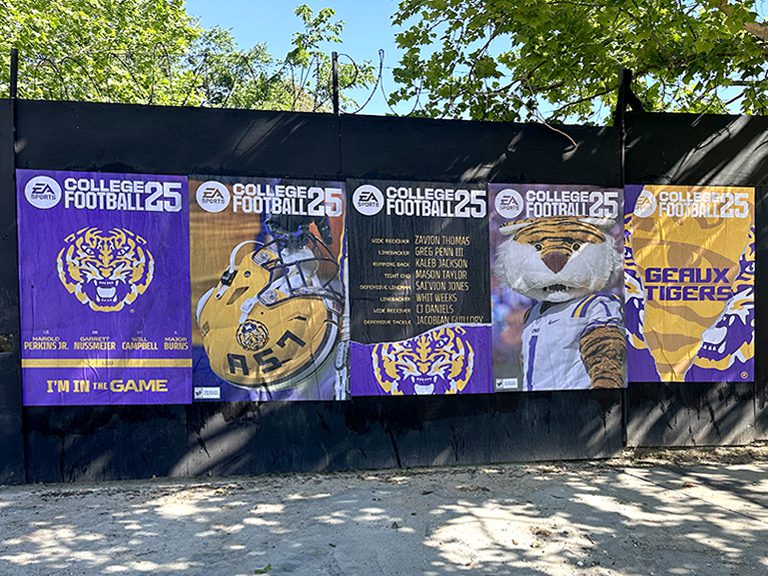
A poster can be almost any size, but in practice, specific dimensions have become standard for specific uses. Those standards exist because of print production economics, display hardware requirements, and the accumulated conventions of decades of poster printing and distribution. Knowing the standards saves time, money, and the frustration of finding out your design does not fit where you intended to use it.
We produce and place posters as part of marketing campaigns across major US cities. We order specific sizes for specific placement types, coordinate with print vendors on specs, and work with design teams to make sure files are built correctly before anything goes to print. The size of a poster is the first question in every production conversation.
This guide answers the question completely, covering every major standard poster size, its typical application, and the technical requirements that go with each format.
The most common general-purpose poster size in the United States is 24 inches wide by 36 inches tall. This is the default for most promotional, event, and entertainment poster applications, and it is the standard for which most retail poster frames are designed.
The United States uses imperial measurements for poster sizing. The most common standard formats range from 11×17 for small flyers up to building-wrap scale for large-format outdoor applications. Here are the most important standard sizes and what each is typically used for.
11 x 17 inches: The Mini-Poster
This small format sits at the boundary between a flyer and a poster. At 11 inches wide and 17 inches tall, it is sized to print on standard office large-format copiers and printers, which makes it the most affordable poster format to produce in small quantities. Community bulletin boards, local event promotion, restaurant specials, and neighborhood announcements all commonly use this format. It is not suited for any placement that requires viewing from more than about 10 feet away.
18 x 24 inches: The Indoor Promotional Poster
At 18 inches wide and 24 inches tall, this is a midsize format that works well for indoor promotional applications where the standard 24×36 would be too large. Retail store window displays, restaurant promotional posters, event venue interior placements, and point-of-sale displays all use this size. It reads clearly from distances of 5 to 15 feet, which covers most indoor viewing conditions.
24 x 36 inches: The Standard Poster
The 24×36 format is the dominant standard for general-purpose poster advertising in the United States. At 2 feet wide by 3 feet tall, it creates genuine visual presence on a wall, in a window, or mounted on a surface. It reads clearly from distances of 10 to 30 feet. It fits the standard retail poster frame sizes available at most home goods and art supply retailers. It is the format most print shops stock and the one with the widest print vendor availability at standard pricing.
For street-level mounted poster campaigns, this is the workhorse format. The vast majority of urban poster campaigns we run use 24×36 as the primary format. It handles, ships, and installs efficiently in quantity. And it is large enough to carry impactful creative at the viewing distances typical of sidewalk-level placements.
27 x 40 inches: The Theatrical One-Sheet
The 27×40 one-sheet is the standard for US movie theater marketing. It is slightly larger than the general-purpose 24×36 and uses specific proportions designed for theater lobby display hardware. This format is essential for anyone producing theatrical marketing materials. For non-theatrical applications, the 24×36 format is the more practical choice because it is more widely available and fits standard retail frame sizes.
36 x 48 inches: The Large Format Poster
At 3 feet wide and 4 feet tall, the 36×48 poster is in the large-format category. It requires a focused large-format printer to produce and is too large for standard retail frames. It is used for trade show displays, high-visibility retail environments, event signage, and any application where the 24×36 is insufficient due to viewing distance or competitive visual environment.
Choosing the right poster size is not simply a matter of picking the largest format you can afford. Several specific factors should drive the size decision.
Viewing distance is the most important factor. Every element of your poster, especially text, must be readable at the distance from which your audience will actually encounter it. A poster on a coffee shop bulletin board is read from arm’s length. A poster on a building wall is read from across the street. The viewing distance determines the minimum text size, which in turn affects how much information you can include, which ultimately shapes the right overall poster format.
Display environment affects the practical size choice. A poster that will be installed in a standard retail frame is limited to 11×17, 18×24, or 24×36, which are the standard frame sizes available. A poster going on a construction hoarding with unlimited wall space can be as large as the print vendor can produce. Knowing the physical environment before designing prevents the common problem of creating artwork that does not fit the intended space.
Budget and quantity interact with size in specific ways. Smaller sizes are cheaper per unit, which matters when you need hundreds or thousands of copies. Larger sizes cost more individually but create stronger presence, which may justify the higher cost if the placement type warrants it. For campaigns where each individual placement is a high-visibility location, the cost premium of a larger format often pays back in stronger consumer response.
Never design a poster without knowing where it will be placed. The placement determines the size. The size determines the design constraints. This sequence prevents the most common and expensive mistakes in poster production.
Aspect Ratios and Poster Design
Poster sizes have specific aspect ratios that determine the proportional relationship between width and height. Understanding aspect ratios helps you design consistently across multiple formats and ensures your artwork translates well when adapted from one size to another.
The 24×36 format has an aspect ratio of 2:3 (or 1:1.5). This means the height is exactly 1.5 times the width. Dividing the height by the width for any poster gives you its aspect ratio, which you can use to verify that a rescaled version will match the original proportional composition.
The 27×40 theatrical one-sheet has an aspect ratio of approximately 1:1.48, which is slightly wider relative to its height than the 24×36. The difference is subtle, but it means artwork designed for a 27×40 will not fill a 24×36 without proportional adjustment.
The 11×17 mini-poster has an aspect ratio of approximately 1:1.55, which is slightly narrower relative to height than the 24×36. Again, artwork needs to be adapted rather than simply resized to move between formats with different aspect ratios.
When adapting artwork across multiple formats, always rebuild the composition for each format rather than simply scaling. Elements that work proportionally in a 24×36 layout may need to be repositioned, resized, or even replaced to maintain compositional balance at a different aspect ratio. The best campaigns are designed with multiple formats in mind from the start, with art direction decisions made to ensure the creative works at every format it will be used in.
Poster Size and Print Production Cost
Poster size directly affects production cost, though not always in the straightforward linear way people assume. Understanding how print vendors price large-format work helps you plan budgets accurately and avoid surprises at the invoice stage.
Most large-format print vendors charge by the square foot of printed area rather than by a flat rate per unit. A 24×36 poster (6 square feet) will cost approximately twice as much to print as an 18×24 poster (3 square feet) at the same quantity, other factors being equal. Moving from 24×36 to 36×48 (12 square feet) doubles the material cost again.
Setup costs are relatively fixed regardless of size. For digital large-format printing, there is minimal setup because each file is printed directly without plate production. This means short runs of large-format posters (5 to 50 pieces) are practical and not prohibitively expensive per unit. Longer runs of thousands of copies may become more cost-effective on offset printing equipment if the format is close to standard offset press sheet sizes.
Substrate choice adds to cost in ways that scale with size. Lamination, UV coating, and premium paper stocks cost more per square foot than standard matte paper. For outdoor applications requiring weatherproof substrates, the material cost premium can be significant on large-format prints. Always include substrate specifications when getting quotes to ensure you are comparing equivalent products.
How Poster Size Affects Campaign Strategy
When we plan a poster campaign, the size decision is more than a logistics question. It is a strategic decision that affects the campaign’s visual presence, cost structure, and audience reach. Understanding how size fits into campaign strategy helps brands make better decisions at the planning stage rather than finding out after production that the format does not match the intent.
For awareness campaigns in dense urban markets, the goal is usually maximum visibility to the largest number of target consumers. The 24×36 format strikes the right balance of visual presence, production cost, and installation practicality for most urban street campaigns. It is large enough to read easily from passing foot traffic, small enough to install quickly across many locations, and priced appropriately for campaigns that need volume across a city.
For prestige brand campaigns where quality and production value communicate brand positioning, larger formats and premium substrates justify the higher cost. A luxury brand that places fewer, larger-format posters in carefully selected high-visibility locations in the right neighborhoods communicates differently from the same brand plastering 24×36 posters on every available surface. The scarcity and scale of fewer, larger placements reinforces the premium positioning.
For event marketing where the campaign has a short life but needs to be unmissable during the event window, the focus shifts to maximum geographic density in a specific area. Smaller formats placed at extremely high density around the event venue can produce stronger local awareness than fewer large-format placements at a distance. The right format for event marketing is the one that allows the most placements within the walking radius of the event at the budget available.
Digital File Specifications for Poster Printing
Getting the digital file specifications right is essential for producing posters that print at the quality level the design deserves. Incorrect specifications discovered after the print run are expensive to correct and sometimes impossible to fully recover from.
Resolution is the first specification to get right. For close-up viewing at 24×36 and smaller, 300 DPI at full print size produces professional-quality results. For large-format prints viewed from a distance, 150 DPI at full print size is typically sufficient. Never use 72 DPI (screen resolution) for any print application regardless of size.
Color mode must be CMYK for all print work. RGB files will be converted by the printer’s software, and this conversion often produces color shifts that differ from what you see on screen. Building the file in CMYK from the start and proofing on a calibrated monitor or requesting a physical proof before the full print run ensures color accuracy.
File format affects how the vendor processes the job. Most professional print vendors accept PDF/X-1a, high-resolution TIFF, or native file formats like PSD and AI. PDF/X-1a is the most widely accepted professional print delivery format and embeds all fonts and color profiles correctly. Always confirm the vendor’s preferred delivery format before submitting files for a production run.
Poster Sizing for Outdoor and Environmental Applications
When posters move beyond the standard indoor and street-level formats into large outdoor environments, sizing becomes a different kind of challenge. Building wraps, outdoor banners, large-format wall installations, and event environmental graphics all require specific design and production approaches that differ significantly from standard poster production.
Building wraps are printed on vinyl or mesh material in extremely large format. The design is typically printed at low DPI (often 30-72 DPI) at actual size because the viewing distance from street level makes pixel-level resolution unnecessary. The file sizes for building wraps are enormous even at these reduced resolutions because the physical dimensions are measured in feet or even hundreds of square feet.
Construction hoarding installations use panels of poster material tiled to cover large surface areas. Individual panels are typically printed at standard large-format sizes (24×36 or 36×48) and installed in a contiguous grid. The overall design spans multiple panels and must account for the seams between them. Registration marks and panel numbering in the file help installers achieve accurate alignment.
Event environmental graphics, including step-and-repeat backdrops, stage banners, and directional signage, use a range of large-format sizes that are typically custom to each event. Standard event backdrop sizes range from 8×8 feet to 16×8 feet depending on the event space, camera angle, and number of people that need to fit in the typical photographed frame.
What file format should I save my poster design in?
Save your final poster file as PDF/X-1a for professional print delivery. This format embeds all fonts and color profiles and is widely accepted by print vendors. High-resolution TIFF at 300 DPI is another reliable option. Always confirm with your specific vendor before submitting, as different shops have different requirements.
Frequently Asked Questions
What is the size of a standard poster?
The standard poster size in the US is 24 inches wide by 36 inches tall. This is the most common size for entertainment, promotional, and street campaign posters. It is the size most print shops stock and the standard for which most retail poster frames are designed.
What is the most common poster size?
24×36 inches is the most common poster size for general promotional use in the United States. The 11×17 is the most common small format (technically a mini-poster or flyer). For theatrical film marketing, the 27×40 one-sheet is the most common format in theater lobby applications.
What size poster does Walmart sell?
Walmart and most major retail chains stock poster frames in standard sizes: 11×17, 18×24, and 24×36 inches. They also stock pre-printed entertainment and art posters in 24×36 inches, which is the standard retail poster format. Some specialty retailers also stock 27×40 frames for theatrical one-sheet collectors.
How big is an A3 poster?
An A3 poster in the international ISO paper system measures approximately 11.7 inches wide by 16.5 inches tall. This is roughly equivalent to the US 11×17 format (tabloid size). For most US applications, 11×17 is the standard equivalent to A3. For European applications, A3 is specified directly.
What size poster works best for window displays?
For most retail store windows, the 18×24 or 24×36 formats work best. The 18×24 is appropriate for smaller windows and interior window placements. The 24×36 is better for larger windows and high-foot-traffic storefronts where greater visual presence improves the impact of the placement.
Can I print a poster at home?
Home printers produce 8.5×11 or 8.5×14 inches at most. Printing at 11×17 requires a tabloid-format home printer, which are available but less common. For any standard poster size (18×24, 24×36, or larger), professional large-format printing at a print shop is required. Most online print services offer home delivery of large-format posters with turnaround times as fast as 24-48 hours.
What is the cheapest poster size to print?
The 11×17 mini-poster is the cheapest format to produce because it prints on standard tabloid printers available at most copy shops and office supply stores. For standard promotional posters, the 18×24 is cheaper than the 24×36. Cost scales roughly with the square footage of the printed area, so smaller formats cost less per unit at equivalent quantities.
What file format should I save my poster design in?
Save your final poster file as PDF/X-1a for professional print delivery. This format embeds all fonts and color profiles and is widely accepted by print vendors. High-resolution TIFF at 300 DPI is another reliable option. Always confirm with your specific vendor before submitting, as different shops have different requirements.