Our crews get asked this constantly. Here’s the honest answer, grounded in ten-plus years of running print campaigns on actual streets.
Our crews get asked this constantly. Here’s the honest answer, grounded in ten-plus years of running print campaigns on actual streets.
What is regular poster size? We hear this question before almost every campaign we plan. And the answer is: it depends on what you’re doing, where you’re doing it, and what you mean by “regular.”
If you mean the most common poster size used in American street campaigns, outdoor promotion, and entertainment marketing, the answer is 24 inches by 36 inches. That’s what our crews order most often. That’s what most printers stock. That’s what most designers build toward when a client says “give me a poster.”
But “regular” means different things in different contexts. A regular poster for a theater chain is 27×40. A regular poster for a school science fair is 22×28 (poster board size). A regular poster for a coffee shop window is 11×17.
This guide breaks down what “regular” actually means in each context, so you can make a real decision.
For outdoor campaigns, street-level marketing, and general advertising, 24×36 inches is the standard. It’s two feet wide and three feet tall. Portrait orientation.
The 24×36 became the default for several practical reasons. It fits cleanly on a 24-inch print roll, which is a standard large-format press width. The 2:3 aspect ratio is visually balanced. The size is large enough to be read from across a city street but small enough to print in bulk at a reasonable cost.
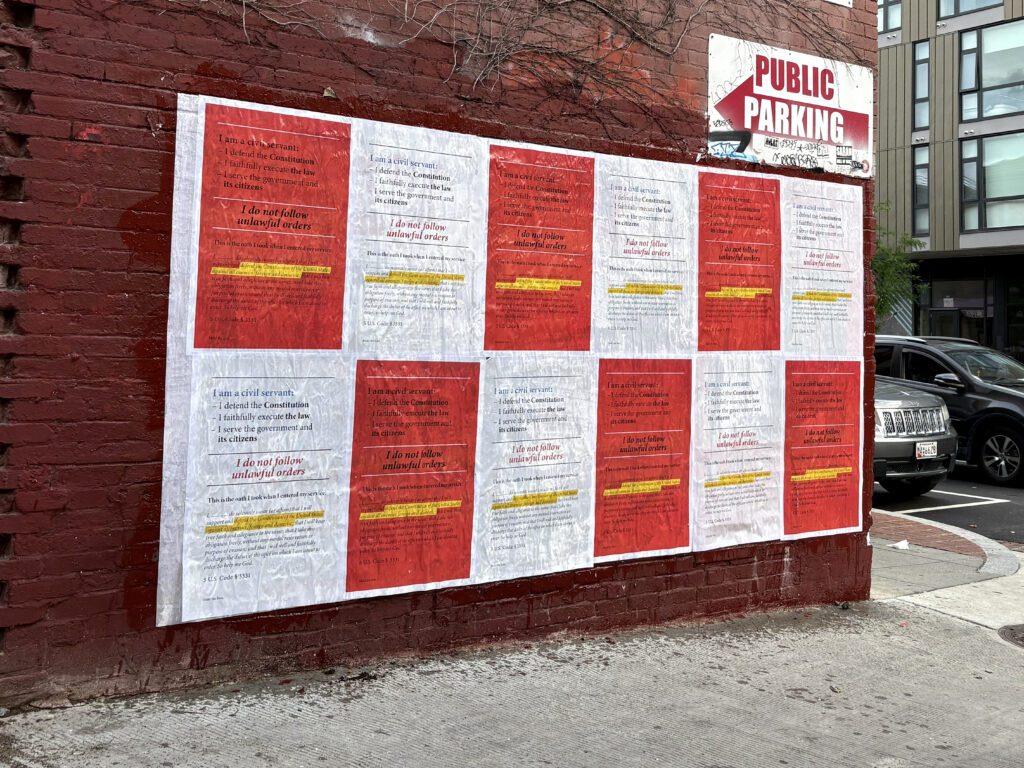
When we plan a campaign on a construction wall in the Meatpacking District in New York, or along South Michigan Avenue in Chicago, 24×36 is what we reach for. It tiles well on large walls, each piece creating a panel in a larger visual composition, and it reads clearly from 15 to 20 feet away when the headline type is set properly.
For music marketing, film promotion, brand launches, and event advertising, 24×36 is the default. Print shops almost always stock this size. Turnaround times are shorter because the paper is on hand and the cut is familiar.
Quick Answer: If someone asks you for a “regular poster,” they almost always mean 24×36 inches in an outdoor or campaign context. If they’re talking about poster board for school or office use, they mean 22×28 inches.
Regular Poster Size by Context
Regular shifts based on the environment. Here’s how the term maps across different settings.
Context
Regular Poster Size
Notes
Street campaign / outdoor marketing
24 x 36 inches
Standard for US urban advertising
Movie theater lobbies
27 x 40 inches
Standard one-sheet for display cases
School / science fair / office
22 x 28 inches
Standard poster board sold in stores
Bar / coffee shop interiors
11 x 17 inches
Fits window frames and bulletin boards
Concert venue / club
18 x 24 inches
Common in music venue hallways
Retail window display
18 x 24 or 11 x 17
Depends on window size
European outdoor campaigns
A1 (23.4 x 33.1 in)
ISO standard used outside the US
Why 24×36 Became the Regular Standard
The 24×36 standard isn’t arbitrary. It emerged from the print and advertising industries over decades of practical use.
Large-format inkjet printers use roll paper. The 24-inch roll is one of the most common widths. A portrait poster at 24 inches wide uses the entire roll width with zero waste on the horizontal axis. Cut it at 36-inch intervals and you get a 24×36 with no material waste at all. Perfect sheet yield, zero offcuts.
The 2:3 aspect ratio (width to height) is also close to the golden ratio and mirrors the proportions of 35mm film photography and many traditional art formats. Designers gravitate toward it naturally. Stock photography and typography templates are built around it.
When entertainment marketing dominated the poster industry in the 1960s through the 1980s, the 24×36 became associated with album covers, concert announcements, and movie promotional art. That association stuck. Today, when a brand wants to launch a campaign that looks “like a real campaign,” they reach for 24×36 because the format carries cultural weight.
From a supply chain perspective, 24×36 poster frames are widely available at retail, which means the format has consumer uses beyond just commercial campaigns. Frame makers at IKEA, Target, and specialty art retailers stock 24×36. That keeps demand high, which keeps supply stable, which keeps pricing consistent.
When Regular Poster Size Isn’t Enough
Sometimes 24×36 is too small. And knowing when to go bigger is part of our job.
High-traffic outdoor locations need scale. On a 40-foot wall along the Bowery in New York, a single 24×36 looks lost. We’d tile 10 to 15 panels for that surface, or we’d step up to a larger format printed on heavier stock.
When we work on construction hoarding campaigns, we sometimes use 48×72 inch panels, or 4×8 foot sheets printed and mounted in sequence. These require a different printing method (usually grand-format inkjet on banner material) and a different installation team with the right equipment.
For transit advertising, the regular poster size moves up again. A standard bus shelter face is 47.5×67.5 inches. A standard subway platform poster is often 28×45 or the full 4-sheet at 40×60. These require specialized printing contracts and placement through transit authority networks.
The point is: know your location first. Then pick your size. Don’t decide on a “regular” poster size and then try to retrofit it to the space. Start from the space and work backward to the appropriate format.
Our Process: Before every campaign, our team walks the intended posting areas. We measure available wall space, note clearance heights, check foot traffic patterns, and identify the ideal poster dimensions for each specific location. We’ve done this across neighborhoods in New York, LA, Miami, Chicago, Atlanta, Austin, Nashville, and more.
Regular Poster Size vs. Poster Board Size
Poster board is not the same as a printed poster. But people confuse the two all the time.
Poster board is a physical substrate, a stiff foam-core or cardboard sheet you can write and draw on. It’s sold in craft stores and school supply shops. The most common poster board size is 22×28 inches, which is roughly equivalent to four 8.5×11 sheets of paper arranged in a 2×2 grid.
Poster board at 22×28 is the “regular” size for school projects, science fairs, craft displays, and office sign making. You can buy them at Michaels, Staples, Target, and similar retailers for a dollar or two per sheet.
Printed campaign posters, by contrast, are produced on paper stock (or occasionally vinyl, fabric, or synthetic materials) using professional print equipment. These are used in commercial campaigns, entertainment promotion, and brand marketing. Their “regular” size is 24×36, not 22×28.
The two categories rarely overlap in practice. A school science fair doesn’t need 24×36 printed posters. A major brand campaign doesn’t need foam-core poster boards. Knowing which category you’re in tells you which “regular” applies.
How to Order a Regular Poster for Your Campaign
If you’ve decided that 24×36 is the right regular poster size for your campaign, here’s what ordering looks like in practice.
First, get your artwork to the right specs. A 24×36 file at 150 DPI needs to be 3,600 x 5,400 pixels. Add a 0.125-inch bleed on all sides for safe printing. Keep critical text and logos at least 0.25 inches inside the final cut edge.
Second, choose your paper stock. For outdoor campaigns, we often use 80 lb to 100 lb satin or matte text stock. Gloss stock shows fingerprints and reflects light on walls, which can degrade visibility. For interior art prints and retail placements, gloss works well and makes colors pop.
Third, choose your quantity. Print runs of 250 or fewer are typically digital prints. Runs of 500 to 5,000 or more often move to offset printing, which has higher setup costs but much lower per-unit costs. If you’re covering 50 neighborhoods with 40 pieces each, you need 2,000 sheets. Plan accordingly.
Fourth, confirm turnaround time. Most print shops need 3 to 5 business days for a standard run. Rush printing is available but adds 25 to 50 percent to the cost.
Fifth, plan distribution. Printing 2,000 posters does nothing if they sit in a warehouse. Our team handles placement campaigns in dozens of markets, coordinating crews, location permissions, and timing to maximize campaign impact at launch.
Frequently Asked Questions
What is the regular poster size in the US?
In the US, the regular poster size for advertising and outdoor campaigns is 24×36 inches. For poster board and school/office use, the standard is 22×28 inches. For movie theater display, it’s 27×40 inches.
Is 18×24 a regular poster size?
18×24 is a commonly used size, but it’s considered medium rather than standard for outdoor campaigns. It’s regular for venue promotion, music marketing, and some retail applications. The full-size standard for outdoor use is 24×36.
What’s the regular poster size for a concert?
Concert posters most often come in 18×24 or 24×36 inches. 18×24 is what you see inside venues, in the hallway near the box office or the bar. 24×36 goes on exterior walls and outdoor surfaces near the venue.
What is a regular poster size at school?
At school, a regular poster typically means a 22×28 inch poster board, the kind you buy in packs at office supply and craft stores. This is not a printed commercial poster. It’s a physical board you write or draw on.
What is the regular poster size for a business?
Businesses typically use 11×17 for interior promotions, 18×24 for window and door displays, and 24×36 for exterior walls and high-visibility outdoor placements. The “regular” size depends on where in the customer experience the poster appears.
Does regular poster size vary by country?
Yes. In the US, the standard is 24×36 inches. In most of Europe, it’s A1 (23.4×33.1 inches), which is part of the ISO 216 metric system. The two are very close in size but not identical. Artwork designed for one needs minor adjustment for the other.
What regular poster size works for a movie promotion?
Movie promotions use multiple sizes. The classic theater lobby format is 27×40 inches (one-sheet). For street-level outdoor campaigns, 24×36 is standard. Some productions also run 11×17 for interior and retail window placements.