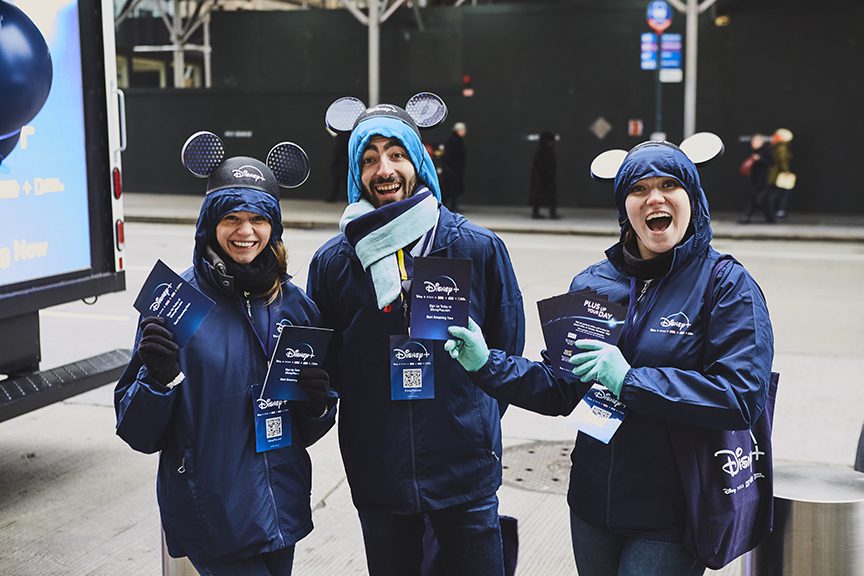
Walking billboard campaigns put advertising at pedestrian level, in the crowds and environments that trucks cannot reach. Planning them well — from carrier positioning to creative to documentation — determines whether the format works or wastes hours in the wrong spots.
Walking billboard advertising is one of the oldest forms of mobile outdoor advertising and one of the most underutilized as part of a coordinated campaign. When most brands think about mobile outdoor advertising, they think about trucks. When the target environment is a festival ground, a transit concourse, a convention floor, or any pedestrian-first space, the truck is not an option. The walking billboard is.
This guide focuses on the planning and execution side of walking billboard campaigns: how to design carrier positioning, what makes a walking billboard campaign effective versus inefficient, how to combine walking billboards with other mobile formats, and what documentation to expect. The goal is to treat walking billboard campaigns with the same operational rigor as truck campaigns, because the factors that make or break a walking billboard campaign are identical — positioning, timing, briefing, and documentation.
A walking billboard campaign has the same basic planning components as a truck campaign, adapted for human movement rather than vehicle movement.
Zone Assignment vs. Route Assignment
Truck campaigns use route-based planning: the vehicle follows a specific path through specific streets at specific times. Walking billboard campaigns typically use zone-based planning: each carrier is assigned to a specific area or position and either stays stationary or moves within that zone rather than following a fixed route through city streets.
This difference reflects the different scale of movement. A truck can cover 10-30 miles of streets in a day, generating wide geographic coverage. A walking billboard carrier covers a few blocks or a specific pedestrian area. The carrier’s value comes from depth of coverage in a specific location, not breadth of coverage across a geography.
Stationary vs. Moving Carriers
The most effective walking billboard position for most campaigns is stationary at a high-traffic point. A carrier standing at a festival entrance, at a transit hub exit, or at a major intersection is seen by every person who passes that point. The exposure is concentrated and sustained — every person who passes is a separate encounter with the advertising.
Moving carriers generate more geographic coverage but less sustained exposure at any single point. A carrier walking a circuit through a neighborhood or festival grounds is seen briefly by each person they pass, rather than standing at a single point where everyone in that area eventually comes to them.
The right approach depends on the environment. In a very dense, slow-moving crowd (a festival, a transit hub during rush hour), a stationary position works better because the foot traffic comes to the carrier. In a spread-out event with lower density per area, a moving carrier may be necessary to reach enough of the audience to justify the campaign hours.
AGM assigns stationary positions to walking billboard carriers whenever the target location has consistent high foot traffic past a defined point. When the environment is spread out, carriers move through defined zones. The brief specifies which approach applies to each carrier and each location.
Carrier Briefing
Walking billboard carriers need a clear brief before the campaign begins. The brief should cover:
The assigned position or zone, with a map and written description
Operating hours: when to start, when to take breaks, when to finish
Board handling: how to wear or carry the boards, how to keep them visible
Any brand ambassador messaging if carriers are expected to interact with passersby
Photo documentation instructions: who takes photos, at what intervals, how they are submitted
Contact information for the ops coordinator in case of an issue
A walking billboard campaign that relies on carriers figuring things out as they go produces inconsistent results. Carriers who are uncertain about their position, their expected behavior, or what to do when something unexpected happens will default to whatever is most comfortable for them, which is usually not what the campaign plan calls for.
Where Walking Billboard Campaigns Perform Best
Music and Arts Festivals
Large outdoor music and arts festivals are one of the most effective environments for walking billboard campaigns. The festival grounds concentrate tens of thousands of people in a defined area over multiple days. Vehicle access is typically restricted, which eliminates truck-based advertising options and makes walking billboards the primary mobile outdoor format inside the festival perimeter. Carrier positioning near the main stage, food and beverage areas, and the festival entrance gates maximizes the number of festival-goers who encounter the advertising.
Convention Centers and Trade Shows
Convention centers during major trade shows are walking billboard environments by definition. The interior of a convention center is exclusively pedestrian. The audience is professionally relevant, moving slowly enough to notice advertising, and in a mental state of actively consuming brand information — they are there specifically to evaluate products and services. Walking billboard carriers in the concourse, at session transitions, and at food and coffee queues reach this audience at multiple points throughout the day.
Convention campaigns also benefit from the close viewing distance that convention settings allow. A carrier in a convention concourse is often within 10-15 feet of every attendee they encounter, which means slightly more detailed messaging can be read than would be possible at street-level viewing distances.
Urban Commercial Streets
Busy commercial pedestrian streets — Newbury Street in Boston, 34th Street in Midtown Manhattan, the Third Street Promenade in Santa Monica, 16th Street Mall in Denver — generate consistent high foot traffic during business hours and weekends. Walking billboard carriers stationed on these streets position the advertising in front of the highest-density pedestrian audiences in their respective cities.
University Campuses
University campuses are pedestrian-dominant environments with concentrated audiences in highly specific demographic profiles. A campus walking billboard campaign during a class-change period on a weekday reaches thousands of students in a short window. Carrier positioning near the student union, major academic buildings, or campus dining facilities hits the highest-density transit points on campus.
Environment
Audience Profile
Carrier Strategy
Best Timing
Festival grounds
Event audience, concentrated
Stationary at entrance/main stage
Event hours, entry/exit windows
Convention center
Professional, industry-specific
Moving through concourse
Session breaks, lunch
Transit hub
Broad commuter and traveler
Stationary at key exit/entry points
Morning and evening peaks
Commercial pedestrian street
Shoppers, tourists, locals
Stationary at high-traffic block
Midday and afternoon
University campus
Students, 18-24
Positioned at student union / dining
Class change times, lunch
Creative for Walking Billboards: What Works at Close Range
Walking billboard creative operates at a different scale than truck panel creative. Viewers are typically 5-20 feet away, and the boards are sized accordingly. This allows for slightly more information than a truck panel but still demands concision — a viewer who glances at a carrier as they pass has 3-5 seconds to register the creative, the same as a viewer seeing a truck.
Best practices for walking billboard creative:
Logo or brand name prominent in the upper third of the panel
Single supporting headline — 5-8 words, maximum
Website URL or short call to action in the lower portion
High contrast, bold colors that remain visible in varying light conditions
Avoid photos or imagery with fine detail that will not read at 15 feet
Walking Billboards as Part of a Multi-Format Campaign
Walking billboard campaigns rarely operate in isolation. The most effective use of the format is as one element in a campaign that includes truck-based mobile advertising for street-level coverage and walking billboards for specific pedestrian environments where trucks cannot go.
A well-designed multi-format campaign for an event, for example, might include:
One LED truck running a route through the streets surrounding the venue for 4-6 hours
Two walking billboard carriers positioned at the main venue entrance during arrival and departure windows
Coordinated creative across both formats so the two elements reinforce each other when an attendee encounters both
Unified photo documentation covering both the truck in the street context and the carriers at the venue entrance
This structure gives the campaign both the wide street-level reach of the truck and the concentrated pedestrian-environment reach of the walking billboards, without compromising either format’s effectiveness by trying to make one do the other’s job.
Documentation for Walking Billboard Campaigns
Walking billboard campaigns are documented through photos taken at regular intervals during the campaign showing carriers in their assigned positions. Photos should show the boards clearly visible, the carrier in the target environment (not on a break, not in a back area), and the foot traffic context around the carrier to confirm the positioning is in a high-traffic area.
AGM’s walking billboard documentation includes:
Photos taken every 30-60 minutes showing each carrier in position
Photos at the start and end of each carrier’s shift
A summary of the assigned positions, hours worked by each carrier, and any position changes made during the day
This documentation is delivered as part of the post-campaign report within 48 hours of campaign completion.
Scaling Walking Billboard Campaigns: From One Carrier to a Full Team
Walking billboard campaigns scale differently than truck campaigns. Adding a second truck to a mobile billboard campaign doubles the geographic coverage. Adding a second walking billboard carrier may double the coverage of a pedestrian zone, or it may allow two complementary positions to be covered simultaneously. Understanding how carrier count affects campaign results helps in making efficient staffing decisions.
Single Carrier Campaigns
A single walking billboard carrier is appropriate for campaigns where the entire target audience passes through one primary access point — a festival entrance, a transit hub exit, a specific street corner. In these environments, one well-positioned carrier reaches every member of the target audience who uses that access point without needing additional coverage in other areas. Over-staffing a campaign with multiple carriers in a single-access-point environment does not improve results — the second carrier is redundant rather than additive.
Multi-Carrier Campaigns
Multiple carriers are appropriate when the target audience is distributed across more than one primary access point, or when the campaign needs to cover both an arrival and departure window at a venue that has multiple entrances. For example, a major stadium with three public entrances and two parking structure exits may need five positioned carriers to cover all audience flow points effectively during arrival and departure. A convention center with a main entrance and a side entrance used by shuttle-bus attendees may need two carriers positioned at the respective access points.
Multi-carrier campaigns require a stronger coordination infrastructure than single-carrier campaigns. Each carrier needs their own brief, their own check-in schedule with the operations coordinator, and their own photo documentation process. Coordinating three or five walking billboard carriers across a large venue requires operational discipline that single-carrier campaigns do not demand.
Walking Billboards at Major Sporting Events
Major sporting events are one of the highest-value environments for walking billboard campaigns because the audience is concentrated, predictable, and highly engaged with the event context. The practical challenges of operating near a major stadium or arena during an event make walking billboards the most viable format in many cases — truck access is frequently restricted near major venues during events.
NFL and NBA Events
Professional football and basketball events draw 60,000-100,000+ attendees at the largest stadiums and arenas. The pre-game arrival window — typically 90 to 120 minutes before kickoff or tip-off — concentrates this audience in the streets and plazas surrounding the venue. Walking billboard carriers positioned at the primary pedestrian access points during this window are seen by the majority of the event audience as they arrive.
The post-game departure window is more chaotic but also represents the highest concentration of the audience in the immediate venue area. Carriers who remain positioned at exit points during post-game departure reach the audience again as they leave — creating a second exposure that reinforces the pre-game encounter.
Outdoor music festivals — Coachella, Lollapalooza, Governors Ball, Bonnaroo, and hundreds of regional events — are the most controlled environment for walking billboard campaigns because the audience is within a defined festival perimeter for the duration of their attendance. A carrier inside the festival grounds reaches the audience multiple times over the course of a day as attendees move between stages, food vendors, and rest areas.
Festival-adjacent campaigns outside the perimeter capture the audience during arrival and departure at the entry gates. Inside-perimeter campaigns (requiring festival approval and often vendor credentials) reach the audience during their full attendance. The two approaches are not mutually exclusive — a coordinated campaign with carriers both inside and outside the festival perimeter creates maximum coverage across both the entry/exit windows and the in-festival period.
AGM has coordinated walking billboard campaigns at major festivals and sporting events in New York, Los Angeles, Chicago, and other markets. Event-specific campaigns require advance coordination with venue management regarding access and positioning — AGM handles this coordination as part of event-adjacent campaign planning.
Measuring Walking Billboard Campaign Results
Walking billboard campaigns are documented through photographs and time logs, similar to truck campaigns but with different logistics. Because the carrier is a person rather than a GPS-tracked vehicle, the documentation relies on carrier self-reporting combined with supervisory oversight.
AGM’s approach to walking billboard documentation:
Each carrier takes a minimum of one photo per hour showing themselves in position with their assigned zone or location visible
A check-in system (phone call or text to the ops coordinator) confirms each carrier’s status at defined intervals
A supervisor visits each carrier position at least once during the campaign day to confirm positioning and carrier status
All photos are submitted to the ops coordinator the same day and compiled into the post-campaign documentation package
The post-campaign report for walking billboard campaigns includes the carrier photos, the check-in log, and a written summary covering each carrier’s assigned position, hours worked, and any positioning adjustments made during the day. This is delivered to the client within 48 hours of campaign completion, on the same timeline as AGM’s truck billboard reporting.
Walking Billboard Campaign Management
Managing a walking billboard campaign in the field requires a different operational framework than managing a truck campaign. The carrier is a person, not a vehicle, and the operational oversight needs to account for the challenges of managing human performance in a field environment: breaks, positioning drift, energy levels throughout a long campaign day, and communication with a central coordinator.
AGM’s walking billboard campaign management structure for a standard day-long campaign involves: a pre-campaign carrier briefing in the morning before the campaign starts (position assignment, route or zone review, documentation instructions, emergency contact), mid-day check-ins (phone or text contact with each carrier to confirm positioning and status), photo submission verification (confirming that documentation is being captured at the required intervals), and end-of-day sign-off (confirming hours worked and collecting final documentation).
For larger walking billboard campaigns with multiple carriers across a wide area, a dedicated field supervisor who visits each carrier position at least once during the day provides a higher level of quality assurance than phone-only oversight. The field supervisor can observe positioning quality, carrier energy and engagement, and any positioning issues that need adjustment, and can make real-time decisions about redeployment if one position is underperforming relative to another.
Indoor Walking Billboard Applications
Walking billboard advertising is not limited to outdoor environments. Indoor applications — shopping malls, airport terminals, convention centers, sports arenas, and large retail environments — create unique opportunities that outdoor campaigns cannot access. These indoor environments often have higher foot traffic concentration than outdoor zones, combined with restrictions on motor vehicle access that make walking billboards the only mobile advertising format available.
Shopping mall walking billboard campaigns position carriers in the main concourse areas during peak shopping hours. The captive audience inside a mall is engaged with commercial activity by definition — they are there specifically to browse and purchase. A walking billboard carrying a brand message in a mall concourse reaches an audience in exactly the right consumer mindset to be receptive to advertising.
Airport terminal walking billboard campaigns target a captive, dwell-heavy audience. Airport passengers have time to kill between flights, are in a receptive mindset for premium brands (airports are associated with business and leisure travel, both of which correlate with premium spending), and are often in the market for specific categories (travel accessories, premium food and beverage, technology). Walking billboard carriers in airport terminals need to work within the airport’s commercial activity guidelines, which typically require advance approval and may restrict carrier positions to specific terminal areas.
Sports arena and entertainment venue walking billboard campaigns can position carriers in concourses, concession areas, and entry plazas during events. These positions require advance coordination with venue management, which typically involves submitting a request through the venue’s commercial activity approval process. AGM handles this coordination for indoor venue campaigns as part of the campaign planning process.
Walking Billboards vs. Sandwich Boards: A Clarification
The terms “walking billboard” and “sandwich board” are sometimes used interchangeably, but they represent different concepts. A sandwich board is a specific format — the A-frame front-and-back board hung from the carrier’s shoulders. A walking billboard is a broader category that includes sandwich boards, backpack frame boards, handheld signs, and other human-carried advertising formats.
When planning a walking billboard campaign, the format specification (which type of board) should be decided based on the campaign environment and the viewing distance requirements. Sandwich boards work well for close-range pedestrian environments where the carrier will be stationary. Backpack frames work better in dense crowds where elevated visibility is needed. Handheld signs work for directional applications or situations where the carrier needs maximum flexibility to change position and orientation quickly.
In practice, many campaigns use more than one format simultaneously — sandwich board carriers at the primary entrance and backpack frame carriers moving through the interior of a festival, for example. Mixing formats based on the specific environmental requirements of each position produces better results than committing to a single format across all positions regardless of what the environment calls for.
AGM specifies the format recommendation for each carrier position in the campaign brief based on the specific environmental characteristics of that position. This specificity is part of the planning process that distinguishes a managed walking billboard campaign from ad hoc ambassador staffing.
Estimating Coverage Area for Walking Billboard Campaigns
A useful planning metric for walking billboard campaigns is coverage area estimation: how large of a geographic area can a campaign effectively cover with a given number of carriers in a given number of hours?
A stationary carrier positioned at a single high-traffic point covers that point’s foot traffic for the full campaign period. If 1,000 people pass that point per hour and the carrier is positioned there for 6 hours, the carrier generates approximately 6,000 pedestrian-level brand encounters over the campaign period, assuming a conservative 100% capture rate for people who pass within 20 feet of the carrier’s position.
A moving carrier covering a neighborhood circuit at walking speed can cover several city blocks in an hour, generating fewer concentrated exposures at any single point but reaching a wider geographic area. A carrier moving at a moderate pace through a festival grounds might cover 0.5 square miles of event area in an 8-hour campaign day, generating lower-frequency exposure across the full event rather than high-frequency exposure at a single access point.
For most walking billboard campaign objectives — event access point saturation, festival ground coverage, convention center concourse presence — the stationary format at a well-chosen position delivers more concentrated value than moving coverage. The exception is when the target audience is distributed widely across a large area with no single high-concentration point, in which case mobile coverage by one or more walking carriers is the more effective approach despite the lower per-point exposure.
Walking Billboards in the Digital Age
The persistence of walking billboard advertising as a viable campaign format in the age of digital marketing reflects a genuine market need that digital advertising does not serve. As screen-based advertising competes for increasingly fragmented attention in increasingly saturated digital environments, the physical presence of a person carrying a brand’s message in a relevant pedestrian environment creates an encounter that is distinct from anything a screen can produce.
Walking billboards are also inherently shareable in the social media era. A person carrying an interesting, well-designed, or surprising advertising board is worth photographing. Festival-goers, commuters, and urban pedestrians who see a creative walking billboard campaign in their environment often document it and share it because it is a visually interesting element of their real-world experience. This organic sharing extends the campaign’s reach through social media channels without any additional advertising investment.
The brands that use walking billboard campaigns most effectively in the current environment are ones that design the campaign specifically to be photographable and shareable. The board design is visually interesting from multiple angles. The carrier is positioned in locations that provide compelling visual context. The creative is relevant enough to the event or environment that people who share it can attach personal commentary that drives additional engagement. This social media integration transforms a relatively simple physical advertising format into content that travels beyond the geographic reach of the campaign itself.
Walking Billboard Campaigns and Community Events
Community events — neighborhood street fairs, cultural festivals, farmers markets, charity walks and runs, local parades — create concentrated pedestrian audiences that walking billboard campaigns can serve without the vehicle access complications that complicate truck billboard campaigns in the same environments. Many community events actively restrict vehicle traffic from the event area, making walking billboard carriers the only mobile advertising format available inside the event perimeter.
For brands that want to demonstrate community engagement and local presence, walking billboard campaigns at community events create the right context. The format is low-intrusion relative to the event’s character — a person carrying boards is a more natural element in a street fair or farmers market than a large commercial truck would be. The campaign feels like a natural part of the event rather than a corporate interruption of it.
The selection of community events for walking billboard campaigns should be driven by audience alignment, not just geography. A neighborhood street fair in an affluent residential area reaches a different audience than a cultural festival celebrating a specific community’s heritage, which reaches a different audience than a charity walk that concentrates health-conscious, community-engaged participants. The audience profile of the event should match the brand’s target audience for the campaign to deliver genuine value rather than broad but unqualified exposure.
AGM coordinates walking billboard campaigns at community events by working with event organizers when necessary to confirm access requirements and position any approval or credentialing process that is needed. For events that allow outside commercial activity in their pedestrian areas, advance notification to the event organizer — even when formal approval is not required — maintains good relationships with the community organizations that run these events and avoids conflicts during the campaign day.
Frequently Asked Questions
How are walking billboard campaigns organized?
A walking billboard campaign requires defining the target area, identifying where carriers will be positioned or walking, determining operating hours, briefing carriers on the boards they are wearing and any brand ambassador messaging, and coordinating photo documentation throughout the campaign. AGM handles all of these logistics.
What is the ideal location for a walking billboard carrier?
The ideal position is at a point of maximum pedestrian concentration where the carrier is visible to the flow of traffic — a venue entrance, a major intersection, the entrance to a transit hub, or the main pedestrian corridor of a commercial district. Positioned correctly, a single stationary carrier can be seen by every pedestrian using that access point.
Are walking billboards effective at trade shows and conventions?
Yes. Convention centers and trade show floors are among the most effective environments for walking billboard campaigns because the audience is concentrated, moving slowly, and primed to notice and process advertising. Carriers in convention center concourses, at session break points, and at food and coffee queues reach attendees at high-attention moments.
What information should be on a walking billboard?
Walking billboard boards should carry the brand name or logo prominently, a single short message (under 10 words), and a clear call to action if relevant — a location address, a URL, or a phone number. Because viewers are at close range, slightly more information can be read than on a truck panel, but concise messaging still outperforms dense copy.
How does AGM document a walking billboard campaign?
AGM documents walking billboard campaigns through timestamped photos taken at regular intervals throughout the campaign, showing carriers in position at their assigned locations. Photo documentation is delivered as part of the post-campaign report within 48 hours of campaign completion.