Urban Advertising: What It Is and How to Use It | AGM
City consumers are the most marketing-saturated audience in the world. Urban advertising that actually works has to earn its place in their environment, more than occupy it.
Urban advertising is any brand marketing campaign designed to reach consumers in densely populated city environments through formats that fit the physical, cultural, and social character of those environments. It includes outdoor poster campaigns, street team activations, brand murals, projection marketing, transit-adjacent placements, ambient installations, sampling programs, and experiential events, all executed with the specific dynamics of urban pedestrian culture in mind.
The city environment is not the same as suburban or rural advertising territory. City consumers walk. They use transit. They live at a higher density per square mile, which means the foot traffic patterns are more concentrated and the ambient noise level, the volume of competing visual and experiential information in their environment, is dramatically higher than anywhere else. Urban advertising has to compete in that environment to be worth the investment.
We run urban advertising campaigns in New York, Los Angeles, Chicago, Miami, Boston, Washington DC, San Francisco, and a range of other markets. Each city has its own character, its own foot traffic geography, and its own audience culture. What works on the streets of Bushwick in Brooklyn does not work the same way in the Loop in Chicago, and what works in Wynwood in Miami plays differently than it would in the Mission District in San Francisco. This piece covers the principles that apply across urban markets and the specific considerations that make city-by-city execution matter.
Why Urban Advertising Is Different From Other Out-of-Home Marketing
The traditional out-of-home advertising model, billboards along highways and transit shelters in commercial districts, treats the environment as a channel and the consumer as a passive audience. The consumer is moving through a space, and the ad occupies a surface in that space. The transaction is purely visual and entirely passive.
Urban advertising, as we practice it, goes further. It uses the city environment more than as a backdrop for placements but as an active element in the campaign design. The specific character of a street or neighborhood shapes the creative execution. The foot traffic pattern at a specific intersection at a specific time of day shapes the placement strategy. The cultural associations of a particular block, its history, its current community, the kinds of consumers it attracts, shape the tone and creative approach.
When we place a brand graphic on a building wall on Orchard Street in the Lower East Side of Manhattan, we are more than choosing a surface. We are choosing a cultural context. The Lower East Side has a specific identity, its history in streetwear, in music, in immigrant culture, in nightlife, and a brand that shows up there inherits some of that context. Good urban advertising uses cultural context intentionally. Bad urban advertising ignores it and produces campaigns that feel out of place or tone-deaf.
The other major distinction is the role of earned media. Urban advertising campaigns in visually rich environments generate organic social content at a rate that conventional outdoor advertising does not. When a brand installation in Wynwood or the Arts District in LA is genuinely compelling, people photograph it and share it. The physical placement reaches the people who walk past it; the earned social content reaches an audience that extends far beyond the geographic area of the installation. That multiplication effect is part of what makes urban advertising efficient.
Core Formats of Urban Advertising
Outdoor Poster Campaigns
Large-format outdoor posters, placed on building walls, construction barriers, scaffolding wraps, and other high-visibility surfaces in dense urban environments, remain one of the most effective urban advertising formats. They provide sustained visual presence over the duration of the campaign, generate thousands of exposures per day in high-traffic locations, and can be produced and placed quickly when the creative is finalized.
The key to effective poster campaigns in urban environments is location selection. A poster on a wall that gets three thousand passersby per day is dramatically more valuable than one that gets three hundred, even if the latter location is less expensive. We scout locations based on actual foot traffic data and the audience profile of each location, not on posted rate cards. In New York, the difference between a wall on 14th Street near Sixth Avenue and a wall two blocks away can be a factor of five in daily exposures.
Street Team and Sampling Activations
Street teams deployed in urban environments create direct consumer contact in the environments where the target audience spends their daily life. A product sampling team outside the 14th Street Union Square subway station in New York reaches tens of thousands of people on a single weekday. A street team on the Magnificent Mile in Chicago during lunch hours intercepts the exact consumer profile that most consumer brands want to reach. The density of urban environments makes street team activations more efficient per dollar than almost any other format.
Street teams work best when the team is well-briefed, energetic without being aggressive, and positioned where the target consumer naturally pauses or slows down rather than where they are rushing through. The brief stop, at a crosswalk, at the entrance to a transit station, at the exit of a lunch spot, is the moment of maximum receptivity. We position our street teams to intercept those moments, not to chase people who are trying to get somewhere quickly.
Brand Murals and Large-Scale Art
Brand murals in urban environments serve multiple purposes at the same time. They create persistent visual presence at a specific location. They generate earned social media content as people photograph them. They create cultural association by appearing in the visual environment of a specific neighborhood. And when executed well, they become landmarks that the neighborhood’s residents and visitors reference as part of the local visual culture.
The neighborhoods where brand murals generate the most cultural traction in the US include the Arts District in Los Angeles, Wynwood in Miami, Wicker Park and Logan Square in Chicago, the Bushwick area of Brooklyn, the Mission District in San Francisco, and NoDa in Charlotte. These neighborhoods have running visual cultures built around murals and public art, which means a well-executed brand mural fits naturally into the existing visual context rather than appearing as an intrusion.
Ambient Environmental Installations
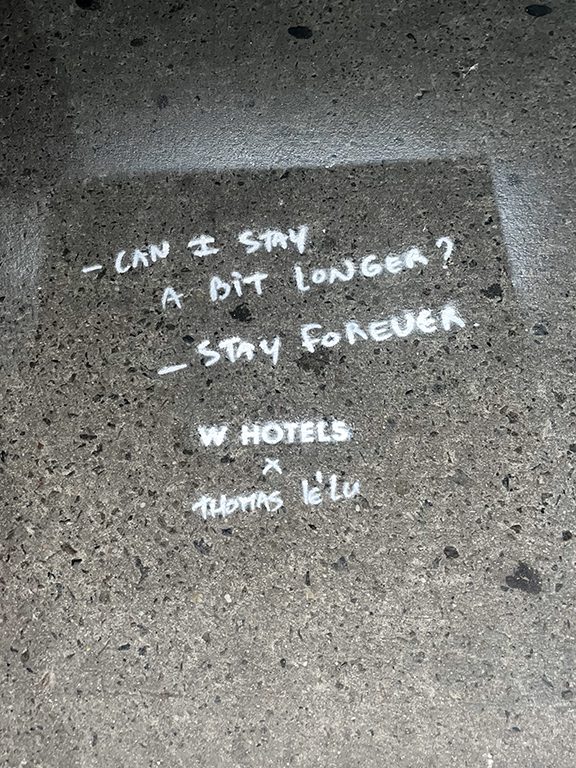
Ambient installations use elements of the existing urban environment to create brand moments without conventional ad placements. A branded chalk stencil on a sidewalk. A physical installation on a public surface that changes how people interact with that space. A custom wrapped newsstand or phone kiosk. A branded bus shelter interior. These formats work because they surprise the consumer in an environment they thought they knew, the unexpectedness of finding a brand in an unexpected context is itself attention-generating.
Projection Marketing
Projection campaigns use high-powered projectors to place brand imagery on building facades, public surfaces, and other large canvases after dark. The format requires no physical modification to the surface, creates dramatic visual impact at scale, and can be executed relatively quickly compared to permanent installations. We use projection campaigns for product launches, event announcements, and awareness campaigns that benefit from dramatic visual presence in specific urban locations.
Urban Advertising by City
City
Best Formats
High-Value Neighborhoods
Peak Foot Traffic Windows
New York City
Street teams, posters, murals, projections
SoHo, Lower East Side, Chelsea, Williamsburg, Flatbush
8-10am, 12-2pm, 5-8pm weekdays
Los Angeles
Murals, pop-ups, event-adjacent activations
Venice, Fairfax, Arts District, Silver Lake
Weekends, event-based concentration
Chicago
Street teams, posters, experiential
Wicker Park, River North, Logan Square, Lakeview
12-2pm, 5-8pm weekdays; weekends in warmer months
Miami
Murals, pop-ups, sampling, projections
Wynwood, South Beach, Brickell, Design District
Evenings and weekends, event weeks
San Francisco
Street teams, murals, experiential
Mission, SoMa, Hayes Valley, North Beach
Lunch hours, evenings, weekends
City knowledge matters: Urban advertising campaigns that treat every city as the same environment consistently underperform. The neighborhoods, foot traffic patterns, cultural contexts, and consumer profiles differ significantly from city to city and from neighborhood to neighborhood within each city. We build every urban advertising campaign around the specific dynamics of the market it is running in, not around a generic urban template.
The Audience That Urban Advertising Reaches
Urban advertising reaches the consumers who live and work in major cities, a demographic that is disproportionately young, educated, high-income, and culturally influential. City consumers are also the first adopters: they encounter trends before they reach suburban and rural markets, and their behavior often predicts broader market shifts. Reaching this audience effectively is valuable more than for its immediate conversion potential but for the cultural influence that urban early adopters carry into wider consumer culture.
The urban consumer is also, as noted above, the most marketing-saturated audience in the world. They have seen more advertising before 9 AM than a suburban consumer sees in a day. This means they have extremely well-developed ad-filtering skills. Conventional advertising that reads as obviously commercial gets skipped, ignored, or actively resented. Urban advertising that fits naturally into the cultural context of the environment, that offers genuine value or genuine interest, and that feels like it belongs there earns a different response.
We design every urban advertising campaign with this filtering reality in mind. The first question we ask is not “how do we get noticed?” The first question is “why would a person who has learned to ignore most of what they see actually engage with this?” When we have a good answer to that question, the campaign concept is ready to move into production. When we do not have a good answer, we go back to the creative.
The authenticity filter: Urban consumers are exceptional at detecting inauthenticity. A brand that tries to appropriate cultural credibility it has not earned will get called out publicly and often sharply. We help clients understand what their brand authentically belongs in and what it does not, and we design campaigns that stay within the territory where the brand can show up genuinely rather than reaching for cultural contexts that do not fit.
Urban Advertising for Different Brand Categories
Urban advertising campaigns look different across different brand categories. Here is how we approach the format for some of the categories we work in most frequently.
Consumer packaged goods brands, food, beverage, personal care, household products, benefit most from high-frequency sampling campaigns and ambient visual presence near the retail environments where consumers make purchase decisions. A sampling campaign that intercepts consumers in the neighborhood where they do their weekly grocery shopping creates a direct link between the brand encounter and the purchase moment.
Technology and app brands benefit from formats that drive immediate digital action, QR codes in high-traffic locations, experiential demonstrations that let consumers try the product on the spot, and high-visibility visual placements in the commuter corridors where their target audience moves every weekday. The physical touchpoint drives the digital conversion, and the campaign design should make that handoff as frictionless as possible.
Fashion and apparel brands benefit from cultural placement in the neighborhoods where their target consumer’s identity is formed, the streetwear corridors, the arts districts, the music and nightlife zones where the brand can claim authentic presence. Large-format visual installations in these environments build brand identity through cultural association rather than through direct product messaging.
Entertainment brands, streaming services, record labels, film studios, media companies, benefit from ambient presence around the venues, corridors, and cultural institutions that their target audience frequents. A campaign that surrounds a concert venue, a film festival footprint, or a cultural event creates brand association with the cultural moment the consumer is already emotionally invested in.
Urban Advertising Strategy for Market Entry
One of the highest-value applications of urban advertising is market entry, a brand establishing presence in a new city or neighborhood where it has no existing consumer base. Urban advertising is particularly effective for this purpose because it creates the appearance of genuine market presence before a brand has built it through sales or word of mouth. If a consumer sees a brand on the walls of their neighborhood, they assume it is already part of that market. The physical presence precedes and creates the cultural reality.
For market entry, we recommend a multi-format approach that creates both visual presence and direct consumer contact simultaneously. Visual formats, murals and large-format graphics, build ambient awareness across the target neighborhoods. Staffed activations, street teams and sampling programs, create direct consumer encounters that generate trial and first-person brand experience. The combination means that consumers in the new market encounter the brand through multiple channels at the same time, which accelerates the familiarity-building that is the core objective of a market entry campaign.
Geographic concentration matters more for market entry than for campaigns in established markets. A brand entering New York should not spread its initial budget across all five boroughs. It should concentrate on the two or three neighborhoods where its target consumer is most densely clustered and most likely to be the early adopters who establish word-of-mouth momentum. In our experience, a concentrated presence in the right two neighborhoods is far more effective for market entry than a diluted presence across ten neighborhoods. Depth before breadth.
The sequencing of market entry advertising matters. We typically recommend starting with visual presence, murals and large-format graphics, two to three weeks before the first staffed activations. The visual presence builds initial familiarity so that when consumers encounter the brand ambassador or sampling team, they have already seen the brand in their neighborhood and have a baseline of recognition to build from. The staffed activation then answers questions, provides trial, and deepens the relationship that the visual presence initiated.
Urban Advertising for Different Audience Segments in the Same Market
Many brands target multiple audience segments within the same city, and urban advertising campaigns need to account for the geographic separation of those segments within the urban environment. Different neighborhoods serve different audiences, and a campaign designed for one audience profile will not reach a different profile even within the same city.
In New York, the difference between a campaign designed for the Williamsburg and Greenpoint audience, younger, creative-adjacent, Brooklyn-identified, and one designed for the Upper West Side audience, older, family-oriented, more traditional consumption patterns, is dramatic in every dimension: location, format, creative, tone, and messaging. Both are New York audiences. A campaign for one will not reach the other, regardless of how large or how broadly placed.
When brands need to reach multiple distinct audience segments in the same city, we design the campaign as separate geographic and format tracks that share a unified brand identity but are otherwise tailored to the specific audience and neighborhood context of each segment. The same brand presence, expressed through different creative approaches and placed in different neighborhoods, creates a campaign that genuinely reaches multiple audiences rather than a campaign that reaches one audience while being placed in locations the other audience never visits.
The creative adaptation between segments can be subtle or significant depending on how different the audiences are. For some campaigns, the same creative runs in different locations because the brand identity is versatile enough to resonate across both segments. For others, we develop distinct creative executions that speak specifically to each segment’s interests and cultural context while maintaining the consistent visual brand identity that ties them together as one campaign.
AGM Field Note: The most common urban advertising mistake we see is designing one campaign creative and placing it everywhere in the city without thinking about which neighborhoods contain which audiences. A brand campaign that runs in SoHo, Bushwick, and the Upper East Side at the same time is reaching three very different consumer profiles with the same message. Sometimes that is the right choice. Often, it means the campaign is optimized for none of them and genuinely resonant with very few.
Urban Advertising and the Community Relationship
Urban advertising is not a one-way channel. The city is a community, and brands that show up in that community are making a statement about who they are and what they value. Getting that statement right requires genuine respect for the neighborhoods where the campaign runs.
Genuine respect in practice means: choosing creative that fits the visual culture of the neighborhood rather than imposing a generic brand look that ignores local context. It means working with local artists and installers where the campaign design supports collaboration. It means not treating neighborhood walls as blank canvases that happen to have convenient pedestrian traffic, but as surfaces with cultural history and community meaning that the brand presence should serve rather than exploit.
Brands that show up in urban communities with genuine respect build something over time that is more valuable than advertising reach: they build community belonging. The brand that is welcomed in a neighborhood because it has consistently shown up with quality, with relevance, with something that actually adds to the visual or social fabric of the place, has a different relationship with residents than the brand that runs a campaign and leaves. That belonging is the foundation of genuine urban brand authority.
We have watched brands build real community standing in specific neighborhoods over years of thoughtful urban advertising presence. And we have watched brands damage their standing by treating a neighborhood as a backdrop rather than a community. The difference in outcome is substantial and long-lasting. We take this seriously in how we advise clients on location selection, creative approach, and the sustained presence strategy that follows a campaign launch.
Frequently Asked Questions: Urban Advertising
What to Expect When You Work With Us on Urban Advertising
When a client comes to us for an urban advertising campaign, the first conversation is always about the audience. Not the format, not the locations, the audience. Who are they? Where do they actually go in the cities we are targeting? What are they thinking about and doing when they are in those environments? The clearer we can get on those questions, the more precisely we can design a campaign that actually reaches them.
We then build the campaign plan around the audience geography: the specific streets, neighborhoods, and temporal windows where the audience is most concentrated and most receptive. The format follows from that geography. We produce the creative, execute the field work, document everything in real time, and deliver a full post-campaign report within five business days. That process is the same whether we are running a single-day street team in Brooklyn or a six-week, five-city poster campaign. The discipline of the process is what makes the results consistent.
Frequently Asked Questions
What is urban advertising?
Traditional outdoor advertising, roadside billboards, transit shelter ads, airport placements, is designed to reach a broad audience in transit. Urban advertising uses the specific character of city environments, including their density, pedestrian culture, and cultural context, to create more targeted and more culturally relevant brand moments. Urban advertising tends to be more location-specific, more format-diverse, and more integrated with the cultural identity of the specific neighborhoods where it runs.
What cities do you run urban advertising campaigns in?
Our primary markets are New York, Los Angeles, Chicago, Miami, San Francisco, Boston, Washington DC, and Las Vegas. We also operate in Atlanta, Houston, Seattle, Denver, Austin, Nashville, and a range of secondary markets. New York is where we have the deepest infrastructure, but our multi-market operational model means we can execute consistently across all of our active markets.
How do you select locations for urban advertising campaigns?
We select locations based on foot traffic data, audience profile analysis, competitive environment mapping, and direct field scouting. For every campaign, we send a field lead to walk the potential locations before finalizing the plan. The field scout documents actual conditions, surface quality, sight lines, surrounding context, competing visual elements, that do not show up in any dataset. The combination of data and direct observation is what produces the best location decisions.
Can urban advertising campaigns generate social media reach?
Yes, and we design campaigns with that potential in mind from the beginning. When a campaign is visually compelling and placed in a neighborhood with high social media activity, the organic content it generates can reach an audience that is multiples of the physical footprint. We track earned social content as a campaign metric and design the visual and experiential elements of activations to maximize the quality of the content people naturally want to create and share.
What budgets do urban advertising campaigns typically require?
Campaign budgets depend on format, market, and duration. Street team activations start at $389.99 per 6-hour shift for a standard team member. Poster campaigns start at $4,500 for 100 standard posters (24×36). Mural installations are quoted by project scope. We provide detailed line-item budgets before any engagement begins.
How do you measure the results of an urban advertising campaign?
Measurement is built into our campaign design from the start. For street team campaigns, we track direct consumer interactions. For ambient placements, we estimate exposures based on verified foot traffic counts at the specific location. For all formats, we monitor earned social media content. For campaigns with specific conversion objectives, app downloads, website traffic, retail sales lift, we track the downstream metrics that connect to the physical campaign.
How do urban advertising campaigns work in cities with heavy tourism?
Tourist-heavy cities like New York, Las Vegas, Miami Beach, and parts of Los Angeles add an interesting dimension to urban advertising. Tourists and locals respond to campaigns somewhat differently, tourists are often more receptive to sampling and experiential formats because they are in exploration mode, while locals are the audience for campaigns that need sustained neighborhood presence. We design campaigns to serve the specific audience objective, which sometimes means leaning into tourist concentration and sometimes means deliberately targeting the local consumer base.
Do you work with local brands or only national advertisers?
We work with both. National brands use us for city-by-city market entries, product launches, and localized campaign execution within their national strategy. Local and regional brands use us for concentrated campaigns in their home market, where we bring the same professional field execution and location intelligence that we apply to national campaigns. We have run campaigns for individual restaurant groups, local retailers, real estate developers, and event venues alongside campaigns for Fortune 500 consumer brands.