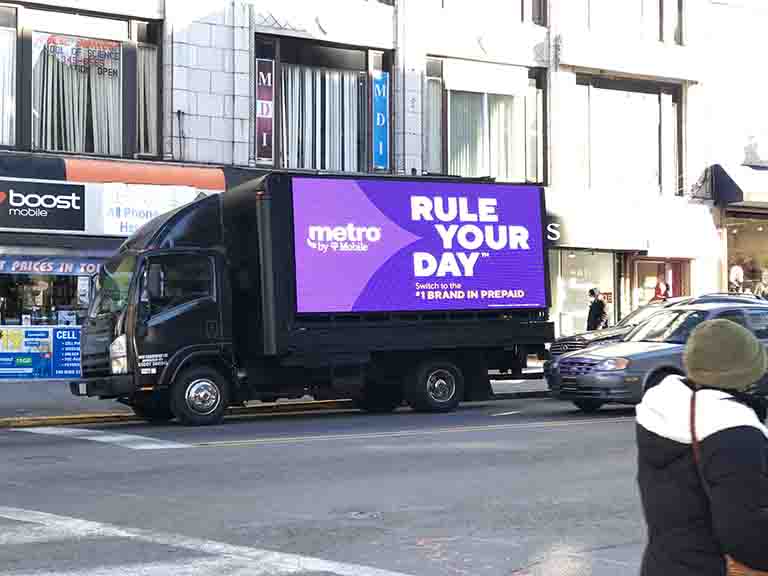
The crowd is already there. You just need to be next to it. That is the core logic behind truck-side event advertising.
When 40,000 people are streaming into a stadium, filing out of a concert, or walking through a street festival, a branded truck parked in the right spot reaches more of your target audience in four hours than a week of digital ads. The format is simple. The impact is not.
We are American Guerrilla Marketing. We have run truck-side and mobile advertising campaigns outside stadiums, at music festivals, near college campuses, and in high-density urban locations across the country. This guide breaks down how truck-side event advertising works, what formats are most effective, and how to plan a campaign that actually drives results.
Truck-side event advertising uses branded vehicles, usually box trucks or flatbed trucks with large-format graphics, as mobile advertising and activation platforms positioned near or at events and high-traffic locations.
At the most basic level, a truck-side campaign wraps a vehicle in your brand creative and parks it in a high-visibility location. People walking past see a large, impossible-to-miss billboard at street level. Unlike a static billboard mounted 30 feet in the air, a truck-side placement is at eye level and often directly in the path of pedestrian traffic.
More advanced truck-side campaigns turn the vehicle itself into an activation platform. The truck side opens to reveal a sampling station. A stage folds out for a live performance. Screens on the side play brand content. LED displays cycle through brand messages. The truck becomes more than a billboard but a functioning experiential marketing vehicle.
Why Truck-Side Advertising Works at Events
Events concentrate your target audience in a specific geographic area for a predictable window of time. That concentration is extremely valuable. Here is why truck-side advertising is particularly effective in that context.
The audience is already in a heightened emotional state. People attending concerts, sports events, and festivals are excited, energized, and open to new experiences. They are much more receptive to brand engagement than they would be at home or at work.
The crowd moves past the truck. Unlike a static billboard that requires people to drive by on a highway, event foot traffic flows right past a truck parked on the approach route. The exposure is at walking speed, giving people time to actually read and register the message.
The positioning creates exclusivity by proximity. A brand truck parked outside a major concert venue or sporting event gains an implied association with the event, even without an official sponsorship deal. For brands looking to reach a specific fanbase at scale, this is extremely efficient.
The vehicle is photogenic. A well-designed truck wrap looks spectacular. At the right event, it generates organic social content as people photograph it against the backdrop of the venue or the crowd.
Types of Truck-Side Event Advertising
Format
What It Is
Best For
Typical Use Case
Static Truck Wrap
Full-vehicle branded wrap, parked for maximum visibility
Brand awareness, new product announcement
Stadium approach routes, concert venue perimeter
LED Mobile Billboard
Large LED screen on truck side cycling through content
Multiple messages, promotional offers, video
Downtown districts, street festivals, event perimeters
Sampling Truck
Branded truck with a built-out side opening for product sampling
CPG, food and beverage, product trial
Pre-game crowds, music festivals, farmer’s markets
Branded Stage Truck
Vehicle with a stage that unfolds from the truck bed
Live performances, brand entertainment
Street festivals, outdoor markets, neighborhood events
Promotional Vehicle
Custom-designed branded vehicle with interactive elements
Premium brand experiences, product launches
Product reveal events, luxury brand activations
Where We Position Truck-Side Campaigns
Location selection is the most important strategic decision in truck-side event advertising. We do more than park near whatever event is happening. We select positions based on detailed foot traffic analysis and the specific goal of the campaign.
Stadium Approach Routes
The blocks leading to a major sports venue on game day carry extraordinary foot traffic. Tens of thousands of fans walk the same routes from the nearest transit stops to the gate. We have run truck-side campaigns on the approach routes to Yankee Stadium from the 161st Street subway station, on the walk from the Red Line to Wrigley Field in Chicago, and near the main pedestrian entrance to SoFi Stadium in Inglewood. These positions put the brand in front of the exact fan demographic you are trying to reach.
Music Festival Perimeters
Major music festivals draw thousands of attendees who spend hours outside the main festival grounds waiting, tailgating, or exploring the surrounding area. A branded truck parked in the right spot in the festival perimeter captures a young, engaged, socially active audience in a relaxed mood. We have positioned campaigns outside major festivals in New York, Austin, Miami, and Los Angeles.
Street Festivals and Block Parties
Street festivals are a natural home for truck-side advertising because the street environment is already set up for foot traffic engagement. Attendees are strolling, exploring, and in a discovery mindset. A branded truck with a sampling component or interactive element fits naturally into this environment.
Urban High-Traffic Corridors
Outside of specific events, we also run truck-side campaigns in urban areas with consistently high pedestrian traffic. Broadway and 34th Street in midtown Manhattan. Michigan Avenue in Chicago. Rodeo Drive in Beverly Hills. These placements are not tied to a specific event but reach dense, consistent crowds throughout the day.
The right truck-side position outside a stadium approach route can generate 15,000 to 50,000 pedestrian exposures in a single game. At that concentration, truck-side advertising is one of the most cost-effective formats available for event-adjacent marketing.
Integrating Sampling with Truck-Side Advertising
The most powerful version of truck-side advertising combines the visual impact of the branded vehicle with live product sampling. Instead of a passive impression, the brand creates an active moment of trial.
We have run sampling programs from branded truck platforms for food and beverage brands, personal care products, and CPG items. The truck creates the visual anchor. Brand ambassadors staff the sides. Product moves into consumer hands while the brand impression is at its peak.
The combination works because the two functions reinforce each other. The visual impact of the truck draws attention. The sampling experience creates a memory. The result is both awareness and trial in a single touchpoint, which is far more valuable than either one alone.
Multi-City Truck-Side Campaigns
One of the underused capabilities in truck-side advertising is multi-city campaigns that run at the same time or in sequence. We have managed campaigns that put branded trucks outside events in New York, Chicago, Los Angeles, and Atlanta on the same weekend. This approach is especially effective for national product launches where you want to create a sense of ubiquity across markets at the same time.
We coordinate the vehicle sourcing, wrap production, positioning logistics, and staffing across all markets. The client gets a single campaign plan, a single point of contact, and consistent execution everywhere.
Truck-side event advertising is one of the few formats that puts a billboard-scale brand impression at pedestrian level, at the exact moment your target audience is most emotionally engaged. The format combines the reach of outdoor advertising with the targeting precision of event marketing.
What Truck-Side Advertising Costs
Budgets for truck-side event advertising vary based on the number of vehicles, the level of customization, the staffing requirements, and the number of markets. Here are rough ranges to calibrate expectations.
Single-vehicle static wrap campaign (one day, one city): Approximately $3,000 to $8,000 including vehicle, wrap, driver, and positioning logistics.
Single-vehicle LED mobile billboard (one day, one city): Approximately $5,000 to $12,000 depending on screen size and content complexity.
Sampling truck activation (one day, one city, with ambassadors): Approximately $8,000 to $20,000 including vehicle, staffing, product, and logistics.
Multi-city campaign (four markets, single weekend): Typically $30,000 to $75,000 depending on scope and level of customization.
Measuring Truck-Side Campaign Results
We measure truck-side campaigns using a combination of manual counts and post-campaign analysis. Pedestrian impression counts at the location give a baseline reach figure. For sampling campaigns, we count units distributed. For campaigns with a digital integration component, we track scans, downloads, or coupon redemptions.
We also document every campaign with photography and video, which gives clients both campaign assets and evidence of execution.
Designing the Truck Wrap That Gets Noticed
The wrap is the single most visible element of your truck-side campaign. It is the canvas that does the heavy visual lifting. A mediocre wrap wastes the location advantage. A great wrap turns every impression into a genuine brand moment.
Here is what we have learned about truck wrap design that actually works in high-foot-traffic environments.
Big, simple, and readable from 20 feet. People walking past a truck are not going to stop and read small text. The message has to land in under two seconds at a walking pace. That means one dominant visual, one clear brand identifier, and if there is a message, it needs to be very short. Five words maximum.
High contrast beats clever every time. At street level, surrounded by urban visual noise, the wraps that cut through are the ones with the highest contrast. Black on yellow. White on black. Bold color combinations that do not exist in the natural environment around the truck. Subtle design is invisible in this context.
The brand element has to be dominant. We have seen wraps where the logo is small and centered in a sea of lifestyle imagery. That does not work on a truck. The brand needs to be large enough to read from across the street. The purpose of the campaign is brand awareness. The brand has to be the most memorable thing on the truck.
Consider what the truck looks like in motion. Even for parked activations, the truck often drives through the city to and from the event location. The design should work from all angles and look great in traffic, more than when stationary.
Connecting Truck-Side Advertising to Digital Campaigns
Truck-side advertising does not have to exist in isolation from your digital channels. The most effective campaigns today build a bridge between the physical truck presence and digital engagement.
A simple QR code on the truck side allows passersby to scan and land on a campaign page, a product page, or a special offer. We track scans as a measurable engagement metric. This turns a passive visual impression into a conversion opportunity.
Hashtag campaigns invite people to post about the truck on social media. A bold, visible hashtag on the wrap encourages sharing. We monitor the hashtag during the campaign to track organic content generation.
Brands can also run geofenced digital ads targeting the same areas where the trucks are positioned. A person who sees the truck on the way into the stadium also gets a digital ad while they are inside. The two exposures compound each other. Combined, they are more memorable than either one alone.
Case Studies in Truck-Side Event Success
Some of the most effective truck-side campaigns we have run follow a consistent pattern. The brand has a specific audience it wants to reach. We identify where that audience concentrates in large numbers for a predictable window of time. We position the brand there with a high-impact visual presence and, when appropriate, a sampling or interactive component. The result is dense, relevant exposure with minimal wasted exposures.
For a beverage brand, we positioned sampling trucks outside three major stadium venues on the same weekend across two cities. Over 12,000 samples distributed. Crowd energy was already high coming off a major game. The sampling rate was among the highest we have ever recorded for a standalone street program.
For a fashion brand, we positioned a wrapped truck on Melrose Avenue in Los Angeles and on Orchard Street in New York’s Lower East Side over a single week. The truck served as both a billboard and a photo backdrop that shoppers in those areas actively photographed and shared. Social content generated outpaced the paid campaign running at the same time by a significant margin.
When Truck-Side Advertising Is the Right Choice
Truck-side event advertising is not right for every campaign. It excels in specific situations. Here is a quick guide to when this format fits.
Use truck-side advertising when you have a specific event or location where your target audience concentrates in large numbers. If you cannot identify that event or location, the format loses its central advantage.
Use it when your brand message is simple and visual enough to land in under two seconds of exposure. Complex messages belong in other channels where you have more time with the audience.
Use it when you want to build or reinforce brand awareness in a specific geographic market. Truck-side advertising is a blunt awareness instrument in the best sense. It is designed for reach and recognition, not for explaining features or driving detailed consideration.
Use it when you want to be perceived as culturally relevant to a specific scene or community. Being present at the right events, in the right neighborhoods, creates an association that advertising alone cannot buy.
Permits and Positioning: What Brands Need to Know
Truck-side advertising is more than showing up with a vehicle. In most major US cities, parking a commercial truck in a specific location for an extended period requires either a street space permit, property owner approval, or both. We handle all permitting research and applications as part of our campaign planning process.
In New York, commercial vehicle parking near major event venues can require coordination with the venue itself, with local community board protocols, and in some cases with the NYPD for traffic management. We know the permit environment in New York and every other major city we operate in. We do not discover requirements the morning of a campaign. We solve them in advance.
Private property placement is often the cleanest solution. Partnering with a nearby business or property to position the truck in their parking lot or loading zone eliminates street permit complexity entirely. We identify and negotiate these partnerships as part of campaign production. The truck gets a stable, approved position. The property owner sometimes gets a fee or a sampling benefit. It is a straightforward arrangement that consistently outperforms a spot on a public street where the position can be contested by traffic enforcement.
Frequently Asked Questions
What is truck-side event advertising?
Truck-side event advertising uses branded vehicles positioned near events or in high-traffic urban areas as mobile advertising and activation platforms. The format ranges from simple truck wraps to fully built-out sampling stations and stage trucks. It places your brand at eye level in front of dense pedestrian crowds.
How is truck-side advertising different from a mobile billboard?
A mobile billboard is a truck that drives a route to generate moving exposures. Truck-side event advertising positions the vehicle in a fixed, high-foot-traffic location to maximize exposure to a specific crowd. Many truck-side campaigns also include interactive or sampling components that mobile billboards do not.
What events work best for truck-side advertising?
Sporting events, music concerts, street festivals, college move-in weekends, food and drink festivals, and outdoor markets all generate the concentrated foot traffic that makes truck-side advertising effective. The key is high pedestrian density at a specific time and location you can plan around.
Can you run truck-side campaigns in multiple cities at once?
Yes. We coordinate multi-city truck-side campaigns with consistent creative execution and centralized reporting. This works especially well for national product launches where you want to generate awareness in multiple markets at the same time.
Do you handle truck sourcing and wrapping?
Yes. We manage vehicle sourcing, wrap design and production, driver coordination, positioning logistics, and staffing if needed. You work with us as a single partner, not with multiple vendors.
How do you measure the results of a truck-side campaign?
We use pedestrian impression counts at the location, units distributed for sampling campaigns, and digital engagement tracking when the campaign includes a QR code, hashtag, or mobile component. We document all campaigns with photography and video and provide a campaign report at the end.
How far in advance should I book a truck-side campaign?
For major events where positioning near the venue is important, we recommend booking two to four weeks in advance. For multi-city campaigns, four to six weeks minimum. Rush campaigns are possible depending on availability but planning ahead gives you more options.