Tour event marketing is the engine that turns show dates into sold-out nights. Every touring event, whether it is a music concert, a comedy tour, a theatrical production, or a brand-sponsored live experience, faces the same fundamental challenge: in each new city, most of the potential audience does not know the event is coming. They need to find out, they need to care, and they need to buy a ticket before the show happens and the opportunity closes. Accomplishing all three in every city on the route is what tour event marketing is designed to do.
American Guerrilla Marketing has built its practice around exactly this kind of multi-city promotional work. Based in Industry City, Brooklyn, we run tour marketing campaigns for live events across the country, handling the street-level advertising, ambassador programs, and OOH coordination that drive real attendance results. This guide covers the full scope of what tour event marketing involves, which approaches work best for different event types, and how to build a campaign that generates momentum in every market.
Understanding the Audience in Each Market
Every tour event marketing campaign begins with a fundamental question: who is the audience for this event in each specific city, and where do they spend their time? This question sounds simple but getting the answer right requires genuine local knowledge and audience insight that goes beyond generic demographic data.
The audience for a touring Broadway production concentrates in different neighborhoods and uses different media than the audience for a hip-hop concert, even if both events are happening at the same venue. The theater audience may be reachable through arts district posters, editorial content in local arts publications, and partnerships with theater-adjacent businesses. The hip-hop audience may require street-level presence in specific neighborhoods, ambassador engagement in music community spaces, and coordination with local radio and nightlife marketing.
Our team builds audience maps for each tour that identify the key demographic segments, the neighborhoods where they concentrate in each market, the media they consume, and the community spaces where they can be reached with authentic ambassador engagement. This mapping informs every subsequent tactical decision.
Building the Campaign Architecture
A tour event marketing campaign is not a single campaign executed in multiple cities. It is a series of market-specific campaigns coordinated under a unified creative strategy and a shared production infrastructure. Getting the architecture right from the start determines whether the campaign can be executed efficiently and whether the results justify the investment.
The campaign architecture we build for each touring event covers the following elements: creative strategy (what is the visual identity of the campaign and how does it translate to different formats?), tactical mix by market tier (which cities get which combination of tactics?), production timeline by market (when do materials need to be produced, shipped, and installed for each city?), and documentation requirements (what proof-of-performance materials are required for each market?).
We distinguish between major markets, where the event is a significant cultural moment and the marketing investment should match that significance, and secondary markets, where the investment needs to be calibrated to venue capacity and ticket price. This tiered approach prevents overspending in markets where the returns cannot justify it while ensuring that the highest-opportunity markets get the resources they need.
Out-of-Home Tactics That Drive Tour Event Attendance
The out-of-home tactics that move tickets for touring events fall into three categories: high-reach format advertising that creates broad awareness, targeted placement advertising that concentrates on the specific audience, and human engagement that creates personal connections with potential ticket buyers.
High-reach format advertising includes LED billboard trucks that cover large geographic areas within each city, reaching a broad cross-section of the potential audience. For major venue shows, this broad reach is important: the potential audience is distributed across the city, and a mobile advertising format that moves through multiple neighborhoods reaches them where they are rather than waiting for them to pass a fixed location.
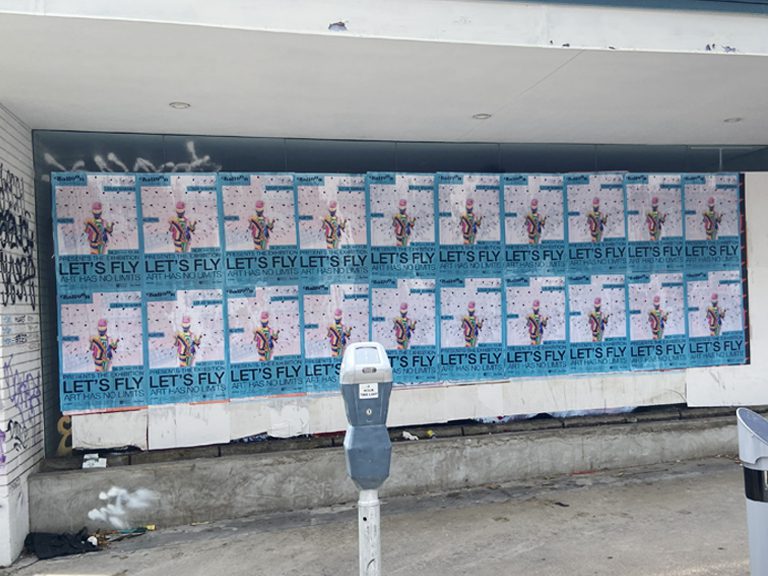
Targeted placement advertising includes wheatpasted poster campaigns in the specific neighborhoods where the tour’s audience concentrates, and sidewalk stencils near venue entrances and transit stops. These tactics concentrate the campaign’s impact in the areas of highest audience density, creating a sense of saturation within the target community.
Human engagement through brand ambassador programs creates direct personal connections with potential ticket buyers in the community spaces they frequent. For tour events, ambassador engagement is especially valuable in the music and entertainment communities where word-of-mouth travels fastest and carries the most credibility.
Timing the Campaign Around the Ticket Sales Curve
Tour event marketing needs to align with the ticket sales lifecycle in each market. Ticket sales for live events typically follow a pattern: an initial burst at announcement, a slower middle period, and a final rush as show night approaches. The marketing campaign should support each phase of this curve with appropriately timed activity.
During the announcement period, marketing should amplify the initial buzz and capture the attention of people who hear about the show for the first time. In the middle period, marketing maintains awareness and provides reasons for fence-sitters to commit: specific venue information, set list speculation, artist context, and the social proof of other fans’ excitement. In the final period before the show, marketing shifts to urgency: the show is coming, seats are selling, this is the last chance.
Street-level marketing is especially effective in the middle and final periods. By that point, digital marketing has saturated the obvious channels, and physical advertising in the audience’s environment creates a reminder that cuts through the digital noise. An LED truck driving through a fan’s neighborhood in the week before a show they have been considering can be the push that converts intent to purchase.
Integrating Street-Level Marketing With Digital Promotion
Tour event marketing performs best when the physical and digital campaigns are designed and executed as a coordinated system rather than parallel efforts. The creative language of the physical campaign should be recognizable in the digital campaign, so fans who see a poster in their neighborhood immediately connect it to the digital ads they have been seeing in their social feeds.
Geo-targeting in digital advertising can be aligned with the physical campaign’s deployment timeline, so that online ads intensify in neighborhoods where street-level materials are appearing. This synchronized approach creates a surround-sound effect where fans encounter the campaign from multiple directions in a short time window, significantly increasing the probability of conversion.
Physical campaign elements also generate content for digital channels. Documentation photos of poster installations and LED trucks, ambassador-created content from the street, and fan-generated photos of campaign elements all create material for the event’s social media channels and can be incorporated into paid digital advertising. This content pipeline from physical to digital is one of the underappreciated benefits of strong street-level execution.
Post-Tour Analysis and Campaign Improvement
Every touring event provides an opportunity to learn and improve for subsequent markets and future tours. Comparing campaign activity data across markets, ticket sales performance by market, and qualitative feedback from local promoters and venue teams builds a picture of what worked and what could be better.
Our team conducts market-by-market campaign analysis as part of our standard reporting for touring events. We identify the campaigns or tactics that outperformed expectations, analyze the characteristics of those markets and campaigns that explain the outperformance, and develop recommendations for how to apply those learnings in remaining markets on the current tour or in future touring seasons.
This continuous improvement approach means that a client who works with us across multiple tours gets progressively better campaign performance, not just repeated execution of the same approach. The learnings compound, and the campaigns get sharper with each tour.
Frequently Asked Questions
What is tour event marketing?
Tour event marketing is the promotional strategy that drives awareness and attendance for a touring live event across multiple cities. It encompasses out-of-home advertising, street-level activations, ambassador programs, digital coordination, and any other tactic used to build market presence before and during each tour stop.
What is the most important element of tour event marketing?
The most important element is reaching the right audience in each market with enough lead time to convert awareness into ticket purchases. This requires knowing where the target audience concentrates in each city, deploying the right mix of tactics for that audience, and starting early enough in each market to build momentum before show date.
How does tour event marketing differ from general event marketing?
General event marketing typically covers a single event in a single location. Tour event marketing adds the complexity of coordinating campaigns across multiple cities simultaneously, adapting strategies to local market conditions, and maintaining brand consistency while the show moves from city to city.
What role does out-of-home advertising play in tour event marketing?
Out-of-home advertising is the physical evidence of a tour’s presence in each city. Poster campaigns, LED trucks, and sidewalk graphics create visible, city-specific advertising that builds awareness among people who may not encounter the show through digital channels. For live events, physical advertising builds cultural credibility alongside digital reach.
How far in advance should tour event marketing begin?
Tour event marketing should begin four to six weeks before each show date in most markets. Major arena shows in competitive markets may benefit from earlier starts, while smaller venue shows in markets where the artist has strong existing awareness can sometimes be effective with a three-week lead time.
Can AGM handle tour event marketing for non-music touring events?
Yes. While music tours are our most common touring event category, we also handle tour event marketing for comedy tours, theatrical productions, brand activation road trips, and other forms of touring live entertainment. The strategic framework is consistent across categories, with tactical adaptations for each event type.
What is included in AGM’s tour event marketing services?
Our tour event marketing services include campaign strategy and planning, out-of-home advertising execution across all formats, brand ambassador program management, production coordination, site approval handling, social amplification support, and complete campaign documentation and reporting.
How early should a brand start planning?
For most campaigns, the smart move is to start planning at least two to four weeks before the launch window so production, routing, staffing, and reporting are all lined up.
What makes one market perform better than another?
Market fit depends on audience density, neighborhood behavior, route efficiency, and whether the creative belongs in that setting. The busiest city is not always the best city.
Can AGM bundle this with other services?
Yes. AGM often combines this work with supporting formats so the campaign has stronger repetition and cleaner reporting across the whole run.
How does AGM quote pages like this?
For more on this, explore our experiential marketing. For more on this, explore our street team activations. We quote from official rate cards where they apply, then scope the remaining production, staffing, and routing details to the actual job.