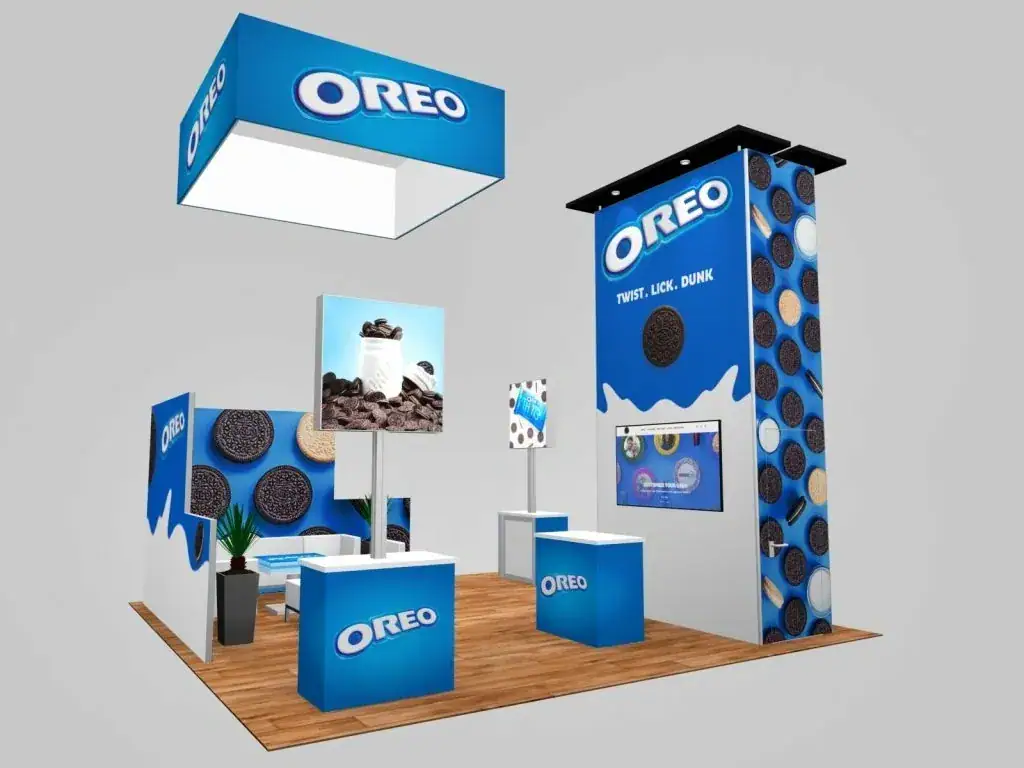
Tradeshow booth design in 2026 has shifted decisively away from the logo-plastered, brochure-stacked, fishbowl-draw booth that was standard industry practice for two decades. The brands winning at trade shows today understand a fundamental redesign of the visitor’s motivation: attendees are no longer there to collect free pens and business cards. They’re there to have conversations, evaluate solutions, and remember the brands that gave them a genuine experience. The booth design trends that dominate 2026 reflect that shift, and the brands that haven’t caught up are spending $20,000 on floor space and walking away with leads that don’t convert. This guide covers the five trends driving booth design performance in 2026, what good execution actually requires, and how street-level brand activation around conference venues amplifies what happens inside the hall.
Trend 1: Minimalism With Premium Finishes, Less Clutter, More Brand
The most consistent finding across tradeshow booth design research in 2026 is the decisive shift toward minimalism. WillWork’s 2026 tradeshow design guide summarizes the movement clearly: “Tradeshow design in 2026 is all about function over form.” PRSHINE’s analysis agrees: “Cluttered booths are being replaced by clean, modern designs. Minimalism with premium finishes is one of the strongest exhibition stand trends for 2026.”
The practical meaning of this trend: fewer panels, fewer graphics, fewer products on display, fewer competing visual elements. More open space, more premium material finishes (aluminum, concrete texture, natural wood, brushed steel), more focused messaging, and more room for the conversation that’s the actual point of tradeshow participation. A booth that looks expensive without looking busy signals brand confidence. A booth that’s packed with every product, every claim, and every graphic element signals brand anxiety, the desperate attempt to communicate everything because the exhibitor doesn’t know what matters most.
The minimalist booth is also a more effective conversation environment. When there’s nothing for a visitor to read or interact with passively, the conversation with the booth staff becomes the primary activity. That conversation, human, specific, responsive to the visitor’s actual situation, is the tradeshow interaction most likely to produce a qualified lead. Cluttered booths give visitors reasons to browse without engaging. Clean booths invite dialogue.
Execution requirement: Professional exhibit fabrication with quality materials, no DIY pipe-and-drape, no low-budget popup backdrops with wrinkled fabric. Budget minimum $8,000–$15,000 for a 10×10 booth with premium finishes. 10×20 with open layout and branded flooring: $20,000–$40,000+. The investment in quality materials pays back in the brand perception it creates versus a budget fabrication.
Trend 2: Interactive Technology That Creates Dwell Time
Expo Stand Service’s 2026 tradeshow booth design analysis identifies technology integration as the dominant trend in booth design: “In 2026, booths will use touch screens, product demo kiosks, and AR or VR experiences. Interactive booths keep people longer, and longer visits mean better conversations. Better conversations lead to better leads.”
The technology element in a tradeshow booth is not decoration, it’s a dwell-time mechanism. A visitor who enters a booth because they’re curious about a touchscreen demonstration stays in the booth longer than a visitor who picked up a brochure. During that extended dwell time, the booth staff has more opportunity to qualify the lead and have a meaningful conversation. Interactive technology is a lead quality tool, not just an attention tool.
Interactive technology that consistently performs at tradeshows:
Product configurator touchscreens: Allow visitors to customize a product specification (for manufacturing, tech, or construction clients) and see real-time visualization of the configuration. Visitors who have customized a product using the booth’s tool are significantly more qualified leads than visitors who collected a brochure.
AR product demonstrations: Augmented reality applications that let visitors see a product in a context they specify, furniture in their living room dimensions, a piece of industrial equipment scaled to their facility footprint, a software interface in their workflow context, create a personalized demonstration that no static display can replicate.
VR immersive experiences: Full VR headset experiences allow brands with complex physical environments (real estate developments, destination venues, manufacturing facilities) to give booth visitors a tour that couldn’t otherwise happen on a trade show floor. VR experiences are highest-impact for brands selling things that visitors can’t physically bring to the show.
Live data and analytics displays: Screens showing real-time data feeds relevant to the visitor’s industry, market performance data, operational efficiency metrics, live sensor data, position a brand as a source of valuable intelligence rather than just a vendor seeking a transaction.
Trend 3: Micro-Attractions That Are Irresistible and Shareable
Strategic Factory’s 2026 tradeshow booth trends analysis identifies “micro-attractions” as a critical engagement driver: “successful booths use micro-attractions that are quick, creative, and irresistible. Spin-to-win wheels with tiered prizes. Claw machine to gamify the giveaway experience.”
The micro-attraction principle is simple: give people a reason to stop at your booth that isn’t about your product. A visitor walking a 500-booth trade show floor in hour three of a tiring day is primed to walk past your product demo. That same visitor will stop for a carnival claw machine, a well-designed spin wheel, or a cold espresso bar. The stop creates the engagement opportunity.
The best micro-attractions are: fast (30 seconds or less to participate), visually distinctive from 30 feet away (drawing attention from across the aisle), tied to something valuable (the prize or experience should feel worth stopping for), and documented (photo moments that generate social media posts from participants, extending the booth’s reach beyond the attendees who visit in person).
Social media moment design is increasingly embedded in micro-attraction design: a branded photo backdrop, a distinctive visual installation, or a shareable branded artifact. Attendees who share content from the booth create earned media that reaches their professional network, a conference audience is a concentrated professional community, and content shared within it reaches highly relevant prospects who couldn’t attend in person.
Trend 4: Hospitality-Grade Environments, The Booth as a Destination
The highest-performing large-island booths at major tradeshows in 2026 function less like traditional exhibit spaces and more like hospitality environments: private meeting areas with comfortable seating, espresso and beverage service, dedicated presentation theaters with theater seating, and ambient environmental design that creates a physical sanctuary from the chaotic energy of the tradeshow floor.
This “booth as destination” approach serves a specific strategic purpose: it creates a reason for qualified prospects to schedule time at the booth rather than passing through. When a prospect has agreed to come to the booth for a meeting, a coffee, or a scheduled product demonstration, the lead qualification conversation happens in an intentional, non-rushed context rather than a grabbed-moment-on-the-fly interaction. The conversion rate from scheduled booth meeting to follow-up demo is dramatically higher than the conversion rate from aisle-grab-and-brochure.
Budgeting for hospitality-grade booth elements: A well-designed private meeting pod within a 20×20 island booth adds $5,000–$15,000 to fabrication costs. A branded espresso station with attendant service for a 3-day show runs $2,000–$5,000. Professional hospitality staffing (separate from the sales team, a greeter and barista whose job is creating the welcome experience) runs $300–$600/day. The ROI is measured in meeting quality and lead depth, not just traffic volume.
Trend 5: Sustainable Materials and Reusable Modular Systems
Sustainability in tradeshow booth design is no longer a differentiator, it’s becoming a baseline expectation, particularly for brands whose customers and prospects value environmental responsibility. The trend toward sustainable booth materials encompasses: reusable modular systems (designed for multi-show deployment rather than custom builds that are trashed after one show), natural and recycled material finishes (bamboo, reclaimed wood, recycled aluminum), reduced printed collateral (digital delivery replaces printed brochure stacks), and carbon footprint tracking for booth fabrication and logistics.
Modular system design is also economically sound independent of sustainability values: a well-designed modular booth system that costs $25,000 and deploys to 10 shows over 3 years averages $2,500/show. A custom build at $20,000 per show for 10 shows costs $200,000, an 8x cost difference for equivalent visual impact. The brands that figured this out years ago are running the same modular systems with incremental graphic updates while competitors rebuild annually.
Integrating Tradeshow Presence With Street-Level Conference Marketing
The tradeshow booth is one component of a conference marketing strategy, not the entire strategy. The most sophisticated conference marketing programs extend brand presence beyond the conference hall, into the hotel corridors, the restaurant and bar districts where evening networking happens, and the streets surrounding the convention center where attendees move between sessions, hotels, and dinners.
AGM executes street-level campaigns around major conference venues, street poster campaigns in the neighborhoods surrounding convention centers, street team activations at the conference hotel clusters, and LED truck deployments in the conference district, for clients who want to reach the conference audience before they ever enter the hall. An attendee who has seen a brand’s street presence all week around the conference venue arrives at the tradeshow floor with established awareness and pre-built familiarity. That arrival context changes the quality of the conversation that happens at the booth.
For major conferences in cities like Las Vegas (CES, SEMA, NAB), Chicago (McCormick Place events), Orlando (HIMSS, InfoComm), and New York (Advertising Week, Fashion Week, ComicCon), AGM coordinates conference-adjacent campaigns that capture the attendee audience throughout the full conference week, not just during exhibit hall hours. Contact americanguerrillamarketing.com/contact to plan the street-level component of your next major tradeshow.
Booth Trends Only Matter If They Support the Follow-Up System
Lighting, interactivity, and immersive design all help a booth win attention, but the trend that decides ROI most often is still the one nobody sees from the aisle: lead follow-up design. A beautiful booth that collects weak notes and slow follow-up is a leaky system. The strongest exhibitors now treat badge scans, qualification questions, instant routing, and post-show nurture as part of booth design because that process determines whether traffic turns into pipeline.
In practice, that means the booth layout should support quick conversations, clear demo zones, and simple lead capture moments instead of creating a theatrical environment that is hard to staff. The attendee experience must make it easy for staff to learn who the visitor is, what problem they are trying to solve, and what the next step should be after the event. Trendy materials and LED flooring are useful only if they help the right conversation happen.
Why 2024 Booth Trends Still Matter in 2026 Planning
The reason planners still look back at 2024 design trends is that many of them became baseline expectations. Interactive elements, sustainability cues, modular structures, and better lighting are no longer special by themselves. They are table stakes in categories where dozens of exhibitors are competing for the same short attention window. What creates advantage now is how thoughtfully those trends are adapted to your audience, your sales motion, and the venue context.
For brands working major conventions, AGM often pairs booth strategy with outside-the-hall visibility so the experience starts before attendees hit the expo floor. Street teams, posters, mobile media, and hotel-zone activations can warm the audience and make the booth feel familiar the moment they see it. That is when design starts behaving like campaign strategy rather than decoration.
Booth Design Should Make the Next Step Obvious
After the look and feel grabs attention, the attendee still needs a clear next step. That could be a live demo, a scheduled meeting, a product comparison, or a simple scan that routes them into the right follow-up sequence. The best booths do not just attract people. They reduce ambiguity about what should happen next, which is why clean signage, visible staff roles, and obvious interaction points still outperform clever but confusing layouts.
Brands that want to support the booth with citywide visibility can combine show-floor design with surrounding guerrilla media. AGM helps exhibitors extend the campaign beyond the venue at americanguerrillamarketing.com/contact.
Frequently Asked Questions About Tradeshow Booth Design
What’s the average cost of a professional tradeshow booth in 2026?
A 10×10 professionally fabricated booth with quality materials runs $8,000–$20,000. A 10×20 linear or island booth runs $15,000–$40,000. A 20×20 island booth with hospitality elements, technology integration, and premium finishes runs $40,000–$100,000+. These figures cover fabrication and design but not shipping, drayage, show-site labor, or the booth’s show participation fees (floor space rental, electrical, internet, rigging).
What’s the most important factor in tradeshow booth design?
Clarity of purpose and message. A visitor should understand what a booth does within 3 seconds of seeing it from across the aisle. Booths that require explanation or close inspection to understand what the exhibitor offers lose the audience before they’ve engaged. Lead with the value proposition, not the logo or the product catalog.
How do I drive traffic to my tradeshow booth?
Pre-show email campaigns to registered attendees with a reason to visit (meeting offer, exclusive demo, desirable giveaway). Conference app notifications for shows with app platforms. Social media promotion before and during the show. Scheduled meetings set before the show opens. Micro-attractions visible from the aisle that create organic walk-up traffic. Street-level brand presence around the conference venue in the days before the show opens.
Should I invest in an interactive technology element for my booth?
Yes, if the technology demonstrably extends visitor dwell time and creates qualified conversations. A touchscreen product configurator for a technical product is a strong investment. A generic iPad kiosk with a PDF brochure is not. The technology must serve the lead qualification purpose, not just check the “interactive” box on the exhibit brief.
How do I measure tradeshow ROI?
Track leads by quality tier (hot/warm/cold based on qualification criteria defined before the show), count scheduled demos and meetings generated, and follow through with 90-day pipeline tracking to measure how many leads progress to active opportunity and closed-won status. Total cost of show participation (space, fabrication, travel, staff time, pre/post-show marketing) divided by pipeline generated gives a cost-per-opportunity metric comparable to other marketing channels.
What Booths Still Get Wrong in 2026
The biggest mistake is trying to communicate everything at once. Booth walls crowded with every service, every feature, and every logo feel insecure. The visitor should understand the company’s relevance in 3 seconds and discover the deeper story through conversation or interaction. Clutter kills curiosity.
The second mistake is staffing mismatch. A beautiful booth staffed by people who don’t know how to qualify, greet, or hold a useful conversation undercuts the fabrication investment immediately. Great booth design and great booth staffing are not separate disciplines. They are parts of the same conversion system.
Additional FAQ
How much space do you need for an effective booth?
Enough to support the job you want the booth to do. A 10×10 can work extremely well for focused demos and meetings. A 20×20 or larger is more appropriate when hospitality, theater presentations, or immersive interaction are core parts of the plan. Bigger is not automatically better if the traffic and staffing plan don’t justify it.
Should trade show booths connect to citywide marketing outside the venue?
Yes. The strongest conference campaigns extend into hotel corridors, nightlife districts, transit hubs, and the blocks surrounding the convention center. That outside-the-hall presence warms the audience before they ever hit the booth floor.
What is the fastest way to improve campaign performance without increasing spend?
Improve the message-market match before adding budget. Sharper creative, clearer offers, better landing experiences, and tighter geographic targeting usually open up more performance than simply spending more money against a weak setup.
Booth Planning Beyond the Booth Footprint
The exhibit itself is only one part of trade-show performance. Entry signage, pre-show outreach, appointment scheduling, QR capture workflow, demo pacing, lead follow-up, and off-floor city presence all shape the actual ROI. Too many teams pour money into fabrication and then under-resource the outreach and follow-up systems that turn booth traffic into pipeline.
Think about the attendee journey: seeing a teaser on the walk in, spotting the booth from a distance, understanding the offer in 3 seconds, entering without friction, having a useful interaction, and getting a timely follow-up afterwards. Good booth design supports all of those stages.
FAQ Additions
What is the most important zone inside the booth?
The front edge. If the entry experience is awkward or visually unclear, fewer people cross the threshold and the rest of the booth matters less.
Should trade show creative match broader city marketing?
Yes. When booth visuals align with hotel, street, and event-side media, the whole campaign feels larger and more memorable.
Frequently Asked Questions
The Top 5 Tradeshow Booth Design Trends for 2026: Function, Experience, and the End of Clutter generates better results when placement, timing, creative, and local execution all work together. These questions cover the details brands usually need before launch, during rollout, and while evaluating performance.
What makes a trade show booth design effective in 2024?
An effective booth combines clear branding, easy navigation, strong lighting, and an experience that gives attendees a reason to stop instead of walking past.
Are minimalist booth designs better than crowded booths?
In many cases, yes. Cleaner layouts often make the message easier to understand and give product demos or conversations more room to happen.
How important is interactivity in a trade show booth?
Very important. Screens, demos, product handling, and live engagement usually increase dwell time more than static graphics alone.
What colors work best for a trade show booth?
The best colors are the ones that support your brand while still standing out from the hall. Contrast matters more than simply choosing bright colors.
Should a booth be designed for lead capture or brand awareness?
Ideally both, but the layout should reflect the main priority. Lead focused booths need easy conversation zones, while awareness focused booths may lean harder on spectacle and visibility.
What is the biggest booth design mistake?
Trying to say everything at once is a common mistake. Attendees need to understand the brand and offer within a few seconds.
How do you make a smaller booth look premium?
Use stronger lighting, cleaner graphics, better materials, and one focused interaction rather than cluttering the space with too many elements.
Do trade show booths need photo worthy features?
If possible, yes. A visual moment that attendees want to photograph can extend the booth beyond the floor and help the brand show up in social coverage.
How early should booth design planning start?
Start as early as possible so you have time for layout decisions, fabrication, shipping, staffing plans, and any technology or demo integration.
How do you measure whether a booth design worked?
Track foot traffic, dwell time, scans, meetings, demo volume, lead quality, and how easily the staff could move people through the space.
Related Pages and Articles