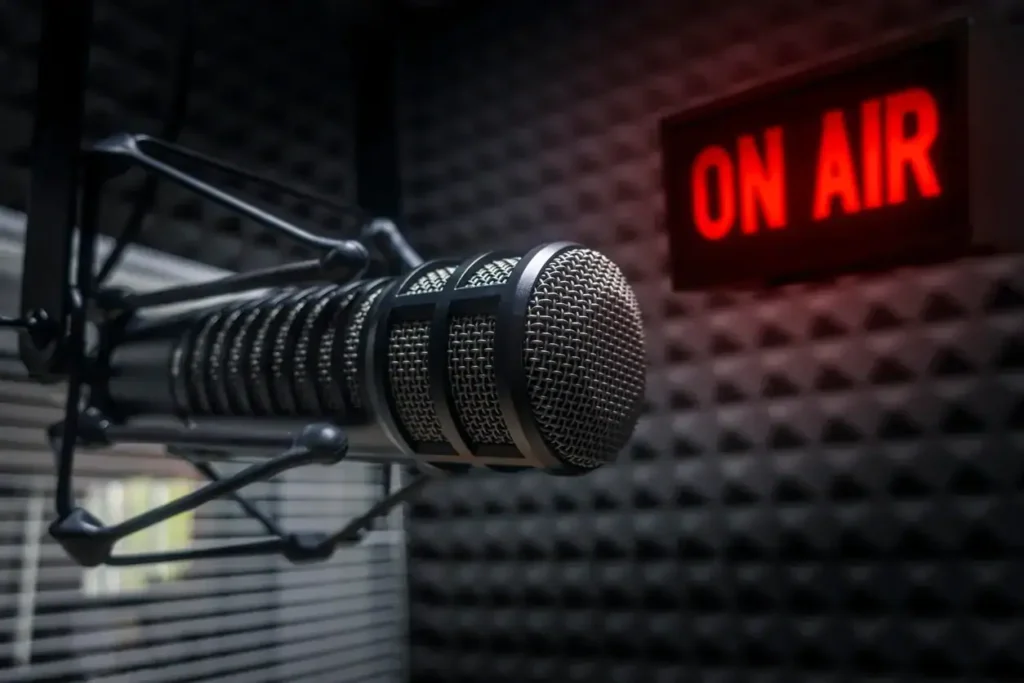
Radio advertising has outlasted every “it is dying” prediction made about it in the last thirty years. AM/FM radio still reaches over 85% of American adults every week, including in the car during commutes, when no other advertising medium has comparable access to an audience’s undivided auditory attention. Add streaming audio platforms like Spotify and Pandora, and the podcasting ecosystem that has expanded what “radio advertising” means in practice, and the medium’s reach in 2026 is actually larger than it was a decade ago. The format has evolved. The audience has not gone anywhere.
Radio advertising occupies a specific and irreplaceable slot in the advertising landscape. It is a mass-reach local medium that reaches audiences during the commute window when they are trapped in their cars with nothing to look at but the road. It is a frequency medium that builds brand familiarity through repetition. It is a credibility medium where host endorsements and station trust transfer to the brands they promote. These characteristics make it genuinely useful for specific advertisers and advertising objectives, and genuinely limited for others.
This guide covers how radio advertising works in 2026, which businesses benefit most, what effective radio creative looks like, how the economics work across market sizes and formats, and how to amplify radio campaigns with out-of-home advertising that reaches the same commuter audience at the same moment.
Why Radio Still Reaches Wide Audiences in 2026
The resilience of radio advertising comes from its unique access to the commute environment. In a world where people control their media consumption with increasing precision, the car remains one of the last places where passive, ambient media consumption is the norm. Commuters are not usually searching for things, scrolling feeds, or skipping ads. They are driving, and the radio is on.
Nielsen Audio data consistently shows that radio reach has not collapsed the way print or linear TV have. Over 85% of adults 18+ still tune in weekly, and the medium’s composition skews toward adults with established household incomes, a profile that suits many advertisers very well. The audience has not abandoned radio. It has supplemented it with streaming audio and podcasting, expanding the total available audio advertising audience rather than replacing it.
The Commute Window Is Exclusive Territory
The morning drive (6-10am) and afternoon drive (3-7pm) dayparts are the most valuable radio advertising slots because they capture commuters during a period when audio is typically the only media input they are receiving. No screen is competing for attention. The ad gets the ears because the ears are available, and the listener is in a decision-primed headspace, thinking about their day ahead or the tasks they need to complete when they get home.
Audio Streaming Has Expanded the Audience
Digital radio and streaming audio, including Spotify, Pandora, Apple Music, Amazon Music, and iHeart Radio’s streaming offerings, have brought the radio advertising model to younger demographics and to on-demand listening contexts beyond the commute. Streaming audio advertising reaches listeners when their ears are available regardless of whether they are in a car, and the targeting precision of streaming platforms exceeds what traditional broadcast radio can offer. Together, broadcast radio and streaming audio cover a comprehensive audio advertising landscape.
Radio Advertising Formats
Radio advertising includes several formats with different cost, production, and effectiveness profiles.
Standard :30 and :60 Spots
The :30 spot is the standard unit of radio advertising. It is long enough to deliver a message with context but short enough to fit within a commercial break without overstaying its welcome. :60 spots allow more storytelling, more complex offers, and stronger emotional development but cost more and are less common in competitive commercial blocks. :15 spots are available on many stations at lower cost and work well for frequency-focused brand reminder campaigns where the message is already established.
Sponsorships and Live Reads
Sponsorships, including traffic sponsorships, weather sponsorships, and news segment sponsorships, give brands brief mentions in high-attention editorial contexts at lower cost than commercial spots. Live reads, where the on-air talent reads the ad copy in their own voice during the regular programming flow, benefit from the trust relationship between host and audience and often outperform pre-recorded spots on a response rate basis.
Remote Broadcasts and Promotions
Remote broadcasts, where a station does a live broadcast from a brand’s location, drive foot traffic and social attention for retail businesses, new locations, and special events. These promotions require coordination with the station and a compelling reason for listeners to visit, but when executed well, they create a level of community engagement that standard commercials cannot match.
What Businesses Benefit Most from Radio Advertising
Radio is a mass-reach, broad-format medium. It is not a precision targeting tool. The businesses that see the best ROI from radio advertising are those that benefit from reaching a large, diverse local audience consistently over time rather than reaching a narrow, precisely defined demographic slice.
Auto Dealerships
Auto dealerships have been among the largest and most consistent radio advertisers for decades because the category characteristics, a broad potential audience, high transaction value that justifies significant advertising investment, and a purchase decision that often happens while commuting are a near-perfect fit for the medium.
Retail and Home Services
Furniture stores, home services (HVAC, plumbing, roofing), grocery and food service, and general retail benefit from radio’s mass-reach characteristics because they sell to everyone in the market rather than a specific demographic. A plumbing service that runs on the local AM news station is reaching the homeowners in that market efficiently across all ages and demographics.
Legal and Healthcare
Law firms and healthcare providers are among the largest radio advertisers in mid-sized markets because they serve broad populations and the emotional nature of their services makes audio a credible and effective medium for establishing trust and recognition.
Radio Advertising Costs and Market Dynamics
Radio costs vary significantly by market size, station format, and daypart. Understanding these variables prevents budget surprises and enables smarter buys.
Small and Medium Markets
In small to medium markets (population under 500,000), :30 spots run $100-$500 per spot depending on station and daypart. Weekly package deals that include spots across multiple dayparts are standard and provide both reach and frequency at managed costs. A $3,000-$5,000 monthly investment provides meaningful presence on a primary station in most small and medium markets.
Major Markets
In major markets like New York, Los Angeles, Chicago, or Miami, prime drive-time spots on popular stations can run $2,000-$10,000 or more per :30. Reaching mass audiences in these markets through radio requires substantially larger budgets, which shifts the math toward supplementing radio with more targeted digital channels and high-impact OOH placements that provide physical presence at lower CPM than major market broadcast radio.
Pairing Radio With Out-of-Home Advertising
Radio and OOH advertising are natural strategic partners. Both media reach the commuter audience during the same window. A listener who hears a radio ad on their way to work, then passes a billboard, transit ad, or poster campaign for the same brand during their commute, receives a layered impression that drives recall significantly higher than either medium alone. The audio triggers the visual memory; the visual reinforces the audio message.
Our team deploys poster campaigns and LED billboard truck routes synchronized with radio flights for brands that want to own the commuter environment comprehensively. When the radio ad runs during drive time and the billboard truck is in the same traffic corridors on the same days, the brand’s presence in the commute moment is amplified across two senses simultaneously. The result is significantly stronger brand recall and conversion than either medium achieves independently.
For brands running radio campaigns in specific markets, adding a sidewalk stencil campaign near key transit hubs or a guerrilla marketing activation in the brand’s core neighborhood creates additional physical touchpoints that reinforce the audio message without requiring incremental media spend on a second radio station.
Creating Effective Radio Advertising
Radio creative is pure audio. There are no images, no motion graphics, no visual context. The ad must communicate entirely through sound: voice, music, effects, and copy. This simplicity is what makes radio creative both straightforward to understand and genuinely difficult to execute well.
The First Three Seconds
Radio listeners change stations or tune out during commercial breaks. The first three seconds of a radio spot must earn attention or the rest of the ad will not be heard. Strong radio creative opens with something unexpected, relevant, or emotionally resonant that gives the listener a reason to stay. A sound effect that creates curiosity, a question that is immediately relatable, or a provocative opening line all work better than opening with the brand name.
One Message, One Call to Action
Radio is not a format for complex messages. A :30 spot that tries to communicate three product benefits, a promotional offer, and multiple calls to action communicates nothing. The most effective radio ads commit to one message and one call to action, then repeat both clearly enough that a listener can act on the information even if they were distracted during part of the spot.
Radio Advertising in the Streaming Audio Era
Podcast advertising has expanded what radio advertising means. Host-read podcast ads reach highly engaged, niche audiences through a trusted voice in an on-demand context. For brands with strong demographic alignment to a specific podcast’s audience, these placements can deliver conversion rates that traditional broadcast radio cannot approach. The host-audience trust relationship in podcasting is among the most valuable trust transfers available in advertising.
Spotify, Pandora, and similar platforms offer programmatic audio advertising with demographic and behavioral targeting more precise than broadcast, at CPMs that are often lower than prime-time broadcast radio in major markets. For brands that want the reach model of radio with added targeting precision, streaming audio advertising provides an accessible entry point.
Frequently Asked Questions About Radio Advertising
Is radio advertising still effective in 2026?
Yes. Over 85% of Americans still listen to AM/FM radio weekly, including in cars during commutes when no other medium has comparable reach. Streaming audio platforms like Spotify, Pandora, and podcasting have further expanded audio advertising’s reach to younger demographics and on-demand listening contexts.
How much does radio advertising cost?
In small to medium markets, :30 spots cost $100-$500 per spot. In major markets, prime drive-time :30 spots on popular stations can cost $2,000-$10,000 or more. Total campaign budgets for effective local radio typically start at $3,000-$10,000 per month.
What are the best dayparts for radio advertising?
Morning drive (6-10am) and afternoon drive (3-7pm) are the highest-audience dayparts and command premium rates. Midday dayparts are lower cost and reach working-from-home adults and retail customers. Overnight and weekend dayparts are lowest cost and suit frequency-focused campaigns on tighter budgets.
What types of businesses benefit most from radio advertising?
Local and regional businesses with broad geographic appeal benefit most, including auto dealerships, home goods retailers, healthcare providers, restaurants, law firms, home services, and retail chains. Businesses selling to a mass local audience tend to see the best ROI from radio’s wide-reach format.
How do you write effective radio advertising copy?
Effective radio copy is conversational, simple, and repeatable. Open with something that captures attention immediately, deliver one clear message, include a specific call to action, and repeat the brand name and key message. Professional voice talent and production quality matter because audio is the only brand signal available in the format.
How does podcast advertising compare to traditional radio?
Podcast advertising reaches a more engaged, often more affluent audience. Host-read podcast ads benefit from the trust relationship between podcaster and audience, driving conversion rates that traditional radio spots cannot match. Podcast advertising is more targeted and typically more expensive on a CPM basis, but ROI can be exceptional for brands with strong demographic fit.
How does radio advertising pair with out-of-home campaigns?
Radio and OOH are natural complements because both reach audiences during the commute window. A listener hearing a radio ad while commuting, then passing an OOH billboard or transit placement for the same brand, receives a dual-touchpoint impression that drives significantly higher recall than either medium alone. Synchronizing radio and OOH campaigns with consistent messaging creates layered impression environments that outperform single-medium strategies.
Frequently Asked Questions
What is the power of advertising on the radio reaching a wide audience?
American Guerrilla Marketing provides the power of advertising on the radio reaching a wide audience services across 50+ U.S. markets. Every campaign is planned, scouted, executed, and GPS-documented by our field teams. We work with regional brands and Fortune 500 companies on campaigns that require real street-level execution and documented proof of performance.
How does AGM approach wide audience?
Our process starts with a market consultation to understand your goals, target audience, and budget. We then scout locations, handle any required permissions or permits, coordinate production and installation with our local crews, and provide a full GPS-tagged photo report after the campaign runs.
What markets does American Guerrilla Marketing cover for wide audience?
We operate in 50+ U.S. markets including New York, Los Angeles, Chicago, Miami, Houston, Atlanta, Seattle, Denver, Boston, and dozens of secondary markets. Contact us to confirm availability and pricing for your specific market.
How much does a wide audience campaign cost?
Campaign pricing depends on market, format, quantity, and duration. We work with budgets ranging from targeted single-market runs to national rollouts across multiple cities. Use our RFP Builder or contact us directly for a custom quote based on your specific campaign requirements.
How do I get started with wide audience through AGM?
The fastest way to get started is to submit your campaign details through our RFP Builder at americanguerrillamarketing.com, or contact us directly at [email protected] or (646) 776-2770. Our team typically responds within one business day with availability and initial pricing.