The Super Bowl is the single largest marketing event in American culture. The game itself draws 70,000 people to the stadium and over 100 million television viewers. But the real marketing opportunity is not in the game. It is in Super Bowl week: the seven days that turn the host city into one of the most concentrated collections of media, business decision-makers, influencers, and sports fans in the country. And that week-long window is open to any brand willing to show up in the streets.
At American Guerrilla Marketing, Super Bowl week is one of our most executed campaign windows. Our team deploys LED mobile billboard trucks, brand ambassador street teams, wheatpaste campaigns, and sports OOH advertising throughout the Super Bowl host city in the days surrounding the game. No NFL relationship required. No eight-figure sponsorship fee. Just a well-planned, well-executed street campaign that reaches the same audience the official sponsors are paying hundreds of millions of dollars to reach, in the physical spaces where no official sponsor can own the territory.
This guide explains how Super Bowl guerrilla marketing works, what tactics generate the highest impact during Super Bowl week, and how to plan a campaign that competes for attention against the world’s biggest brands on one of the world’s biggest marketing stages.
The Super Bowl Week Audience: More Than the Game
The Super Bowl’s marketing value extends far beyond the game itself. Super Bowl week in the host city brings 150,000 to 200,000 visitors from across the country and internationally. These are not just football fans. They are media professionals, brand executives, agency people, influencers, athletes from other sports, musicians, celebrities, and the full range of people who treat Super Bowl week as a cultural event rather than just a sports event.
The mix of people in a Super Bowl host city during game week is genuinely extraordinary. The concentration of marketing industry professionals alone makes it a business development opportunity. The media presence means that anything interesting that happens in the public spaces of the city during that week has a realistic chance of being photographed and published. And the general public, both visitors and local residents who want to participate in the energy of the moment, fills the entertainment districts and surrounding neighborhoods with exactly the kind of brand-receptive crowd that street-level marketing reaches most effectively.
For brands that execute well during Super Bowl week, the audience is not just the people who physically encountered the campaign in the host city. It is every journalist, social media user, and content creator who shared photos and stories of the city’s brand activity during the week. A single well-executed Super Bowl guerrilla marketing moment can travel nationally in hours.
Why Guerrilla Marketing Outperforms Official Sponsorship
The argument for Super Bowl guerrilla marketing over official sponsorship is straightforward: you get access to the same audience in the same physical environment at a fraction of the cost, and without the creative restrictions that official sponsorship typically imposes.
Official NFL Super Bowl sponsorship at the brand level runs into the tens or hundreds of millions of dollars for the full package. The most brands typically see for that investment is stadium signage, broadcast brand integrations, and official event access that reaches the in-stadium and broadcast audience. They do not own the streets of the host city. They do not control what people see when they walk from their hotel to the official fan experience. They do not stop brands from putting LED billboard trucks on every major road between the stadium and the entertainment district.
That territory, the public streets and spaces of the host city during Super Bowl week, is open to any brand that wants it. And during the most media-saturated week in American sports, that territory gets more attention per square foot than at any other time of the year. A wheatpaste campaign that goes up in the host city entertainment district on the Monday before the Super Bowl will be seen, photographed, and possibly covered by hundreds of media and social accounts throughout the week. No official relationship required.
Sports Mobile Billboard Advertising at the Super Bowl
Our LED billboard trucks are the centerpiece of most Super Bowl guerrilla marketing campaigns. During Super Bowl week, the host city’s major corridors, from the airport to the hotels, from the hotels to the official fan experience venues, from the entertainment districts to the stadium on game day, carry volumes of foot and vehicle traffic that rival normal peak hours by multiples.
We route our trucks on these corridors during peak traffic windows throughout the week. The early morning routes cover the hotel corridors as media and business professionals begin their days. The midday routes cover the entertainment districts where the fan experience events and brand parties are concentrated. The game day routes cover the stadium approach corridors and the surrounding neighborhoods where the largest crowds concentrate in the hours before and after kickoff.
Super Bowl game day truck deployment requires specific planning. The NFL creates significant traffic management around the stadium on game day, and truck routes need to be planned around those restrictions while maintaining coverage of the corridors where the crowd is actually moving. Our team scouts the host city venue in advance and builds routes that work within the actual traffic pattern rather than a generic plan.
The creative on Super Bowl trucks needs to hold up in the most media-saturated environment of the year. Our team advises on creative that will photograph well, be legible at the speeds and distances of the deployment routes, and communicate the brand message without relying on NFL brand-rightss that require site approval process.
Brand Ambassador Street Teams During Super Bowl Week
Super Bowl week is seven days of continuous event activity in the host city. Every night is a major brand party or event. Every day has major fan experience venues, media events, and gathering spots throughout the city. Our brand ambassador street teams work all of these spaces throughout the week, concentrating coverage on the highest-traffic windows and locations.
During Super Bowl week, the ambassador opportunity is different from a single-game deployment. The crowd is in the city for multiple days, which means repeated encounters with the same brand build frequency in a way that a one-day game deployment cannot. A visitor who encounters your ambassadors on Tuesday, sees your billboard truck on Thursday, and gets a sample from a street team on Saturday before the game has had three distinct impressions over five days. That frequency, from a single week of deployment, is what makes Super Bowl week such a disproportionate marketing window.
Our ambassador briefings for Super Bowl week focus on the full range of audience types the team will encounter: football fans, media professionals, brand executives, and the general public. The interaction approach differs significantly across these groups, and ambassadors who can adapt in real time to the person in front of them generate significantly better campaign results than those working from a single rigid script.
Wheatpaste Campaigns and OOH in the Super Bowl Host City
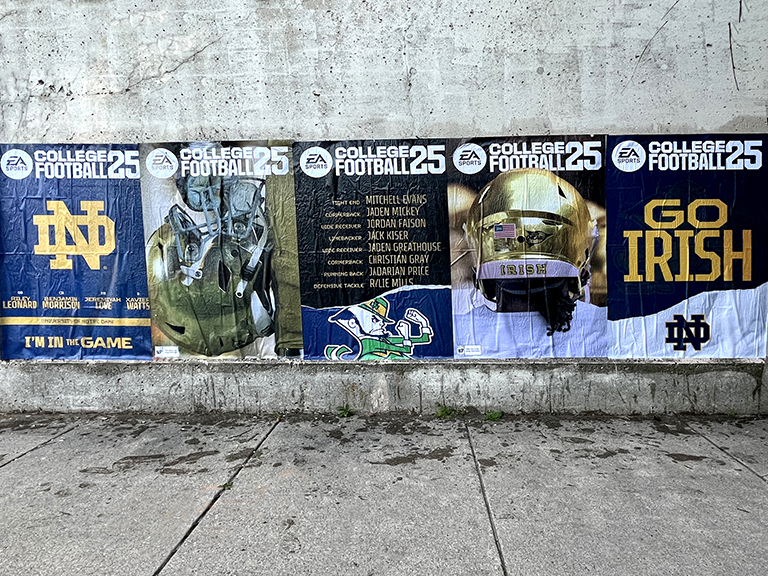
The best Super Bowl wheatpaste poster campaigns go up in the host city entertainment districts and high-traffic corridors in the days before the week begins. Posters that are on the walls when media and visitors arrive on Monday establish brand presence from day one and maintain it throughout the week as the audience turns over with each arriving wave of visitors.
Super Bowl host cities vary significantly in their street-level marketing environments, and our team adapts the wheatpaste and OOH strategy to the specific city. The entertainment corridors in New Orleans look different from those in Las Vegas or Phoenix. The neighborhoods where visitors concentrate differ from city to city. We do the advance site work to ensure the poster campaign is placed where the audience actually is, not where a generic plan would put it.
Sidewalk stencils on the primary pedestrian corridors around the major Super Bowl week event locations create ground-level brand visibility for the enormous foot traffic volume that those areas carry throughout the week. In markets where the Super Bowl experience is concentrated in a few key zones, the sidewalk stencil on a high-traffic corridor can generate impressions numbering in the tens of thousands over the course of the week.
The Media Opportunity: Super Bowl Guerrilla Marketing Goes National
Super Bowl week is the single most media-rich environment in American marketing. Every major publication, television network, and digital media outlet has people on the ground in the host city. Photographers and content creators are actively looking for stories and images that stand out from the wall of official marketing.
A well-executed, genuinely creative Super Bowl guerrilla marketing campaign has a realistic chance of being photographed and published in marketing trade press, sports media, and general interest publications in a way that extends the campaign’s reach far beyond the people who physically saw it in the host city streets. We have seen Super Bowl guerrilla campaigns generate national media coverage that created brand awareness well beyond what any equivalent media buy would have achieved.
This earned media potential is a factor in how we design Super Bowl campaigns. What is the moment that a photographer would want to capture? What is the image that would travel well socially? What is the story that a marketing journalist covering Super Bowl week activations would want to tell? Designing the campaign with these questions in mind does not compromise the street-level effectiveness. It amplifies it by giving the media a reason to tell the story.
Super Bowl Guerrilla Marketing and the NFL’s Ambush Marketing Rules
The NFL has significant brand-rights protections around the Super Bowl name, team logos, and associated intellectual property. Brands that use these brand-rightss without official site approval process face approved action from the NFL. This is a real constraint that shapes what Super Bowl guerrilla marketing can say.
What it cannot shape is where brands can be, what they can show, and how they can engage the public in the public spaces of the host city. The NFL does not own the streets. It does not control public sidewalks, public parks, or the city’s bar and restaurant scene. The brands in those spaces during Super Bowl week, showing their own logos and creative, connecting to the energy of the moment without using NFL brand-rightss, are operating entirely with proper approval.
Our team works with clients on creative approaches that connect authentically to the Super Bowl moment without requiring NFL brand-rights use. The game is the game. The city is the city. The fans are fans. A brand can be part of all of that without ever saying the words “Super Bowl” in its creative, by simply being present, interesting, and relevant in the physical environment where it is all happening.
Planning a Super Bowl Guerrilla Marketing Campaign
The Super Bowl host city is announced well in advance, and brands that want to execute during Super Bowl week should begin planning in October for a February game. The best resources in any host city, LED truck inventory, ambassador staffing, and quality OOH placements, are claimed by brands that move early. Brands that wait until January to start planning for a February Super Bowl find themselves with significantly limited options.
September to October: Initial conversations, strategy session, objectives defined. Confirm which host city markets you want to cover and what the campaign goals are.
November: Campaign plan finalized, creative brief issued, resources booked. This is the window when the best truck inventory and ambassador staffing options are still available in the host city market.
December: Creative into production. Any applicable local site approval processes initiated. Pre-campaign site reconnaissance planned for January.
January: Final site reconnaissance in the host city. Route plans confirmed. Ambassador team final briefing. Print production for wheatpaste and any other physical elements complete.
Super Bowl week: Full deployment across all tactical channels, running from the start of the week through game day and the post-game period on Sunday night.
Post-campaign: Performance documentation, impression reporting, media monitoring for any earned coverage. Debrief and recommendations for next year.
Which Brands Win Super Bowl Guerrilla Marketing
Every brand that executes well in the public spaces of the Super Bowl host city during game week has an opportunity to reach one of the most concentrated, high-value marketing audiences in the country. But the brands that generate the most return are the ones that show up with a clear story, genuine creativity, and execution discipline.
The Super Bowl environment is crowded even at the street level. Official and unofficial marketing fills the host city throughout the week. What breaks through is not the largest truck or the most ambassadors. It is the most interesting idea, the best-executed creative, and the clearest connection between the brand and the moment.
Brands that have used Super Bowl guerrilla marketing successfully in recent years share a common characteristic: they came with a specific, focused concept, not a generic “be present” directive. A campaign built around one memorable idea, executed consistently across all tactics, will outperform a scattered campaign with multiple disconnected elements, regardless of budget.
Our team brings that concept discipline to Super Bowl campaigns we build. We would rather run one focused, memorable campaign than ten things that add up to noise. The environment demands that specificity, and the brands that bring it are the ones that walk away from Super Bowl week with something to show for the investment.
Frequently Asked Questions
What is Super Bowl guerrilla marketing?
Super Bowl guerrilla marketing is brand activation in the public spaces around the Super Bowl host city during Super Bowl week , using mobile billboard trucks, brand ambassadors, wheatpaste campaigns, OOH advertising, and street-level tactics to reach the massive Super Bowl audience without an official NFL sponsorship. It is approved, effective, and often delivers stronger recall than official sponsorship placements.
Is it approved to market around the Super Bowl without an NFL sponsorship?
Yes. Guerrilla marketing and OOH advertising in the public spaces of the Super Bowl host city , the streets, approach corridors, surrounding neighborhoods, and public gathering areas , are approved without any NFL relationship. Brands cannot use NFL brand-rightss like ‘Super Bowl’ or team logos without site approval process, but they can market freely in the physical environment of Super Bowl week.
How large is the Super Bowl marketing opportunity?
Super Bowl week brings 150,000 to 200,000 visitors to the host city, in addition to the 70,000 in-stadium attendees on game day. The entire week is a continuous marketing window, with events, parties, and fan gatherings filling the host city from Monday through Sunday.
What tactics work best for Super Bowl guerrilla marketing?
LED mobile billboard trucks around the stadium and in the host city entertainment districts, brand ambassador street teams at fan gatherings and surrounding neighborhoods, wheatpaste poster campaigns in the days before the game, and sidewalk stencils on high-traffic corridors all produce strong results during Super Bowl week.
When should we plan Super Bowl guerrilla marketing?
Planning should begin in October for a February Super Bowl. The host city for the following year’s Super Bowl is announced well in advance, and the best OOH inventory, truck resources, and ambassador staffing in that market are secured by brands that move early. Waiting until January for a February Super Bowl leaves you with limited options.
What is sports mobile billboard advertising at the Super Bowl?
Sports mobile billboard advertising at the Super Bowl involves LED billboard trucks running the primary corridors of the host city during peak Super Bowl week traffic windows , including the areas around the stadium on game day, the entertainment districts where official and unofficial Super Bowl events are concentrated, and the hotels and convention areas where visitors are concentrated throughout the week.
Can small and medium brands do Super Bowl guerrilla marketing?
Yes. Super Bowl guerrilla marketing is specifically designed for brands that want Super Bowl week presence without official NFL sponsorship costs. A well-planned street campaign in the host city can generate significant exposures and media attention at a fraction of the cost of official partnerships, and is the primary strategy for brands that want Super Bowl week visibility without the eight-figure sponsorship price.