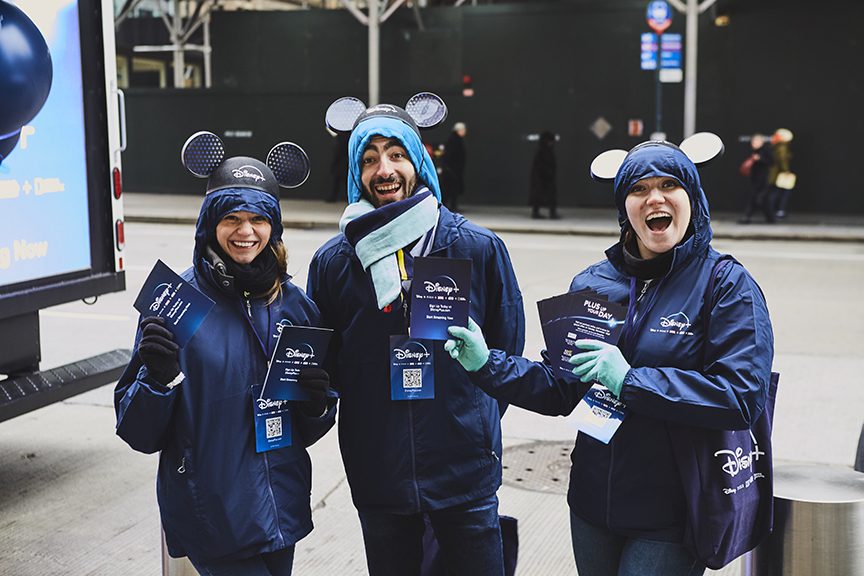
A street teamer is an individual who represents a brand, artist, or organization in public spaces, at events, and in targeted consumer environments through direct personal interaction. The street teamer is the human face of a field marketing campaign: the person who approaches strangers, starts conversations, distributes samples, and creates the live brand moment that no advertising format can replicate.
At American Guerrilla Marketing, we recruit, train, and deploy street teamers for brands across North America. We put street teamers in New York subway stations, Los Angeles farmers markets, Chicago event perimeters, Miami beach corridors, and college campuses in cities across the country. We know what makes a street teamer excellent, what makes them good, and what makes them a liability to a brand’s reputation in the field. This guide covers all of it.
The job of a street teamer looks simple from the outside. Show up, represent the brand, hand out things, talk to people. In practice, it requires a specific combination of interpersonal skill, product knowledge, situational awareness, physical stamina, and professional discipline that not everyone brings to the work. The best street teamers are the ones who understand that every person they interact with is the brand’s consumer relationship in miniature. That interaction either builds the relationship or damages it. There is no neutral.
AGM Field Note: The best street teamer we have ever deployed was not the most outgoing person on the team. They were the most attentive one. They read each person they approached before speaking, adapted their energy to the consumer’s state, and created genuine connections rather than scripted pitches. Attention is the street teamer’s most valuable skill.
A street teamer running a product sampling campaign distributes individual product samples to consumers in targeted locations. The distribution itself is secondary to what surrounds it: the approach that creates the opening, the brief product explanation that generates interest, the moment of trial, and the conversion prompt that turns a positive experience into a purchase action. A skilled street teamer manages all four of these in a single fluid interaction that takes 90 seconds or less in most street-level environments.
Brand Conversation
Street teamers whose primary function is brand conversation are deployed to generate awareness and preference through direct dialogue. They approach consumers in a non-pressured way, share the brand’s story in a conversational tone, and answer questions that a consumer would never think to ask a brand through a digital channel. The conversation-focused street teamer needs product knowledge, brand voice fluency, and genuine enthusiasm that reads as authentic rather than performed.
Collateral Distribution
Distributing flyers, coupons, promotional cards, and branded materials is a component of almost every street team campaign. A good street teamer does not hand collateral indiscriminately; they target the distribution to consumers who are most likely to act on it, create a brief moment of engagement that gives the collateral meaning before placing it in the consumer’s hand, and ensure the consumer leaves with a clear understanding of what they received and why it is worth their attention.
Event Activation
At events, street teamers often have a more complex role that includes working a branded station or interactive activation, managing the flow of consumer engagement across a shift, creating social media moments, and coordinating with other team members and event logistics. Event activation requires strong situational awareness and the ability to manage multiple consumer interactions simultaneously without losing quality in any of them.
Street Teamer Responsibility
Key Skill Required
Common Campaign Type
Product sampling
Approach, product knowledge, conversion
CPG launch, brand entry
Brand conversation
Storytelling, active listening
Awareness, repositioning
Collateral distribution
Targeting, energy management
Event promotion, couponing
Event activation
Multitasking, crowd awareness
Festival, retail event
Data collection
Survey administration, data entry
Consumer research
Social content creation
Photography, platform knowledge
Brand activation
The Street Teamer’s Day
A street teamer’s shift typically runs six hours, though eight and ten hour shifts are available for campaigns with extended coverage needs. Here is what a typical six-hour street team shift looks like from start to finish.
The shift begins with a briefing, either the day before or in the hour before deployment, covering the day’s specific locations, the campaign’s current talking points, any updates from previous shifts, and logistical details including sample quantities, materials, and reporting requirements. A properly briefed street teamer arrives at their location knowing exactly what they are doing, why, and how success will be measured that day.
The first hour is typically the highest-energy period of the shift. Ambassadors are fresh, the location is new (or re-engaged after an overnight break), and the first interactions set the tone for the day. Experienced street teamers use the first hour to calibrate their approach to the specific dynamics of that day’s location: foot traffic volume, consumer mood, competitive activity, and any unexpected variables that affect the deployment plan.
Mid-shift performance management is where active field supervision is most critical. Energy can drift, approach can become mechanical, and interaction quality can decline without active feedback and encouragement. Our field supervisors manage for mid-shift performance maintenance through check-ins that provide both accountability and support for the street teamer who is four hours into a six-hour deployment.
The final hour is often a second peak for consumer engagement as afternoon foot traffic increases in most urban environments. Skilled street teamers use end-of-shift energy strategically, often pushing hard in the final 90 minutes when traffic is high and the shift’s interaction targets can still be influenced by final-hour effort.
AGM Field Note: The most common failure mode for street teamers is not rudeness or incompetence. It is going through the motions. The street teamer who approaches the 200th person of the day with the same energy and genuine interest they brought to the first person is rare and valuable. That consistency is what our training and management process is designed to support.
What Makes a Great Street Teamer
We recruit street teamers across our field markets and we have developed a clear picture of what separates the excellent ones from the competent ones. Here are the qualities that consistently predict street team performance.
Genuine interest in people. The street teamer who approaches strangers because they genuinely enjoy meeting people and connecting with them creates interactions that feel different from the street teamer who approaches because it is their job. Consumers sense the difference immediately. Recruit for genuine people orientation, not just professional friendliness.
Product affinity. An ambassador who uses, believes in, or is genuinely curious about the product they are representing speaks about it with a credibility that ambassadors without that affinity cannot manufacture. We match ambassadors to brands and products where natural affinity exists or where the training can build genuine product enthusiasm.
Situational adaptability. Every person a street teamer approaches is different. Their mood, their receptivity, their time constraints, their prior knowledge of the brand, and their potential interest in the product are all variables that a skilled street teamer reads and responds to in real time. The ability to adapt approach, pace, and messaging to each individual consumer without losing the core brand story is the skill that separates excellent street teamers from good ones.
Physical stamina and resilience. Six hours of standing, walking, and engaging with strangers in variable weather conditions is physically and mentally demanding work. The street teamers who maintain consistent performance throughout the shift rather than declining visibly in the final two hours are the ones whose performance data is worth analyzing and repeating.
Frequently Asked Questions About Street Teamers
How much do street teamers get paid?
Street teamer compensation varies by tier and market. Our Standard tier is $389.99 per 6-hour shift per team member. Premium tier is $589.99 per 6-hour shift. Overtime is available at $65 per hour. Travel day compensation is $275 per day when applicable. These rates reflect the professional standard of the work: trained, managed representatives who are accountable for performance, not casual labor.
What training does a street teamer receive before deployment?
Every street teamer deployed on a campaign receives brand-specific training covering the product, the brand story, key messages, how to handle common questions and objections, the campaign’s specific objectives and metrics, field reporting requirements, and safety protocols. Training is delivered through written briefing documents and live sessions before the first deployment. No street teamer goes into the field without being thoroughly prepared for the specific campaign they are representing.
Can a street teamer work multiple campaigns simultaneously?
Street teamers in our network may work multiple campaigns for different brands at different times, but never simultaneously on the same shift. Each campaign receives a street teamer’s full attention during their assigned shifts. Briefing documents are campaign-specific and the ambassador’s focus during any given shift is entirely on the brand they are representing at that time.
What does a street teamer wear during a deployment?
Branded uniforms or branded gear developed for each specific campaign. The range is from a simple branded t-shirt to a full branded kit including jacket, hat, bag, and accessories. For premium campaigns or brand-sensitive environments, we produce custom uniforms that meet the brand’s specific visual standards. All branded apparel is provided by AGM as part of the campaign package at Premium tier; Standard tier includes basic branded elements.
How quickly can American Guerrilla Marketing deploy a field team?
Standard programs can be deployed within two to three weeks of a confirmed brief and product delivery. Programs requiring specialized training, multiple markets, or custom materials may need three to five weeks. For urgent campaign windows, contact us directly and we will tell you honestly what is feasible within your timeline. We move quickly when the situation requires it, but we do not sacrifice training quality for speed.
What markets does AGM cover?
We have active field teams and established infrastructure in New York, Los Angeles, Chicago, Miami, Austin, Atlanta, Boston, Seattle, Denver, Philadelphia, Dallas, Houston, San Francisco, Washington DC, and more than a dozen secondary markets. For campaigns in markets where we do not maintain a permanent team, we activate partner networks that operate under our briefing and reporting standards. Contact us to confirm coverage in your specific target markets.
Do you provide proof of field activity?
Yes. Every deployment includes GPS route tracking and photo documentation that confirms ambassador presence at the planned locations during the planned times. This documentation is included in daily shift reports and is available for client review throughout the program. We do not rely on self-reported ambassador activity. The documentation is objective and independently verifiable.
Can we observe a live deployment?
Yes. We encourage client observers during active campaigns, particularly during the first week when the brand’s direct observation of ambassador performance is most valuable. Observers can attend any scheduled shift by coordinating with the account management team. We have nothing to hide from client observation and we find that brands who observe at least one shift have a much better understanding of the program’s performance and potential.
What reporting do we receive?
Daily reports delivered within 24 hours of each shift, covering samples distributed or interactions logged, locations covered with GPS confirmation, consumer feedback themes, and field management observations. A final campaign report at program close covers all shift data, location performance analysis, consumer feedback summary, and recommendations for the next program. For multi-week programs, weekly summary reports are also provided.
The AGM Approach
American Guerrilla Marketing has spent years building field marketing programs that produce results brands can measure, report internally, and build on. Our approach is built on three principles: recruit the right people, train them thoroughly, and manage them actively in the field. When those three things are done well, field marketing programs consistently outperform expectations. When any of them is missing, the program produces activity without evidence of value.
We work with emerging brands launching their first product, established brands entering new markets, and mature brands defending their consumer relationships against competitive pressure. The tactics adapt to the brand’s situation. The standards do not. We bring the same recruitment discipline, training rigor, and field management quality to every campaign regardless of its size or the client’s stage of growth.
Call us at (646) 776-2770 or email [email protected] to start the conversation. We will ask the right questions, give you honest answers about what is achievable in your market and timeline, and build you a program that is worth running and worth measuring. American Guerrilla Marketing. Field marketing that puts your brand exactly where it needs to be.
Field Marketing as a Business Growth Strategy
Field marketing programs, including street teams, brand ambassador programs, and product sampling campaigns, are among the most direct contributors to measurable business growth available to consumer brands. They generate the trial that drives first purchase. They build the community presence that drives repeat purchase. They collect the consumer intelligence that drives smarter product and marketing decisions. And they create the brand momentum that makes every other marketing investment more effective.
The brands that allocate a consistent portion of their marketing budget to field marketing over multiple years build consumer relationships that brands relying solely on media advertising cannot match. The consumer who has tried your product in person, who has had a genuine conversation with someone who represents your brand and knows it well, and who has made a positive association between your brand and a real moment in their daily life is a fundamentally different customer than the consumer who has only seen your advertising. The first consumer has a relationship. The second has an awareness. Relationships drive the repeat purchase, the recommendation, and the loyalty that build business value over time.
We have watched brands build from zero market recognition to category leaders in their distribution footprint through consistent investment in field marketing alongside their digital and retail strategies. The trajectory is not accidental. It is the predictable result of building genuine consumer relationships through direct contact over time. Field marketing is the channel that does that work. Digital advertising can create awareness at scale. Field marketing creates the relationships that convert awareness into loyalty.
Building a Year-Round Field Marketing Calendar
The most strategically effective field marketing programs are built around a year-round calendar that aligns deployment timing to the consumer moments, seasonal patterns, and event windows that maximize program effectiveness. Here is how we think about annual field marketing calendar planning for our clients.
January and February are strong months for health, wellness, and fitness brands targeting New Year resolution consumers who are actively seeking new products in these categories. The post-holiday period also creates strong trial opportunity for food and beverage brands as consumers who received product as gifts look for the retail outlet to repurchase.
March through May is one of the highest-impact windows of the year for most consumer categories. Spring brings renewed outdoor activity, increased consumer foot traffic in urban neighborhoods, and the beginning of the outdoor event season that creates the concentrated consumer environments that make field marketing particularly productive. Welcome Week and spring semester campus programs generate some of the highest per-shift contact volumes of any period in the year.
June through August is summer, which concentrates consumer activity around outdoor events, beach and park environments, and festival seasons. Food and beverage, fitness, and lifestyle brands see some of their highest sampling program performance during summer deployments. The outdoor venue density in summer is the highest of the year and the consumer mindset during this period, relaxed, social, and open to new experiences, is one of the most favorable of any season for building new consumer relationships.
September and October bring back-to-school, market re-entry after summer, and the beginning of the holiday season ramp-up. Fall is one of the strongest consumer engagement periods for most categories and one of the best investment windows for brands that want to build consumer relationships before the holiday purchase season peaks in November and December.
November and December are high-purchase-intent periods that create strong retail sampling and street team opportunities for brands positioned in categories that benefit from holiday gifting, seasonal flavors, and year-end purchase motivation. Event-based field marketing at holiday markets and community celebrations is particularly productive for the right brand categories during this period.
The Consumer process and Field Marketing
Understanding where field marketing fits in the consumer’s process from non-awareness to loyal customer is essential for designing programs that produce the right kind of value at each stage.
At the non-awareness stage, the consumer has no existing knowledge of the brand. Street team programs and product sampling at high-traffic locations generate the first exposure. This first exposure is the most valuable if it is a live product trial because the consumer leaves the interaction with a genuine product experience rather than just an advertising exposure that they may or may not remember.
At the consideration stage, the consumer is aware of the brand but has not yet committed to purchase. Sampling programs near retail locations, event-adjacent sampling programs, and ambassador interactions that answer the consumer’s specific questions and address their specific objections are the field marketing tools most effective at this stage. The goal is to remove the remaining uncertainty that is preventing the first purchase decision.
At the first purchase stage, the consumer is ready to buy. A street team ambassador who can direct this consumer to the nearest retail location, provide a coupon or QR code that adds value to the purchase decision, or facilitate a direct purchase on the spot converts this stage at the highest rate. The proximity between the positive field marketing interaction and the purchase opportunity is the most critical variable at this stage.
At the loyalty stage, the consumer has purchased and is deciding whether to purchase again. Field marketing supports loyalty through ongoing brand presence in the consumer’s environment, through ambassador interactions that reinforce positive brand associations, and through sampling of new products or new flavors that expand the consumer’s engagement with the brand. Loyalty-stage field marketing is often neglected in favor of acquisition programs, but the investment in retaining and deepening the relationship with existing consumers is consistently one of the highest-return uses of field marketing budget.
How We Measure Field Marketing Return
Measuring the return on field marketing investment is more nuanced than measuring digital advertising return, but it is thoroughly doable when the measurement framework is built before the program starts rather than reverse-engineered after it ends. Here is how we approach field marketing measurement for our clients.
For retail-focused programs, the primary commercial measurement is sales velocity lift on deployment days versus non-deployment days at each sampled store location. This requires access to point-of-sale data from the retail partner, which most brands can negotiate as part of their retail relationship. The lift calculation is straightforward: total units sold on sampling days divided by total units sold on non-sampling days over the same period gives you the sampling lift multiplier. When that multiplier is greater than 1, the sampling program is driving incremental purchase. When it is substantially greater than 1, the program is delivering strong commercial return.
For street-level and event programs without a direct retail measurement point, we measure commercial return through a combination of consumer self-reported purchase intent captured through ambassador interactions, coupon and QR code redemption rates, and correlation analysis comparing digital and retail engagement metrics in deployment zones during and after the program versus comparable control periods. These measures are not as precisely attributable as point-of-sale data but they provide directional evidence of commercial impact that is sufficient for informed program evaluation and investment decision-making.
We build the measurement framework specific to each program before the first shift and deliver the analysis in a final report format that is useful for internal justification conversations as well as for planning the next program. Our goal is to give brands the data they need to make confident decisions about their field marketing investment, not just to report on activity that the program produced.
Integrating Field Marketing With Your Existing Programs
Field marketing works best as an integrated channel within a broader marketing program rather than as a standalone investment. Here is how integration with the most common complementary channels works.
Digital advertising integration. Geo-targeted digital advertising in the same geographic zones as active field marketing deployments creates a layered consumer encounter that drives stronger brand recall than either channel alone. The consumer who has seen your brand’s ad on social media and then encounters your ambassador in person in the same neighborhood is receiving reinforced brand messaging from two qualitatively different channels simultaneously. We help brands plan the geographic and timing alignment of their field and digital programs.
Retail promotion integration. Field marketing programs that run alongside in-store promotions, price reductions, or display features create a combined pull-and-push dynamic that drives purchase velocity more effectively than either element alone. The field marketing creates awareness and trial. The in-store promotion creates urgency and purchase incentive. We coordinate timing of field programs to align with retail promotion windows whenever the two can be synchronized.
PR and earned media integration. Field marketing activations that are designed with earned media potential built in can generate press coverage and social media sharing that extends the campaign’s reach far beyond the consumers directly engaged by the field team. We help brands design activations that have genuine newsworthiness or social shareability, and we coordinate timing of activations with PR outreach to maximize the earned media opportunity from field activities.
Email and owned channel integration. Consumer data collected during field marketing programs feeds the brand’s owned marketing channels when it is structured correctly. Email addresses, phone numbers, and social follows collected during ambassador interactions with existing consumers or qualified prospects are direct additions to the brand’s owned audience. We design data collection into programs for brands that want to build their owned channels through their field marketing investment.
The American Guerrilla Marketing Difference
American Guerrilla Marketing was built on the conviction that field marketing, done with genuine discipline and genuine care, is the most powerful consumer marketing investment available to brands that are serious about building real consumer relationships rather than just media metrics. We bring that conviction to every program we build and every client relationship we maintain.
Our recruitment process is more disciplined than the industry standard because we know that the person standing in front of the consumer is the entire program in that moment. Our training investment is higher than the industry standard because we know that an undertrained ambassador is a brand liability, not a brand asset. Our management infrastructure is more strong than the industry standard because we know that unmanaged field teams perform at the minimum rather than the maximum. And our reporting is more specific than the industry standard because we know that the brand cannot make good decisions from bad data.
These investments cost more than the industry minimum. They are worth every dollar when measured against the performance difference between a program built with this level of care and one built to a budget without it. We are not the cheapest field marketing option. We are the option that produces results worth the investment.
Call us at (646) 776-2770 or email [email protected] to start building your program. We are ready for the hard questions and confident in the honest answers we will give you. American Guerrilla Marketing. Field marketing that builds brands in the real world.