New York City is the most competitive advertising market in the world. Every brand with a national ambition shows up in New York. Every media company, every outdoor advertising operator, every experiential agency has an NYC chapter in their portfolio. The billboards cost more, the talent costs more, the logistics cost more, and the audiences are more skeptical, more bombarded, and more discerning than anywhere else.
Street marketing works in New York because it operates in a register that bought media can’t access. The pole on Bedford Avenue in Williamsburg, the construction hoarding on Canal Street, the wall on the corner of Orchard and Delancey, these are surfaces that reach New Yorkers where they actually live, not where a media buyer mapped them. The brands that show up in the street show up in the culture. That distinction matters to the audiences that matter most.
AGM is a street marketing agency operating in New York City with a wall network, crew infrastructure, and market history across every borough. Here’s how we operate, what we run, and what a street marketing campaign in NYC actually looks like when it’s built to perform.
—
Why NYC Is the Right Market for Street Marketing, and the Wrong Market to Wing It
New York’s streets are the most heavily posted, most closely observed, and most culturally loaded advertising environment in the country. That density is both the opportunity and the argument for working with an operator who knows the market.
The opportunity is reach. Manhattan, Brooklyn, Queens, the Bronx, and Staten Island combined represent the largest single-city addressable street audience in the United States. Williamsburg, SoHo, the LES, Harlem, Astoria, Fordham, each neighborhood has a distinct demographic profile, a distinct posting culture, and a distinct relationship to street-level advertising. A street marketing campaign in New York isn’t one campaign. It’s a series of micro-campaigns across distinct territories, each requiring specific location knowledge and operational credibility.
The argument for experienced operators is that market knowledge is the actual product. Anyone can put up posters. Knowing which corridors move the needle for your specific audience, which surfaces hold placements, which neighborhoods have established posting culture versus enforcement sensitivity, and how to deliver geo-tagged documentation that makes the campaign reportable, that’s not something you figure out on your first NYC run. AGM has been running street campaigns in New York long enough that this knowledge is structural, not situational.
—
Street Marketing Formats AGM Runs in NYC
NYC street marketing covers a broader toolkit than most markets. The city’s density, diversity, and visual culture support every street-level format at meaningful scale. Here’s what works and how each format functions in the New York context.
Wheatpaste and Poster Campaigns
Wheatpaste is the foundation of NYC’s street advertising culture. Poster campaigns on private and commercial walls across Manhattan, Brooklyn, and Queens have run continuously since before most of the brands doing them today existed. Record labels, film studios, fashion houses, and tech companies all run wheatpaste campaigns in New York as part of standard release and launch strategy.
AGM’s NYC wheatpaste campaigns run on a private property wall network developed over years of operating in the market, combined with targeted public corridor placements in established posting neighborhoods. The wall network delivers the cleanest legal situation available, property owner consent, documented placement, and removal coordination as a service. Corridor placements in neighborhoods like Williamsburg, Bushwick, the LES, and SoHo run in the same gray zone that’s operated without meaningful friction in New York for decades.
Standard wheatpaste formats:
24×36 posters, 100: $4,500 | 200: $5,500
48×72 large-format, 100: $10,500 | 200: $13,500
Snipe Advertising
Snipes are small-format paper posters, 9×12 or 11×14, installed in quantity across neighborhood territories. New York’s snipe culture runs deeper than any other American city. Every nightlife corridor in Manhattan and Brooklyn has snipe history going back generations. Concert promoters, labels, streetwear brands, and campaign teams have used snipes to seed neighborhoods before events, launches, and activations since the format’s earliest days.
A 400-snipe run in a single weekend, installed across Williamsburg, the LES, Harlem, and Astoria, creates a presence that feels like saturation to the audiences moving through those corridors. An 800-snipe run expands that coverage to a broader borough map. The format is fast, targeted, and cost-efficient relative to its impression volume.
9×12 snipes, 400: $4,500 | 800: $5,500
11×14 jumbo snipes, 400: $6,500 | 800: $7,500
Sidewalk Decals
Removable vinyl decals applied to sidewalk surfaces at high-traffic pedestrian points. Sidewalk decals work in New York at retail entrances, around event venues, near transit access points, and in any corridor where you want directional attention or brand presence at eye level. The format is particularly effective around product launches, pop-up retail, and event activations where the decal is part of a multi-format street presence rather than a standalone campaign.
Sidewalk decals are priced from $2,904 for 5 locations, scaling based on quantity. Contact AGM for a market-specific quote.
Sidewalk Stencils
Chalk or paint stencils applied to sidewalk surfaces. Chalk stencils are the fastest-deploy format in the toolkit, installed in hours, visible immediately, and gone with the next rain. Paint stencils hold for two to eight weeks. Both formats are well-suited to NYC’s event culture and the kind of same-day or next-day activation that major brand launches and entertainment releases often require.
Stencils work particularly well paired with wheatpaste or snipe campaigns, they extend the campaign’s footprint to the pavement in the same neighborhoods where wall and pole placements run above.
Building Projections
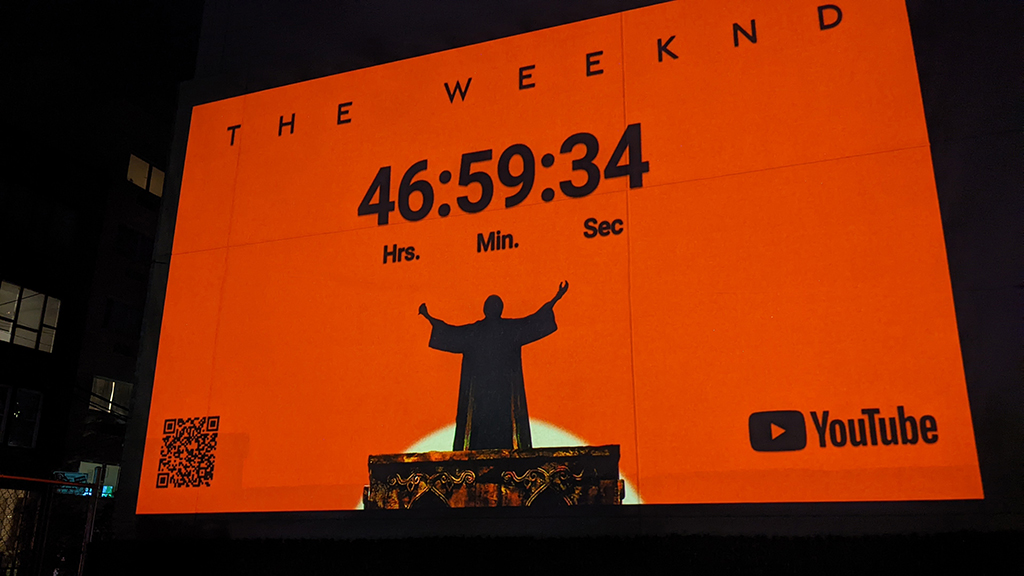
High-lumen projections onto building facades, night-time activations, and event-tied light installations. NYC’s density of large flat facades, particularly in Manhattan, DUMBO, and LIC, makes the city one of the best projection markets in the country. A well-executed building projection in New York generates the kind of social media sharing and press coverage that makes the format earn back its cost in earned media value alone.
AGM has run projection activations across New York’s highest-visibility façades, coordinating with building management, working through the city’s event infrastructure, and delivering activations that scale from one-night brand moments to multi-night campaign installations.
Street Teams and Brand Ambassadors
Human-powered street marketing in NYC, sampling, experiential activations, flyer distribution, product seeding, and brand ambassador programs. Street teams in New York require a different operational profile than other markets: crew members need to be culturally competent in the neighborhoods they’re working, conversationally effective with NYC’s characteristically discerning public, and briefed to represent the brand without friction in high-density pedestrian environments.
AGM’s NYC street team programs are staffed with people who know the city’s neighborhoods and consumer culture. The brief translates; the activation delivers.
—
NYC Street Marketing by Neighborhood
New York’s neighborhoods are distinct media markets. A campaign strategy that works in Williamsburg needs different execution in Harlem, which needs different execution in SoHo. Here’s how AGM approaches the city’s primary street marketing territories.
Williamsburg and Bushwick, Brooklyn
The anchor of NYC’s creative street culture. Williamsburg’s Bedford Avenue corridor and the streets radiating from the L train stops carry the city’s highest concentration of culture-forward consumers aged 21–40. Bushwick extends that reach into a denser, younger, more DIY-oriented territory. Both neighborhoods have deep wheatpaste, snipe, and sticker posting histories. For music, entertainment, fashion, cannabis, and lifestyle brands, Brooklyn’s creative corridor is the highest-priority street marketing territory in the city.
Lower East Side and East Village, Manhattan
The LES has been a primary posting corridor since New York’s street advertising culture was being built. Orchard, Rivington, Essex, and the streets around Delancey carry decades of poster history. The neighborhood’s layered residential, retail, nightlife, and restaurant culture means the same audience encounters the campaign in multiple contexts over the course of a day. East Village runs at similar density along 1st and 2nd Avenues, with a slightly older demographic mix and strong nightlife correlation.
SoHo and NoLIta, Manhattan
Retail traffic and international tourist volume make SoHo one of the highest-impression-per-location neighborhoods in the city. Spring, Prince, and Houston have consistent pedestrian density throughout daylight hours. The demographic mix is broad, useful for brand awareness plays that need wide reach rather than demographic precision. NoLIta tightens toward the lifestyle and fashion consumer and carries strong boutique retail correlation.
Harlem, Manhattan
125th Street and its surrounding avenues carry foot traffic that rivals midtown at peak hours. For brands targeting Black urban consumers, entertainment and music audiences, and culturally embedded urban demographics, Harlem is a priority posting market. The neighborhood has hosted political, cultural, and commercial street campaigns continuously for generations, the posting infrastructure and cultural receptivity are both well-established.
The Bronx
The Bronx is where NYC street advertising culture began in the modern sense, and that history is still embedded in the neighborhood’s relationship to street-level brand presence. Fordham Road, the Grand Concourse, and the areas around Yankee Stadium carry consistent foot traffic and strong demographic relevance for music, entertainment, fashion, cannabis, and consumer product brands. The Bronx is an underutilized market relative to its audience value, campaigns here face less competitive clutter than Brooklyn and Manhattan corridors.
Astoria and Long Island City, Queens
Queens is the borough most underserved by street marketing agencies that default to Manhattan and Brooklyn. Astoria’s restaurant and nightlife corridor reaches a young professional demographic with strong brand receptivity. LIC’s rapidly expanding residential and arts community has become a genuine street posting market over the past several years. Queens campaigns typically deliver strong value-per-impression relative to comparable Manhattan and Brooklyn neighborhoods.
Midtown Manhattan
Commuter density, tourist volume, and transit-adjacent foot traffic make midtown useful for specific campaign types, entertainment, retail, consumer products. The posting surfaces available in midtown are more limited than in downtown and outer borough neighborhoods, but the impression volume on correctly selected locations is extremely high. Midtown works best as a component of a larger borough-spanning campaign rather than a standalone territory.
—
What Brands Use NYC Street Marketing For
The use cases that consistently appear in AGM’s NYC street marketing work fall into a few persistent categories:
Entertainment and music releases. Album drops, film releases, streaming premieres, tour announcements, and event promotions. Street marketing in NYC is standard operating procedure for the entertainment industry precisely because the city’s audience reacts to it. A wheatpaste and snipe run across Brooklyn and Manhattan for a record release isn’t unusual, it’s what the label’s street marketing team schedules as part of release week.
Fashion and streetwear launches. Brand presence in SoHo, the LES, and Williamsburg for launches, pop-ups, and seasonal campaigns. The audience that matters for these brands assigns cultural weight to street presence in those neighborhoods. The campaign signals belonging.
Cannabis brand building. Adult-use legalization has made New York a major cannabis advertising market, and the format restrictions that limit cannabis brands on digital platforms make street marketing disproportionately valuable. Snipe, wheatpaste, and stencil campaigns run in creative and nightlife corridors reach adults in public space without platform gatekeeping.
Tech and startup brand seeding. Consumer tech brands, fintech, food delivery, and other urban-focused startups use street campaigns in targeted NYC neighborhoods to build awareness before broader media activations. The street presence creates cultural familiarity, the brand feels like part of the neighborhood before the product is widely known.
Event and experience marketing. Pop-up retail, brand activations, experiential events, and campaign-tied installations use street marketing to drive foot traffic and create neighborhood-level awareness. The formats that work best for event correlation are snipes (for the days before an event) and street teams (for same-day and in-venue coverage).
—
What to Expect When You Work With a Street Marketing Agency in NYC
The operational reality of a professionally executed NYC street marketing campaign looks nothing like the DIY version. Here’s the actual workflow:
Campaign brief and territory recommendation. AGM takes a brief, objectives, target audience, timing, budget, creative assets, and returns a territory map with format recommendations. Which neighborhoods, which formats, what volume, what documentation deliverables. This is not a standardized package; it’s built for the specific campaign and audience.
Location scouting and wall network access. AGM’s NYC operation includes a private property wall network built over years of market activity. Campaign territory scouting identifies additional public corridor placements in established posting neighborhoods. Location selection is where most of the strategic work happens, the difference between a campaign that performs and one that fills a run report without moving the needle is almost always location quality.
Print coordination. For formats that require printed materials, snipes, wheatpaste posters, decals, stencils, AGM coordinates print production directly or works with the brand’s print vendor. Standard print-to-install lead time is five to seven business days; rush production is available when the campaign timeline requires it.
Installation. AGM’s NYC crews install across all five boroughs. For campaigns covering multiple neighborhoods simultaneously, crews are deployed in parallel, the full territory can be covered in a weekend installation window. Installations are timestamped and geo-tagged in real time.
Documentation and run report. Every AGM NYC campaign delivers a full run report within 48 hours of installation completion: geo-tagged installation photos, placement locations by neighborhood and address, installation dates and times, and estimated impression counts based on foot traffic data. The run report is the deliverable that makes the campaign reportable to marketing leadership, agency partners, and record label A&Rs.
Removal coordination. When the campaign concludes or a removal request comes in, AGM handles it. The brand doesn’t field calls or manage operational logistics post-installation. Standard removal turnaround is 24–48 hours.
—
FAQ: Street Marketing Agency NYC
What does a street marketing agency do in NYC?
A street marketing agency in New York plans, executes, and documents street-level advertising campaigns across the city’s neighborhoods. This includes format selection (wheatpaste, snipes, stencils, decals, projections, street teams), location scouting and territory mapping, installation coordination across boroughs, and run reporting with geo-tagged documentation. The agency absorbs the operational complexity, the brand gets the street presence without managing the execution.
How much does a street marketing campaign cost in NYC?
Costs vary significantly by format and scope. A targeted snipe campaign covering two to three Brooklyn neighborhoods runs $4,500 for 400 placements. A multi-format campaign combining wheatpaste, snipes, and sidewalk decals across five boroughs operates in a different budget range. AGM provides campaign-specific quotes based on format selection, territory, and volume. Contact AGM directly for a quote built around your campaign objectives.
Which NYC neighborhoods are best for street marketing?
Williamsburg and Bushwick for culture-forward, 21–38 creative and lifestyle consumers. Lower East Side and East Village for nightlife, music, and retail audiences. SoHo and NoLIta for broad brand awareness and retail correlation. Harlem for urban entertainment and culture audiences. The Bronx for music and entertainment with lower competitive clutter. Astoria and LIC for young professional demographics in Queens. The right territory depends on your audience profile and campaign objectives, AGM recommends based on both.
Is street marketing legal in New York City?
On private property with owner consent, yes, entirely. Wheatpaste, snipes, stencils, and decals on AGM’s private property wall network and vetted commercial surfaces are legitimate commercial placements with property owner agreements in place. Placements on public surfaces operate in the same widely tolerated gray zone that has made street advertising a functioning industry in New York for decades. The enforcement focus in NYC is on MTA transit infrastructure, DOT property, and government assets, not on commercial paper campaigns in posting corridors that have hosted them for generations.
How long does it take to launch a street marketing campaign in NYC?
For formats that require printed materials, five to seven business days for standard print production plus a weekend installation window. For chalk stencils or street team activations, same-week deployment is possible. For campaigns tied to specific event dates or release windows, AGM builds the timeline backward from the activation date. Rush production and installation are available when the window is compressed.
Can AGM handle campaigns that run across multiple cities beyond NYC?
Yes. AGM operates street marketing campaigns nationally, Los Angeles, Chicago, Miami, Nashville, Austin, Seattle, Denver, Philadelphia, Atlanta, Dallas, Houston, Boston, San Francisco, and additional markets. Multi-city campaigns are coordinated as a single operation: one brief, one point of contact, synchronized installation windows, and a consolidated run report covering all markets. For brands doing national rollouts with a NYC anchor, AGM handles the full scope.
—
Ready to Run a Street Marketing Campaign in NYC?
AGM is a street marketing agency with active operations across New York City’s five boroughs. Wheatpaste, snipe advertising, sidewalk stencils, sidewalk decals, building projections, and street teams, we run the full toolkit in the city’s highest-value neighborhoods, with the market history, crew infrastructure, and documentation to make the campaign perform and prove it. Contact AGM to talk through your campaign objectives, timeline, and territory, we’ll build a recommendation from there.
—
Related Pages and Articles