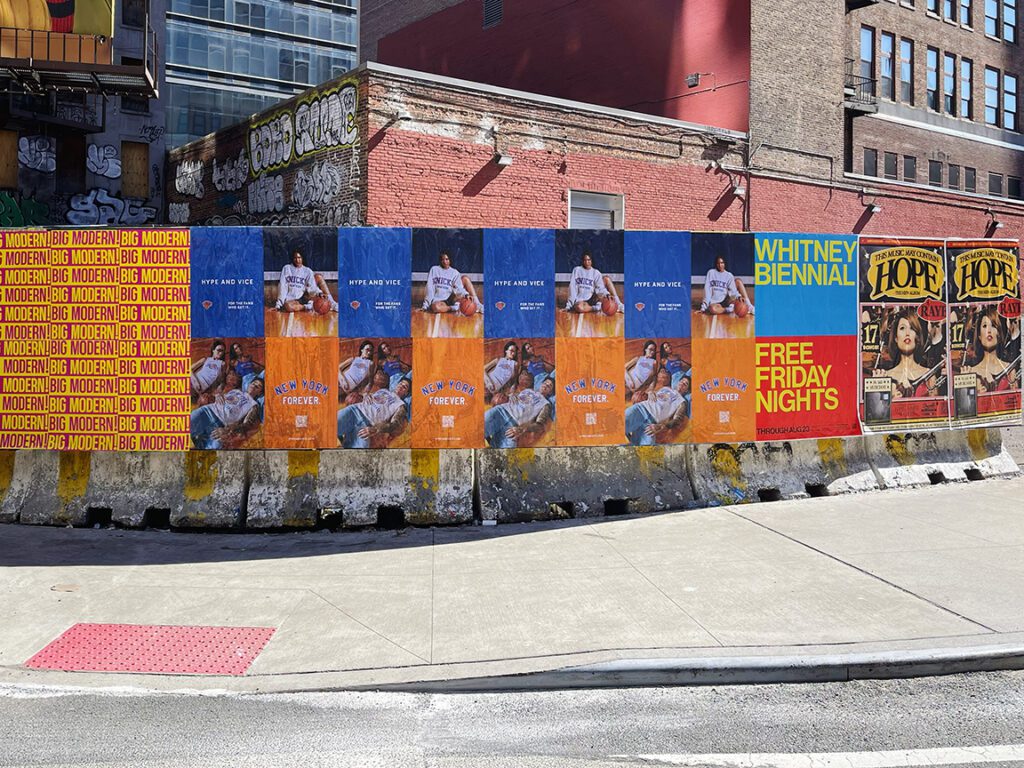
Most outdoor advertising tries to be seen from a distance. Billboards are designed to be read from moving vehicles at 65 miles per hour. Bus overhead panels are positioned for transit riders looking up from their seats. Highway signs exist to be processed in a fraction of a second by drivers who’ve already passed them before they finish reading.
Street-level advertising is different. It operates in the world where people are moving slowly, on foot, in the neighborhoods where they live and work and spend their leisure time. At street level, the encounter between a person and an advertisement is close, often unhurried, and frequently accompanied by the kind of ambient attention that isn’t available to faster media. A person walking down a block with a vivid wheatpaste campaign on the wall has between 15 and 45 seconds of potential exposure to that creative — a lifetime in advertising terms.
This guide covers every major street-level advertising format: what each one is, how it works, what it costs, when to use it, and how to combine formats for maximum impact. Our team has executed street-level campaigns across 50+ U.S. markets for brands from independent launches to national campaigns. This is the practical knowledge that comes from executing hundreds of campaigns at ground level.
Wheatpaste Poster Campaigns
Wheatpaste poster campaigns are the foundational format of street-level advertising. The concept is simple: oversized printed posters (typically 24×36, 48×72, or larger) applied to walls, construction barriers, and approved surfaces using a paste adhesive, typically in the overnight hours when foot traffic is low and installations can be completed without interruption.
The format works because it puts large-format visual creative directly in the visual environment of pedestrians walking through urban neighborhoods. A 60×40 inch poster on a wall at eye level in SoHo or Williamsburg is not a background element — it’s part of the neighborhood visual landscape, and pedestrians engage with it the same way they engage with street art, storefronts, and other features of their urban environment.
Our wheatpaste team handles all aspects of campaign execution: location scouting in each target market, overnight installation, GPS-tagged photography of every placement, and post-campaign reporting. We run campaigns in 50+ U.S. markets with local crews who know the specific walls, permitting environments, and pedestrian flows in their markets.
Format Variations
Standard wheatpaste posters run in the 24×36 to 48×72 inch range. Oversized installations using multiple posters to create a single large composition (sometimes called “wallscapes” or “multi-sheet installations”) can cover entire building sides in high-density markets. Individual poster campaigns in the 50-200 unit range are the most common deployment scale for urban brand campaigns.
Sidewalk Stencils
Sidewalk stencils apply branded creative directly to pedestrian surfaces — sidewalks, crosswalks, plaza floors — using cut stencils and water-based, temporary paint or chalk formulas. The format is uniquely ground-level: it exists in the literal plane where feet land, where eyes look when navigating pedestrian environments, and where discovery happens.
Sidewalk stencils are particularly effective for directional wayfinding (guiding pedestrians toward an event, a store, or an activation), for campaigns targeting the space immediately outside retail locations or transit exits, and for brands that want to create a unexpected, ground-level brand moment that breaks the visual pattern of above-eye-level advertising.
Our sidewalk stencil team uses water-based, temporary formulas that are removable and compliant with regulations in the markets we operate in. We scout locations for surface suitability, install overnight, photograph with GPS coordinates, and monitor durability throughout the campaign period. Standard campaign sizes run 20-100 stencils across a target neighborhood or geographic zone.
Street Team Programs
Street team programs deploy trained brand ambassadors at high-traffic pedestrian locations to create direct human engagement with a brand. Street teams can distribute product samples, branded merchandise, event invitations, or promotional materials, or simply engage pedestrians in conversations about a brand or product.
The street team format is the only street-level advertising format that creates genuine two-way human interaction. Every other format is a visual impression; a street team is a conversation. When the team is well-trained and the encounter is designed with genuine value for the pedestrian, street team interactions create brand memories that pure visual advertising cannot match.
Street Team Deployment Models
Static deployment stations teams at a specific location (a transit exit, a market entrance, a park perimeter) for the duration of the activation window. Mobile deployment moves teams through a specified geographic zone, covering more ground but producing shorter individual interactions. Event-adjacent deployment concentrates teams near relevant events where the target audience is already concentrated. Each model suits different campaign objectives and audience behaviors.
LED Billboard Trucks
LED billboard trucks bring the visual impact of digital OOH to the streets in a mobile format. A truck equipped with high-resolution LED screens on the sides and rear can display full-motion video creative while moving through urban traffic, reaching pedestrians and other drivers throughout its route circuit.
The mobility is the key advantage. Unlike a fixed billboard, an LED billboard truck can be routed through the specific neighborhoods, time windows, and event contexts where the target audience is concentrated. For event-period campaigns (convention marketing, sports events, concerts, festivals), LED trucks can circle the venue campus for hours, reaching every pedestrian in the surrounding zone multiple times.
We route LED trucks based on pedestrian count data, event schedules, and neighborhood flow analysis to maximize impression delivery to the target audience during the campaign window. Standard campaign durations run 4-8 hours per day, with multi-day campaigns for sustained market coverage.
Flyposting and Wall Installations
Flyposting refers to the high-density poster installation in commercially dense urban environments — multiple posters on the same wall or across multiple adjacent walls in a concentrated zone. Flyposting creates visual saturation in specific neighborhood zones, establishing a brand’s presence as an unavoidable part of the visual environment rather than a single impression.
High-density zones in New York (the Bowery, the Meatpacking District, Long Island City along the 7 train elevated), Los Angeles (Hollywood, Silver Lake, Echo Park), and other major markets support flyposting campaigns with high foot traffic and strong social sharing behavior from pedestrians who photograph and post interesting wall installations.
Bus Shelter Advertising
Bus shelter advertising places printed or digital creative in the shelters at bus stops throughout urban markets. Bus shelters are viewed at close range by waiting transit riders who have dwell time to actually read creative, making them one of the most attentive close-contact advertising surfaces in the urban environment. Bus shelter networks in major markets are managed by JCDecaux and other vendors and are typically purchased through formal OOH vendor relationships rather than guerrilla execution.
Projection Mapping and Light Installations
Building projection mapping and light-based installations project branded creative onto building facades in high-traffic urban locations, creating temporary but visually dramatic brand moments in the nighttime environment. Projection campaigns are particularly effective for event-period launches, awards ceremonies, product reveals, and entertainment marketing where the visual scale and surprise factor create strong social media sharing moments.
Projection campaigns require permits in most markets and benefit from advance technical scouting to identify appropriate building surfaces, projection distances, and power access. We execute projection campaigns for entertainment, tech, and consumer brands in markets where the format is permitted.
Combining Formats: The Integrated Street-Level Approach
The strongest street-level advertising campaigns combine multiple formats to create layered brand presence across the visual planes of the pedestrian environment. A campaign that runs wheatpaste at eye level on walls, stencils at ground level on sidewalks, and street teams at transit exits creates a coordinated visual experience that reinforces the brand message at every point of pedestrian contact.
Multi-format campaigns also cover the geographic gaps that any single format leaves. Wheatpaste covers walls; stencils cover ground surfaces; LED trucks cover moving traffic routes that neither format reaches. Each format extension adds incremental reach at a fraction of the cost of equivalent reach from a traditional media buy.
Our team designs integrated street-level campaigns that allocate budget across formats based on the specific objectives, geography, and audience of each campaign. Contact us at (646) 776-2770 or through our contact page to discuss what a multi-format street-level campaign looks like for your brand.
Frequently Asked Questions
What is street-level advertising?
Street-level advertising refers to out-of-home marketing formats deployed at or near ground level in pedestrian environments, as opposed to elevated billboards or transit overhead displays. Street-level formats include wheatpaste poster campaigns, sidewalk stencils, street team activations, LED billboard trucks, bus shelter advertising, and branded installations placed at human scale in the pedestrian environment.
What is the difference between street-level advertising and traditional outdoor advertising?
Traditional outdoor advertising primarily reaches audiences at traffic speed from elevated positions (roadside billboards, highway signs, transit overhead displays). Street-level advertising reaches pedestrians at human scale and close range, creating more detailed brand encounters with higher dwell time. Street-level formats typically produce more memorable impressions per exposure because they’re encountered at close range while people are walking and looking around.
How much does street-level advertising cost?
Street-level advertising costs vary by format. Wheatpaste campaigns in major markets run $2,500-$10,000 for 50-200 poster deployments. Sidewalk stencil campaigns run $500-$2,500. Street team programs run $800-$2,000 per deployment day. LED billboard trucks run $1,500-$3,500 per day. Full integrated street-level campaigns combining multiple formats typically run $8,000-$40,000 depending on market, duration, and scale.
What types of brands benefit most from street-level advertising?
Street-level advertising is particularly effective for consumer brands in lifestyle, food and beverage, entertainment, fashion, and tech categories targeting urban pedestrian demographics. Real estate developers building neighborhood awareness, sports teams creating community presence, and retail brands launching new locations all use street-level formats. Any brand trying to reach a specific urban neighborhood audience at ground level benefits from street-level formats.
Which street-level advertising format is most cost-effective?
Wheatpaste poster campaigns typically produce the lowest cost per impression of any street-level format in dense urban markets because they generate a high volume of pedestrian impressions over days or weeks for a relatively low deployment cost. Sidewalk stencils are also highly cost-efficient. The most cost-effective format depends on the specific market, target neighborhood density, and campaign objective.
What markets does American Guerrilla Marketing cover for street-level advertising?
We execute street-level advertising campaigns across 50+ U.S. markets and select international cities. Core markets include New York, Los Angeles, Chicago, San Francisco, Miami, Austin, Seattle, Denver, Boston, Washington DC, Atlanta, and Nashville. Our operations base is in Industry City, Brooklyn NY and we manage all market activations centrally. Call (646) 776-2770 to discuss your market.