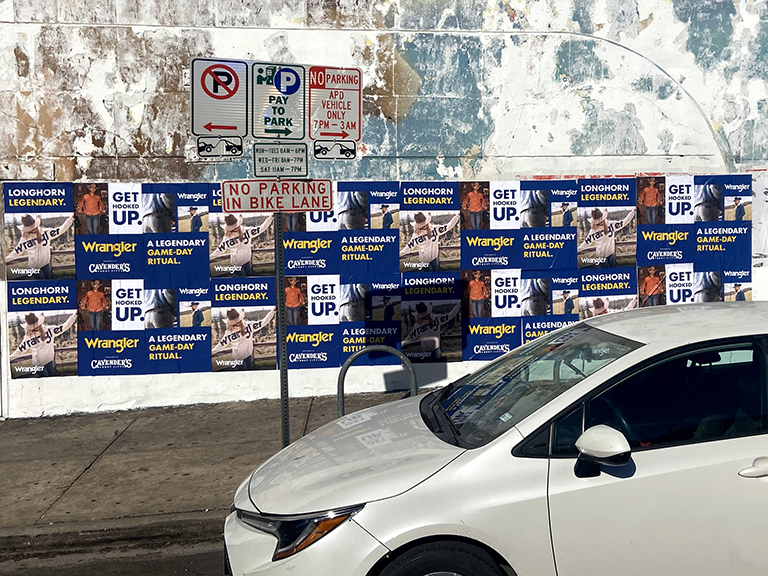
When someone searches for a street agency, they are looking for something specific. Not a social media firm. Not a PR shop. Not a traditional ad agency. They are looking for a team that actually goes outside, puts trained people on real streets in real cities, and creates physical brand moments that reach consumers in the places where they live, work, and spend their time.
That is exactly what we do at American Guerrilla Marketing. We are a street agency in the truest sense of the phrase. Our people are on the ground in New York, Los Angeles, Chicago, Miami, Atlanta, and dozens of other cities every week. They are distributing samples, running street team programs, staffing pop-up activations, and creating the kind of real-world brand presence that no amount of digital spending can replicate.
We have been doing this since 2007. We know every neighborhood in every major US city that matters for street-level marketing. We know which corners produce the best foot traffic, which times of day reach which consumer profiles, and which activation formats work for which types of brands. That knowledge, built over nearly two decades of ground-level work, is what you are hiring when you work with us.
A street agency specializes in marketing that happens in physical public spaces. The tactics vary but the philosophy is consistent. Get your brand in front of real people in the real world, not on their screens but in the moments of their daily lives when they are most receptive and most likely to form lasting exposures.
Our services span the full range of street-level marketing tactics:
Street team distribution: Trained teams at high-traffic intersections, transit hubs, event venues, and neighborhood corridors distributing samples, promotional materials, and brand messages
Product sampling: Direct product trial at locations where your target consumer is present and receptive, selected through careful analysis of foot traffic patterns and consumer profiles
Pop-up experiences: Temporary branded spaces that give consumers a complete, immersive encounter with your brand on your terms
Brand ambassador programs: Ongoing community-level representation by trained individuals who embody your brand in authentic, trusted ways
Guerrilla marketing campaigns: High-creativity, high-impact tactics that create brand moments in public spaces using stenciling, installations, projections, and other creative formats
Event presence: Brand activation at cultural events, community gatherings, music festivals, sporting events, and anywhere else your consumer concentrates in large numbers
We also produce the content that documents these activations and makes them useful beyond the immediate audience. Photos, video, and social content that turn ground-level moments into digital assets your brand can use across channels.
Why Brands Choose a Street Agency
The case for street marketing grows stronger every year that digital advertising gets more expensive and less effective. Here is the reality of what brands are dealing with in 2025.
Digital CPMs keep rising. The average cost to reach a thousand people on social platforms has increased significantly year over year. At the same time, consumer attention on those platforms has fragmented. People are scrolling faster. Ad blockers are standard. Feed algorithms change constantly, making organic reach unreliable and paid reach expensive.
Meanwhile, the real world is relatively uncrowded by comparison. Most brands have pulled resources toward digital and left the streets underinvested. A well-placed street team at a busy farmers market or near a popular gym on a Saturday morning can reach hundreds of engaged, receptive consumers at a cost per interaction that is dramatically lower than digital channels.
Street marketing also produces something digital cannot produce. Physical contact. When you hand someone a sample or hand them a beautifully designed promotional piece, they hold something that carries your brand’s quality signals. They can feel whether the packaging is premium or cheap. They can taste whether the product delivers on the promise. That sensory information is the most persuasive form of brand communication that exists.
The brands that understand this are investing in street marketing as a complement to their digital presence, not as a replacement for it. The two channels work best together, with ground-level activation creating the real-world social proof and consumer experience that makes digital advertising more credible and more effective.
Our Core Street Marketing Services
Service
What It Delivers
Key Markets
Street Team Distribution
Mass awareness, sample reach, direct consumer contact
All US cities
Product Sampling
First trial, purchase conversion, word-of-mouth
50+ US markets
Pop-Up Activations
Immersive brand experience, content generation
NYC, LA, Chicago, Miami, Atlanta
Brand Ambassador Programs
Ongoing community presence, organic advocacy
All major markets
Guerrilla Marketing
Press coverage, social buzz, creative brand statements
Urban markets nationwide
Event Marketing
Captive audience engagement, lifestyle association
Festival, event, and venue-rich markets
Street Marketing in New York City
New York City is our home market and the one we know most deeply. Every neighborhood in New York has its own cultural identity, its own pedestrian patterns, and its own dynamics that determine how street marketing works within it.
SoHo on a Saturday afternoon is a completely different environment than the same street at 8 AM on a Tuesday. The Upper West Side produces different consumer interactions than Bushwick. The foot traffic at Grand Central at 6 PM is not the same consumer profile as the foot traffic at the same station at 10 AM.
We have spent nearly two decades developing this granular knowledge of New York’s street-level marketing environment. We know where to be for a beverage brand that wants to reach health-conscious young professionals. We know the corners that produce the most receptive audience for a fashion brand. We know which parks and which markets give you the best access to the families and parents that a children’s product needs to reach.
That knowledge is not available from a national agency operating out of a central office. It comes from people who have been running campaigns in specific neighborhoods for years and have learned what the data alone cannot tell you.
Street Marketing in Los Angeles
Los Angeles is a different kind of street marketing challenge. The city is sprawling, car-dependent, and fragmented into dozens of distinct communities that do not interact with each other in the way New York neighborhoods do. Effective street marketing in LA requires a map-level understanding of which pockets hold which consumer profiles.
We have developed that understanding through years of running campaigns across the full geography of the city. We know the foot traffic and the consumer profile of Abbot Kinney, of the Fairfax corridor, of Olvera Street, of the Farmers Market at Third and Fairfax, of the beach boardwalk in Santa Monica. We know how the consumer in Culver City differs from the consumer in Highland Park. We build LA campaigns around that knowledge.
Street Marketing in Other Major Markets
We run strong street marketing programs in Chicago, Miami, Atlanta, Houston, Dallas, Philadelphia, Boston, Seattle, Austin, Denver, Nashville, and Charlotte. Each of these cities has its own distinct geography, culture, and consumer dynamics, and we bring the same neighborhood-level knowledge to each of them that we have in New York and Los Angeles.
In Chicago, we know Pilsen and Wicker Park and Hyde Park and Bronzeville and the Near North Side as distinct environments with distinct consumer profiles and distinct activation dynamics. In Miami, we understand the difference between the tourist-heavy environment of South Beach and the local-community texture of Little Havana and Wynwood. In Atlanta, we understand how the creative economy of the Old Fourth Ward differs from the mainstream commercial activity of Buckhead.
This city-specific knowledge is what we bring to every campaign we run outside our home market. We do not treat markets as interchangeable. We treat each city as its own environment that requires its own approach.
How We Staff Street Teams
Our street teams are our most important resource. The quality of a street marketing campaign depends entirely on the quality of the people executing it. We invest heavily in recruiting, training, and retaining the best street marketing staff in every market we operate in.
We recruit people who are genuinely enthusiastic about the brands they represent. We do not place random bodies in branded shirts. We find people who fit the brand, who can speak credibly about the product, and who have the interpersonal skills to create brief but genuine connections with strangers in public spaces.
We train every team member on the specific brand they are representing. Product knowledge, key differentiators, target consumer profile, and the specific messaging and approach we want them to use in the field. This training happens before every activation, more than at initial onboarding.
We monitor performance in real time. Field supervisors circulate through activation zones, checking in with team members, observing interactions, and making real-time adjustments when something is not working. We do not deploy and disappear. We actively manage quality throughout the activation window.
Content Production from Street Activations
Every activation we run produces content. The photos and video captured during street team operations, sampling programs, and pop-up events become a library of authentic brand documentation that our clients use across their social channels, in press outreach, in investor materials, and in retailer presentations.
We plan content production as part of every campaign brief. We think about the visual moments that will tell the brand story most compellingly, and we position photographers and videographers to capture them. We produce content in the formats that work best on the platforms our clients are most focused on, whether that is short-form video for Instagram Reels and TikTok, long-form documentation for YouTube, or high-resolution photography for press and print.
Brands that leave content production as an afterthought in street marketing campaigns miss a significant portion of the value their activation investment could deliver. We treat it as a primary deliverable.
Measuring Street Agency Performance
We are rigorous about measurement in everything we run. After every activation, we deliver a full campaign report that includes distribution counts, location data, photo documentation, field team observations, and any attribution data tied to the campaign through redemption codes, QR scans, or unique tracking mechanisms.
We also monitor secondary metrics. Social activity in the neighborhoods and zip codes where we activated. Brand mention volume during and after the activation window. Traffic to brand websites and social profiles in the days following major activations.
We are always honest in our reporting. If something underperformed, we say so and we explain why. If we learned something about the market that should inform the next campaign, we include it. Our clients make better decisions about their marketing investments when they have honest, complete information, and providing that is part of our commitment to every engagement.
How Long Does It Take to See Results from Street Marketing?
This question comes up in almost every new client conversation. The honest answer: it depends on what you’re measuring and what the campaign is built to do.
For sampling programs tied to retail distribution, sales velocity lift can show up within the same week as the activation. Stores where sampling ran on a Saturday often show measurable lift the following week. That’s fast. Some clients see it in their POS data by Wednesday.
For brand awareness campaigns, the timeline is longer. Awareness builds through repeated exposure. A two-week street poster campaign in a specific neighborhood creates cumulative exposures that strengthen recognition over the campaign period and into the weeks following. You will not see a spike on day one. You will see a brand recall lift after sustained presence.
For community-building programs like brand ambassador work, the results compound over months. The ambassador who becomes a genuine community figure in a neighborhood brings in referral business and organic word-of-mouth that a short-term activation cannot generate. This kind of return is slower but far more durable.
We always set these expectations before a campaign launches, not after it ends. Clear timelines and clear measurement frameworks prevent the disappointment that comes from mismatched expectations.
The Street Agency Model in a Digital-First World
The most common objection we hear from brands that have not worked with a street agency is some version of: why would we spend money on physical marketing when we can reach millions of people digitally for less? It is a reasonable question and it deserves a direct answer.
You are not choosing between physical and digital marketing. You are choosing whether to add the physical dimension to a digital strategy that is almost certainly already in place. The question is not which channel to use. The question is whether physical presence would make your digital investment more effective, and in almost every case, the answer is yes.
Digital advertising is most effective when it reaches people who already have some prior awareness or affinity for the brand. Cold digital exposures produce much lower engagement and conversion rates than warm ones. A consumer who tried your product at a sampling event two weeks ago and then sees your Instagram ad is a fundamentally different prospect than one who has never encountered the brand in any form.
Street marketing creates the prior awareness that makes digital more effective. It creates the social proof that makes digital more credible. It creates the community conversation that makes digital more organic. These reinforcement effects are what makes the combination of physical and digital so much more powerful than either channel alone.
Our Street Team Training Program
We run a formal training program for every street team before they go live. The training covers four core areas that we consider non-negotiable for effective brand representation in the field.
Product knowledge. Every team member learns the product deeply. Ingredients, origin story, key differentiators, production process where relevant, and the competitive context that makes this product worth trying over alternatives. They cannot answer consumer questions confidently if they do not know the product well.
Consumer empathy. We train teams to understand who they are talking to. What does the target consumer care about? What objections are they likely to have? What questions are most common? The team member who understands the consumer before the interaction can navigate it far more effectively than one who is just following a script.
Brand voice and standards. How should this brand sound in conversation? What words and phrases align with the brand identity? What approaches feel off-brand and should be avoided? These standards come from the brand team but get translated into practical conversational guidance in our training program.
Interaction protocols. How to approach someone in a way that does not feel intrusive. How to handle rejection gracefully. How to close a conversation that is going well with a clear next step. How to document interactions for reporting purposes. The mechanics of excellent field interaction are skills that can be taught and practiced.
This training investment is what separates our teams from the hired bodies that many agencies deploy. Our people are prepared to represent your brand well, more than to be present in its name.
Let’s Hit the Streets
If your brand needs to show up in the real world with energy, presence, and impact, we are the agency to make that happen. We have been doing this for nearly two decades and we are very good at it.
Tell us what you need and we will build a program that delivers it.
Frequently Asked Questions
What is a street agency?
A street agency is a marketing firm that specializes in ground-level, physical-world campaigns. This includes street teams, product sampling, pop-up activations, brand ambassador programs, guerrilla marketing tactics, and event presence. The work happens in public spaces rather than on screens.
How is a street agency different from an experiential agency?
Experiential agencies often focus on large-scale branded events and immersive environments. Street agencies operate at the grassroots level, working with smaller teams and more distributed tactics across a broader geographic area. Many street agencies, including AGM, offer both street-level tactics and experiential event production.
What markets does AGM cover?
We operate across the full United States with particular strength in New York City, Los Angeles, Chicago, Miami, Atlanta, Houston, Dallas, Philadelphia, Boston, Seattle, Austin, Denver, and Nashville. We also run programs in secondary markets through our national partner network.
How do you select locations for street team activations?
We select locations based on foot traffic volume, consumer profile matching, time-of-day optimization, and competitive context. We use a combination of pedestrian count data, consumer research, and direct market experience to identify the locations that will produce the highest-quality consumer interactions for each specific brand and campaign objective.
Can you run street team programs in multiple cities at the same time?
Yes. We regularly run coordinated street campaigns across ten to thirty cities at the same time. We have national account managers who oversee multi-market programs and ensure consistent execution and brand standards across every location.
How do you measure street marketing results?
We track distribution volume, consumer interactions, redemption code activity, QR scans, field team qualitative observations, and social monitoring in activation zones. Post-campaign reports provide a complete picture of what happened in each market during the campaign period.
Do you do one-day activations or only longer programs?
We do both. Single-day activations are often used for event tie-ins, product drops, or market tests. Multi-week programs are used for sustained launch windows, brand awareness campaigns, and ambassador programs. We build programs that fit the goals and timeline of each specific client situation.