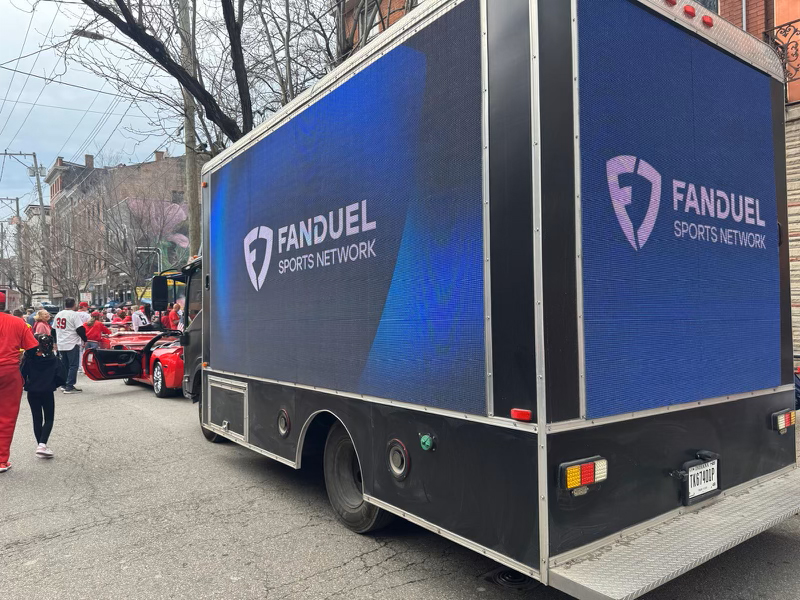
Sports event marketing is not just about getting fans to the game. It is about creating a brand experience around the entire event, from the moment a fan sees the first advertisement through their post-game conversations the next day. For brands, that means showing up at every stage of the fan’s game day process: in the street-level advertising they encounter on the way to the venue, in the activation space they walk through before the gates open, and in the social content that captures the energy of the day after the final whistle.
American Guerrilla Marketing, based at Industry City in Brooklyn, executes integrated sports activations, LED truck programs, ambassador campaigns, and out-of-home advertising for brands, sports organizations, and event sponsors across the country. Our field crews operate from initial route planning through final placement logs and photo reporting, giving clients documented proof of every touchpoint we run on their behalf. This guide covers the full sports event marketing picture: what it involves, which elements drive the most value, and how to build a campaign that works across the complete fan process.
The Three Phases of Sports Event Marketing
Effective sports event marketing operates across three distinct phases: pre-event, event day, and post-event. Each phase has different goals, different audience behaviors, and different tactics that produce results.
The pre-event phase is about building awareness and driving ticket purchases. In this phase, the priority is reaching potential ticket buyers in the weeks before the event and giving them enough information and motivation to commit to attending. Poster campaigns in sports neighborhoods, geo-targeted digital advertising in fan communities, and ambassador word-of-mouth in relevant gathering spaces are the most effective pre-event tactics. The goal is to make the event feel unavoidable and worth attending long before game day arrives.
Event day is the highest-intensity phase. The audience is concentrated, emotional engagement is at its peak, and every brand interaction carries weight. This is when LED trucks, ambassador sampling programs, and experiential activations in the venue approach zone create the most memorable brand encounters. Everything in the event day phase should be designed for immediate visual draw and strong memory formation.
Post-event extends the brand association beyond the event itself. Social content generated by ambassadors and fans during the event feeds into the brand’s ongoing communications. Post-event reporting documents what happened, what fans experienced, and what the campaign delivered. And the positive brand associations created on event day begin their work of building long-term loyalty with each fan who experienced them.
Pre-Event OOH Advertising for Sports Events
In the weeks before a major sporting event, out-of-home advertising in sports neighborhoods and transit corridors builds brand presence in the environment where fans live and commute. Wheatpasted poster campaigns on approved posting surfaces near arenas and in sports-adjacent neighborhoods create environmental advertising that reaches fans during their daily routine, not just when they are actively thinking about the event.
We build pre-event OOH programs around a detailed campaign calendar that maps poster deployment timing to the event date. A campaign for a major playoff game might begin four weeks out with an initial wave of poster placements, followed by a second wave two weeks out as ticket urgency rises, and a final push in the seventy-two hours before game day to capture last-minute buyers. Each wave is photographed and logged, with geo-tagged documentation delivered to clients at campaign close.
Poster Campaigns and Neighborhood Seeding
For ticket sales-focused campaigns, pre-event posters carry clear information about the event, the stakes, and how to purchase tickets. For brand awareness campaigns, pre-event posters create the association between the brand and the upcoming event before the game day environment becomes crowded with competing messages. The placement strategy differs based on the objective, but in both cases, we prioritize surfaces with high daily traffic in the demographics that match the event’s fan base.
Our production team handles printing, site-approval planning where required, and paste crew deployment from our Industry City Brooklyn operation. Placement logs document every surface, every crew member, and every installation date, giving clients a full chain of custody from print production through final installation.
Transit Corridor Advertising
Transit corridors between major transportation hubs and sports venues represent some of the most dependable pre-game audience environments in any market. Fans walking from subway stations or bus stops to the venue follow predictable routes at predictable times, creating a concentrated audience for advertising placements along those corridors. We map transit routes from key hubs to the venue and identify the highest-traffic intersections, walls, and surfaces for poster placement.
In New York, this means understanding which subway exits feed specific fan populations, which walking routes fans prefer based on time and weather, and which surfaces get the most dwell time from people slowing down to check directions or wait for lights. That route knowledge, built through years of field work across New York venues, is what separates well-placed campaigns from wasted production.
Game Day Activations
Game day activations in the approach zone around sports venues create live brand experiences that reach fans in the highest-engagement moment of their relationship with the event. Product sampling, photo installations, interactive games, and ambassador engagement are the most effective activation formats in this environment because they require the fan to stop, interact, and form a direct association between the brand and the energy of the day.
Our team handles pre-event site surveys of every activation zone, mapping foot traffic patterns, entry and exit flows, and sight lines from key approach corridors. That survey informs the physical placement of the activation space, the orientation of signage, and the ambassador positioning strategy for the day. We do not guess at where fans will walk; we know because we have walked those routes ourselves.
Experiential Activation Design
The physical design of a game day activation matters as much as the concept. A visually striking activation space draws fans toward it from a distance; a generic branded tent does not. We design activations for immediate visual draw that creates curiosity from across the venue plaza, then delivers on that visual promise with a genuinely engaging experience once fans arrive. Activation design briefs include dimensional drawings, material specs, and crew placement diagrams before build day, so every element of the space is planned rather than improvised.
Fan dwell time within the activation space determines how much brand communication can be delivered. A fan who stops for thirty seconds gets a sample and a logo impression. A fan who stays for four minutes because the activation is genuinely interesting gets a full brand story. We design for longer dwell time by building activations around activities, not just displays, and we track dwell time through our on-site crew notes so clients can see what held attention and what did not.
Product Sampling and Ambassador Programs
Product sampling in high-fan-density zones around sports venues is one of the most direct forms of brand engagement available in the event marketing toolkit. When a fan receives a product sample on the way into a game, the brand gets associated with the anticipation and excitement of that moment. That association is harder to build through any other format.
Our brand ambassador teams are briefed specifically for each deployment, with product knowledge scripts, brand voice guidelines, and geographic assignments that maximize fan contact within the sampling window. Ambassadors carry tracking sheets that log sample counts, fan responses, and notable interactions. Those logs feed directly into the post-event campaign report.
LED Billboard Trucks on Game Day
LED trucks positioned near venue entrances during peak arrival times are one of the highest-return single investments in sports event marketing. The fan audience concentration in the approach zone, combined with the visual impact of a high-resolution moving display, creates a brand impression that reaches thousands of fans in a matter of hours. We position trucks at the intersections of highest fan flow, move them along planned routes as the arrival window progresses, and document each position with timestamped photography.
A single LED truck running a two-hour pre-game deployment along a well-planned route near a major arena can generate more fan exposures than a full week of standard OOH advertising in a less concentrated environment. The cost efficiency of that concentration is what makes LED truck programs one of the most frequently recommended formats for sports event marketing budgets.
Route Planning and Audience Flow
Route planning for stadium LED truck deployments starts with the specific geography of the venue and the fan arrival patterns for that sport and that event. A basketball arena with a single primary transit exit has a different fan flow profile than a football stadium with four separate parking lots and multiple transit options. We map each venue’s arrival geography before the first deployment, identifying the sequences of positions that maximize cumulative fan encounters across the full arrival window.
That route plan is delivered to the truck team as a timed sequence with specific addresses, turn-by-turn directions, and photo requirements at each position. After the deployment, we compare planned and actual routes, note any adjustments made in the field, and incorporate learnings into the route plan for the next event. Over a season, this iterative approach produces routes that are significantly more efficient than the initial plan.
Sponsorship Activation Campaigns
For brands with official sports sponsorships, the marketing campaign around the sponsorship is often more important than the sponsorship rights themselves. A logo placement inside the arena that fans see during timeouts is low-engagement advertising. A fan encounter outside the arena where a brand ambassador hands them something they actually want, while an LED truck reinforces the brand visual, is high-engagement advertising. We help sponsoring brands activate the value of their rights investment with street-level campaigns that give fans a genuine brand experience.
Sponsorship activation programs through our team typically include a pre-season planning session to identify the highest-priority games on the schedule, a production brief that aligns activation concepts with the brand’s broader campaign messaging, and a logistics plan that covers every game in the program. Brands that treat their sports sponsorship as a platform for street-level activation rather than a passive rights package see consistently higher brand recall among the fan base.
Post-Event Campaign Extensions
The game day campaign does not end when the final whistle blows. Social content generated by ambassador teams and fans during the event extends the brand’s presence into the days after, keeping the association between the brand and the event alive in fan feeds and conversations. We plan post-event content collection as part of the game day brief, tasking ambassador teams with capturing specific content types that can be used in post-event social posting.
For brands running campaigns across multiple events in a season, post-event content from each game feeds into a growing library of authentic fan engagement documentation. That library becomes a campaign asset in its own right, demonstrating consistent brand presence across the season and building the narrative of a brand that is genuinely part of the sports community rather than an occasional advertiser.
Multi-City and Touring Event Sports Marketing
Sports leagues, national brands with multi-market sponsorships, and touring championship events all require sports event marketing programs that operate consistently across multiple cities. Managing that consistency, from production quality through crew briefing through post-event reporting, is a logistics challenge that requires centralized coordination and local market knowledge in every city on the schedule.
Our team coordinates national sports event marketing programs with a central production and planning function based in Brooklyn and local field crews in each market. Campaigns are designed at the brand level, adapted for the specific venue geography of each market, and executed with the same quality standards in every city. National clients receive unified campaign reporting that aggregates results across markets, so the total campaign performance is visible in a single document rather than scattered across individual market reports.
Building Loyalty Through Consistent Sports Event Marketing
The real return on investment in sports event marketing is realized over time, not at a single event. Brands that show up consistently across a season, at multiple events, with the same quality of execution and the same respect for the fan culture, build the kind of familiarity and affinity that single-event campaigns cannot achieve. This is why season-long sports event marketing programs consistently outperform per-event investments in both brand recall and commercial results.
Our team works with brands to build season-long sports event marketing programs that are efficient to execute and consistent in quality. The production infrastructure, ambassador relationships, and placement strategies developed for the first game of the season are refined through each subsequent game, creating a program that gets more precise as the season progresses. By the post-season, the brand has a documented presence across the full fan process that no other agency who skipped the regular season can replicate.
Campaign Documentation and Proof Reporting
Every campaign we run is documented from setup through breakdown. Our field crews submit geo-tagged photographs of every placement, every activation space, and every ambassador deployment location at the start and end of each shift. Those photos are organized into a structured campaign report with placement logs, crew assignments, timing data, and reach estimates by format.
For clients with QR codes on any printed materials, we integrate scan data from the event window into the campaign report, showing the geographic and temporal distribution of fan interactions with the printed materials. For ambassador programs, interaction counts and sample logs are included. For LED truck deployments, route records and position photos document the coverage achieved against the planned route.
This documentation standard matters for two reasons. First, it gives clients the ability to verify what was done and where, which is a basic accountability requirement for any marketing spend. Second, it creates a growing archive of campaign performance data that informs planning for every subsequent event. Clients who have run with us for a full season have a detailed record of what worked best at each venue and each event type, which makes planning for the following season faster and more precise.
Frequently Asked Questions
What is sports event marketing?
Sports event marketing is the full range of promotional and brand-building activities around live sporting events. It covers pre-event advertising to drive attendance, game day activations to engage fans, sponsorship activation campaigns, and post-event marketing to extend the brand association beyond the event itself.
Who uses sports event marketing services?
Sports event marketing services are used by sports teams and leagues looking to drive attendance, brand sponsors activating their sponsorship investment, consumer brands targeting the sports fan demographic, venue operators promoting events, and sports governing bodies promoting major championship events.
What does a sports event marketing campaign include?
A full sports event marketing campaign includes pre-event OOH advertising in sports neighborhoods and transit corridors, game day LED truck and ambassador programs near the venue, experiential activations in the venue approach zone, social content creation, and end-to-end campaign reporting with geo-tagged photo documentation and placement logs.
How do you drive attendance with sports event marketing?
Driving attendance requires reaching potential ticket buyers before they make their decision. Poster campaigns and LED trucks in neighborhoods where the target demographic concentrates, combined with targeted digital advertising and ambassador outreach in relevant communities, build awareness and urgency that convert to ticket purchases. Timed campaign waves in the weeks before the event maintain that pressure through the decision window.
How does sports event marketing differ from sports sponsorship?
A sports sponsorship is a paid relationship that grants rights to certain placements and associations. Sports event marketing is the execution of promotional campaigns to build brand awareness and fan engagement around events. Marketing activates the value of a sponsorship, but you can also run effective sports event marketing without a formal sponsorship arrangement by focusing on the public spaces surrounding the venue rather than in-venue placements.
Can sports event marketing include multi-city campaigns?
Yes. Sports leagues, national brands with multi-market sponsorships, and touring sports events all require multi-city sports event marketing campaigns. Our team coordinates national programs with centralized planning and local field crews in each market, delivering consistent quality and unified reporting across every city on the schedule.
What reporting does AGM provide for sports event marketing?
We provide geo-tagged photo documentation of all placements and activations, placement logs with timestamps and location data, reach estimates by format, QR scan data where applicable, and a summary analysis of performance and recommended adjustments for future events. Reports are delivered after each game or event covered and compiled into a season-summary document for season-long programs.
How early should a brand start planning?
For most campaigns, the smart move is to start planning at least two to four weeks before the launch window so production, routing, staffing, and reporting are all lined up.
What makes one market perform better than another?
Market fit depends on audience density, neighborhood behavior, route efficiency, and whether the creative belongs in that setting. The busiest city is not always the best city.
Can AGM bundle this with other services?
Yes. AGM often combines this work with supporting formats so the campaign has stronger repetition and cleaner reporting across the whole run.
How does AGM quote pages like this?
We quote from official rate cards where they apply, then scope the remaining production, staffing, and routing details to the actual job.