
November 13, 2026
Snipe Advertising for Charlotte Brands
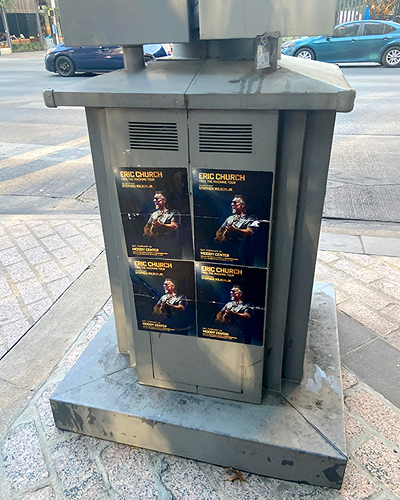
Snipe Advertising is the format Charlotte’s own code speaks to most directly, and most people selling it here do not mention that.
Snipes are the small, high count signs that live at eye level and just above it. They are the format built for repetition. One of them does nothing. Forty of them along a corridor change what a neighbourhood feels like it is talking about that month. The whole economic logic of a snipe run is volume across a route someone travels more than once.
Which is exactly why Charlotte is a harder snipe market than clients expect, and why I spend more of a Charlotte kickoff call saying no than I do in most cities.
Charlotte’s Unified Development Ordinance, Article 22, addresses signs painted, pasted, stapled, taped or otherwise affixed to a tree, fence, utility pole, bench, trash receptacle or similar non sign structure. That list is the snipe placement playbook almost word for word. Other cities leave more room for interpretation. Charlotte wrote the list out.
I am not going to tell you what is legal or illegal here. That is a grey area, enforcement is inconsistent, and the outcome depends on surface ownership, local ordinance and whether permission existed. What I will tell you is that when a city names fence, pole, tree, bench and bin specifically, an operator who still routes your campaign across those surfaces is selling you their appetite for risk and calling it local knowledge.
So this page is about the version of snipe advertising that actually holds up in Charlotte: where the surfaces genuinely are, what a Carolina summer does to a sign at eye level, how a crew routes a run across a city that scores 26 on walkability, and which weeks make the volume worth buying.
Charlotte’s sign article hits snipes harder than any other format
Large format paste work needs a wall. Walls have owners, owners can be asked, and a single conversation can unlock an entire elevation. Snipe work has historically run on the stuff in between walls, which is precisely the category Charlotte enumerates.
Article 22 covers signs affixed to a tree, fence, utility pole, bench, trash receptacle or similar non sign structure, and the article provides for inspections and enforcement actions, with appeals and variances under Article 37. The wider North Carolina pattern matches: municipal sign ordinances across the state commonly reach bills, placards, posters and advertisements on telegraph, telephone and electric light poles, trees, and traffic control signs and their supporting structures.
One word in the Charlotte language deserves specific attention, because it changes the plan. Charlotte names fence.
In most markets, temporary construction fencing is the snipe surface of choice. It is everywhere in a growing city, it sits at perfect eye height, it faces the footway, and it is nobody’s treasured façade. Crews treat it as ambiguous ground. In Charlotte, with fence written into the article explicitly, I do not treat it as ambiguous. We approach site hoarding and scaffolding through the contractor or the site owner as a permission conversation with a named party, or we leave it alone.
There is a second regime most snipe crews ignore until it bites. Charlotte regulates right of way use formally. The city’s code includes a utility right of way use article under which the transportation department adopts standards governing closure of any portion of the right of way to vehicular or pedestrian traffic, including a Work Area Traffic Control Handbook. Snipe work happens on the footway by definition. A crew that parks badly, blocks a sidewalk, or works out of a vehicle half in a lane has created a separately regulated and extremely visible problem that has nothing to do with the signs themselves.
UNVERIFIED: Charlotte’s actual enforcement intensity, removal practice and complaint response times. We assert no fine figures and we do not pretend to predict how a given inspector reads a given surface.
What reduces risk here is unglamorous and it works: named property owners, written permission, private surfaces, photo documentation at install, and a removal commitment with a date on it.
Where snipes still work in Charlotte
Strip out the named structures and Charlotte still has real snipe territory. It is just more deliberate than a client expects.
Camp North End is the strongest answer. It is a redeveloped industrial site, which in practice means consolidated ownership across a large footprint. For a format whose economics depend on count, a single controlling party who can authorise placements across a whole site is worth more than a dozen scattered permissions. This is the rare Charlotte location where snipe volume and documented permission can coexist without a month of relationship work.
NoDa carries snipes culturally. The district runs along North Davidson Street about a mile and a half north east of Uptown, began as a 1903 textile mill village, and was renamed by artists who took over its vacant storefronts in the 1990s. It is now a mural covered music and brewery quarter. Repetitive small format work reads as native there in a way it would not in a manicured retail district. Private frontage, venue owned surfaces and business owners who actually want the foot traffic are the route in.
South End gives you the route structure. The Rail Trail is a three and a half mile linear park running alongside the light rail through the brewery and apartment density. Snipe runs want a corridor people traverse repeatedly, and a continuous linear pedestrian spine of that length is close to ideal. The surfaces adjacent to it are privately held and the businesses along it are reachable.
FreeMoreWest and the western Uptown edge are active development submarkets. Development means transitional sites and owners who are findable, which matters more for snipes than aesthetics do.
Plaza Midwood I handle carefully. It is eclectic, it is requested by name constantly, and it sits under historic district protection alongside Dilworth and Myers Park. Historic overlay is a scrutiny flag. A high count run of small signs across façades in a protected district is the opposite of a quiet install. We will work it where an owner relationship genuinely supports it, and we will not pretend it is a volume play.
Uptown is a timing buy, not a standing one, which I cover further down.
What a Carolina summer does to a sign at eye level
Charlotte is humid subtropical: hot, humid summers, rainfall spread fairly evenly through the year, heavy seasonal downpours and frequent afternoon thunderstorms through the warm months, with summer temperatures running from the mid seventies into the mid nineties.
Snipes sit lower and closer than wall posters, which changes the failure modes.
Fade is the big one, and July is the reason. July is the sunniest month in Charlotte at an average 10.9 hours of sunshine, and it carries the highest UV index of the year, averaging a maximum of 7. That is a sustained load across the brightest month. Untreated inks on uncoated stock shift visibly over a summer cycle, and strong reds and blues go first. On a wall poster at height, a client might tolerate that. On a snipe at eye level, where people are two feet away reading the thing, faded stock looks abandoned. A sign that looks abandoned actively damages the brand it carries.
So for summer runs here: UV stable ink, a laminate on any vinyl component, and a refresh cycle written into the plan rather than bolted on after the complaint.
Afternoon storms set the schedule. Frequent warm season afternoon thunderstorms mean adhesive and paste applied mid afternoon can get rained on before it has cured. From June through August we work early morning or night. This is the most common correction I make to a Charlotte brief, usually because somebody wants daylight photography of the install.
Humidity cuts both ways. July averages 69 per cent relative humidity, against an annual average reported around 59 per cent. High humidity extends paste open time, which helps on anything larger, but it also stretches the window during which weather can ruin the work. On small format, the more relevant effect is that damp stock handles badly and a sign hung with a bubble at eye level is a sign people notice is wrong.
Winter is the easy season and clients never believe it. Freeze and thaw is a secondary concern in Charlotte, not a season long constraint. Sources describe winters variously as cold with strong seasonal contrast and as mild. Either way it is not a snowbelt, salt air is irrelevant because the city is inland, and road salt use is limited compared with northern markets. Occasional ice events are exception handling. If longevity is the priority and the calendar allows it, a winter run here outlasts a July run by a comfortable margin.
UNVERIFIED: Charlotte’s exact annual freeze and thaw cycle count and average snowfall.
Routing a snipe run across a car dependent city
Snipe campaigns live or die on route logic, and Charlotte’s route logic is unusual.
The city scores 26 out of 100 on Walk Score, classed as car dependent, requiring a vehicle for most errands. A central Charlotte location scores 89, classed as very walkable. NoDa sits at 65. That spread is the defining logistics fact in this market.
It means a snipe run here cannot be a single continuous walking route. It is hub and spoke: drive between districts, work each district on foot. The van is the stock store, the base and the only thing connecting four separate working areas.
It also means the honest unit of volume is the district, not the mile. Forty signs concentrated along the Rail Trail or through NoDa’s core register as a campaign. The same forty spread evenly across the metro register as nothing. Snipes compound through repetition on a route someone actually repeats, and in a car dependent city most people do not repeat a walking route outside a handful of districts.
Crew size for snipe work is driven by count and reach. A two person team covers a lot of ground on reachable surfaces, one placing and one managing stock, sequence and documentation. Anything requiring height, or any placement adjacent to a live footway, gets a third person as spotter. The spotter is not overhead. A crew that looks organised and purposeful draws far fewer questions at two in the morning than two people doing something awkward in the dark.
Night windows: after bar close is the standard slot in NoDa and South End. Both carry real residential density now. South End is explicitly an apartment boom corridor and NoDa has substantial residential at its core. These are not empty warehouse blocks after midnight. People live above the breweries. Quiet load outs, no dragged ladders, no repeated van doors.
NoDa’s two Blue Line stations, 25th Street and 36th Street, put Uptown roughly twelve minutes away by rail. A crew carrying stock usually still drives, but that connection matters to the campaign logic: NoDa and Uptown share an audience, so a snipe run across both is one message seen twice by the same person rather than two separate campaigns.
Uptown itself is compact and convention driven. Expect congestion around the Spectrum Center and the Convention Center on event days, which turns a simple van reposition into lost time.
UNVERIFIED: current Uptown parking rules, overnight loading access and active roadworks. We check those per job.
The weeks that justify a Charlotte snipe run
Volume formats want a moment. Charlotte has several real ones.
The CIAA Men’s and Women’s Basketball Tournament is the window I would build around. It pairs 22 basketball games with educational programming, community engagement, Fan Fest, Super Saturday, step shows and concerts. That is a week long, city wide audience concentration with a cultural programme attached, not a single fixture. For a repetition format, a week where the same people move through the same core repeatedly is exactly the conditions snipes need.
Convention weeks make Uptown worth buying. The Charlotte Convention Center runs a continuous calendar of conventions, conferences and tradeshows. Those weeks import a large, concentrated, short stay audience into a compact walkable area. A snipe run in Uptown during a dead week and the same run during a convention week cost the same effort and do not perform the same.
The professional sports rhythm gives a baseline. Charlotte hosts teams at nearly every level of American sport, with the Carolina Panthers and Charlotte Hornets as anchors, the Spectrum Center as the Uptown arena, and the city described as having 151 upcoming sports events across its venues. Autumn Sundays and the basketball season from autumn through spring produce repeating high footfall days in the core.
UNVERIFIED: specific tournament, festival and university term dates for the coming year. Confirm directly before locking an install window. We do not schedule a client’s run against a date we have not verified ourselves.
What goes wrong in Charlotte, and what we refuse
We refuse the named structures. Poles, trees, benches, bins and fences. Charlotte wrote them into Article 22. Clients ask for them because they are everywhere and look like free inventory. They are the first thing an inspector looks at and the first thing a complaint names.
We talk clients out of treating construction fencing as a soft target. It is the standard snipe surface in a lot of markets. Charlotte’s explicit inclusion of fence changes the calculation, and we read that as covering temporary site fencing. If a client wants hoarding, we go to the contractor and get it in writing or we drop it.
We talk clients out of metro wide distribution. This is the most common and most expensive Charlotte mistake. At 26 citywide walkability, thinly spread snipes do not accumulate into anything. They just look like someone littered. Concentrate in two or three districts and the same count reads as deliberate.
We talk clients out of Plaza Midwood as a volume district. It is lovely and it is protected, alongside Dilworth and Myers Park. High count small format across protected façades invites exactly the attention a campaign does not want.
We talk clients out of July as a default. With the year’s highest UV load in the sunniest month, eye level signs fade where people can see it happening. If the launch date is fixed, we plan refreshes. If it is flexible, we move it.
We talk clients out of install photography at two in the afternoon in August. A storm before cure ruins the run and nobody got a usable photo anyway.
On removal, we commit with a date and we document both ends. In a market where the viable surfaces are private and owner permission is the whole foundation, those owner relationships are the real inventory. One bad removal costs more than a campaign earns.
If the count the brief needs cannot be supported honestly on available Charlotte surfaces, the better answer is usually fewer, larger placements rather than more marginal ones. Wheatpasting and Poster Campaigns on the big consolidated wall planes at Camp North End or across NoDa’s mural friendly frontage will often deliver the presence a client wanted from volume, with a cleaner permission trail behind it.
Frequently asked questions
Why is snipe advertising harder in Charlotte than in other cities?
Charlotte’s sign article names the exact surfaces snipe campaigns traditionally use: trees, fences, utility poles, benches and trash receptacles. Most codes are vaguer. Because Charlotte writes the list out, including fence, we route around all of it and work private surfaces with documented owner permission instead. That reduces available count but makes the campaign defensible.
Where do snipes still work well in Charlotte?
Camp North End first, because consolidated ownership of a redeveloped industrial site makes volume and permission compatible. NoDa next, where a mural covered arts and brewery district along North Davidson Street absorbs repetitive small format naturally. South End’s Rail Trail gives three and a half miles of continuous pedestrian corridor, which is the route structure snipe repetition needs.
Is snipe posting legal in Charlotte?
It is a grey area and we treat it that way. Enforcement is inconsistent and outcomes turn on surface ownership, local ordinance and permission. Charlotte’s sign article names specific structures we avoid completely. We reduce risk through property owner permission, private surfaces, photo documentation at install and removal commitments with dates, not through assurances about legality.
How many signs does a Charlotte snipe run need?
Count matters less than concentration here. Charlotte scores 26 on citywide walkability against 89 in its core, so signs spread across the metro do not accumulate. The same quantity concentrated through NoDa, along the Rail Trail or across Camp North End reads as a campaign. We size count to the districts chosen, not to a target number.
When should a Charlotte snipe campaign run?
For audience, the CIAA tournament week and Uptown convention weeks concentrate people more than any arbitrary date. For material longevity, winter outperforms summer here since this is not a snowbelt and salt air is not a factor. Avoid mid afternoon installs from June through August because of frequent afternoon thunderstorms before adhesive cures.
How long will the signs stay up?
That depends on surface, exposure and the removal date we agree. July carries the year’s highest UV index in its sunniest month, so eye level stock fades visibly across a summer cycle, with reds and blues going first. We plan refresh cycles for summer runs, specify UV stable ink, and remove on schedule rather than leaving faded stock out.
Request a campaign quote
Bring us the districts that matter to the brand and the weeks that matter to the business. We will tell you how much honest snipe count Charlotte can actually support on permissioned surfaces, and where that count is better converted into fewer, larger placements.
We will route the run district by district rather than pretending the city walks as one, approach hoarding through the named site owner, flag the historic overlay areas before they cost you time, confirm calendar dates directly, and put a removal date in writing.
Request a campaign quote with your target districts, your run length and your launch window. If snipes are the wrong format for what you want in Charlotte, we will say so before you print anything.

Ready to Run Your Campaign?
Call us or email us. We’ll tell you exactly what we can do in your market and what it costs.
Related Service
Explore similar advertising solutions offered by American Guerrilla Marketing.
American Guerrilla Marketing — Los Angeles
Street-level campaigns in Los Angeles and nationwide. Wheatpasting, LED trucks, street teams, and more.
(646) 776-2770
Related Articles
-
Snipe Advertising for Arlington Brands
November 13, 2026
-
Snipe Advertising for Madison Brands
November 13, 2026
-
Snipe Advertising for Oklahoma City Brands
November 12, 2026
-
Snipe Advertising for Richmond Brands
November 12, 2026
-
Snipe Advertising for Seattle Brands
November 11, 2026