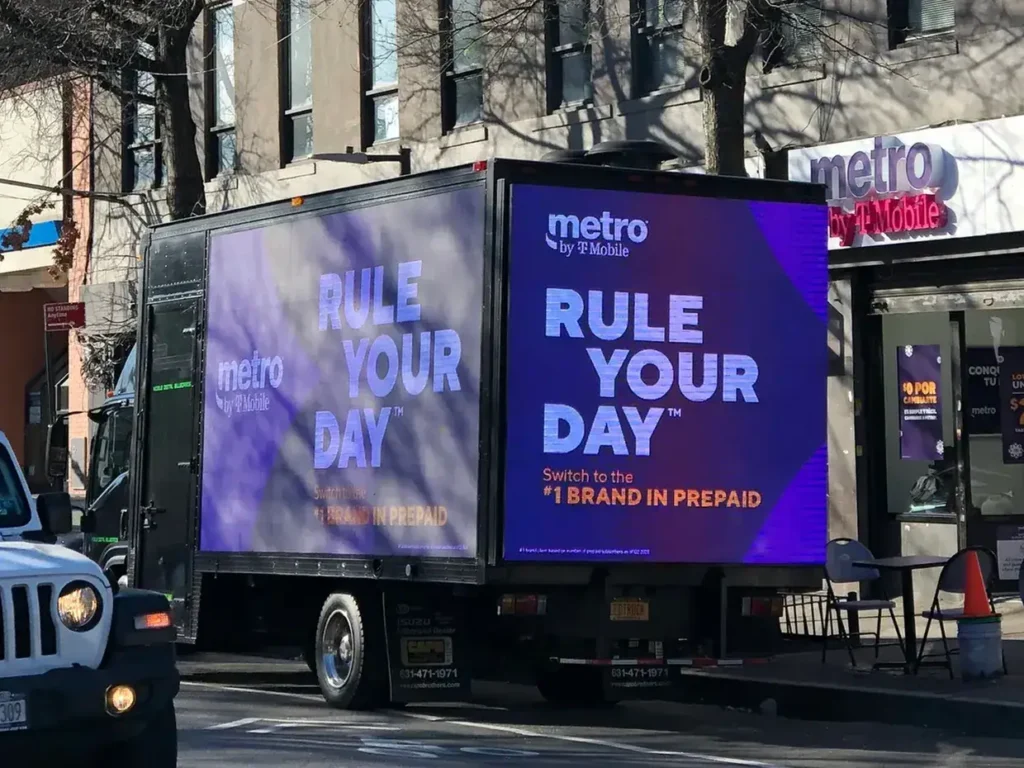
Seattle Mobile Billboards: LED Truck Advertising 2026
Seattle’s tech-heavy economy, walkable core neighborhoods, and culturally active population make it a strong mobile billboard market. Knowing where the audience is — and when — is what separates a campaign that lands from one that circles the wrong blocks all day.
Seattle is a mid-size city with a major-market demographic profile. The concentration of Amazon, Boeing, Microsoft, and dozens of high-growth tech companies in the metro area has produced one of the highest median household income levels of any city in the country. The creative and cultural community centered around Capitol Hill, Fremont, and Ballard represents a distinct and valuable consumer segment. Together, these two demographic pools — the tech professional and the Pacific Northwest creative — give mobile billboard advertisers in Seattle access to audiences that most brands actively want to reach.
The format works differently here than in New York or Los Angeles. Seattle is more compact and less dense, which means a single truck can cover more of the city’s key zones in a single day. But the city’s terrain — hills, water, and a street layout that does not follow a simple grid — requires specific route knowledge that generic planning cannot provide. AGM covers how the Seattle market actually works for mobile billboard campaigns.
Seattle’s Geography for Mobile Billboard Campaigns
Seattle’s core is organized around several distinct geographic zones separated by waterways, topography, and highway infrastructure. Understanding how these zones connect — and which ones are actually navigable for a box truck — is the foundation of effective route design.
Downtown Seattle and Belltown
Downtown Seattle runs from Pike Place Market at the north end through the retail core along Pine Street and Pike Street to the Westlake Center area. The immediate downtown generates moderate to high foot traffic on weekdays, with retail workers, tourists visiting Pike Place, and office workers in the surrounding blocks. Belltown, immediately north of downtown, carries a slightly younger and more bar-and-restaurant-oriented demographic.
The 3rd Avenue and 4th Avenue corridors through downtown are the primary truck routes through the core. The hills that drop sharply toward the waterfront limit access to some western blocks, but the main commercial streets are viable for box trucks.
Capitol Hill
Capitol Hill is consistently the most valuable mobile billboard zone in Seattle. The neighborhood on the ridge east of downtown combines dense residential population with the city’s most active bar, restaurant, music, and arts scene. Broadway is the main commercial corridor, running north-south through the heart of the neighborhood. Pike and Pine Streets, crossing Capitol Hill east-west, anchor the busiest blocks of the neighborhood’s nightlife zone.
Capitol Hill draws a demographic that skews young (22-38), educated, culturally engaged, and high-income relative to age. For brands targeting this profile — tech products, fashion, music, food and beverage, personal care, financial products for younger audiences — Capitol Hill is the highest-concentration zone in the city. Peak hours are afternoon through late evening, with weekend afternoons generating the most sustained foot traffic at street level.
South Lake Union
South Lake Union is Seattle’s primary tech office district. Amazon’s headquarters campus dominates the southern portion of the neighborhood, with thousands of employees moving through the area daily. The rest of the district is populated with mid-size to large tech companies, startups, and the supporting retail and restaurant infrastructure that has grown around the tech campus.
Campaigns targeting the tech professional audience should concentrate in South Lake Union during business hours. The area around Westlake Avenue, Dexter Avenue, and the Amazon campus blocks delivers the highest concentration of tech workers. Lunch hour (11:30 AM – 1:30 PM) is the best window for the strongest pedestrian concentration as workers move between buildings and restaurants.
Pioneer Square
Pioneer Square, just south of downtown, is Seattle’s historic arts and nightlife district. The neighborhood has an established gallery scene, several established music venues, and a bar scene concentrated around First Avenue and Occidental Avenue. The demographic skews creative and arts-oriented with a mix of long-term residents and spillover from downtown and Capitol Hill.
Pioneer Square is most active on Thursday through Saturday evenings when gallery openings, live music, and bar traffic converge. Campaigns with an arts, music, or nightlife association should route through Pioneer Square during these evening windows.
Fremont and Ballard
Fremont and Ballard, in Seattle’s north end, represent the outdoor recreation and craft beer culture that is distinctively Pacific Northwest. Fremont Avenue and 36th Street in Fremont carry a neighborhood commercial scene that skews active-lifestyle and independent-minded. Ballard’s Market Street is one of the most active independent restaurant and brewery corridors in the city.
For brands with outdoor, craft, sustainability, or independent-culture associations, Fremont and Ballard are the most brand-resonant zones in Seattle. Campaigns in these neighborhoods work on weekday evenings and weekend afternoons when the neighborhood audience is at street level.
Seattle’s summer months (June through September) transform the city’s outdoor spaces. The Parks, waterfront, and outdoor event venues generate massive foot traffic that almost no other season produces. Summer is AGM’s recommended window for maximum-reach Seattle campaigns.
Neighborhood
Primary Audience
Best Campaign Hours
Capitol Hill
Creative, LGBTQ+, young professional
2 PM – 11 PM daily
South Lake Union
Tech workers, Amazon employees
8 AM – 6 PM weekdays
Downtown / Belltown
Office workers, retail shoppers, tourists
11 AM – 7 PM daily
Pioneer Square
Arts, creative, nightlife
Thu-Sat 6 PM – 11 PM
Fremont
Outdoor/lifestyle, independent culture
12 PM – 8 PM weekends
Ballard
Craft culture, neighborhood residents
5 PM – 10 PM weekdays, all day weekends
Seattle Event Opportunities for Mobile Billboards
Seattle’s event calendar provides several recurring windows where mobile billboard campaigns can align with concentrated audience moments.
Climate Pledge Arena
Seattle’s top-tier indoor venue hosts NHL games (Kraken), concerts, and major touring shows. The arena is located in Seattle Center, just north of downtown, with Queen Anne and Lower Queen Anne neighborhoods surrounding it. Pre-event and post-event truck positioning near the arena access routes on 1st Avenue North and 2nd Avenue North delivers concentrated audience exposure during the highest-traffic windows of event days.
T-Mobile Park
T-Mobile Park, home of the Mariners, sits in the SoDo district south of downtown. The area around 1st Avenue South and Edgar Martinez Drive generates strong game-day foot traffic before and after games, particularly during the summer baseball season. Combining a pre-game positioned truck with a moving route through Pioneer Square during the same window covers both the sports audience and the neighborhood’s broader evening crowd.
Bumbershoot and Summer Festivals
Seattle Center hosts Bumbershoot (the city’s major music and arts festival) over Labor Day weekend. The surrounding Queen Anne and Belltown neighborhoods, plus the Seattle Center grounds, concentrate tens of thousands of festival-goers over three days. A truck campaign timed around Bumbershoot and positioned in the adjacent neighborhood corridors reaches a concentrated, culturally engaged audience at a defined time.
Weather Considerations for Seattle Mobile Billboard Campaigns
Seattle’s reputation for rain is real, particularly from October through April. Sustained rainfall affects mobile billboard campaigns in two ways: it reduces pedestrian foot traffic (fewer people at street level means less exposure per truck hour), and it puts stress on static vinyl panels over multiple days of wet conditions.
For year-round Seattle campaigns, LED panels are more reliable than static vinyl in rainy conditions because they are fully sealed and the display remains visible regardless of rain. For campaigns where timing is flexible, concentrating runs in the May through September dry season eliminates weather-related risk entirely and takes advantage of Seattle’s genuinely excellent summer conditions.
How AGM Runs Seattle Mobile Billboard Campaigns
AGM operates Seattle campaigns through a local operator network with vetted vehicles and drivers who know the city’s streets, hills, and traffic patterns. Route design for Seattle takes the city’s terrain into account — the steep grades near Capitol Hill, the waterfront limitations on the western edge, and the bridge and tunnel access requirements for reaching the Eastside — rather than treating Seattle like a flat-grid city.
All Seattle campaigns include GPS tracking, timestamped photo documentation, and a post-campaign report. For multi-day campaigns or campaigns that span both Seattle proper and the Eastside, AGM coordinates the full operation from a single point of contact.
Seattle’s Tech-Adjacent Consumer Demographics
One of Seattle’s most distinctive characteristics as a mobile billboard market is the spillover of the tech industry’s economic impact into the broader consumer market. The presence of Amazon, Microsoft, Expedia, Zillow, and dozens of high-growth tech companies in the metro area has created a broad consumer base with above-average income, high digital fluency, and significant spending power across categories that extend well beyond technology.
For consumer brands in food, apparel, outdoor gear, financial products, home furnishings, and personal care, Seattle’s tech-enriched consumer base represents a concentrated, high-value target that is more accessible through precise local advertising than through national buys that do not specifically target the Puget Sound market. Mobile billboard campaigns that reach this audience in their day-to-day environment — the South Lake Union lunch spots, the Capitol Hill coffee shops, the Bellevue retail corridor — create brand encounters that national outdoor buys cannot engineer.
The Amazon Effect on South Lake Union
Amazon’s headquarters campus has transformed South Lake Union from a light-industrial neighborhood into one of the densest office environments in the Pacific Northwest. Tens of thousands of Amazon employees move through the neighborhood daily. The restaurants and coffee shops along Westlake Avenue and Dexter Avenue serve this population during business hours. The residential buildings that have been built around the campus house thousands of Amazon and tech workers who live within walking distance of the office.
For brands targeting the tech professional demographic — consumer electronics, financial products, food delivery, professional services, lifestyle brands — South Lake Union during business hours is the most concentrated access point in the city. A truck stationed near the Amazon Spheres or running the Westlake Avenue corridor at lunch reaches an extraordinarily specific audience in a compact geographic area.
Seattle’s Outdoor Culture and Mobile Billboard Strategy
Seattle’s outdoor recreation culture — hiking, climbing, kayaking, cycling, skiing — creates a distinct consumer segment that is concentrated in specific neighborhoods and active during specific seasons. For outdoor gear, activewear, outdoor food and nutrition, and outdoor lifestyle brands, Seattle is one of the highest-value markets in the country.
The neighborhoods where this outdoor culture is most concentrated — Fremont, Ballard, Capitol Hill, Queen Anne, and the Eastside suburbs near the Cascade trailheads — are specific enough to plan precise mobile billboard routes around. A campaign targeting outdoor enthusiasts that routes through Fremont on a summer weekend afternoon will encounter a disproportionately high concentration of people who participate in outdoor activities relative to any random urban sample.
Seasonal timing matters for this demographic. Spring (April-May) is the period when outdoor enthusiasts are planning their summer activities and making gear purchases. Summer (June-September) is when they are most active and most receptive to outdoor-adjacent brand messaging. Fall (September-October) is the shoulder season for hiking and the beginning of ski gear buying. Aligning a mobile billboard campaign with these purchase timing windows increases the relevance of the advertising encounter.
Seattle’s outdoor culture and its tech culture overlap significantly. A demographic of outdoor-active tech workers in their 30s and 40s represents a high-income, brand-engaged consumer segment that responds to authenticity and quality over generic promotional advertising. Mobile billboard campaigns in Seattle that reflect this demographic’s values — precision, quality, real-world experience — outperform generic brand advertising in this market.
Practical Guide to Seattle’s Street Network for Mobile Billboard Campaigns
Seattle’s street layout presents specific navigation challenges that differ from grid-based cities. The city’s hills, waterways, and non-grid street pattern require route design that accounts for grade limitations and bridge access.
Hills and Grade Restrictions
Several of Seattle’s iconic neighborhoods are located on steep hills that create practical constraints for large vehicle navigation. The steep grade of Capitol Hill on the east side, Queen Anne on the north side, and the cliffs above the waterfront on the west side all require specific route knowledge to navigate safely in a box truck. AGM routes avoid grades that create unsafe conditions for the truck size being used.
Bridge and Water Crossings
Seattle is a city of water crossings. Moving between neighborhoods on different sides of Lake Union, Lake Washington, or Portage Bay requires bridge crossings that add time and logistical complexity to multi-neighborhood routes. Campaigns that span Capitol Hill and Fremont, or South Lake Union and Ballard, need route planning that accounts for the crossing time and traffic patterns at the relevant bridges.
Access to the Eastside
Reaching Bellevue and the broader Eastside — where Microsoft’s campus, Expedia’s headquarters, and a significant portion of the Seattle metro tech workforce are located — requires crossing Lake Washington via the I-90 or SR-520 floating bridges. Both bridges carry significant traffic during commute hours. Campaigns that include Eastside coverage should account for bridge crossing times in the daily route plan.
Seattle’s Creative Industry and Mobile Billboard Advertising
Beyond the tech sector, Seattle has a substantial creative industry that includes film and television production, gaming (home to Bungie, Valve, and a cluster of gaming studios), music (the city that produced Nirvana, Soundgarden, and Pearl Jam has a current music scene that remains culturally significant), visual arts, and design. This creative community concentrates in Capitol Hill, Fremont, and the Central District and represents a valuable consumer and professional demographic for specific categories of advertiser.
For gaming companies, entertainment brands, music labels, creative tools and software, and brands that want genuine association with creative culture, Seattle’s creative industry neighborhoods are high-value campaign zones that are distinct from the tech professional audience in South Lake Union. The overlap between tech and creative is significant — many Amazon and Microsoft employees are also gamers, music fans, and arts consumers — but the creative industry audience in Capitol Hill and Fremont is more purely culture-oriented and carries a different brand receptivity profile than the tech campus professional.
Gaming company campaigns in Seattle should prioritize PAX West (the major gaming convention held in Seattle each September) as a campaign timing anchor. PAX West draws 70,000+ attendees to the Washington State Convention Center in downtown Seattle and creates one of the highest concentrations of the gaming target demographic anywhere in the country during its four-day run. Mobile billboard campaigns timed to PAX West and positioned in the convention center’s surrounding corridors and the adjacent Capitol Hill neighborhood reach the gaming audience at its highest-concentration moment in the Pacific Northwest.
Seattle’s Waterfront and Summer Outdoor Campaign Opportunities
Seattle’s relationship with its waterfront transforms dramatically in summer. The central waterfront along Alaskan Way, the Great Wheel, Pike Place Market’s waterfront staircase, and the Olympic Sculpture Park all generate summer foot traffic that is among the highest of any location in the city. The opening of the Seattle waterfront redevelopment has significantly increased the area’s pedestrian capacity and activity.
Summer campaigns that include the waterfront corridor — trucks routing along Alaskan Way and through the Pike Place Market area — reach a combination of tourists, locals taking advantage of the summer weather, and the outdoor dining audience at the fish-and-chips restaurants and coffee shops that line the waterfront. This is Seattle’s most tourist-accessible zone and reaches a demographic that is both in a leisure mindset and highly engaged with the city’s visual environment.
The Lake Union waterfront in South Lake Union is a different but also valuable summer campaign zone. Lake Union Park, the houseboats on the lake, and the outdoor dining along the waterfront create summer foot traffic that is more locally oriented than the central waterfront tourist mix. MOHAI (Museum of History and Industry) at Lake Union Park anchors the area’s cultural draw. A summer afternoon truck campaign that routes through South Lake Union and along the Lake Union waterfront reaches a mixed audience of tech workers, families, and locally-oriented leisure seekers.
Multi-Day Seattle Mobile Billboard Campaign Structure
For brands that want to build sustained awareness in Seattle over a campaign week rather than a single high-impact day, multi-day campaign structures should be planned with variation built in rather than running the same route on repeat days. The same route running on five consecutive days builds frequency with residents who follow that route regularly, but misses the portions of the target audience who are only in those areas on specific days of the week.
An effective multi-day Seattle campaign structure rotates through different neighborhood combinations on different days. For example: Day 1 covers Capitol Hill and the Central District; Day 2 covers South Lake Union and downtown; Day 3 covers Fremont and Ballard; Day 4 covers the Eastside (Bellevue and Redmond); Day 5 returns to Capitol Hill for a second weekend coverage day with higher Saturday foot traffic than the weekday run. This rotation builds cumulative coverage across Seattle’s key zones while also delivering frequency in the highest-priority zones.
For event-adjacent campaigns, the multi-day structure aligns with the event calendar rather than neighborhood rotation. If a major event occupies the same venue for multiple days (a multi-day festival, a sports series, a multi-day conference), the campaign concentrates near the venue on event days and uses remaining campaign days for broader neighborhood coverage.
Seattle Mobile Billboard Campaigns for Tech Product Launches
Seattle’s position as a tech industry hub makes it one of the most important markets for technology product launch campaigns targeting both consumers and industry professionals. When a consumer technology company launches a new product in Seattle, they are advertising simultaneously to the tech-savvy general population and to the tech industry workers who will influence product adoption among their networks and communities.
Tech product launch campaigns in Seattle that want to reach both audiences need a route that covers the consumer zones (Capitol Hill, Fremont, the Eastside retail corridors) and the professional zones (South Lake Union, the Amazon and Microsoft campus areas, Redmond’s tech corridor). This dual coverage is achievable in a single multi-day campaign by sequencing the route to cover professional districts during business hours and consumer neighborhoods during evenings and weekends.
The documentation from tech product launch campaigns in Seattle also serves a secondary audience: the tech industry media concentrated in the city. Journalists, bloggers, and industry analysts who see the truck in South Lake Union or Fremont may photograph or mention it in coverage. This organic media value is more pronounced in Seattle than in most other markets because of the concentration of tech-focused media and the high sensitivity of Seattle’s tech community to new product announcements from companies whose products they use professionally.
AGM has executed tech product launch campaigns in Seattle for consumer hardware, software platforms, mobile applications, and enterprise products. The campaign structure varies by target audience (consumer vs. professional) and campaign objective (awareness vs. influencer reach), but the documentation and reporting standards are consistent across all campaign types.
Comparing Seattle Mobile Billboard Rates to Other Pacific Northwest Markets
Seattle is the largest and most expensive mobile billboard market in the Pacific Northwest, but it is not the only viable market in the region. Portland, Oregon, which is approximately 2.5 hours south of Seattle, is a mid-size market with a distinctive culture, strong local brand loyalty, and mobile billboard infrastructure that makes it a cost-effective addition to Pacific Northwest campaigns.
Portland’s mobile billboard market operates at lower day rates than Seattle, with particularly effective campaign zones in the Pearl District (Portland’s upscale urban neighborhood with high pedestrian foot traffic), the Alberta Arts District (independent arts and culture community with a creative professional demographic), and the Mississippi Avenue neighborhood (one of Portland’s most walkable commercial streets). For brands serving both the Seattle and Portland markets, running coordinated campaigns in both cities is more efficient through a single agency that coordinates both markets than through separate vendors in each city.
Vancouver, British Columbia, while a separate country with different operating requirements, is sometimes included in Pacific Northwest campaign planning for brands with Canadian operations. Cross-border campaign coordination requires attention to different advertising regulations and operational logistics, but the demographic and cultural similarities between Seattle and Vancouver make it a natural market extension for brands serving both the U.S. Pacific Northwest and British Columbia.
Seattle Mobile Billboard Campaign Documentation and Reporting
Documentation standards for Seattle mobile billboard campaigns follow the same framework as AGM’s standard across all markets, with a few Seattle-specific considerations. The city’s distinctive geography creates photo opportunities that are more visually compelling than in many other markets — the proximity of the Olympic Mountains, Mount Rainier visible from key vantage points on clear days, the dramatic waterfront views, and the recognizable architecture of the downtown skyline all provide compelling backdrops for campaign photography.
AGM’s Seattle campaign documentation specifically identifies photo locations that capture both the truck’s creative and Seattle’s distinctive visual context. An image of a branded truck with the Space Needle visible in the background, or on the Pike Street market overpass with Elliott Bay in the frame, creates documentation that has both functional verification value and strong social media content value. Planning these specific photo locations into the campaign brief — and briefing the driver or photographer on capturing them — is a small planning step that significantly increases the quality and usability of post-campaign documentation.
GPS route maps for Seattle campaigns require more interpretation than for grid-based cities because the routes are less visually intuitive on a map. AGM’s post-campaign reports for Seattle campaigns include written route notes alongside the GPS maps to explain the logic of each route segment — why the truck went where it went and what audience the route was designed to reach at each stage of the day. This contextual explanation makes the GPS documentation more meaningful for clients who are reviewing it as part of a post-campaign evaluation.
Seattle Mobile Billboards: A Quick-Reference Market Guide
For brands planning their first Seattle mobile billboard campaign, this quick-reference summary covers the key market parameters.
Primary campaign zones: Capitol Hill (creative/LGBTQ+/young professional, best in afternoons and evenings), South Lake Union (tech professional, best during business hours), Pioneer Square and Belltown (arts/nightlife, best evenings), Fremont and Ballard (outdoor culture/independent lifestyle, best weekends and evenings). The Eastside cities of Bellevue and Redmond add Microsoft campus and suburban tech professional coverage.
Best campaign seasons: Summer (June-September) for maximum outdoor foot traffic. Spring and fall for balanced weather and local audience (not tourist-heavy). Winter campaigns are possible but have weather risk and lower foot traffic in outdoor zones.
Operational notes: Seattle’s hills and non-grid streets require route confirmation for truck access. The city is more compact than Los Angeles or New York, so a well-planned route can cover multiple key zones in a single day without the transit time penalties common in sprawling markets. Waterfront access is convenient from downtown. Eastside access adds bridge crossing time to routing calculations.
Campaign lead times: Standard static campaigns require 10-14 business days from confirmed booking to campaign start. LED campaigns with existing creative can launch in 7-10 days. Event-adjacent campaigns near Climate Pledge Arena or T-Mobile Park should be booked at minimum 3 weeks before the event date to ensure truck availability and parking logistics on the event day.
Frequently Asked Questions
What neighborhoods in Seattle work best for mobile billboard advertising?
Capitol Hill is the most consistently high-value neighborhood for mobile billboard campaigns in Seattle — dense, walkable, and culturally active. South Lake Union delivers the tech professional audience during business hours. Pioneer Square and Belltown are strong for evening campaigns. Fremont and Ballard reach a creative and outdoor-oriented demographic.
How does Seattle’s rain affect mobile billboard campaigns?
Seattle’s rainy season runs roughly October through April. Static vinyl panels can handle moderate rain, but sustained heavy rain reduces pedestrian foot traffic and can affect vinyl tension over time. LED panels are sealed and perform better in rain. Summer campaigns (May through September) operate in the most reliable conditions.
Is the tech audience in Seattle accessible via mobile billboard advertising?
Yes. South Lake Union is the primary location for major tech employers in Seattle, including Amazon’s campus. Routes through South Lake Union during business hours and at lunch concentrate the campaign in front of a high density of tech and professional workers.
Does AGM run mobile billboard campaigns in Seattle?
Yes. AGM operates Seattle mobile billboard campaigns through a vetted local operator network with full route design, GPS tracking, and photo documentation.
Can mobile billboard trucks reach Bellevue and the Eastside from Seattle?
Yes, via the I-90 or SR-520 bridges. The Bellevue downtown core and the Redmond corridor (near Microsoft’s campus) are viable additions to Seattle campaigns for brands targeting the full Puget Sound tech and professional audience.