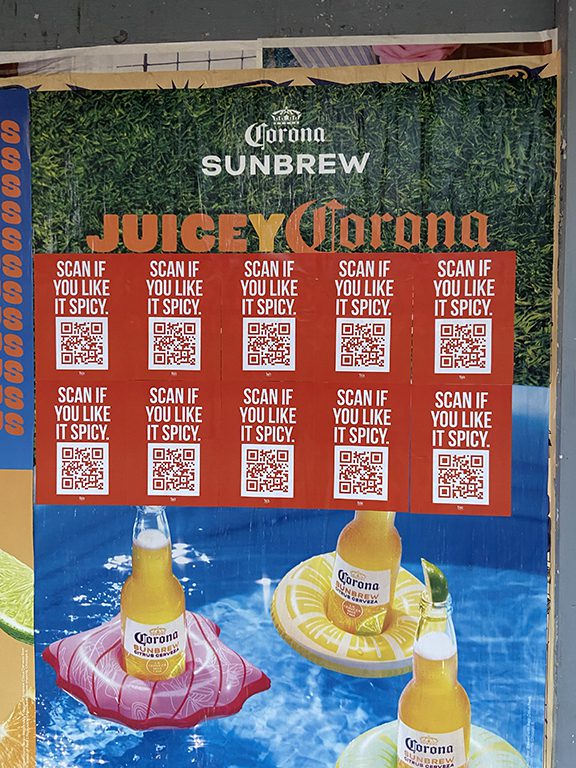
Most roadside advertising reaches drivers moving at 60 mph with their minds elsewhere. The street-level alternative puts brands in front of people who are walking, looking, and actually receptive to what they encounter.
Roadside marketing covers a wide range of outdoor advertising formats: highway billboards, transit shelter posters, bus wraps, roadside signage, and the many variations of print and digital display that appear in the visual corridor of streets and roads. The term is broad enough to include both mass-reach awareness formats and the highly targeted, pedestrian-scale formats that we execute every day for brands in New York, Los Angeles, Chicago, Miami, and other major markets.
The most important distinction in roadside marketing is the difference between vehicular-speed advertising and pedestrian-speed advertising. These two formats serve fundamentally different purposes, create fundamentally different kinds of brand encounters, and should be planned and evaluated on fundamentally different criteria. Understanding that distinction is the starting point for making intelligent roadside marketing decisions. We work in the pedestrian-speed end of the spectrum, and we have spent ten years learning exactly what that distinction means for brand recall, audience engagement, and campaign ROI.
The Vehicular-Speed versus Pedestrian-Speed Distinction
A driver passing a billboard at 60 miles per hour has approximately three seconds of potential exposure to the message on that board, assuming they are looking in the right direction at the right moment. The practical window for message delivery is a single bold visual and four to six words of text. Anything more complex than that is not processed before the car has moved past. The format is awareness at scale, built for repetition and simplicity.
A pedestrian walking past a well-placed street-level poster or approaching a brand street team has a fundamentally different exposure window. They are moving at three to four miles per hour. They can stop. They can read. They can interact. They can photograph. They can ask a question. The format is capable of delivering complex messages, creating personal interactions, generating organic social documentation, and producing the kind of direct brand encounter that actually drives behavior rather than just building passive awareness.
These two formats are not interchangeable. A brand that runs a billboard campaign and a street-level guerrilla campaign is running two different kinds of media that serve different purposes. Evaluating the guerrilla campaign by billboard metrics, or vice versa, produces misleading conclusions about both. We help brands understand what each format is actually delivering so they can evaluate and optimize each appropriately.
Core Roadside Marketing Formats
Highway and Freeway Billboards
Highway billboards are the highest-reach, lowest-depth format in outdoor advertising. They build awareness at scale through repetition, which works well for brands with very simple messages that benefit from broad geographic reach. In markets where the target consumer is primarily car-dependent, they are often the most efficient awareness format available. In dense urban markets where car traffic does not represent the primary movement pattern of the target audience, their efficiency drops significantly.
For brands whose target audience is concentrated in dense urban neighborhoods, highway billboards are often a poor fit. The person walking through Williamsburg or the Fairfax District is not in their car when they are most accessible to the brand. The billboard on the BQE reaches them during a commute, in a mental state that is not receptive to the brand message, at a moment when they have zero ability to act on whatever they see. The guerrilla marketing placement in their neighborhood reaches them when they are walking, browsing, socializing, and receptive.
Transit Shelter Advertising
Transit shelter advertising occupies a middle position between vehicular and pedestrian speed. The people waiting at a bus or subway stop are stationary, which means their exposure window is essentially the full duration of their wait. They have nothing to do but look. Transit shelter advertising that is placed at stops serving the right demographic, with creative designed to hold attention over a thirty-second to three-minute wait, can be a highly effective format for brands whose target audience uses public transit.
The limitation of transit shelter advertising is that the format is highly standardized. The boards at every shelter are the same size, in the same orientation, with the same visual context. There is limited ability to differentiate your placement from the previous advertiser’s placement in the same location. The format is reliable but not surprising, which means it rarely generates the organic social documentation that more unexpected street-level placements produce.
Bus and Vehicle Wraps
Vehicle wraps create a mobile billboard that moves through the city rather than waiting for the city to move past it. A well-designed bus wrap on a high-frequency route in a target neighborhood creates repeated brand exposures for everyone on that route over the campaign period. The format is particularly effective in cities where specific bus routes serve highly concentrated demographic corridors.
Brand-wrapped vehicles, specifically campaign-branded trucks, vans, or cars parked at strategic locations rather than moving on routes, are one of the most effective hybrid formats we use. A vehicle wrapped in brand creative and positioned at a corner adjacent to a transit entrance, or in front of a targeted retail cluster, creates a static visual presence at pedestrian scale while also generating the attention that a distinctively branded vehicle naturally attracts.
Street-Level Postering and Guerrilla Placements
Street-level postering on boards, walls, construction barriers, and free-standing structures in pedestrian-dense neighborhoods is the format where guerrilla marketing most directly competes with conventional roadside advertising. The advantages are significant. Street-level placements in culturally specific neighborhoods reach the exact right audience at walking speed, where they can engage fully with the message. The creative can be more complex than a highway billboard. The placement can be chosen with a specificity that no standardized outdoor advertising network can match.
The disadvantage of non-standardized street-level placements is that they require operational expertise to execute correctly. Identifying the right locations, accessing the available surfaces, installing correctly, and maintaining placements through the campaign run all require local market knowledge and professional field teams. That is what we provide. The brands that try to execute street-level postering campaigns without the infrastructure to do it properly produce campaigns that look amateur and reflect poorly on the brand.
AGM Field Note: One of the most consistent observations we make when inheriting campaigns from brands that tried to self-execute is location selection based on availability rather than audience. They placed wherever they could get space, rather than identifying where their audience is and then finding space there. These are opposite approaches and they produce opposite results.
Roadside Marketing by Target Audience Type
Audience Type
Primary Movement Pattern
Best Roadside Format
Key Locations
Young urban professionals
Pedestrian, transit
Street-level postering, street teams
Cultural neighborhoods, transit hubs
Creative class, artists
Pedestrian, cycling
Wheat paste, ambient
Arts districts, gallery corridors
Suburban commuter
Car, commuter rail
Highway billboard, transit shelter
Freeway corridors, commuter stations
College and young adult
Pedestrian, campus
Street-level postering, sampling
Campus adjacencies, student neighborhoods
Event attendees
Pedestrian, transit
Street teams, postering, projections
Event corridors, venue adjacencies
Street-Level Roadside Marketing in Major US Cities
New York City
New York is the most pedestrian-dense city in the United States, which makes it the strongest market for street-level roadside marketing. The subway system moves several million people through the city daily, which means transit-adjacent placements at station exits reach massive volumes of pedestrian traffic at walking speed. Our primary pedestrian-scale placement zones in New York: the SoHo Broadway and Spring Street corridor, the Williamsburg Bedford Avenue strip, the Union Square perimeter, the Flatiron District at 23rd Street and 5th Avenue, and the Lower East Side Rivington and Orchard Street corridor.
In New York, highway and freeway billboard advertising is relevant primarily for brands targeting drivers on specific routes, which is a minority of the city’s population for most consumer categories. The most culturally influential New York audience, the young, creative, professional demographic that carries brand endorsement power, moves primarily on foot and by subway. That is the audience that street-level roadside marketing reaches.
Los Angeles
Los Angeles presents the opposite challenge: the city is car-dependent at a scale that makes pedestrian-scale street marketing a precision exercise rather than a broad coverage strategy. Highway and freeway billboards in LA are genuinely relevant for mass-audience brands because most of the city’s population spends significant time in their cars. The specific pedestrian corridors that support street-level marketing are well-defined and require neighborhood-specific knowledge to target correctly.
Our street-level roadside marketing zones in Los Angeles: Melrose Avenue and Fairfax Avenue in the Fairfax District, Abbot Kinney Boulevard in Venice, the Arts District in Downtown LA along Traction Avenue and Mateo Street, and the Sunset Boulevard corridor in Silver Lake. These zones have genuine foot traffic and culturally engaged pedestrian audiences that support street-level placements. Outside of these zones, the format’s effectiveness drops sharply because the pedestrian density is insufficient to make the investment worthwhile.
Chicago
Chicago’s public transit system and its walkable commercial neighborhoods create strong conditions for street-level roadside marketing in specific zones. Wicker Park’s Milwaukee Avenue corridor, Pilsen’s 18th Street, Lincoln Park’s Armitage and Webster Avenue commercial strips, and the Michigan Avenue corridor in the Near North Side all support pedestrian-scale advertising with the foot traffic and audience quality to justify the investment. Chicago’s transit system is also a relevant placement medium: L train platform advertising and the transit shelter network on busy routes reach the pedestrian audience at scale across the city.
Miami
Miami’s roadside marketing environment is split between the high-foot-traffic zones of Wynwood, South Beach’s Lincoln Road, and Brickell, and the car-dependent suburban corridors that make up the majority of the metro area’s geography. For brands targeting the culturally engaged, social-media-active audience in Miami, street-level placements in Wynwood and Lincoln Road consistently outperform highway advertising in the same market, because the audience that drives brand conversation in Miami is concentrated in those pedestrian zones.
Roadside Marketing at Events and Festivals
Major outdoor events and festivals create temporary roadside marketing environments that differ significantly from the baseline conditions in their host cities. During a major festival, the audience density along the approach corridors spikes dramatically. The pedestrian mode of movement that makes street-level advertising effective replaces the vehicle-dominant traffic patterns that define those same corridors on non-event days. And the audience is in a heightened state of social and cultural engagement that makes them more receptive to brand encounters than they are in their everyday commuting and shopping routines.
The approach corridors are the highest-value roadside marketing zones during festival periods. In New York during major events at Central Park or the Hudson River waterfront, the pedestrian corridors approaching the event sites see foot traffic volumes that rival the city’s busiest commercial streets. In Chicago during Lollapalooza, the streets around Grant Park carry the full festival audience between the lakefront venue and the surrounding neighborhoods. In Miami during Art Basel, the streets of Wynwood, the Wynwood Walls approach, and the Miami Beach convention center approach carry the most culturally engaged and socially active audience of any week in the city’s calendar.
Planning roadside marketing around major events requires knowing the approach routes before the event takes place. We conduct advance scouting of the approach corridors for major events in the cities where we operate, identifying the specific placement locations along those routes that will see the highest traffic concentration during the event period. The scout also identifies the timing: how early before the event do people begin moving through the approach corridors? How long after does pedestrian traffic in the zone remain elevated? The answers shape the campaign timeline and the installation schedule.
Brand-wrapped vehicles are particularly effective during event periods because they can be repositioned in real time to stay with the highest traffic concentrations. A vehicle that moves from the main approach corridor to a secondary egress route as the event ends catches the departing audience in a location that static placements might not cover. The flexibility of mobile formats is a genuine advantage during events where pedestrian flow patterns change significantly over the course of a day.
What Street-Level Roadside Marketing Delivers That Billboards Do Not
The fundamental difference between highway billboard advertising and street-level guerrilla roadside marketing is the quality of the brand encounter it creates. This is not about which format is objectively better; it is about which format is right for the specific campaign goal and the specific audience being targeted.
Street-level roadside marketing creates encounters at human scale. The person walking past a well-placed, well-designed poster in their neighborhood is in physical proximity to the brand message, moving slowly enough to absorb it, in a context where the placement has been chosen for its relevance to their demographic and lifestyle. The encounter has the intimacy and specificity that highway advertising cannot produce.
Street-level placements in culturally relevant neighborhoods carry an implicit brand endorsement signal. The fact that a brand is present in Williamsburg, or on Fairfax, or in Wynwood says something about the brand’s self-understanding. It signals that the brand knows who it is and knows where its people are. That signal is part of the message, and it is entirely absent from highway advertising, which is democratically indifferent to cultural geography.
Street-level placements generate organic social documentation in a way that highway advertising does not. People photograph interesting things in their neighborhood. They do not photograph billboards on the expressway. The organic reach generated by a striking street-level placement in a culturally active neighborhood can significantly exceed the direct foot traffic reach of the placement itself. That amplification multiplier is one of the primary value drivers of guerrilla roadside marketing relative to conventional outdoor formats.
The Case for Pedestrian-Speed Roadside Marketing in the Digital Era
The context for outdoor advertising has changed significantly in the past decade in ways that make street-level pedestrian advertising more valuable relative to other formats. The growth of digital advertising created an expectation, largely unmet, that digital channels would replace outdoor advertising as the primary medium for brand awareness. What actually happened is more nuanced: digital advertising saturated to the point of declining effectiveness as audiences developed avoidance behaviors, while physical advertising, specifically the unexpected and high-quality street-level variety, became more valuable because it remained genuinely surprising to the audience in a media environment where nothing else was.
The audience that guerrilla marketing targets, specifically the culturally engaged, urban, socially active consumer who drives cultural trends and brand adoption, is the most digitally sophisticated and ad-literate demographic in the country. They are the most effective at tuning out digital advertising. They are the least likely to be moved by a CPM-optimized retargeting campaign. And they are, paradoxically, the most receptive to physical brand encounters in the cultural spaces they actually inhabit, because those encounters are still genuinely unexpected in a way that nothing digital is anymore.
This dynamic creates a structural advantage for brands willing to invest in high-quality street-level roadside marketing. The competition for attention at street level in culturally specific neighborhoods is lower than the competition for the same audience’s attention online. The brand that runs a well-produced campaign on the right blocks in Williamsburg is not competing against thousands of other brands for the same viewer’s attention in a fraction of a second. It is occupying physical space in the audience’s physical environment, where the encounter happens at human scale and human speed, and where the memory formed is of a fundamentally different quality than a digital impression.
Planning a Street-Level Roadside Marketing Campaign
Street-level roadside marketing campaigns are planned through the same operational framework as any other guerrilla marketing campaign. The foundation is the audience and location analysis: who is the target audience, where do they physically move through the city, and which specific streets and blocks within those zones offer the best combination of foot traffic volume, surface availability, and cultural relevance for the brand?
The location scout answers these questions at the operational level. We walk the target neighborhoods at the times of day when the campaign will run, observe actual foot traffic patterns, identify available placement surfaces, assess the competitive advertising environment, and document the specific blocks that meet the campaign’s requirements. The scout report gives the brand a clear picture of exactly where the campaign will run and the specific rationale for every placement decision.
Production standards for street-level roadside marketing are identical to the standards we apply to any other outdoor advertising format: materials selected for weather resistance and UV stability in the specific market’s climate conditions, print quality that holds color accuracy at outdoor scale, and installation quality that makes every placement look as good in person as it does in the pre-campaign approval. The visible quality of the campaign’s physical execution is itself a brand signal, and it should reflect the brand’s standards accurately.
Campaign monitoring during the run tracks placement condition, organic social documentation volume, and any market-specific feedback from our field teams. If a high-performing placement is damaged or removed during the campaign run, we know it and replace it. If a specific location is generating high organic social documentation, we prioritize its maintenance and can expand adjacent to it if additional surfaces are available. Passive installation and abandonment is not how we run campaigns.
Integrating Street-Level and Highway Roadside Marketing
The most effective roadside marketing campaigns for brands with both urban and suburban market coverage use both street-level and highway formats, each serving the specific audience segment and context it is best suited for. Highway billboards build broad awareness across the suburban and commuter population. Street-level campaigns build deep credibility and direct engagement with the urban cultural audience. The two formats are not redundant; they serve genuinely different audiences through genuinely different mechanisms.
When budget allocation between the two formats is contested, we advise based on the specific audience profile for the campaign. A brand targeting a primarily urban, pedestrian-movement audience should allocate the majority of the outdoor budget to street-level placements and treat highway advertising as supplementary reach. A brand targeting a primarily suburban, car-dependent audience should reverse that allocation. A brand targeting both should build separate channel strategies for each, evaluated independently against audience-appropriate metrics rather than compared using the same measurement framework.
The Production Chain Behind Effective Street-Level Roadside Marketing
Street-level roadside marketing production involves a chain of decisions that collectively determine the quality of what actually appears on the wall or on the street. Understanding this production chain helps brands allocate time and budget realistically and avoid the compressions that cause campaign quality to drop at the point where quality matters most: the public-facing execution.
Creative development for street-scale materials requires different attention than creative for digital or print publication. The visual needs to be tested at the actual output scale under actual outdoor light conditions before the production run is approved. Colors shift between monitor-calibrated digital files and large-format outdoor print. Contrast ratios that look strong on a screen can lose legibility in direct sun. Text that reads clearly at arm’s length may be illegible at twenty feet. These problems are common and entirely preventable if the creative is tested at scale before production runs begin. We test all creative at actual output scale as a standard part of every campaign’s production workflow.
Print production at outdoor advertising standards uses paper weights, ink formulations, and protective finishes specific to the outdoor exposure conditions of each market and each installation method. Weather conditions, duration, and installation surface type all affect material selection. A campaign designed to run for four weeks in Miami in July needs different material specs than one running for two weeks in New York in October. We specify materials for the specific conditions of each campaign and work with print vendors who produce at consistent quality to those specifications.
Installation scheduling is the final production variable. The timing of installation relative to the campaign launch, the weather conditions during the installation window, and the availability of the installation crew in each market all need to be coordinated to ensure that materials appear on the right surfaces in the right locations on the right days. Installation is not the last-minute logistical task it is often treated as. It is an operational step that requires the same planning discipline as every upstream step in the production chain.
Frequently Asked Questions
What is roadside marketing?
Roadside marketing refers to advertising that reaches consumers through physical placements in the visual corridor of streets and roads. The term covers formats from highway billboards to street-level posters, transit shelter advertising, vehicle wraps, and pedestrian-scale guerrilla placements. The most important variable within roadside marketing is whether the format operates at vehicular speed or pedestrian speed, because this determines the depth of brand encounter the format can create.
Is roadside marketing the same as out-of-home advertising?
Roadside marketing is a subset of out-of-home advertising. Out-of-home advertising includes any advertising seen outside of the home, which covers everything from highway billboards to airport advertising to venue screens. Roadside marketing specifically refers to the advertising formats in the visual environment of streets, roads, and transit corridors.
How does street-level marketing outperform highway billboard advertising for urban brands?
In dense urban markets where the target audience moves primarily on foot or by transit, highway billboard advertising reaches the audience during commutes in a mental state that is not receptive to the brand message. Street-level marketing reaches the same audience in their neighborhood at walking speed, where they are engaged with their environment and capable of absorbing a brand message. The brand recall generated by a street-level encounter in a relevant neighborhood consistently outperforms the recall generated by a vehicular-speed impression from the same demographic.
What makes a good street-level roadside marketing placement?
The right location is the most important variable. A good placement is in a neighborhood where the target audience has high movement frequency during the campaign period. The surface is visible to foot traffic at an appropriate viewing angle and distance. The competitive advertising environment is not so saturated that the placement cannot stand out. And the cultural context of the neighborhood is appropriate for the brand’s identity and message.
Can roadside marketing work in both urban and suburban markets?
Yes, but the format mix changes significantly. In dense urban markets, street-level pedestrian formats produce the strongest results because the target audience moves on foot. In suburban markets where the target audience is primarily car-dependent, highway billboard and high-traffic arterial advertising are more appropriate. Most brands targeting both urban and suburban audiences need different format strategies for each market type.
How do you measure roadside marketing campaign effectiveness?
We measure brand recall through surveys with the target demographic in markets where the campaign ran, organic social documentation volume for street-level placements, and client-provided commercial metrics where available. We do not use raw impression counts or DEC (daily effective circulation) estimates as primary performance metrics because they measure exposure volume rather than brand impact.
How much does a street-level roadside marketing campaign cost?
Cost depends on the format, the market, the scale, and the duration. A focused postering campaign in a single neighborhood in New York or Los Angeles is the lowest-cost entry point for professional guerrilla roadside marketing. Multi-format, multi-market campaigns scale up from there. Contact us at (646) 776-2770 for a scope-specific estimate.
We have ten years of location-specific knowledge in every major US market where we operate. We know which blocks in which neighborhoods generate the strongest brand encounters for which audience profiles. We run our own crews rather than subcontracting, which means consistent execution quality and real accountability. And we report honestly on what each campaign delivered, including what did not perform as expected.