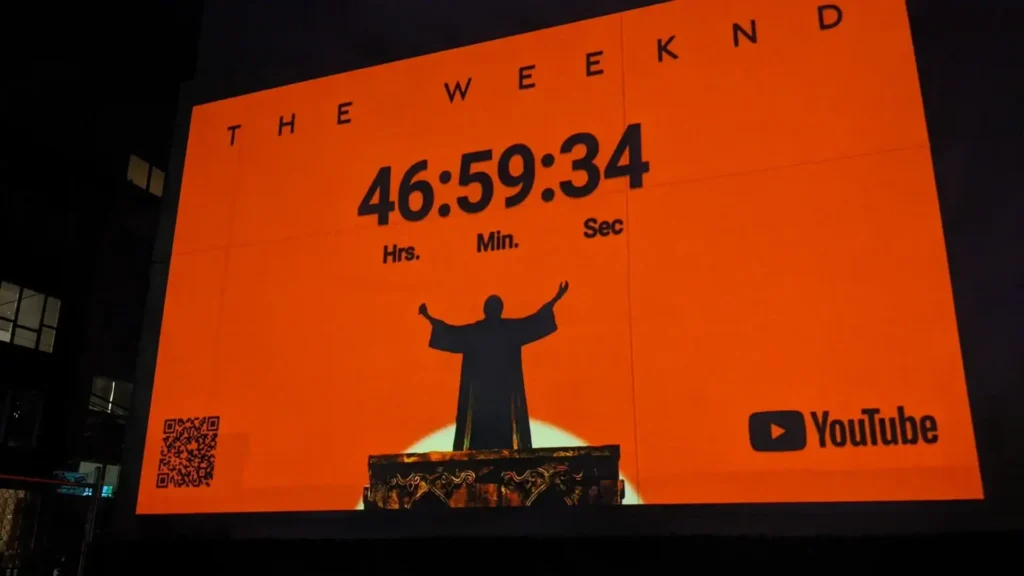
There is a category of advertising that does not ask for attention — it commands it. Not through volume, frequency, or algorithmic targeting, but through sheer visual spectacle. A brand projected across the face of an entire city block. A logo blazing across a bridge tower in full color. An animated product reveal flowing across a landmark building that people have walked past a thousand times and never looked at twice.
Projection media is the most visually arresting format in guerrilla advertising. It transforms environments — buildings, bridges, public squares, historic facades — into temporary brand canvases of a scale that no physical installation or digital display can replicate. And it does something no other format reliably accomplishes: it makes bystanders stop, stare, pull out their phones, and share what they are seeing before the brand has spent a dollar on social media amplification.
Our team at American Guerrilla Marketing executes projection advertising campaigns across major U.S. markets. We handle location scouting, permitting coordination, equipment selection and deployment, content technical review, and full campaign documentation. Here is how projection media works, why it works, and how to use it effectively.
What Is Projection Advertising and How Does It Work
Projection advertising uses high-powered projectors — ranging from standard event projectors to industrial-grade units capable of covering 10-story building facades — to display brand imagery, video content, or animated campaigns onto any large, light-receiving surface.
Equipment and Technology
The core technology in projection advertising is the projector itself. Consumer-grade projectors output 2,000-5,000 lumens — sufficient for indoor presentations but completely inadequate for outdoor urban projections where ambient light competes. Professional outdoor projection advertising uses units ranging from 10,000 to 100,000+ lumens, capable of maintaining visibility on large surfaces even in partially lit environments.
Modern projectors support high-definition image and video content (1080p and 4K), ultra-short throw configurations for tight urban spaces, and wireless content management systems that allow content changes without physical access to projection hardware. LED-based projection technology has dramatically improved energy efficiency and lamp longevity compared to earlier xenon-lamp systems.
Surface Selection
Not all surfaces project equally. Light-colored smooth surfaces (white or light gray stone, concrete, painted walls) produce the highest image brightness and color accuracy. Dark surfaces absorb light and produce significantly dimmer projections. Textured surfaces create visual artifacts that reduce image clarity. Our location scouting process evaluates surface color, texture, and angle before committing to any projection site.
Content Requirements
Projection media content must be engineered for the format. High contrast, bold typography, and limited color palettes perform best. Complex, detail-rich imagery loses definition at large scale and in ambient light conditions. Content designed for screens — small, high-resolution, viewed at close range — rarely translates effectively to building-scale projection without significant redesign for the format.
Why Projection Media Creates Disproportionate Brand Impact
Projection advertising’s effectiveness as a marketing format is not primarily about the impressions it generates during the live deployment. It is about what those impressions create in downstream channels.
Organic Social Amplification
People film projection advertising. They photograph it. They tag it on Instagram, post it on TikTok, and share it to their stories. A well-executed projection in a high-foot-traffic urban location will generate dozens to hundreds of organic social media posts from bystanders who witnessed it — posts that carry all the credibility of user-generated content because they are user-generated content. The brand does not pay for this amplification. The spectacle earns it.
Earned Media Coverage
Large-scale, well-executed projections in prominent urban locations attract local media coverage. A brand projection on a notable building in a major city is news — especially when the creative is visually striking or the timing aligns with a culturally relevant moment. Earned media exposure from a single night’s projection can reach audiences many times larger than those who witnessed the live event.
Event Amplification
When projection advertising coincides with an event — a product launch, a concert, a sporting event, a brand anniversary — it transforms the event environment into a branded spectacle. Attendees at a venue with a projection advertising display become participants in a brand experience, not passive observers of an advertisement. That participation generates stronger brand recall and more motivated social sharing than passive exposure.
Scale Creates Credibility
There is a psychological effect at work when a brand appears at large scale in a prominent urban location. Scale signals investment, which signals seriousness. A brand that projects its image across a building in a major city is not a brand that is uncertain about itself. The scale of the display communicates the scale of the commitment, which influences how consumers perceive the brand’s market position and credibility.
Types of Projection Advertising Executions
Projection media campaigns take several distinct forms depending on the campaign objective, budget, and deployment environment.
Building Facade Projections
The most common and highest-impact form of projection advertising: a high-powered projector aimed at a large building facade, displaying a brand image or animated loop for an extended activation window (typically 2-6 hours per night over one or multiple nights). Building facades offer the largest available canvas and typically the best ambient context for maximum visual impact.
Projection Mapping
Projection mapping (also called 3D projection mapping or spatial augmented reality) calibrates projection content to the specific geometry of the target surface — including architectural features, windows, corners, and irregular shapes — creating the illusion that the building itself is moving, transforming, or interacting with the projected imagery. Projection mapping produces the most visually spectacular effects but requires more complex content production and technical setup than standard building projections.
Guerrilla Projection
Smaller-scale, rapid-deployment projections — typically using 10,000-20,000 lumen portable units — on building walls, bridges, or public surfaces in high-foot-traffic urban areas. Guerrilla projections can be deployed and relocated quickly, making them suited to multi-location campaigns, event activations, and situations where large-scale fixed projections are not logistically or legally feasible.
Event and Venue Projection Integration
Projection advertising integrated into event environments — on stage backdrops, venue facades, event space walls, and outdoor amphitheater screens — amplifies event branding and creates shareable visual moments for attendees. This format works particularly well for launch events, concerts, sporting events, and brand-hosted experiences.
Location Strategy: Where Projection Advertising Works Best
The success of a projection campaign depends heavily on location selection. The wrong surface or the wrong environment dramatically reduces impact regardless of content quality or projector power.
High-Foot-Traffic Urban Locations
The highest-value projection locations combine a suitable surface (light, smooth, large) with high pedestrian density and natural dwell time — people who stop and spend time in the area rather than passing through quickly. Plazas, parks, waterfront areas, and entertainment districts offer the best combination of audience volume and dwell time.
Iconic Architecture as Context
Projecting on or near architecturally significant structures borrows the cultural equity of the building itself. A projection adjacent to a city landmark acquires the landmark’s association — scale, permanence, cultural significance — through proximity and visual context. Location selection is a creative decision, not just a logistical one.
Event Venue Proximity
Projections near major event venues (stadiums, arenas, convention centers, theaters) during events capture concentrated audience windows of high-energy, receptive consumers. The pre-event excitement window — when audiences are arriving and in an engaged, anticipatory state — is particularly productive for projection advertising adjacent to venue entry corridors.
Projection Media in the Context of a Broader Campaign
Projection advertising creates the most campaign value when it is not isolated — when the spectacle is connected to other campaign elements that extend its reach and lifespan beyond the live activation window.
Social Media Integration
A projection campaign with a dedicated hashtag, social media countdown, and real-time share amplification creates a social layer that extends the campaign’s reach to audiences who did not witness the live projection. The spectacle feeds the social strategy; the social strategy delivers the spectacle to audiences who were not there.
Combined Street Campaign
Projection media paired with wheatpaste poster campaigns in the same neighborhood creates a multi-scale visual presence — the massive projection visible from hundreds of feet, the poster present at eye level on every block. Both formats reinforce the same message across the same audience through different visual contexts. Combined with brand ambassador teams on the ground during the projection window, the campaign creates a complete street-level experience that generates brand encounters across multiple touchpoints simultaneously.
PR and Media Coordination
For campaigns with media relations objectives, projection activations can be timed and positioned to support press events — giving photographers and videographers compelling visual content, giving journalists a story worth covering, and generating coverage that extends the campaign’s reach to audiences the brand’s owned channels cannot efficiently access. Our broader guerrilla marketing services framework includes coordination with brand PR teams on campaign timing and media strategy.
Campaign Deliverables: What AGM Provides
Every projection media campaign we execute includes the following deliverables:
Location Scouting and Site Assessment
Pre-campaign location scouting covering surface evaluation, throw distance measurement, ambient light assessment, power availability, and permitting requirements for each candidate site.
Equipment Specification
Projector selection based on throw distance, surface size, ambient light conditions, and content type — ensuring adequate brightness for visible impact rather than under-powered washout.
Permitting and Authorization
Coordination with local municipalities, property owners, and relevant authorities to secure appropriate permissions for the planned activation.
Professional Content Review
Technical review of client-supplied creative to confirm compatibility with projection format requirements — including contrast, resolution, file format, and animation loop structure.
On-Site Production Management
Full production management on deployment night — equipment setup and focus, content loading and display management, on-site oversight for the duration of the activation.
Photo and Video Documentation
Professional photography and video capture of the projection in action, delivered for client use in marketing, social media, and PR channels.
Frequently Asked Questions: Projection Media Advertising
What is projection advertising?
Projection advertising uses high-powered projectors to display brand imagery, video content, or animated campaigns onto buildings, bridges, public squares, and other large surfaces — creating immersive, large-format brand experiences that generate organic social sharing and earned media coverage.
How much does projection advertising cost?
Single-night building projections start from approximately $5,000-$15,000 for a basic setup. Multi-night campaigns with animation, custom content production, and large-scale projectors in premium urban locations can range from $25,000 to $100,000+. Contact our team for a custom estimate.
Is projection advertising legal?
Legality varies by city and location. Many municipalities require permits for large-format projections visible from public rights-of-way. American Guerrilla Marketing navigates permitting requirements and secures appropriate authorizations for all projection campaigns.
What content works best for projection advertising?
High-contrast imagery, bold typography, and short-loop animated content perform best. Designs must be legible at scale and in ambient light conditions. 10-30 second animation loops work effectively for extended activations.
How large can projection advertising be?
Modern projectors can cover entire building facades — 10-story and larger surfaces — with sufficient brightness for nighttime urban visibility. Scale is determined by the projector’s lumen output, throw distance, and ambient light conditions at the location.
What cities does American Guerrilla Marketing run projection campaigns in?
We execute projection advertising campaigns across all major U.S. markets, including New York City, Los Angeles, Chicago, Miami, Austin, Nashville, Atlanta, and Seattle. Our team handles location scouting, permitting, equipment, and content display for campaigns coast to coast.
Can projection advertising be used for events and product launches?
Yes. Projection media is particularly effective for product launches, album releases, event promotions, and retail openings. The format creates a spectacle that generates earned media, social sharing, and strong brand recall from event attendees.
Frequently Asked Questions
What is projection media the future of immersive advertising?
American Guerrilla Marketing provides projection media the future of immersive advertising services across 50+ U.S. markets. Every campaign is planned, scouted, executed, and GPS-documented by our field teams. We work with regional brands and Fortune 500 companies on campaigns that require real street-level execution and documented proof of performance.
How does AGM approach immersive advertising?
Our process starts with a market consultation to understand your goals, target audience, and budget. We then scout locations, handle any required permissions or permits, coordinate production and installation with our local crews, and provide a full GPS-tagged photo report after the campaign runs.
What markets does American Guerrilla Marketing cover for immersive advertising?
We operate in 50+ U.S. markets including New York, Los Angeles, Chicago, Miami, Houston, Atlanta, Seattle, Denver, Boston, and dozens of secondary markets. Contact us to confirm availability and pricing for your specific market.
How much does a immersive advertising campaign cost?
Campaign pricing depends on market, format, quantity, and duration. We work with budgets ranging from targeted single-market runs to national rollouts across multiple cities. Use our RFP Builder or contact us directly for a custom quote based on your specific campaign requirements.
How do I get started with immersive advertising through AGM?
The fastest way to get started is to submit your campaign details through our RFP Builder at americanguerrillamarketing.com, or contact us directly at [email protected] or (646) 776-2770. Our team typically responds within one business day with availability and initial pricing.