
November 19, 2026
Projection Advertising in Seattle
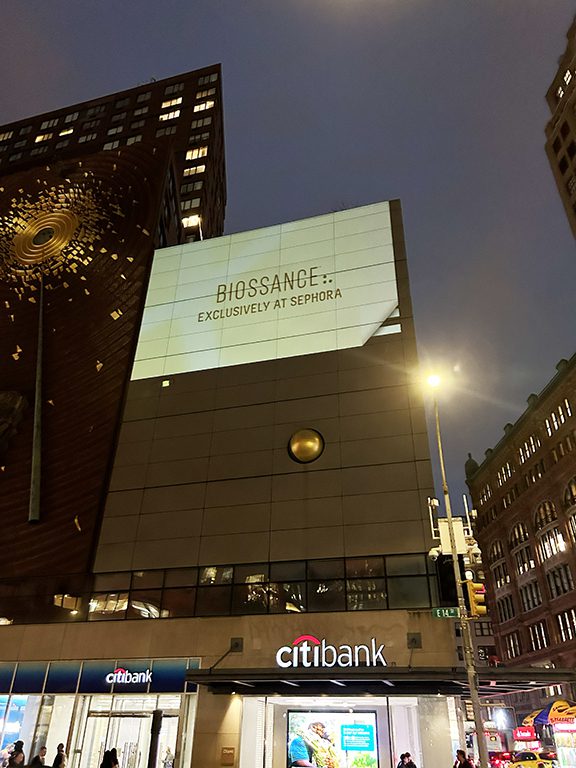
Seattle looks, on paper, like it should be one of the best projection cities in the country.
It sits far enough north that winter darkness arrives very early. From November through February the night starts in the late afternoon, and unlike a lot of cities where early darkness means empty streets, Capitol Hill is still populated. Long dark evenings with people on them is exactly the condition this format wants.
Then you stand on Pike Street in January with a projector and discover the catch.
The same months that deliver the darkness deliver continuous low cloud, persistent drizzle and permanently wet pavement. Every one of those scatters light. Cloud base bounces your spill back down, airborne moisture softens the beam over distance, and wet asphalt reflects streetlight up into the scene. You get the darkness and lose the contrast, which is a bad trade, because contrast is the whole product.
Summer inverts the problem completely. Seattle’s dry season gives clean air and genuinely good optical conditions, and then the latitude that handed you those early winter nights takes its payment. Sunset in high summer is so late here that a usable window barely opens before ten at night.
So the honest answer for Seattle, and it is not the answer most briefs arrive expecting, is that the best projection conditions in this city are the shoulder weeks. Early autumn and late spring, when the air is relatively dry and darkness still arrives at a sociable hour.
Getting that right matters more here than almost anything else in the plan.
The Seattle projection calendar, season by season
Let me lay this out properly, because it drives everything downstream.
Late spring, roughly May into early June. Air is drying out, the worst of the wet season is behind you, and sunset has not yet pushed past a workable hour. Strong window. The city is coming back outdoors and the audience is on the street without the full summer crowd density.
High summer, July and August. Optically excellent. Clean dry air, the best beam quality of the year, long reliable runs of dry nights. Logistically awkward, because you cannot start until late and the audience you want has often moved on by the time the light is any good. This is the season to run short, late, high-impact sessions rather than long evenings.
Early autumn, September into October. The best overall compromise in the Seattle year, and the window I push clients toward if the campaign dates are flexible. Darkness returns to a reasonable hour, the air has not yet gone fully wet, and the city is back from summer with a full calendar.
Deep winter, November through February. Maximum darkness, maximum audience hours, worst optical conditions. Continuous low cloud, drizzle and wet ground. It is workable, but only with short throws, high contrast artwork and realistic expectations. I will take a winter booking in Seattle. I will not pretend it performs like October.
Late winter into early spring, March and April. Still wet, improving light hours. Treat as a weaker version of the autumn window.
The underlying climate facts behind that: Seattle is classified by Köppen as Csb, the warm-summer subtype, with some sources placing it in the oceanic zone. Cool wet winters, warm dry summers. Temperatures typically vary from 37F to 79F and are rarely below 28F or above 88F. Precipitation averages 39.34 inches a year, measured at Sea-Tac, overwhelmingly as rain rather than snow. January is the most humid month at around 85 percent average relative humidity.
Those are not abstract numbers for this format. Humidity is scatter. Precipitation is wet ground. Latitude is the clock.
Drizzle is the specific enemy, and it behaves differently from rain
Operators who have worked hard-rain markets develop a habit: wait out the storm, then work the dry hours afterwards. Thunderstorm cities reward that.
Seattle punishes it, because Seattle’s winter signature is not storms. It is persistent light drizzle that does not stop. There is no clean post-event dry window to move into. From October to May you are not choosing between wet nights and dry nights, you are choosing between less-wet nights and more-wet ones.
What that does to a projection site:
The practical adaptation is short throws. Seattle’s valuable districts are low-rise neighbourhood centres rather than a glass tower core, and the streets are narrow relative to their building heights in exactly the areas worth working. A short throw across a side street to a flat masonry flank concentrates your light and gives moisture far less path length to degrade it. Long cross-street shots that would be fine in a dry market are where Seattle projects fail.
High-contrast artwork is the other half of the adaptation, and I will come back to that.
Pike/Pine is the best projection stock in the city, and here is why
Lonely Planet describes the Pike/Pine stretch of Capitol Hill as aging brick warehouses and former car dealerships made over into Seattle’s nightlife central, with LGBTQI+ bars, music venues, coffeehouses, record stores and fashionable restaurants. Local nightlife coverage positions Pike/Pine as younger, queerer, louder and more neighbourhood-based than Belltown, more late-night than Ballard, and more current than Pioneer Square. The rainbow crosswalks are a recognised marker of the corridor.
For projection, “aging brick warehouses and former car dealerships” is the single most useful description anyone has written about this city.
Former car dealerships mean large, flat, uninterrupted masonry flanks with minimal fenestration. That is the ideal projection surface and it is genuinely rare. Most urban facades are mostly window, and windows do not hold an image, they swallow it and throw fragments into the rooms behind. A big blank brick flank is what you want and Capitol Hill has them.
Low-rise frontage also means your throw angle stays sensible. You are not fighting keystone distortion trying to hit the twentieth storey from street level.
And the audience is correct. Music venues, record stores, late hours, high foot density, a neighbourhood that reads visual work as part of its character rather than as an intrusion. Pike/Pine is the most late-night area in the city, which means a projection run that would have lost its audience by eleven in another market still has one here.
The constraint is the hill. Capitol Hill is elevated above downtown and graded throughout, which affects a projection crew in a way it does not affect most formats: your projector position has to be level and stable, and finding a level position with a clean sightline on a graded street takes longer than it does on a flat grid. We survey for it specifically.
The other neighbourhoods, honestly assessed
Belltown. Compact, rich with contemporary street art on alley walls and building facades, with small pieces and larger murals near nightlife and dining, and easy to cover in a short walking route. The alleys are the interesting part for projection. They are the quietest usable spaces in the central city, they are narrow, which gives you naturally short throws, and the established visual culture means owners there are already comfortable with their surfaces being used for images. That combination is unusual and worth exploiting. An alley is also partially sheltered in a way an open street is not.
Ballard. Live music and a brewery-and-restaurant character, more relaxed than Capitol Hill and less purely late-night. Ballard quietens earlier, which in a winter projection context is less of a problem than it sounds, because darkness also arrives earlier. A six to nine evening run in Ballard in November reaches people who would have gone home before the window even opened in July. The Tractor Tavern is consistently named in local discussion of the area’s venues.
Fremont. A distinct identity, an eccentric character and its own bar scene. It pairs with Ballard on a single shift.
Pioneer Square. The historic district, positioned as less current than Pike/Pine. Heritage building stock and conservation oversight make any work on those facades harder and the owners more constrained. The architecture is beautiful and heavily articulated, which also makes it a poor projection surface. Ornament breaks up an image.
The University District. Serves the University of Washington. We have not established corridor-level detail there and I will not invent any. The UW academic calendar governs that audience entirely, and anything planned there should be timed against the university calendar.
Permissions, framed honestly
Projection sits in a grey area in Seattle as it does everywhere, and nothing here is legal advice.
What the city’s rules actually address is worth being precise about, because people conflate these.
Seattle Municipal Code Chapter 15.48 contains a provision contemplating handbills, signs and posters affixed to City-owned utility poles, lamp poles and traffic control devices under SDOT control, excepting freestanding stop and yield signs and their posts, in accordance with rules promulgated by the Director. That is a framework about affixing physical material to poles. Projection is not that activity, and the pole framework should not be read across to it.
Separately, the Seattle Department of Construction and Inspections enforces the Sign Code, which SDCI describes as regulating most permanent signs in the city, with Chapter 23.55 of the Municipal Code covering signs within the land use code. Permanent signage on private property is a permitted activity with defined area limits. Again, a different track.
Which track a projection installation sits on, and what the current requirements are, is something I have not verified and will not summarise. Confirm it with the controlling authority before planning a campaign. A blog post is not a permit, including this one.
How we reduce risk:
Actual enforcement culture in Seattle, including how the city handles this in practice, is not something we have verified and I am not going to characterise it from anecdote.
Crew logistics in a city of hills and bridges
Most of our Seattle formats are walking-crew work. Projection is not, because projectors, lenses, stands, power and control kit need a vehicle, and the vehicle needs to be close enough to run cable and keep the gear secure and dry.
That collides with Seattle’s geography in specific ways.
Parking is difficult in Capitol Hill and Belltown. Dense residential and commercial occupancy, limited loading access, no realistic prospect of a space adjacent to every site. Ballard and Fremont are easier, which is a genuine argument for those neighbourhoods on a kit-heavy job. Specific parking regulations, loading zones and overnight restrictions by neighbourhood should be confirmed before routing rather than assumed.
We plan two neighbourhoods per night at most, and for projection usually one. The city is built on hills and divided by water. Capitol Hill sits elevated above downtown. Ballard and Fremont are behind the Ship Canal and its bridges, which are a single point of failure on a schedule. Capitol Hill pairs with Belltown, Ballard pairs with Fremont, and a crew asked to cross that divide mid-shift with a van full of optics will spend the night driving.
Crew size is typically two to three. Someone stays with the kit at all times, someone operates, and on a busy Pike/Pine night someone handles the public and the door staff. Setup dominates the time, not the running.
Grade affects setup directly. Levelling a projector on a sloped street, finding a stable position with a clean sightline, and keeping cable runs out of a pedestrian path on a hill all take longer than flat-city estimates allow.
Night windows differ by neighbourhood and by season, which is the Seattle-specific planning skill. Pike/Pine stays genuinely late, so a summer session that cannot start until after ten still finds an audience there. Ballard quietens earlier, so Ballard works best in the dark months when the window opens early enough to catch people before they go home. Belltown’s alleys sit somewhere in between and offer the most shelter.
Timing against what is actually happening in the city
Seattle’s public life concentrates hard into June through September, which is unfortunately the part of the year when the projection window opens latest. That tension is worth planning around rather than ignoring.
Capitol Hill Block Party is the signature event for the Pike/Pine corridor, in the heart of the best district for this format.
Seattle Art Fair runs every July, turning Lumen Field Event Center into a large contemporary and modern art gallery with installations, events and performances. That is an audience primed for projected work. Lumen Field also hosts major sport, so the same location carries very different crowds week to week.
Seafair runs June to August as a multi-event summer institution including a Seafair Weekend Festival with waterborne events. Bumbershoot is positioned as the way to end the Seattle summer. West Seattle Summerfest runs in July in the West Seattle Junction, and Bite of Seattle sits in the wider roster of street fairs and parades.
The two that matter most for projection specifically are Earshot Jazz Festival and Freakout, both named by Visit Seattle among the city’s year-round cultural celebrations. They matter because they put a music audience on the street outside the summer window, in months when darkness arrives at a useful hour. A music crowd out on a dark evening is the single best set of conditions this format gets in Seattle, and most campaign calendars never look there because they are anchored to summer by habit.
Northwest Folklife Festival sits in the same year-round roster.
University of Washington terms govern the U District audience and should be checked against the university calendar.
Seahawks, Mariners, Kraken and Sounders season rhythms are not something we verified, so I will not build advice on them.
What goes wrong, and what we talk clients out of
Booking midsummer because that is when campaigns happen. The most common Seattle error. Optically it is the best air of the year and operationally the window opens too late for most audiences. If the dates can move, move them to September or October.
Expecting winter darkness to be a gift. It is half a gift. You get the hours and lose the contrast to cloud, drizzle and wet ground. Winter works with short throws and bold artwork, and it does not work with a brief that was designed for dry air.
Long throws. Seattle’s moisture punishes path length more than most markets. If the only available position is far from the wall, it is usually not a site.
Detailed artwork. Projection is a contrast medium anywhere, and in Seattle’s scatter-heavy conditions that is doubled. Thin type, fine detail and subtle gradients vanish. Bold shapes, heavy weight, few elements, maximum tonal separation. Clients bring print files and are surprised that a wet brick wall is not a page.
Pioneer Square facades. Gorgeous, heavily articulated, and ornament destroys a projected image. Also the hardest permission conversation in the city.
Pike/Pine without accounting for the grade. Clients plan Capitol Hill as a flat grid and are surprised when siting takes an extra hour.
Wanting it to persist. Projection is live. It exists while the crew is standing there and stops when they pack up. A buyer who is really asking for sustained neighbourhood presence is asking for a different format and deserves to be told so before they book.
That last point has a specifically Seattle answer. On a wet November night, a projected beam is fighting moisture for every bit of contrast, while an emissive screen is not. If a campaign has to run through the wet season and has to reach people across several neighbourhoods separated by hills and bridges, LED Trucks and Mobile Billboards will do that job better than projection will, because the display makes its own light and the vehicle solves the parking and access problem by never needing to park. We often pair the two: a truck carrying the wet months and the cross-town reach, and projection booked into the autumn shoulder weeks where it genuinely shines.
Frequently asked questions
When is the best time of year for projection advertising in Seattle?
The shoulder weeks. Early autumn and late spring, when the air is relatively dry and darkness still arrives at a sociable hour. High summer gives the cleanest air but sunset is so late that a usable window barely opens before ten. Deep winter gives maximum darkness but continuous low cloud, drizzle and wet pavement destroy contrast.
Why does Seattle drizzle matter more than heavy rain would?
Because it does not stop. There is no clean post-storm dry window to move into between October and May, only less-wet nights. Airborne moisture scatters the beam along its whole path, wet pavement reflects streetlight upward, and low cloud returns your spill light. Short throws and covered projector positions are the practical adaptations.
Which Seattle neighbourhoods have the best projection surfaces?
The Pike/Pine corridor on Capitol Hill. The aging brick warehouse and former car dealership stock gives large flat masonry flanks with minimal fenestration, which is exactly what this format needs and is genuinely rare. Belltown’s alleys are narrow, sheltered and quiet, giving naturally short throws. Pioneer Square’s articulated heritage facades break up an image.
Do you need permission to project onto a building in Seattle?
We treat permission as mandatory and get it in writing from whoever controls the target surface, plus permission for the position the equipment occupies. The city’s pole posting framework concerns affixing physical material and should not be read across to projection. This is a grey area, not legal advice. Confirm current requirements with the controlling authority before planning.
How does the hill affect a projection crew on Capitol Hill?
More than clients expect. A projector needs a level, stable position with a clean sightline, and finding one on a graded street takes longer than on a flat grid. Cable runs have to stay clear of pedestrian paths on a slope. Parking in Capitol Hill and Belltown is difficult, and projection is kit-heavy, so vehicle access shapes site selection.
How many sites can you run in a single night here?
Usually one neighbourhood, occasionally two. Setup dominates the time rather than the running, and Seattle is divided by hills and by the Ship Canal bridges. Capitol Hill pairs with Belltown, Ballard pairs with Fremont. Crossing that divide mid-shift with a vehicle full of optics costs more time than the extra site is worth.
Request a campaign quote
If projection in Seattle is on your list, the most useful first conversation is about dates. Season decides more here than anything else, and a campaign that can shift by four weeks is often a campaign that works instead of one that nearly works.
We will tell you honestly if your dates and your target neighbourhoods do not fit the format, and what we would pair it with instead.
Tell us the timing, the corridors you care about and what the campaign has to achieve. Request a campaign quote and we will come back with surveyed sites, a season recommendation and alternates.

Ready to Run Your Campaign?
Call us or email us. We’ll tell you exactly what we can do in your market and what it costs.
Related Service
Explore similar advertising solutions offered by American Guerrilla Marketing.
American Guerrilla Marketing — Los Angeles
Street-level campaigns in Los Angeles and nationwide. Wheatpasting, LED trucks, street teams, and more.
(646) 776-2770
Related Articles
-
Experiential Advertising: How It Actually Works
November 19, 2026
-
New Orleans Projection Advertising: Corridors and Rules
November 19, 2026
-
Experiential Marketing Agency Sydney: Timelines
November 19, 2026
-
Guerrilla Projection Campaign Logistics: How It Installs
November 19, 2026
-
Guerilla Marketing Advertising: How It Works
November 19, 2026