
November 19, 2026
New Orleans Projection Advertising: Corridors and Rules
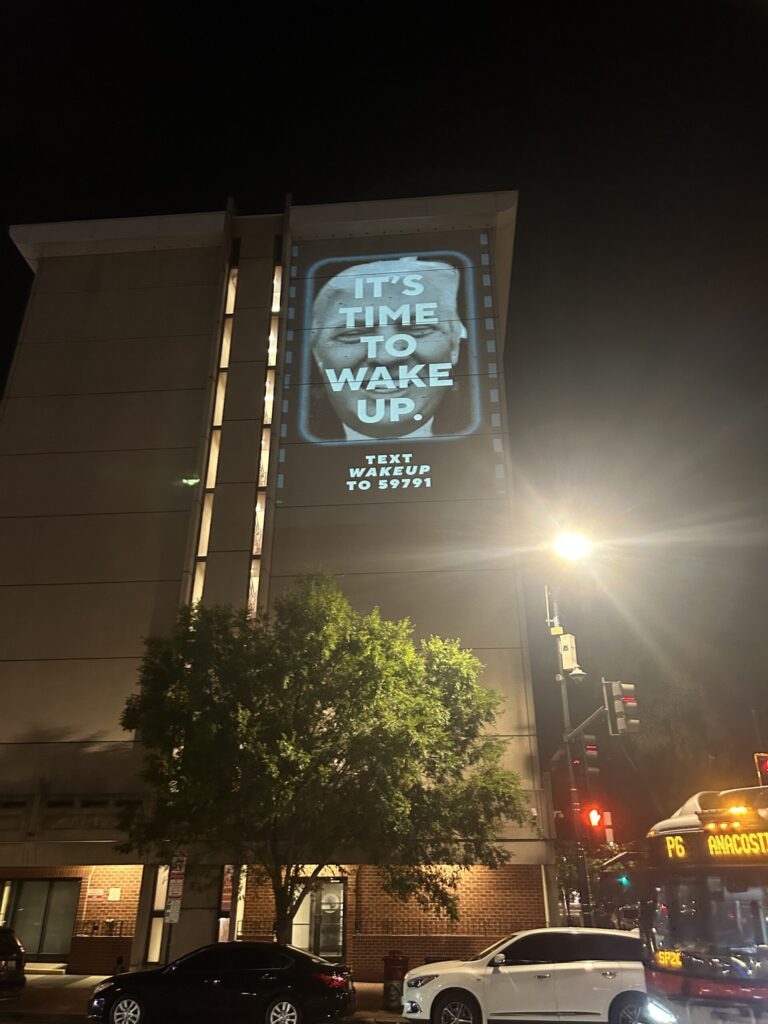
Projection in New Orleans is a seasonal format, and anybody who tells you otherwise has not stood behind a projector here in August.
The city’s air is the issue. New Orleans sits in a marine climate zone, within about 100 miles of sea water, and that combined with its subtropical latitude makes it characteristically humid-subtropical. It has been described as the most humid city in the United States. Heavy, moisture-laden air scatters projected light badly. On a still summer evening the beam becomes the most visible part of the installation and the image on the wall loses contrast before it gets there.
The cooler, drier-feeling months from late autumn through early spring give markedly better results. That is not a small adjustment. It is the difference between a sharp image people photograph and a soft glow people walk past.
There is a flipside worth stating, because it is the thing that makes New Orleans projection interesting rather than merely difficult. Humid air makes a beam visible, and a visible beam is a physical object in the street. Used deliberately, that is an effect you cannot buy in a dry city. We have planned concepts around the beam rather than the wall for exactly that reason. You just have to decide which one you are making before you book the gear.
This page covers how projection runs in New Orleans specifically: which corridors have the geometry, what the climate does to the image and the equipment, how permission splits at the edge of the French Quarter, how Carnival and storm season reshape a schedule, and what we talk clients out of.
The throw distance problem in a low, narrow city
New Orleans is not built for projection, architecturally speaking, and the reason is scale.
Projection needs two things: a large, light, relatively uniform surface, and enough distance between the projector and that surface to fill it. New Orleans gives you very little of either in the neighbourhoods where the audience actually is.
The Marigny and Bywater are colourful Creole cottages on tight streets with small blocks and low-rise building stock. Charming to walk, impossible to light. A one-and-a-half-storey cottage frontage is a small canvas, and the street in front of it is too narrow to back a projector far enough to fill even that.
Frenchmen Street has the densest audience in the city, with roughly a dozen venues packed into the three-block section in the Faubourg Marigny between Esplanade Avenue and Royal Street. It is also narrow, historic, and has almost no blank elevation. Daytime reveals the historic architecture that distinguishes the street from the rest of the city, and that architecture is detailed, varied and entirely unsuited to carrying an image.
So where does it work?
**The St. Claude Arts District** along St. Claude Avenue is the best answer in the city. It is the contemporary gallery and alternative-arts spine running through the Marigny into Bywater, and critically the building stock is lower-rise with more exposed side walls. An exposed side elevation on a wider avenue is the exact geometry projection needs: a flat surface with road width in front of it to achieve throw. Gallery operators along St. Claude are accessible, used to the conversation about imagery on buildings, and quick to decide.
**Construction hoarding** is the other reliable substrate, and in a city with continual renovation work it is abundant. Hoarding is flat, light-coloured, modern, free of architectural detail, and practically belongs to the contractor, who is often amenable. For projection it is close to ideal, and it carries none of the historic-fabric sensitivity that a real wall does.
**Crescent Park** on the Bywater riverfront and the approaches around **Washington Square Park** and the **Marigny Opera House** put people on foot at a slow pace with more open space than the residential streets allow. Open space means throw distance.
**Magazine Street** uptown is a long retail corridor with big concentrations of shops, galleries and bars, and it has more commercial frontage and more modern infill than the Marigny. It runs for miles though, so it is a sequencing job and a projection run there is a one-or-two-site evening, not a tour.
Permission, the Vieux Carré and the grey area
New Orleans splits sharply into two operating environments and conflating them is the most expensive mistake an operator can make here.
**The French Quarter is formally regulated and should be treated as permission-only.** The Vieux Carré Commission, established under Louisiana state law, holds binding authority over exterior alterations, demolitions, new construction and signage across a precisely defined geographic boundary. Before making any change to the exterior of a Vieux Carré property, explicitly including painting, signage and banners, an application to the Commission is necessary.
There is also an active and organised preservation community around the Quarter. When a 2023 proposal would have paused prosecution of Commission-cited violations and relaxed signage standards for a year, preservation groups mounted a public campaign against it.
Projection raises an interesting question in that context, because nothing is attached and nothing is left behind. I am not going to resolve that question for you, and I would be suspicious of anyone who claims to. It is a grey area, it varies by municipality, enforcement is inconsistent, and the outcome depends on surface ownership, local ordinance and permission.
What I will say is that the Quarter’s culture is the governing fact, not the technicality. There is a dedicated authority, an engaged resident lobby, and a shared conviction that the streetscape is a civic asset. A brand throwing light onto a protected facade without an invitation is going to be read as exactly the kind of imposition that community organises against, whether or not anything was physically altered. Speculative projection in the Vieux Carré is a reputational risk far exceeding any media value it could produce.
**Outside the Quarter the character is very different.** The Marigny, Bywater and the St. Claude corridor are neighbourhoods with deep, visible, long-standing street-level visual culture. The practical tolerance for cultural material in the public realm is meaningfully higher here than in most American cities.
How we reduce risk is simple and it is the same everywhere: we get permission from the person who owns the surface. Private wall agreement is the durable route in this city. Venue owners along Frenchmen, gallery operators along St. Claude and construction site managers across the city are reachable and used to the conversation.
The physical presence is the other half of the risk, and it is the half people forget. Projection leaves nothing behind, but the projector, the power source, the vehicle and the crew are all standing in the street for several hours. That presence is what gets noticed first, and in narrow residential Creole cottage streets it is what generates a complaint.
We document every site with dated photography before and after. When a question arrives three weeks later, an accurate record of what was there and for how long is the most useful thing to have.
Humidity, salt and storm season
**Humidity is the governing climate fact.** There is no dry season here. Precipitation in the New Orleans and delta zone averages 60 to 65 inches a year, relatively evenly distributed, with another measure putting it at roughly 63.4 inches. January averages around 54.5°F and July and August around 84°F. The city never gets genuinely cold and never gets dry.
For projection that means scatter, year-round, worst in summer. The mitigations are shortening the throw, which means less air for the light to cross, and choosing a lighter, cleaner surface so that more of what arrives is reflected back. Neither fully solves a July evening. Scheduling does.
**Biological growth changes what a wall reflects.** Persistent moisture in this climate produces mould, algae and biofilm on shaded masonry at a rate northern markets never see. A wall that reads as light grey in a daylight photograph can be carrying a dark biological film that absorbs a significant share of your projected light. We survey surfaces at night with a test projection, and on more than one occasion the fix has been to wash the wall before the run.
**Salt air** reaches the city from the Gulf and from brackish water, and it attacks fixings, fasteners and finishes. For projection that matters when we are rigging a temporary screen or mounting equipment, and anything structural should be specified as marine-grade or it corrodes and stains within a season.
**Hurricane and tropical storm season runs six months, June through November.** This is the defining operational fact of the New Orleans calendar. For projection the exposure is different from a static install, because the equipment goes home with us at the end of the night, but it still governs scheduling, insurance and the willingness of a property owner to commit. Our contracts here carry explicit storm contingency.
**Freeze-thaw is essentially a non-issue.** Winters are mild, which means the best projection months are also comfortable working months. That is a genuine advantage over northern markets where the clearest air of the year comes with conditions that make a five-hour outdoor setup miserable.
**The city floods quickly in heavy rain.** Routes can become impassable within an hour of a downpour, and that is routine rather than exceptional. A projection run involves a vehicle carrying expensive equipment, and we build a contingency night into every schedule here for exactly that reason.
The calendar, and why Carnival is both the opportunity and the obstacle
The official city calendar tracks more than 130 unique festivals and events across a year. New Orleans is not a city with a few peaks, it is a city with an almost continuous event rhythm.
For projection, which is an evening format that buys a few hours of pedestrian attention, the calendar is more or less the whole strategy.
**Carnival season** begins at Twelfth Night, 6 January, and builds to Mardi Gras. Early-season traditions include the Phunny Phorty Phellows streetcar parade and the Joan of Arc Parade, a walking parade through the French Quarter. Carnival is a weeks-long build rather than a single day, which means a long window of elevated evening street activity rather than a single-night spike.
It also lands squarely in the best projection weather of the year. Cool, clearer air and the biggest crowd season in the city arriving at the same time is the single most useful alignment in this market, and if a client has one projection night to spend in New Orleans, that is where I point it.
The obstacle is access. **Parade season closes streets, repeatedly, for weeks.** Parade routes shut down major corridors on a published but complex rolling schedule, and neutral grounds fill with crowds and ladders. A projection setup requires a vehicle, a power source and a stable position for several hours. None of that is compatible with a parade route on a parade night. We plan Carnival projection on the corridors that are not route corridors, on the non-parade evenings, and we confirm against the current year’s published schedule rather than assuming.
The rest of the calendar: **February through June is the dominant season**, with Mardi Gras, Jazz Fest, French Quarter Festival and Essence Fest. **Jazz Fest** runs over two weekends in late April and early May and draws major national acts. **ESSENCE Festival** in summer is nationally significant with a distinct audience, and it is the one genuine reason to consider a summer projection run despite the air. **October and November are the secondary peak**, combining autumn music events with convention season, and they offer improving air clarity.
Convention business is a year-round driver with autumn weighting, and convention weeks shift the downtown and Quarter audience composition substantially toward out-of-town professionals. Saints home games in autumn bring large downtown crowds on game days.
Crew logistics and the hour problem
Projection has a scheduling conflict in this city that no other format has.
**Night windows are later here than anywhere else.** Frenchmen Street and the Quarter do not empty at a predictable hour. The quiet window in the entertainment corridors is narrow and late, roughly from four in the morning.
For a paste crew that is useful information. For projection it is useless, because four in the morning is when there is nobody to see the image. Projection needs the overlap of dark sky and live street, which in the Marigny and along St. Claude means the evening through the early hours. We are working at the busiest time, not the quietest, and the plan has to account for that.
That has consequences. Setup happens before the crowd builds. The position has to be one we can hold with people around it. Cable management on a busy footway is a safety issue and it is managed by a crew member, not by tape. A projection crew in New Orleans is a minimum of two and more often three, where a paste crew of the same ambition would be two.
**Marigny and Bywater are walkable in the European sense.** Tight streets, small blocks, low-rise. Good for foot crews, bad for vehicles. Streets are narrow, parking is tight and residential, and a van idling at 3am on a residential Creole cottage street will be noticed and resented. Generator noise is worse. If a site needs generator power in a residential Marigny street, we will usually advise against the site, because a complaint costs you the relationship that got you the wall.
**Magazine Street is a driving job**, sequenced along its length. **The French Quarter is pedestrian-dense at nearly all hours** with genuinely difficult vehicle access, narrow streets, one-ways, heavy pedestrian spill and delivery restrictions.
**Heat and humidity are a crew welfare issue** through the long summer. Overnight temperatures stay high, the humidity does not relent, and projection crews stand outside for the duration. Shorter shifts than a northern market, which means fewer sites per night.
A realistic New Orleans projection evening is one site, worked properly, or two sites in the same district if they are close enough to walk equipment between. A three-district tour is not a plan, it is a hope.
What goes wrong, and what we push back on
**Summer bookings.** A client with a June launch wants June projection. We tell them the air will scatter the light, the image will soften, storm season is open, and the same budget in November produces a visibly better result. Sometimes they book anyway, and when they do we plan a beam-led concept rather than an image-led one, because that is the version that works in those conditions.
**The French Quarter.** Clients want it because it is the image of New Orleans in their head. We explain the Commission process and the preservation community, and the fact that a brand throwing light on a protected facade uninvited is read as an imposition regardless of the technicality. Most of them end up on St. Claude, which has better geometry anyway.
**Historic facades generally.** Creole cottages and nineteenth-century masonry across the Marigny and Bywater are the kind of fabric this city defends. Even where projection is physically harmless, aiming a commercial image at somebody’s hundred-and-sixty-year-old house is a choice with social consequences. We work hoarding, exposed side walls and modern infill.
**Scale expectations.** Clients ask for a building-height image. New Orleans is a low city with narrow streets, and the throw distance to fill a tall surface usually does not exist. The honest answer is that the format here is a wide, human-scale image at close range, not a skyline takeover.
**Site selection from photographs.** A wall that looks blank in daylight has a security light, a drainpipe, a satellite dish or a biofilm layer. We survey at night with a test projection before committing a site, and if a client will not fund a scouting evening I would rather decline than guess.
**Ambient light.** Contrast is the whole game. A darker wall on a quieter block beats a brighter wall under a floodlight, every time, and raw projector output does not rescue a badly lit site.
What drives scope here: number of nights, crew size, throw distance and the equipment that implies, whether generator power is needed, surface preparation including washing, the scouting evening, how many separate permissions are required, and storm contingency.
Pairing projection with something that stays
Projection’s weakness is that it ends. The power goes off and the campaign is over.
In New Orleans the natural pairing is Wheatpasting and Poster Campaigns on the same St. Claude and Marigny footprint. The hoarding and exposed side walls that make a surface good for projection are the same surfaces that take paper well, and the permission conversation is one conversation rather than two. You buy one spectacular evening that people photograph, and weeks of physical presence in the same streets afterwards.
The sequencing we prefer is paper first, projection second. Posters seed recognition over two or three weeks. The projection night then lands on an audience that already knows the artwork, and the combined recall is noticeably better than either format alone. That is a judgement from how the formats behave, not a measured claim.
Where a campaign needs to convert attention into contact on the night, Street Teams and Experiential on Frenchmen between Esplanade and Royal is the obvious companion, because a dozen venues in three blocks is the easiest footprint in the country for a small team to work.
Frequently asked questions
Does projection advertising need a permit in New Orleans?
It is a grey area that varies by municipality, with inconsistent enforcement, and it depends on surface ownership and permission. The French Quarter is the exception to treat as permission-only: the Vieux Carré Commission holds binding authority over exterior changes including signage within a defined boundary. Elsewhere we work from private property-owner agreement on walls and construction hoarding.
When is the best time of year for projection in New Orleans?
Late autumn through early spring. The city’s heavy, humid air scatters projected light badly, and summer evenings give the worst clarity of the year. The cooler months deliver a markedly sharper image, and they coincide with the Carnival build that begins at Twelfth Night on 6 January, which is the city’s longest sustained crowd season.
Which New Orleans corridors suit projection?
The St. Claude Arts District is the best, because its lower-rise stock offers exposed side walls on an avenue wide enough to achieve throw distance. Construction hoarding anywhere in the city is close to ideal. Crescent Park and the open approaches in Bywater give space. Frenchmen and the Creole cottage streets are too narrow and too architecturally detailed.
Can you project onto French Quarter buildings?
Not speculatively. The Vieux Carré Commission has binding authority over exterior alterations including signage, and the Quarter has an organised preservation community. Even though projection attaches nothing, aiming a commercial image at a protected facade without invitation reads as an imposition in this city, and the reputational risk outweighs the media value.
How does Carnival affect a projection schedule?
It helps and hinders. Carnival runs for weeks from Twelfth Night, putting large evening crowds on the street during the best projection weather of the year. But parade routes close major corridors on a complex rolling schedule and neutral grounds fill with crowds and ladders, which is incompatible with a static setup. We work non-route corridors and non-parade evenings.
How many sites can you run in one evening here?
One site worked properly, or two in the same district if equipment can be walked between them. Projection needs the overlap of dark sky and live street, which is the busiest time rather than the quietest, and narrow Marigny streets make vehicle movement slow. A multi-district tour in a single New Orleans evening is not a realistic plan.
Request a campaign quote
Tell us the corridor, the month and what the creative is meant to do. We will tell you honestly whether the air that month supports an image-led concept or a beam-led one, which surfaces in that district have the geometry, and whether projection is the right format for the job at all.
Request a campaign quote and we will start with the scouting evening, not the equipment list.
Livy Phillips American Guerrilla Marketing Nationwide poster, snipe, decal, projection and LED truck campaigns americanguerrillamarketing.com

Ready to Run Your Campaign?
Call us or email us. We’ll tell you exactly what we can do in your market and what it costs.
Related Service
Explore similar advertising solutions offered by American Guerrilla Marketing.
American Guerrilla Marketing — Los Angeles
Street-level campaigns in Los Angeles and nationwide. Wheatpasting, LED trucks, street teams, and more.
(646) 776-2770
Related Articles
-
Guerrilla marketing meaning: How It Actually Works
November 20, 2026
-
Boulder Projection Advertising: Corridors, Permissions and
November 20, 2026
-
Combining Guerrilla and Traditional OOH Campaigns
November 20, 2026
-
Guerrilla Marketing Campaign: A Field Guide From the Crew
November 20, 2026
-
Guerrilla Marketing Ideas: How It Actually Works
November 20, 2026