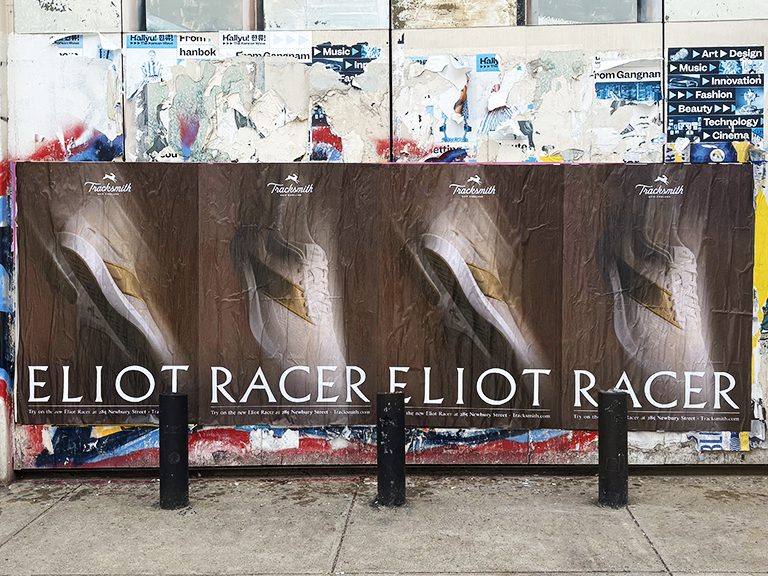
London’s streets have been a canvas for advertising since before billboards existed. The tradition of wall posters, market announcements, and street-level messaging is woven into the city’s visual history. Today, a well-executed poster campaign in London still cuts through in ways that digital and traditional media struggle to match, because it meets people where they actually are, on foot, moving through neighborhoods they know, noticing what’s around them.
Industry City, Brooklyn, NY 11232
Our team at American Guerrilla Marketing runs poster campaigns across London regularly, from focused single-neighborhood deployments in Shoreditch or Camden to citywide programs that build presence across ten or more boroughs simultaneously. This guide covers what makes London poster campaigns work, what formats we use, which neighborhoods we target, and how we manage production and installation end to end.
What Is a Street Poster Campaign in London?
When we talk about street poster campaigns, we mean large-format printed materials installed directly on walls, hoardings, and approved outdoor surfaces at street level. The primary method we use is wheatpasting, which has a long history in London’s creative and music scenes. Wheatpaste poster campaigns use a paste-based adhesive to affix large-format prints to surfaces, creating durable, weatherproof installations that blend naturally into London’s visual environment.
This is distinct from traditional outdoor advertising such as bus shelter panels, Underground poster sites, or premium 48-sheet billboards. Those formats are bought through outdoor media companies at high CPMs and placed in standardized, branded structures. Street poster campaigns are placed directly in the urban fabric, in the areas where people actually spend time, rather than just pass through on their commute.
Why Wheatpasting Works in London
London has one of the most photographically active street art communities in the world. The Brick Lane and Shoreditch corridor is documented daily by hundreds of accounts dedicated to tracking new installations. A well-designed wheatpaste campaign placed in these zones doesn’t just reach the people who physically walk past it. It gets photographed, tagged, and shared, extending the campaign’s reach to audiences far beyond the physical location. This organic amplification layer is what makes street poster advertising particularly valuable in London compared to other formats at similar price points.
approved Surfaces and approved Placements
We work exclusively with approved walls, approved hoardings, and contracted surface networks. Every placement in our London network has been vetted for site-rule alignment. Clients never have to worry about their campaign creating site-rule problems. We’ve developed our approved surface network across London’s key cultural neighborhoods over years of local operation, and we maintain those relationships continuously to ensure availability and quality.
London Poster Campaign Formats
Not all poster formats work equally in every London environment. Here’s how we approach format selection for different campaign objectives and locations.
Single-Sheet Large Format (40×60 inches)
This is the workhorse format for London street campaigns. A 40×60 inch print provides genuine visual impact at the 10 to 20 foot viewing distance that characterizes most London street environments. It’s large enough to command attention without requiring an unusually large wall space, which means we can deploy it across a wide range of surfaces. This format works well for brand awareness, event promotion, product launches, and entertainment campaigns.
Multi-Sheet Composite Installations
For locations with larger wall sections available, we build composite installations using multiple sheets arranged as a single image. A 4-sheet or 8-sheet composite in a prime location creates something that feels more like a mural than a poster, with the visual scale to stop pedestrians at 30 to 40 feet. These installations are particularly effective in Shoreditch, where large wall sections are available and the audience actively engages with large-format street art.
Double-Stack Installations
In some London locations, particularly construction hoardings and long wall sections, we stack two rows of posters vertically to increase visual mass. Double-stack installations create a significant visual presence that reads as an environment rather than a single ad, which is particularly effective for event launches and entertainment campaigns that benefit from immersive visual treatment.
A2 and A3 Dense Saturation
For campaigns targeting the feel of a guerrilla wheat-paste presence without the cost of large-format printing at every site, we deploy denser networks of smaller A2 or A3 format prints across a greater number of surfaces. This approach creates the impression of ubiquity across a neighborhood, with the brand appearing on numerous walls and surfaces throughout the campaign zone. It’s particularly effective for music releases, event launches, and brands that want a genuinely grass-roots aesthetic.
London Neighborhoods for Poster Campaigns
Choosing the right neighborhoods is the most important strategic decision in a London poster campaign. Here’s how we approach the city’s major cultural areas.
Shoreditch and Brick Lane
This is the highest-value street poster environment in London. The Brick Lane corridor, running from Bethnal Green Road down to Whitechapel, is the most photographed street art and poster environment in the city. Every significant cultural campaign in London includes this zone. We have an established approved surface network here that covers the primary walls on Brick Lane, the Shoreditch High Street corridor, Calvert Avenue, and the back streets between Old Street and Bethnal Green Road.
Camden and North London
Camden’s market areas and the Chalk Farm Road corridor offer strong surface options for campaigns targeting youth culture and music audiences. The density of foot traffic around the market areas means that even a moderate number of sites generates significant gross exposures. We cover the Stables Market area, Hawley Crescent, and the back streets of Camden Town.
Soho and Central London
Soho offers the highest raw foot traffic of any London neighborhood, but surface availability is more constrained than in East or North London. We work with a selected selection of high-value approved surfaces in Soho, Carnaby Street, and the surrounding area that deliver premium central London placement without the premium media costs of traditional outdoor formats.
Brixton and South London
The Brixton corridor, including the areas around Brixton Station, Coldharbour Lane, and Atlantic Road, offers strong surfaces for campaigns targeting South London’s culturally engaged community. We also cover Peckham and New Cross, which have developed significant creative communities in recent years and offer strong surface availability.
Notting Hill and West London
The Portobello Road corridor in Notting Hill reaches a different demographic than East or North London. It’s well-suited for fashion, lifestyle, and premium consumer brands targeting a slightly older and more affluent audience. We have approved surface access along Portobello Road and the surrounding streets in W11.
Production Specifications for London Campaigns
Getting the production right is as important as getting the placement right. Low-quality printing in London’s high-scrutiny cultural neighborhoods reads immediately as low-effort, which undermines the campaign’s credibility.
Print Specifications
We print all campaign materials at 300 DPI minimum on premium outdoor paper stock, with sizing calibrated to the specific surfaces in the deployment zone. Color profiles are calibrated for outdoor viewing conditions. Ink saturation is optimized for visibility in London’s frequently overcast light conditions, which differ significantly from the higher-contrast sunlight environments that US print specs are often calibrated for.
Weather Resistance
London’s climate requires materials that can handle rain, humidity, and temperature variation. We use weatherproofed paper stocks for all outdoor campaigns, with paste formulations that maintain adhesion in wet conditions. Campaigns running through autumn and winter receive additional weatherproofing treatment.
Artwork Requirements
We accept artwork in PDF, AI, or high-resolution JPEG/PNG format. For large-format composites, we provide templates specific to the surfaces in our London network. Our team reviews all submitted artwork for print suitability before committing to production, catching any resolution or color profile issues before they affect the final installation quality.
Campaign Planning and Timeline
A London poster campaign follows a clear sequence from brief to installation. Understanding this timeline helps clients coordinate with their broader marketing calendars.
Week One: Strategy and Creative
The first week covers neighborhood selection, surface mapping, format decisions, and creative briefing. If the client is providing artwork, this is when we review files and confirm specifications. If we’re coordinating with a creative partner, this is when concepts are developed and approved.
Week Two: Production
Print production for a standard London campaign takes five to seven working days. Rush production is available for time-sensitive campaigns at an additional cost. Materials are delivered to our London storage and crew before deployment.
Week Three: Deployment
Overnight installation is standard for wheatpaste campaigns in London. Our crew deploys between 10 PM and 5 AM to minimize traffic disruption and maximize installation quality. Photographic documentation is captured immediately following installation, with geo-tagged imagery provided to the client within 24 hours of deployment.
Ready to Launch Your Campaign?
Combining Poster Campaigns with Other London Tactics
Street poster campaigns work best when they’re part of a broader street-level program rather than a standalone tactic. Here’s how we combine poster campaigns with other formats for stronger results.
Posters Plus Street Teams
A wheatpaste campaign running in Shoreditch or Camden pairs naturally with a brand ambassador presence in the same area. The posters create visual familiarity; the street team creates personal engagement. A potential customer who has seen the posters three times on their walk to work and then encounters a street team deploying near those same posters has a significantly different response than someone who only encountered one or the other.
Posters Plus Projection
For evening campaigns or launch events, projection advertising on the same walls where physical posters have been running creates a layered brand presence that generates strong social documentation. A projection event on a building where we’ve already been running wheatpaste for two weeks feels like a crescendo rather than a cold start.
Posters Plus LED Trucks
Our LED billboard trucks can be routed through the same neighborhoods as an active wheatpaste campaign to create coverage across different audience segments. Pedestrians encounter the posters on walls. Vehicular and transit audiences encounter the LED truck. The combined coverage builds reach across the full population moving through a campaign zone.
Measuring London Poster Campaign Performance
Poster campaigns are an awareness medium, and measuring their performance requires an awareness-appropriate framework. We don’t promise lead counts or click-through rates. We do provide verified footfall data for each deployment location, total gross exposures based on pedestrian counts, photographic evidence of installation quality and duration, and organic social monitoring to capture campaign documentation activity.
Footfall Data
We use verified footfall data from pedestrian counting sources for each location in our London network. This gives clients a credible basis for impression estimates rather than inflated theoretical numbers. A wall on Brick Lane with 8,000 pedestrians per day generates 56,000 exposures per week before any social amplification. That’s a verifiable number, not a modeled estimate.
Social Amplification Tracking
For campaigns deployed in Shoreditch, Camden, and other street art-active neighborhoods, we monitor organic social documentation across Instagram, TikTok, and Twitter in the days following installation. We include any documented organic shares in the campaign wrap report, giving clients visibility into the earned media their poster campaign generated.
Creative Best Practices for London Poster Campaigns
The most common reason a London street poster campaign underperforms isn’t location, production quality, or placement. It’s creative. London’s visual environment is genuinely competitive. The streets that matter for brand campaigns, Shoreditch, Brick Lane, Camden, Soho, are full of excellent graphic design from brands that take their creative seriously. Weak creative in these neighborhoods doesn’t just fail to stand out. It gets ignored so completely that the investment in placement and production is largely wasted.
Single Strong Idea
The most effective street poster creative in London is built around a single, strong idea that communicates immediately at the walking pace of a pedestrian. Complicated layouts with multiple messages, long copy, and small text don’t work on street posters. The viewer has a second or two to register the impression. That second needs to deliver one thing: a feeling, a question, a visual surprise, or a brand recognition moment. Multiple things result in nothing landing.
Color and Contrast
London’s frequent overcast conditions create a low-contrast light environment that washes out colors calibrated for bright sunlight conditions. Creative that looks vivid on a monitor can look flat and lifeless on a Shoreditch wall on a grey October afternoon. We review all artwork with outdoor viewing conditions in mind, often recommending color adjustments that look slightly oversaturated on screen but land correctly in the physical environment. Contrast ratios that work in sunny locations need to be boosted for London’s typical light conditions.
Typography for Distance
Text on a London street poster needs to be legible from five to twenty feet depending on the format size. Body copy and small supporting text that’s readable on a desktop screen is typically illegible at street viewing distances. We recommend treating street posters like billboards: headline only, at a font size that’s clearly readable from ten feet, with any supplementary information reserved for QR codes or URLs that interested viewers can follow up on their own device.
Format Matters as Much as Creative
A brilliant concept in the wrong format can fail as surely as weak creative in the right location. A single A2 sheet on a wall that could accommodate a 4-sheet composite looks like an afterthought. A maximalist multi-sheet installation on a narrow wall in a tight street reads as clutter. We match format to surface and surface to neighborhood as part of the pre-production planning, so the campaign architecture supports the creative rather than fighting it.
London Poster Campaign Case Studies: What Actually Works
Rather than describing abstract principles, here’s a concrete picture of what effective London poster campaigns look like in practice. These are composites drawn from the types of campaigns we run regularly, not specific client campaigns.
Music Release: Shoreditch and Brixton Launch
A music label releasing a new artist’s debut album runs a two-week wheatpaste campaign across Shoreditch and Brixton simultaneously. The creative is minimal: artist name, album title, and release date in high-contrast black and white. Fifty sites across both neighborhoods go up overnight on a Thursday, timed to land before the weekend listening peak. By Friday morning, the campaign has been photographed and shared by multiple street art documentation accounts. By the end of week one, the posters have accumulated organic social reach far beyond the direct foot traffic count. The creative quality and neighborhood selection generated the amplification. The budget was a fraction of a digital campaign delivering equivalent reach.
Fashion Brand UK Launch: Camden to Carnaby
An American streetwear brand entering the UK market runs a concentrated campaign across Camden, Carnaby Street, and the Portobello Road area in the three weeks before opening its first UK pop-up. The campaign runs large-format composite prints in the Stables Market area and A2 saturation in Carnaby Street and the surrounding Soho streets. By the time the pop-up opens, the brand is already a recognizable visual in the city’s fashion neighborhoods. The opening day queue includes people who came specifically because they’d seen the posters and been curious about the brand.
App Launch: Central London Saturation
A consumer app launching in the UK runs a three-week campaign combining large-format Shoreditch and Camden installations with a dense A3 saturation program across Soho, Covent Garden, and the South Bank. The large-format work generates social documentation and media coverage. The dense saturation ensures high frequency across the central London commuter population. The combination of both formats in the same campaign window creates the impression of ubiquity that drives app store search spikes and organic install volume.
What is wheatpaste poster advertising in London?
Wheatpasting is a street poster installation method where large-format printed posters are adhered to approved walls, hoardings, and outdoor surfaces using a wheat-based paste. The result is a durable, high-visibility installation that blends into London’s street culture while delivering significant brand presence. We work exclusively with approved surfaces and approved locations.
What neighborhoods do you cover for poster campaigns in London?
We cover Shoreditch, Brick Lane, Camden, Soho, Brixton, Hackney, Notting Hill, Portobello Road, Borough Market, Dalston, Covent Garden, Carnaby Street, and Peckham, among others. Location selection is based on your target audience’s concentration and movement patterns.
What size posters do you use for London street campaigns?
The most common format for wheatpaste campaigns in London is 40×60 inches (approximately A0 through double-A0 equivalents). We also deploy multi-sheet installations that create larger composite images across a wall section. Format selection depends on available surface sizes and campaign objectives.
How long do wheatpaste posters last in London?
In high-traffic cultural neighborhoods like Shoreditch and Camden, wheatpaste installations typically last two to four weeks before being covered by other campaigns or weather. In lower-competition areas, installations can persist six to eight weeks. We offer maintenance visits for campaigns where longevity is a priority.
Do you handle the printing and installation, or just the placement?
We manage the full process from artwork finalization through printing, logistics, and overnight installation. Clients provide approved creative files and we handle everything from that point. We can also work with clients who want to supply pre-printed materials.
How much does a poster campaign in London cost?
A focused single-neighborhood wheatpaste campaign in London covering 20 to 40 poster sites typically starts around $6,000 to custom quote including production and installation. Multi-neighborhood and citywide campaigns scale from there based on volume and zone count.
Related: Wheatpasting & Poster Campaigns | Guerrilla Marketing Services | Sidewalk Stencils | LED Billboard Trucks | Brand Ambassador Agency
Ready to Launch Your Campaign?
Millie Phillips
Campaign Architect , American Guerrilla Marketing
Email: [email protected]
Office: (646) 776-2770
Official Wheatpaste Pricing
We only quote from AGM’s published rate cards or from a custom scope tied to the actual market, route, staffing plan, and production load.
- 24×36 wheatpaste campaign, 100 posters: $4,500
- 24×36 wheatpaste campaign, 200 posters: $5,500
- 48×72 wheatpaste campaign, 100 posters: $10,500
- 48×72 wheatpaste campaign, 200 posters: $13,500
- Optional maintenance for the final two weeks of a monthly run: $3,500
If your campaign needs a different city mix, custom fabrication, or rush timing, contact AGM for a quote built from the same rate-card logic.
How AGM scopes Poster Campaign London: Large-Format Street Advertising Guide
Every wheatpaste deployment plan starts with the same field questions. Where will the audience actually see the work, how long will the message stay in view, what kind of crew does the job need, and what proof will the client want after the run is live. We scope those answers before we talk about volume. That keeps the program grounded in real conditions instead of broad theory. For poster campaign london: large-format street advertising guide, the planning work matters because one weak choice at the start can waste the whole run. A strong route, a realistic install pace, and a clean recap process are what make the campaign feel sharp in the street instead of rushed.
What changes performance in the field
Performance usually comes down to placement, timing, and repetition. The best campaigns do not chase every possible block. They pick the blocks, venues, walls, stations, storefronts, or pedestrian paths that line up with the right audience behavior. We watch how people move through a neighborhood, what side of the street they face, how long they dwell, and what else is competing for attention. For poster campaign london: large-format street advertising guide, that means the visible details, sightline, lighting, install condition, and recap quality all matter. Good field work looks obvious after the fact, but it only feels obvious because the plan was tight before the crew ever rolled.
Budget and timing without guesswork
AGM does not pad numbers with vague ranges. We tie budgets to rate cards where a public rate exists, then fill in the rest with real production needs, staffing, route density, timing, and market conditions. That keeps the conversation honest. On poster campaign london: large-format street advertising guide jobs, timing is often shaped by access windows, weather, production lead time, and how much documentation the client wants back. If a project is simple, the schedule stays simple. If it has many neighborhoods, many surfaces, or several city teams moving at once, the schedule expands because the work on the ground expands. That is a normal operations decision, not filler.
How we document results
Clients do not just need the work done. They need to know where it landed, how it looked, and whether the rollout matched the brief. Our recap process is built around timestamped photos, neighborhood notes, route summaries, and clear proof of completion. On poster campaign london: large-format street advertising guide work, recap quality often decides whether a client books the next run. Clean reporting also helps the next wave because the team can see what held up, what drew the strongest response, and which placements deserve a second pass. The recap is not an afterthought. It is part of the product.
Common mistakes brands make with Poster Campaign London: Large-Format Street Advertising Guide
The most common mistake is chasing surface area without enough planning. Brands sometimes assume that more units or more neighborhoods always means better results. In practice, sloppy spread kills recall. Another mistake is forcing creative that is too dense for the setting. Street work needs clear hierarchy, strong contrast, and a message that makes sense at the distance where the audience sees it. A third mistake is underestimating production details. The stock, finish, weather window, shift timing, and recap expectations all shape the outcome. Strong campaigns respect the boring details because the boring details decide whether the visible work looks premium.
Why this topic matters to AGM clients
Clients hire AGM because they need people who understand street conditions, not just ad concepts. Poster Campaign London: Large-Format Street Advertising Guide is valuable when it turns a broad brand idea into something that holds up in a real place, in front of moving people, with real constraints. That is where execution matters. A page like this should leave you with a clear sense of what the work involves, what can go wrong, and what a disciplined rollout looks like. If the campaign needs city selection, route design, crew planning, printing, fabrication, staffing, reporting, or a combined package, AGM can scope it from one operating plan instead of handing the job off across five vendors.
Frequently Asked Questions About Poster Campaign London: Large-Format Street Advertising Guide
How early should a brand start planning?
For most campaigns, the smart move is to start planning at least two to four weeks before the launch window so production, routing, staffing, and reporting are all lined up.
What makes one market perform better than another?
Market fit depends on audience density, neighborhood behavior, route efficiency, and whether the creative belongs in that setting. The busiest city is not always the best city.
Can AGM bundle this with other services?
Yes. AGM often combines this work with supporting formats so the campaign has stronger repetition and cleaner reporting across the whole run.
How does AGM quote pages like this?
We quote from official rate cards where they apply, then scope the remaining production, staffing, and routing details to the actual job.
Frequently Asked Questions