
November 18, 2026
Portable Billboard: How It Actually Works
A portable billboard is a billboard you can move. That is the whole definition, and it is where most pages on this subject stop.
The useful question is a different one. If you can put the billboard anywhere, where should you put it, for how long, and what actually happens to it while it is there?
That is an operations question, not a definition question, and the answer changes depending on which kind of portable billboard you mean. The term covers at least four genuinely different products that buyers routinely confuse, and choosing the wrong one is the most expensive mistake in this part of the category.
I run street-level campaigns. We paste, snipe, stencil, project and drive. Portable formats sit next to everything else we do, which means I spend a fair amount of time telling clients that the thing they asked for is not the thing that will work on the block they named.
So here is the operator version. The four families, what each one is actually good at, what breaks it, what permission looks like, and what we talk people out of.
The four things people mean by portable billboard
Towable trailer billboards. A frame on a trailer chassis carrying printed faces on both sides, usually with its own lighting. Towed into position, unhitched, left standing for a period, collected later. The closest thing to a traditional billboard that you can move.
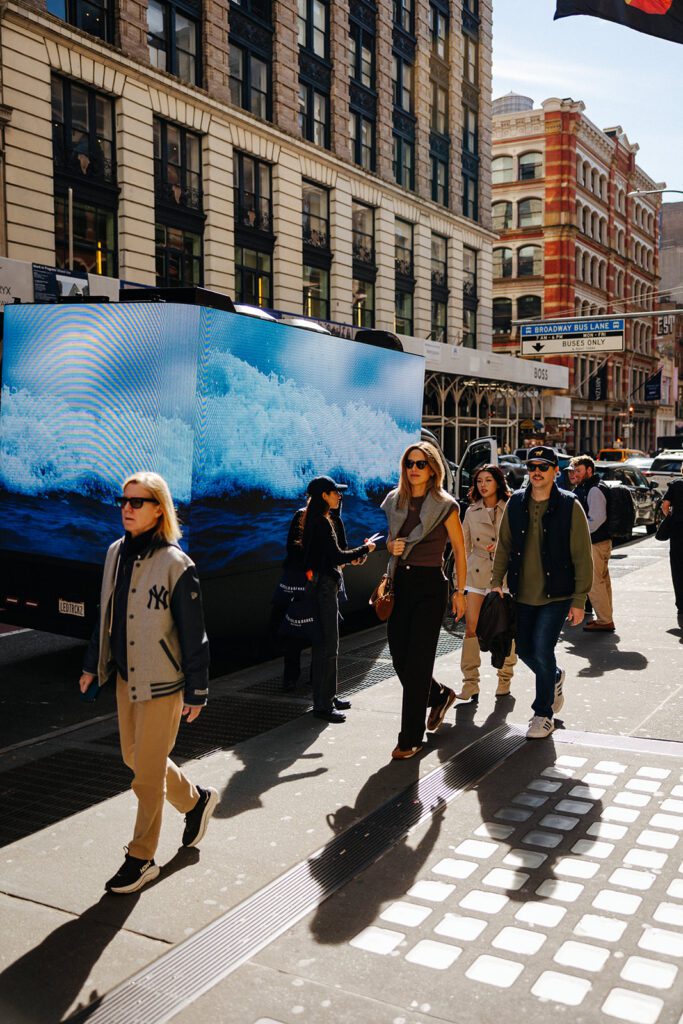
Mobile billboard trucks. A box truck or purpose-built vehicle carrying printed panels or an LED screen, with a driver. Routed and parked rather than dropped and left.
Freestanding modular boards. Panel systems assembled on site, often on a weighted base or a temporary frame. Used at event grounds, parking areas, construction perimeters and private lots.
Small portable units. A-frames, sidewalk signs, sandwich boards, pop-up banner frames. Genuinely portable in the sense that one person carries them.
These are not variations of one product. A towable trailer and an A-frame have almost nothing operationally in common. Decide which family you are actually in before anything else, because the permission picture, the crew, the dwell logic and the failure modes all differ.
Trailer billboards: dropped and left
This is what most commercial buyers mean when they search the term.
How it runs. A tow vehicle brings the trailer to a position, levels it, deploys stabilisers, and leaves. Faces are printed vinyl or rigid panels, installed before transport or fitted on site. Most units carry lighting, often solar or battery, so they work after dark without a power drop.
What it is good at. Holding a position that has no fixed inventory. The classic use is a private lot on a busy corridor, a dealership frontage, an event site perimeter, a construction staging area, a property that wants to advertise itself to passing traffic. If a landowner will say yes, you have a billboard where no media owner ever built one.
What breaks it. Three things, in order.
Wind. A trailer billboard is a large flat surface on a light chassis. Serious wind is the main physical risk, and it is why stabilisers, ballast and orientation matter. A unit positioned broadside to a prevailing wind on an exposed site is a problem waiting to happen. We orient for wind and we reconsider positions in storm season.
Position quality. Trailers end up where there is room to put them, which is often not where the sightline is best. A board at the back of a lot behind parked cars delivers almost nothing. Walk the site at the hour traffic matters and check what a driver actually sees.
Being forgotten. Units left in place for long runs get dirty, get faded, get tagged, and nobody checks. Build a maintenance pass into the plan or the board will be working against you by the end of the flight.
Siting a trailer properly. We walk the site before anything is towed in. The questions are always the same. Which direction does traffic approach from, and does the board present a face or an edge to that approach? How far back from the kerb line does it sit, and what stands between it and the road at the hour that matters? Is there room for the tow vehicle to get in and out without blocking the property’s own access? Where does the sun sit in the afternoon, because a face in hard backlight reads worse than people expect? And is the ground firm and level enough for stabilisers to do their job through a wet week?
That survey takes an hour and it regularly changes the recommended position by thirty or forty feet. Buyers underestimate how much difference that makes. A board angled to meet an approach rather than sitting parallel to the road is the difference between a face people read and a thin edge they never register.
Permission. This is the format where permission is both most necessary and most achievable, because the usual position is private property. Rules on temporary and portable signage vary by municipality, and several places treat them differently from both vehicles and permanent structures. Enforcement is inconsistent. It is a grey area. We start from permissioned private ground and a conversation with the property owner, because that is the version of this format with the least uncertainty attached.
Mobile billboard trucks: routed and parked
Covered in depth in our LED Trucks & Mobile Billboards work, but the essentials matter here because buyers compare the two constantly.
The difference that matters. A trailer holds one position for a long time. A truck visits several positions for short windows. One is about occupying a corridor. The other is about being present at a moment.
The mistake everyone makes. Asking for a truck to drive around all day. That is a parade, not a campaign. A vehicle moving through half-empty corridors passes a given person once, for a couple of seconds, at an angle they did not choose. The value is dwell: standing still where a crowd is already standing still. Stadium egress. Festival gates. Conference entrances at session break. A bar district at the hour the sidewalk fills.
We build a dwell schedule first and treat driving between points as transit rather than inventory.
Screen versus panels. Light decides it. LED reads best from dusk onward and loses contrast badly in direct afternoon sun. Printed panels read in full daylight, need no power and cannot fail. For a midday activation, panels usually win, whatever the client’s preference for the screen.
Crew. A driver who also operates content, at minimum. Add a brand ambassador pair if anything is being handed to anyone, because a driver cannot work a crowd and hold a vehicle at the same time.
Where it falls down. One vehicle is one place at a time. If the objective is metro-wide presence, a truck will not deliver it and no amount of routing changes that.
Freestanding modular boards
How it runs. Panels and frames trucked in and assembled on site by a small crew. Weighted bases, temporary footings or attachment to an existing structure such as a fence line or hoarding. Setup is an hour or several depending on size.
What it is good at. Event grounds, festival perimeters, private lots, construction sites and anywhere you need a large face that will stand for weeks and then disappear with no trace. You control size and position in a way a trailer does not allow, because you are not constrained by a chassis.
What breaks it. Wind again, and ground condition. Soft ground, gravel and slopes complicate ballast. An under-ballasted board in a gust is the single failure mode worth planning around properly.
Permission. Almost always private property with an owner who has agreed. Temporary structures can fall under local rules that vary by municipality, particularly around size and duration. Treat it as a grey area and start from the property owner.
Small portable units
A-frames, sidewalk signs, pop-up frames.
How it runs. Someone puts it out in the morning and brings it in at night. That is the entire operation, and it is also the format’s biggest weakness, because it relies on someone doing that every day.
What it is good at. Immediate frontage. Directing people to a door that is not obvious. Announcing something to people already within thirty feet.
What breaks it. Wind takes them over. Rain soaks cheap inserts. They get moved, they get taken, and in busy pedestrian areas they obstruct. Sidewalk placement is public right of way in most cases, and rules on sidewalk signage vary a great deal by municipality with inconsistent enforcement. It is a grey area, and the usual answer is to keep them on private frontage.
When I push back. When a brand wants a campaign built on these. They are a wayfinding tool. They are not a campaign.
Choosing by objective, not by product
The short version I give clients.
You need a large face on a specific corridor for weeks, and you can get a landowner to agree. Trailer billboard or a freestanding modular board. Trailer if you want it simple and movable. Modular if you want it bigger or shaped to the site.
You need to be at an event or a crowd at a specific hour. Truck. Build it around dwell windows.
You need presence inside a walkable neighbourhood. None of these. This is where portable formats genuinely do not deliver, and I would rather say so than sell you one. A walkable district needs repetition at pedestrian scale, which means Wheatpasting & Poster Campaigns in the corridor, Snipe Advertising on the walking routes, and Sidewalk Decals & Stencils where the queues form. A single board on a lot nearby does not make a neighbourhood feel occupied.
You need metro-wide reach. Fixed inventory or a broad poster layer. Portable formats are point solutions by design.
You need to direct people fifty feet to a door. Small portable unit, and nothing more complicated.
What we talk clients out of
Buying a board for a position nobody looks at. The most common waste in this format. A board exists, traffic passes, and the client assumes exposure. Then you stand there at five in the afternoon and watch the entire sightline disappear behind a line of stopped delivery trucks. Walk the position at the relevant hour before committing.
Long copy. A portable billboard on a corridor is read at speed. A handful of words. One thing to do. Dense layouts and phone numbers nobody will write down are wasted.
Treating a single board as a campaign. One face in one position reaches the people who pass that position. That is a real audience, and it is one audience. If the brief is broader, the board is a component.
Running a truck loop instead of a dwell plan. Said already, worth repeating, because it is the request I get most and the one that wastes the most.
Skipping the maintenance pass. A faded, dirty, tagged board on a good corridor for six weeks does more harm than no board. Build a check into the schedule.
Choosing LED for a daytime run because it sounds better. It will wash out. Panels will perform. I will keep saying this.
Ordering the biggest face available by default. Size is the specification clients fixate on, and past a certain point it stops buying attention and starts buying wind load and siting difficulty. A moderate face angled correctly on a good sightline outperforms a larger one squeezed into the only spot on the lot where it fits.
Pairing portable formats with the rest of the street
The campaigns that work best use a portable board as the anchor and let the street carry the repetition.
Here is how that sequences in practice.
Two weeks out, posters go up in the corridors feeding the area. Night work, usual window roughly eleven at night to five in the morning, chosen for low pedestrian traffic, available kerb space and fewer interruptions. Crews work in pairs, one pasting and one carrying and spotting, with several pairs working outward from a drop point on a bigger corridor. Placement is a repeated grid rather than scattered singles, because repetition inside a walking distance is the entire mechanism.
Surface decides whether that works. Smooth plywood hoarding is the best surface in this business, because paste wets it evenly and the paper lies flat with the edges staying down. Painted concrete and smooth block are close behind. Raw brick is porous and uneven, so paper bridges the mortar lines, sits proud and lifts at the corners. Rolling steel shutters move every morning when the business opens and chew paper fast. Fresh sealant, silicone and anti-graffiti film reject paste outright.
Weather decides the rest. Paste needs a dry setting window and the first hours matter most. Humidity slows the set, rain inside that window takes a run down to the pavement, and below freezing the paste will not bond before it freezes. In Southern summer we work the back of the night because paper dries faster than a crew can lay it. We move nights for weather routinely, and any operator who will not is handing you a failed run.
How long it holds is honestly variable. Days to several weeks. Sheltered surfaces with good adhesion and low interference sit at the long end, exposed corners and heavy foot traffic at the short end.
A week out, snipes saturate the walking routes at eye level.
Then the board goes in and it reads as confirmation rather than as an isolated sign on a lot.
Documentation and what to ask for
Whatever portable format you buy, ask for the same three things.
Position proof. Dated photographs of the unit in position, from the angle a passer-by actually has, not from a flattering diagonal. If the board is behind something, the photograph will show it.
Maintenance record. For any run longer than a couple of weeks, evidence that someone checked, cleaned and fixed what needed fixing.
Removal confirmation. When it came out, and in what condition the site was left. For a trailer or a modular board, this is also what keeps a property relationship usable for the next campaign.
None of that is performance measurement. It is proof of delivery, and it is the thing buyers most often fail to request and most need when reporting internally.
On measurement itself, nobody in out of home has clean attribution and anyone claiming it is selling a model. What is honest: hold comparable markets unexposed and compare branded search or direct traffic, use a distinct short URL or code on the board and treat the volumes as directional, and label any modelled impression figure you are handed as an estimate rather than a count.
Frequently asked questions
What counts as a portable billboard?
Four different products share the name. Towable trailer billboards dropped and left in position, mobile billboard trucks that are routed and parked, freestanding modular boards assembled on site, and small units like A-frames. They differ in crew, permission, dwell logic and failure modes, so decide which family you are actually in before planning anything else.
Trailer billboard or mobile billboard truck?
A trailer holds one position for a long run, which suits occupying a corridor where no fixed inventory exists. A truck visits several positions for short windows, which suits being present at a crowd moment such as stadium egress or a festival gate. Occupying a place and showing up at a moment are different objectives.
Can I put a portable billboard anywhere?
No. Rules on temporary and portable signage vary by municipality, some places treat portable units differently from vehicles and permanent structures, and enforcement is inconsistent. It is a grey area. We start from permissioned private property and a conversation with the owner, because that is the version with the least uncertainty attached to it.
What is the main thing that goes wrong?
Wind and sightline. Wind is the physical risk on any large flat face on a light chassis, which is why orientation, stabilisers and ballast matter and why we reconsider exposed positions in storm season. Sightline is the commercial risk, because boards get placed where there is room rather than where drivers actually see them.
Will a portable billboard work for a neighbourhood campaign?
Usually not on its own. A walkable district needs repetition at pedestrian scale, which portable boards do not provide. Pasted posters build frequency inside a walking distance, snipes saturate the routes in, and sidewalk decals hold the plane people are already facing. A board nearby can anchor that, but it cannot replace it.
How long can a printed face stay up before it looks bad?
It depends on sun, weather and traffic, and it degrades gradually rather than failing on a date. Fading, grime and tagging are the usual issues on longer runs. Build a maintenance pass into any flight beyond a couple of weeks, because a dirty faded board on a good corridor works against the brand it is selling.
Request a campaign quote
If you are considering a portable billboard, tell us the corridor or the event, the dates, and what the campaign is actually for. We will tell you which of the four formats fits, where the unit should genuinely stand, and whether a street layer around it would do more than a bigger board.
We run Wheatpasting & Poster Campaigns, Snipe Advertising, Sidewalk Decals & Stencils, Projection Advertising, LED Trucks & Mobile Billboards and Street Teams & Experiential nationwide.
Request a campaign quote.

Ready to Run Your Campaign?
Call us or email us. We’ll tell you exactly what we can do in your market and what it costs.
Related Services
Explore similar advertising solutions offered by American Guerrilla Marketing.
American Guerrilla Marketing — Los Angeles
Street-level campaigns in Los Angeles and nationwide. Wheatpasting, LED trucks, street teams, and more.
(646) 776-2770
Related Articles
-
Mobile Billboard Advertising Rates: What Drives Scope
November 20, 2026
-
LED Trucks & Mobile Billboards in Virginia Beach
November 20, 2026
-
Planning LED Trucks & Mobile Billboards in Sacramento
November 20, 2026
-
LED Truck Billboard: How It Actually Works
November 20, 2026
-
Electronic billboard companies: How It Actually Works
November 20, 2026