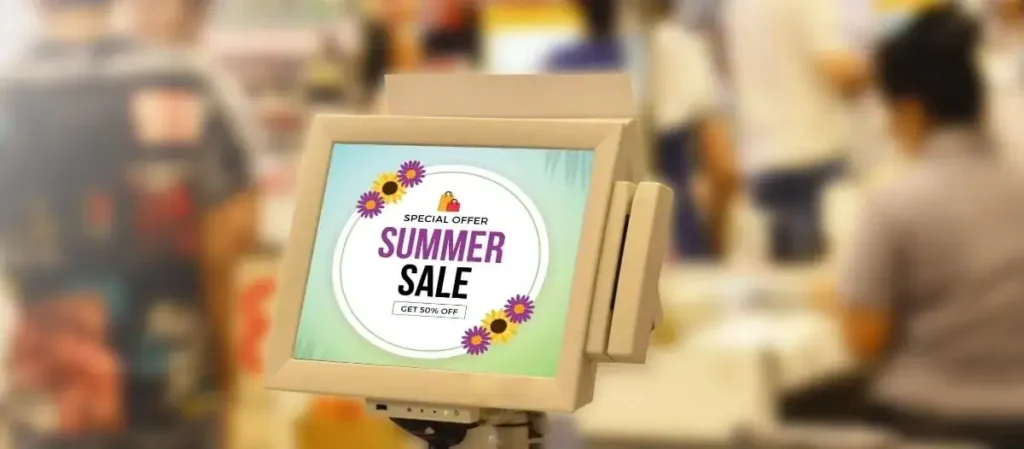
The purchase decision is most often made not before the customer enters a store but during the shopping experience itself. Research consistently shows that 70% to 80% of consumer purchase decisions are finalized in-store. Point of sale advertising exists to influence that decision at the moment it matters most: when the consumer is physically present, product in hand or within reach, in the mental state of buying.
No other advertising medium reaches consumers at precisely this moment with this level of purchase intent. A television commercial seen the night before created awareness. A digital ad seen this morning created interest. The POS display at the end of the aisle, or the counter display next to the register, closes the transaction. It is the final salesperson in the buyer’s journey, operating silently at the highest-leverage point in the retail environment.
This guide covers what point of sale advertising is, which formats work in which contexts, how to design POS materials that actually influence behavior, how to measure performance, and how POS campaigns connect with broader brand activation strategies including street-level guerrilla marketing that drives consumers into the store in the first place.
Understanding Point of Sale Advertising: Definitions and Scope
Point of sale advertising encompasses all promotional materials and displays positioned in retail environments to capture attention and drive purchase. While the term technically refers to materials positioned at the checkout or payment area, it is broadly used to describe the full range of in-store promotional display activity.
Point of purchase (POP) advertising is the more comprehensive term for in-store promotion at any location within the retail environment. POS and POP are frequently used interchangeably in marketing practice, and the distinction matters less than understanding the overall strategy of using physical materials in the retail environment to influence purchase behavior.
Why POS Advertising Is Irreplaceable
Digital advertising can create awareness and intent, but it cannot reproduce the experience of a consumer physically standing in front of a product, holding it in their hands, and making the final decision to put it in their basket. POS advertising speaks directly to that moment. It reinforces the brand story the consumer has been told through external advertising, provides relevant promotional information (price, offer, comparison), and triggers the psychological shortcuts that lead to impulse purchase decisions.
The return on investment for well-executed POS programs is often among the highest in a brand’s marketing portfolio precisely because it operates at such high purchase intent. You are not trying to move someone from awareness to consideration to intent. You are trying to move them from intent to transaction, a much shorter distance.
Point of Sale Advertising Formats
The right POS format depends on the retail environment, the product category, the available placement opportunities, and the campaign budget. Here is a breakdown of the primary formats and their appropriate applications.
Floor Displays and Free-Standing Inserts (FSIs)
Floor displays stand independently in aisle intersections, near store entrances, or in high-traffic open floor areas. They are among the most visible POS formats because they occupy shopper sight lines at eye level and below. A well-designed floor display can hold product, communicate the promotion, and create a branded environment in the retail space that commands attention from across the aisle.
Floor displays require retailer approval and compliance with specific dimensional and structural standards. They typically need to be structurally stable without attachment to shelving or walls, require no tools for assembly, and meet fire code requirements for aisle clearance.
Counter and Register Displays
Counter displays positioned near the checkout register capture attention during the waiting moments before and during payment. Impulse categories, gum, candy, batteries, travel-size products, lip balm, phone accessories, are placed here because the dwell time at checkout creates a buying moment that would not otherwise exist. Counter display sales typically far exceed the velocity of the same product on a shelf in the main category aisle.
Endcap Displays
Endcap placements on the end of aisle shelving are premium real estate in any grocery or mass market retail environment. Endcaps face the main traffic lanes rather than the aisle interior, giving them significantly higher visibility than standard shelf placements. They are frequently used for promotional pricing, seasonal campaigns, and new product launches that need higher visibility than a standard shelf set provides.
Shelf Talkers and Shelf Strips
Shelf talkers are small promotional signs attached to the shelf edge or protruding from the product area at eye level. They are cost-effective POS materials that can highlight price promotions, product features, awards, or calls to action in the immediate context of the product on shelf. Shelf strips run the length of the shelf edge and provide consistent brand presence across the entire product section.
Digital Displays and Interactive Kiosks
Digital point of sale screens allow dynamic content, video playback, and time-of-day creative rotation. They are increasingly common in grocery, pharmacy, and electronics retail environments at checkout lanes and in high-traffic areas. Interactive kiosks enable product exploration, product comparison, and in some categories, personalized recommendation and ordering.
POS Display Design Principles That Drive Conversion
A POS display that fails to attract attention is just an expensive decoration. Effective POS design respects the context in which it operates: shoppers are moving, distracted, time-pressured, and not actively looking for advertising. Your display has roughly one to two seconds to earn a glance, and a few more to communicate something worth acting on.
The Dominance Principle
Every effective POS display is organized around a single dominant element: either a product photo, a promotional offer, or a brand visual. This dominant element is what the eye lands on first. Everything else, the brand name, the supporting copy, the call to action, is secondary and should be visually subordinate. Displays that try to communicate too many things simultaneously communicate nothing effectively.
Color and Contrast
POS materials must stand out from the visual noise of the retail environment. This requires deliberate contrast with both the surrounding shelving and the competing POS materials in the same area. Brand colors should guide the design, but they need to be calibrated against the specific retail environment where the display will live. What stands out in a convenience store looks different from what stands out in a pharmacy or a big-box retailer.
Copy That Converts
POS copy has one job: make the next step obvious. “Try it free.” “Buy 2 get 1 free.” “New flavor.” “Rated #1 by customers.” Short, specific, and direct copy consistently outperforms clever or vague messaging in POS environments. The consumer is not reading for enjoyment. They are scanning for reasons to act or reasons to move on.
Measuring Point of Sale Advertising Performance
The most rigorous measure of POS performance is sales lift analysis: comparing product velocity in stores with the POS program against comparable stores without it during the same period. This analysis controls for regional differences, seasonal variation, and external promotional activity to isolate the incremental sales contribution of the POS campaign.
Retailers that provide point-of-sale scan data enable this analysis at the SKU level, giving brands a precise read on unit sales, basket attachment rates, and promotional price elasticity. Brands without access to retailer scan data can use distributor reports, shipping data, and retailer reorder rates as proxy measures.
How Street-Level Marketing Drives Traffic to POS Programs
Point of sale advertising is a conversion tool. But conversion requires traffic. Street-level marketing, including flyposting, wheatpasting, sidewalk stenciling, and mobile billboard trucks, creates the brand awareness and purchase intent that drives consumers into the retail environment in the first place.
Our team at American Guerrilla Marketing regularly works with consumer brands on coordinated campaigns that pair street-level advertising near retail locations with POS programs inside those same stores. A shopper who has seen a brand’s poster on the walk from the subway to the grocery store and then encounters the brand’s display at the end of the aisle is experiencing compounding impressions that dramatically increase purchase probability compared to either channel operating alone.
This coordination between outdoor advertising and POS execution is an underutilized strategy that tends to produce measurable sales lift above what either channel generates independently.
Retailer Relationships and POS Program Execution
Access to POS placement in major retail chains requires navigating retailer approval processes, compliance with specific display specifications, and often financial arrangements including slotting fees or co-op advertising agreements. Building these retailer relationships is essential for brands that depend on in-store visibility for their commercial performance.
Category managers and merchandising teams at major retailers review POS proposals against their planogram requirements, available floor space, and the financial value of the program to the retailer. A compelling POS program that demonstrates demonstrated consumer engagement, strong sales performance data from test markets, and retailer-friendly economics will typically win placement over programs that lack that evidence base.
Frequently Asked Questions: Point of Sale Advertising
What is point of sale advertising and why does it matter?
Point of sale (POS) advertising refers to promotional materials and displays positioned near the transaction area of a retail environment. It matters because 70% to 80% of purchase decisions are made in-store, and POS advertising reaches consumers at the exact moment they are most receptive to promotional messages. Well-executed POS campaigns drive impulse purchases, product trial, and brand awareness at the final decision point in the buying journey.
What types of point of sale advertising displays are most effective?
Floor displays and free-standing inserts in high-traffic areas, counter displays near the register, endcap displays on aisle ends, digital screen advertising at checkout, and themed shelf displays with branded signage consistently perform best. The right format depends on the product category, the retail environment, and the placement opportunity available through the retailer.
How do I get my POS advertising placed in major retail chains?
Major retail chains have category and merchandising teams that approve and coordinate POS placements. Access typically requires a formal presentation of the POS program, compliance with retailer specifications for display dimensions and materials, and often a co-op advertising arrangement or slotting fee. Working through your retail broker or distributor can simplify the process.
What makes point of sale advertising creative effective?
POS creative needs to communicate in one to two seconds because shoppers are moving. The most effective POS design uses a single dominant visual element, a short and direct headline, and a clear call to action. Color contrast to stand out from the surrounding retail environment is critical. Cluttered, text-heavy POS materials fail because shoppers do not stop to read.
How does point of sale advertising measure ROI?
POS advertising ROI is typically measured through sales lift analysis: comparing sales velocity of the promoted product in stores with the POS program against comparable stores without it. Many retailers provide scan data that allows advertisers to track sales performance at the SKU level during promotional periods.
Can brands use guerrilla marketing to complement traditional POS advertising?
Yes. Street-level advertising near retail locations reinforces the POS messaging consumers encounter inside the store. A shopper who has seen a brand’s poster near the store entrance and then encounters the same brand’s display at the register experiences multiple touchpoints that compound brand recognition and purchase intent.
What is the difference between POS advertising and point of purchase (POP) advertising?
POS advertising specifically refers to materials positioned at the checkout or payment area. Point of purchase (POP) advertising is a broader term that includes all in-store promotional materials from entrance displays to aisle signage to endcap displays. Both are designed to influence purchase decisions in the retail environment.
Frequently Asked Questions
What is point of sale advertising a promotional strategy?
American Guerrilla Marketing provides point of sale advertising a promotional strategy services across 50+ U.S. markets. Every campaign is planned, scouted, executed, and GPS-documented by our field teams. We work with regional brands and Fortune 500 companies on campaigns that require real street-level execution and documented proof of performance.
How does AGM approach promotional strategy?
Our process starts with a market consultation to understand your goals, target audience, and budget. We then scout locations, handle any required permissions or permits, coordinate production and installation with our local crews, and provide a full GPS-tagged photo report after the campaign runs.
What markets does American Guerrilla Marketing cover for promotional strategy?
We operate in 50+ U.S. markets including New York, Los Angeles, Chicago, Miami, Houston, Atlanta, Seattle, Denver, Boston, and dozens of secondary markets. Contact us to confirm availability and pricing for your specific market.
How much does a promotional strategy campaign cost?
Campaign pricing depends on market, format, quantity, and duration. We work with budgets ranging from targeted single-market runs to national rollouts across multiple cities. Use our RFP Builder or contact us directly for a custom quote based on your specific campaign requirements.
How do I get started with promotional strategy through AGM?
The fastest way to get started is to submit your campaign details through our RFP Builder at americanguerrillamarketing.com, or contact us directly at [email protected] or (646) 776-2770. Our team typically responds within one business day with availability and initial pricing.