
November 3, 2026
Reverse Graffiti Durability: Planning a Campaign
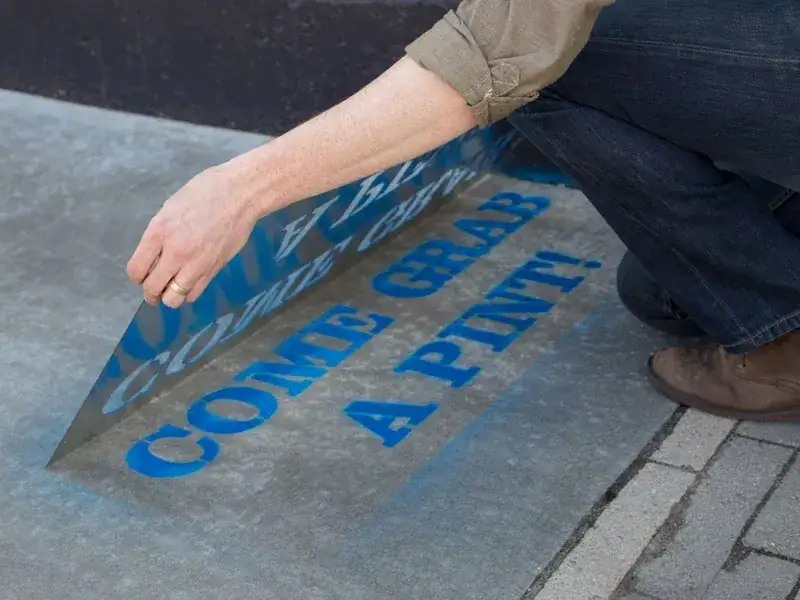
The question I get asked more than any other about this format is how long it lasts. It is the right question. It is also the one most people want a single number for, and a single number is exactly what nobody can honestly give you.
Reverse graffiti does not expire. It closes up. The mark is a clean area inside a dirty field, and from the moment the crew packs up, the city starts refilling it. Exhaust, brake dust, airborne grit, rain streaking, shoe traffic. All of it works to erase the contrast you just created.
So durability in this format is not a shelf life. It is a curve. The mark looks sharpest the night it goes in, stays strong for a while, then softens steadily until it reads as a faint shadow and then as nothing.
Planning a campaign around that curve is a different discipline from planning around a printed medium with a fixed run. This page walks the whole sequence, start to finish, with durability as the organising principle rather than an afterthought.
If you are scoping a reverse graffiti programme and someone has asked you for an end date, read this before you give them one.
What actually erases the mark
Four forces, and they work at different speeds depending on the site.
**Redeposition.** The slow, steady one. Airborne particulate settles back into the cleaned texture. This is what eventually closes every mark, and it is roughly proportional to how dirty the air at that location is. A mark on a busy arterial with heavy diesel traffic refills noticeably faster than one on a quiet side street, which is a genuinely counterintuitive trade: the surfaces that give you the best initial contrast are often the ones that close up quickest, because the same traffic that created the grime keeps creating it.
**Abrasion from foot traffic.** The fast one on horizontal surfaces. Shoes carry material and grind it into open concrete pores. A mark in the middle of a walking desire line degrades visibly faster than one two feet to the side, and you can often see the wear pattern develop as a soft smear across the busiest part of the image.
**Rain.** The unpredictable one, and it cuts both ways. A heavy sustained rain can wash the surrounding dirty field, which reduces your contrast without touching the clean area at all. The mark has not changed, but it looks worse because the background caught up. Alternatively, run off streaking across a wall can carry fresh grime directly into the clean area in visible vertical lines. Light rain often does very little. There is no reliable rule and I do not pretend there is.
**Maintenance.** The sudden one. A property owner’s cleaning contractor, a neighbouring business washing their frontage, a pressure washing crew doing seasonal work. This does not fade a mark, it ends it, often in week one, and it is the single most common reason a placement disappears early.
Notice that three of the four are site characteristics, not material characteristics. That is why durability planning in this format is really location planning.
Which sites hold longest
From crew experience, ranked roughly by how long marks stay legible.
**Sheltered vertical surfaces** hold longest by a clear margin. Nothing walks on them, rain does not hit them directly, and the only erasure mechanism is slow airborne redeposition. Underpass walls, the undersides of overpasses, stair core walls, covered walkway walls, parking structure interiors.
**Vertical surfaces with weather exposure** are next. Still no abrasion, but rain streaking becomes a factor and marks tend to degrade unevenly from the top down.
**Horizontal surfaces outside the main walking line** sit in the middle. The edge of a wide sidewalk, a plaza area off the direct route, the strip near a building wall. They keep abrasion low while staying visible.
**Horizontal surfaces in the walking line** are the shortest lived. Also frequently the highest value placements, because they are where the eyes are. That tension is real and it is a planning decision, not a problem to solve.
**Entryways and thresholds** are the worst case. Concentrated foot traffic, grit tracked in from outside, and often cleaned regularly as well. I generally steer campaigns away from them for anything but a very short burst.
Setting honest expectations with a brand team
Here is how I frame it internally, and I recommend clients adopt the same language because it prevents arguments later.
There are three phases to a reverse graffiti mark.
**Sharp.** The image is crisp, the edges are defined, it photographs beautifully and it reads clearly from distance. This is your hero phase and it is the shortest.
**Legible.** Edges have softened, contrast has dropped, but a passer by still sees the mark and understands it. This phase is considerably longer than the sharp phase and it is where most of the campaign’s actual exposure happens.
**Ghost.** Visible as a change in surface tone if you know it is there, not legible as an image. Functionally over, though it does no harm sitting there.
What I will commit to is install quality, documentation and removal. What I will not commit to is a date on which the mark will still be in a given phase, because redeposition rate, foot traffic and rain are not things I control.
Any operator who offers you a guaranteed visible duration on this format is either going to re install quietly or is going to disappoint you. There is no third option.
Step one: define the durability requirement before the location list
Most briefs arrive with locations first and duration second. For this format, reverse that.
Start by asking what the mark actually has to outlive. The answers usually fall into a few patterns.
If it is a short burst tied to a specific moment, an event, a launch weekend, a conference, then durability barely matters. You want maximum contrast on named dates. That frees you to use high traffic horizontal placements that would be a poor choice for a long run, because you only need the sharp phase.
If it is a sustained presence over a longer push, durability becomes the dominant criterion and the location mix shifts hard toward sheltered vertical surfaces, with a refresh plan built in from the start.
If it is an earned media play where the goal is coverage and photographs, you need the sharp phase to coincide with when photographers and social posts happen, which usually means installing close to the moment rather than early.
If it is a goodwill or brand presence play with no fixed window, you have the most freedom and should optimise for surfaces that hold.
Getting this answer first changes which panels we even bother surveying. Doing it the other way round means rebuilding the location list later.
Step two: survey for durability, not just contrast
A standard site survey asks whether the surface will produce an image. A durability survey asks two more questions.
**How fast will this refill?** Judged by traffic volume and type adjacent to the panel, whether it sits in a wind funnel that carries grit, and how dense the existing grime is relative to the age of the surface. A panel that is extremely dirty on a young surface is telling you it accumulates fast, which means it will close fast.
**What will physically cross it?** Where is the walking desire line, do delivery vehicles park on it, does a sidewalk cafe set up over it, is there a drain that discharges across it in rain.
And one question that is not about physics at all: **who cleans this and when?** Ask the property owner directly whether the surface is on a washing schedule, when it was last done, and whether they will hold off during the run. This is the highest value question in the entire survey and it is the one most people never ask. An owner who washes their frontage quarterly will cheerfully agree to skip a cycle if you ask in advance. They will not think to mention it if you do not.
Low angle daylight photographs are still the baseline requirement for every panel. A straight on shot hides texture and texture is what holds the image.
Step three: design for the fade, not just for day one
Artwork decisions have a direct effect on how long a mark stays useful, and this is where designers can add real durability without anyone spending more on crew.
**Weight survives, detail does not.** As redeposition closes the mark, it closes from the edges inward. Thin strokes close first and can vanish entirely while heavy forms are still strong. A logo rendered at generous stroke weight will outlive the same logo rendered faithfully with its thin elements.
**Simplify to silhouette.** Gradients, outlines, drop shadows and fine text do not exist in this medium on day one, let alone week three.
**Negative space needs room.** Internal counters, the enclosed part of letters, close up as the mark fades. Open them wider than the brand guidelines would normally allow or the wordmark turns into a blob.
**Scale up.** A larger mark degrades more gracefully, because the proportional loss at the edges matters less.
**One idea.** A bold silhouette and a short line of text. Not a URL, not legal copy, and not a QR code, because scan reliability on textured concrete is something I will not promise even when the mark is fresh.
I have had brand teams push back hard on simplification because the result is not an exact reproduction of the identity. The honest trade is this: you can have a faithful mark that is unreadable in two weeks, or a simplified mark that still works. Reverse graffiti is not a reproduction medium.
Step four: build the refresh plan into the schedule
For anything beyond a short burst, assume a refresh and scope it from the beginning rather than bolting it on when someone notices the marks have faded.
A refresh is a re wash through the same stencil, in the same registration. It is faster than the original install because the crew already knows the site, the stencil exists, and positioning is quicker when there is a visible ghost to align to. It is still a scheduled crew visit with travel, setup and weather dependency.
Two things make refreshes work. Keep the stencils, labelled per placement, and keep accurate registration notes and photographs so the crew can align precisely. A refresh that lands slightly off the original leaves a doubled edge that looks worse than the faded mark did.
Timing a refresh is a judgement call made from evidence, not a calendar entry. Which is why the next step matters.
Step five: monitor with photographs, not assumptions
Nobody knows how a mark is ageing unless somebody looks at it.
Our standard documentation is before and after photographs, a context shot from the viewer’s position, location, timestamp and crew log. For a durability campaign, add scheduled re photography of the same placements from the same standing position through the run.
Daylight only. Overnight photographs flatter everything, because artificial light at a low angle exaggerates contrast. The audience sees these in daylight and so should your reporting.
Same position every time, or the comparison is worthless.
Over a few rounds you get a fade curve for each placement, and that curve is genuinely valuable. It tells you which sites in that city hold, which close fast, and where to put the next campaign. On a repeat programme it is the difference between guessing and knowing.
Step six: removal, agreed before install
Removal is quick in this format. Because the image is absence, you take it away by evening out the surrounding area with a broader wash until the contrast disappears and the panel reads uniformly clean.
The important part is that the commitment is made in writing before anything happens. It names the surface, the dates and the undertaking to even out the panel on request. That commitment is the main reason hesitant property owners say yes, and it is the main reason they let us come back.
It also interacts with durability in a way worth planning for. If a mark is going to be allowed to fade naturally rather than be removed, say so to the owner up front and get agreement, because an owner expecting removal on a date who instead watches a ghost linger for weeks will not be pleased.
Permission and ordinance, honestly
This sits in a grey area and I am not going to pretend otherwise.
Whether a cleaned commercial image on a visible surface is treated as cleaning, as advertising requiring a permit, or as a marking subject to local provisions varies by municipality. Codes were largely drafted before this format existed. Enforcement is inconsistent between cities and sometimes between districts within one city.
What we control is the permission chain. We default to privately controlled surfaces, we get written permission naming the surface, dates, artwork and removal, we check for leases, management companies and district rules sitting above the owner, and we document every placement.
Where a client wants genuinely public surface, the honest route is approaching the relevant city department and accepting that the answer varies and may take time. We do not give legal advice and we never characterise the format as legal or illegal. That is a question for your counsel and the local authority with your specific site and artwork in front of them.
Where durability makes us recommend something else
Some briefs want the aesthetic of reverse graffiti and the duration of a printed medium. Those are incompatible and I say so early.
If a campaign needs a mark that is still crisp on a known date months out, it needs Sidewalk Decals & Stencils rather than reverse graffiti. A printed decal applied with owner permission holds its appearance for a defined period, looks identical in every market, comes up on a known schedule, and does not care how dirty the surrounding surface is. It loses the novelty that earns reverse graffiti its attention, and it gains the predictability the brief is actually asking for.
Plenty of programmes run both. Decals carry the consistent, long duration, multi market backbone. A smaller number of reverse graffiti marks go on enthusiastic private frontages at pedestrian pinch points as the story layer, timed so the sharp phase lands when it matters most.
That structure gives you durability where you need it and distinctiveness where it earns coverage, which is usually what the brief wanted before it got written down as one format.
What we talk clients out of on durability grounds
**Guaranteed visible duration.** Cannot be given honestly and I will not give it.
**Long runs on high traffic horizontal placements.** Fine for a weekend. Poor value across an extended push, because abrasion closes them fastest.
**Installing early to be safe.** Counterproductive. The sharp phase is short, so installing well ahead of the moment spends it on nobody. We install close to the window.
**Entryways and thresholds for anything but a burst.** Concentrated traffic plus regular cleaning.
**Skipping the maintenance question.** Clients who do not ask whether the owner washes the frontage lose placements in week one and blame the format.
**Faithful detailed artwork on a long run.** Thin elements close first. Simplify or accept a short useful life.
**Freezing season installs in cold markets.** We will not put water on a public walkway below freezing, which rules out part of the northern calendar regardless of what the durability plan says.
Frequently asked questions
How long does reverse graffiti actually last?
There is no fixed duration, because the mark closes gradually as grime rebuilds rather than expiring. Think in three phases: sharp, legible and ghost. Sheltered vertical surfaces hold far longer than horizontal ones in walking lines, where shoe abrasion dominates. We commit to install quality, documentation and removal, never to a visible duration on a named future date.
What makes a mark fade fastest?
Foot traffic abrasion on horizontal surfaces, heavy adjacent vehicle traffic driving rapid redeposition, and rain, which can either wash the surrounding field and flatten contrast or streak fresh grime into the clean area. The fastest killer is not fade at all, it is a property owner’s cleaning contractor washing the frontage during the run.
Can you refresh a reverse graffiti mark?
Yes, by re washing through the same stencil in the same registration. It is quicker than the original install because the site is known and a ghost remains to align to, but it is still a scheduled crew visit with travel and weather dependency. Keep stencils labelled per placement and keep registration photographs, or a refresh lands off register.
How should artwork change for a longer run?
Increase stroke weight, open internal counters wider than brand guidelines usually allow, simplify to silhouette and scale up. Marks close from the edges inward, so thin elements vanish first while heavy forms stay strong. Drop gradients, outlines, fine text and QR codes, since scan reliability on textured concrete is not something we will promise.
How do you monitor durability during a campaign?
Scheduled re photography of each placement from the same standing position, in daylight only, through the run. Overnight photographs exaggerate contrast and mislead. Comparing the same viewpoint over several rounds produces a real fade curve per site, which tells you which placements hold in that city and informs refresh timing and the next campaign.
Should we ask the property owner about cleaning schedules?
Always, and it is the most valuable question in the survey. Ask when the frontage was last washed, how often it is done and whether they will skip a cycle during the run. Owners agree readily when asked in advance and never think to mention it unprompted. Unasked, this is the most common reason placements disappear early.
Request a campaign quote
Tell us what the marks need to outlive, which markets you are considering and who controls the surfaces. We will build the location mix around the durability requirement rather than the other way round, scope the refresh and removal visits honestly, and tell you plainly if a printed decal programme would serve the brief better.
If someone has already promised a duration we cannot support, we would rather have that conversation now than in week three.
Request a campaign quote and we will start with the durability requirement.

Ready to Run Your Campaign?
Call us or email us. We’ll tell you exactly what we can do in your market and what it costs.
Related Services
Explore similar advertising solutions offered by American Guerrilla Marketing.
American Guerrilla Marketing — Los Angeles
Street-level campaigns in Los Angeles and nationwide. Wheatpasting, LED trucks, street teams, and more.
(646) 776-2770
Related Articles
-
How Sidewalk Decals & Stencils Runs in San Jose
November 3, 2026
-
Sidewalk Decals & Stencils in Los Angeles
November 3, 2026
-
Reverse Graffiti: How It Actually Works
November 3, 2026
-
Decal Performance in Heat and Rain: How Installs Work
November 3, 2026
-
Removable vs Permanent Decal Adhesive Explained
November 3, 2026