Convention attendees in New Orleans move through one of the most walkable, culturally dense corridors in the country. The stretch from the Ernest N. Morial Convention Center through the Central Business District, across Canal Street, and into the French Quarter is not just a transit path — it is a concentrated impression environment that brands can own for the duration of an event. Our team deploys campaigns along this corridor for tech companies, consumer brands, B2B platforms, and entertainment properties during conventions, trade shows, and festivals throughout the year.
The geography of New Orleans works in your favor. Attendees cluster in a tight hotel zone along Poydras Street and Convention Center Boulevard. They walk predictable routes. They eat dinner on the same three blocks. In a city this walkable, street-level marketing does not compete with digital — it saturates the physical world your audience actually inhabits during the event.
This guide covers how we plan and execute convention-period campaigns in New Orleans: where we deploy, which formats perform, how timing maps to event schedules, and what the operational picture looks like from brief to post-campaign report.
The Ernest N. Morial Convention Center Approach Corridor
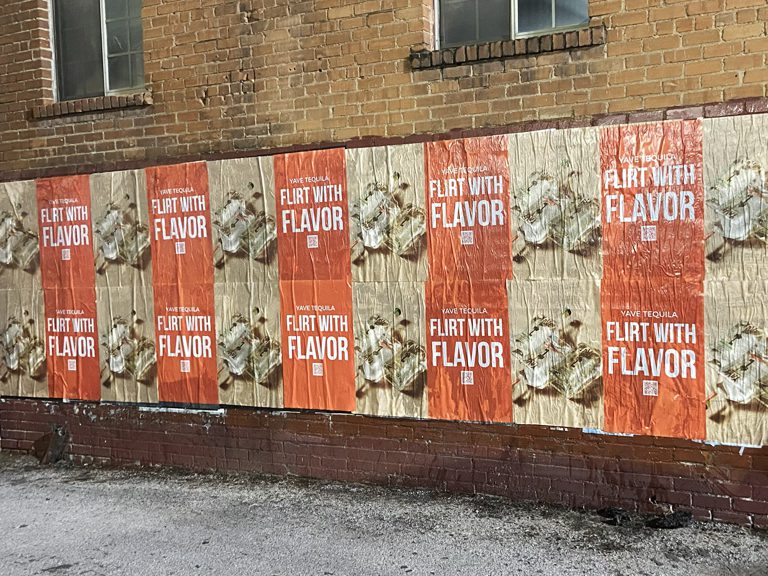
Convention Center Boulevard runs directly in front of the Morial Center’s main halls. Attendees on foot from downtown hotels cross this block repeatedly — morning registration, lunch breaks, evening departures. The sidewalk wall runs along this corridor are among the most accessible high-impression wheatpaste surfaces in the market.
We treat the approach corridor as the campaign foundation. Wheatpaste panels placed the night before a convention opens reach attendees before competing brand activations are even set up inside. The format does not require a permit booth, does not compete for floor space, and does not disappear when the exhibit hall closes. It greets attendees every time they step outside.
For larger conventions, we extend the wall run from the Convention Center Boulevard frontage east through the Warehouse District side streets. The result is a visual corridor that brackets attendee movement from multiple angles.
CBD Hotel Block Tactics
The hotel cluster along Poydras Street, S. Peters Street, and Canal Street contains the majority of convention attendees during any major event at the Morial Center. Our team deploys street team programs at hotel exits during morning departure windows (7:30 to 9:30 a.m.) and evening return windows (5:00 to 8:00 p.m.) when foot traffic is highest and attention is available.
Hotel lobby approaches require coordination with venue management, but sidewalk zones adjacent to hotel entrances are fully accessible. We position brand ambassadors at the precise moment when attendees are transitioning between the hotel and the event — primed for a conversation, not buried in their phones.
Sidewalk stencils at pedestrian crossings near major convention hotels create ground-level impressions that persist throughout the convention period. We deploy these the night before the event opens and typically see three to five days of useful visibility depending on weather and foot traffic wear.
The French Quarter and Frenchmen Street Evening Window
After convention sessions close, attendees move to the French Quarter. Bourbon Street captures the largest volume, but Frenchmen Street in the Marigny draws the professional and creative demographic that makes up the core of most convention audiences. Both zones create strong evening campaign environments.
Evening street team deployments in the French Quarter reach attendees in a relaxed, social state. Branded materials distributed outside popular restaurants and bars — handed directly by trained brand ambassadors — land differently than a logo on a lanyard. We brief teams on the specific event and audience before every deployment so the conversation matches the context.
For brands targeting a younger or more culturally engaged demographic, Frenchmen Street deployments on Wednesday and Thursday evenings during multi-day conventions reach the audience before they have settled into an entertainment routine. These windows are more focused and less saturated than Bourbon Street.
Wheatpaste Campaigns: Surface Map and Scheduling
New Orleans has strong wheatpaste infrastructure for campaigns. The Warehouse District walls west of the convention center, the back streets of the CBD between Magazine and Camp, and the Bywater corridor approaching the Marigny all offer wall surfaces accessible to professional crews. For convention-period campaigns, we concentrate placements in the two to three block radius around the hotel cluster and extend into evening-destination zones.
Scheduling matters. We deploy the night before the convention opens so placements are fresh on day one. For events running five or more days, we schedule a mid-campaign refresh to replace weathered pieces and maintain visual impact through the event’s final day — when attendees are often making their last brand impressions before returning home.
Our wheatpasting and poster campaigns use professional-grade wheat paste and print materials rated for the Southern humidity environment. Pieces that fail early create negative brand impressions. We do not cut corners on material quality.
LED Truck Routes During Convention Events
LED billboard trucks running slow loops through Convention Center Boulevard, Poydras Street, and the Canal Street corridor generate high-impression volume during convention arrival and departure peaks. We route trucks to maximize intersection dwell time at pedestrian crossings where attendees stop and wait, giving the creative message three to eight seconds of unobstructed attention.
Evening routes through the French Quarter create a second daily impression window. Bourbon Street and Decatur Street routes reach the entertainment zone where attendees are in a slower pace and more receptive state. Our LED billboard trucks are calibrated for New Orleans street dimensions and carry GPS tracking for client-facing route documentation.
Street Team Programs: Briefing and Deployment
Street teams working convention environments need more than a stack of flyers. Our brand ambassador agency briefs every team on the specific convention context: what the attendees do professionally, what the event is about, and what the brand’s message should accomplish in a 30-second interaction. Generic street teams hand out materials and get ignored. Briefed teams start conversations and create actual brand encounters.
We deploy convention teams in three windows: morning arrival at the convention center entrance (7:30 to 9:30 a.m.), mid-day lunch exit routes (11:30 a.m. to 1:30 p.m.), and evening hotel return routes (5:00 to 7:30 p.m.). Each window has a different energy and requires a different conversational approach. We adjust messaging by window, not just by day.
Team sizes for New Orleans convention deployments range from four to twelve ambassadors depending on convention size and the number of simultaneous deployment zones. We coordinate across zones with a field supervisor who maintains real-time communication with our operations team in Brooklyn.
Sidewalk Stencils on Convention Approach Routes
Sidewalk stencils placed at pedestrian crossings on Convention Center Boulevard and at hotel exit routes create ground-level directional or brand impressions that persist for the full convention period. We use water-based chalk-format applications that comply with New Orleans public right-of-way standards and fade naturally without requiring removal crews.
The format is particularly effective as a directional tool — “catch us at [event], Booth 412” or a branded arrow pointing toward a nearby activation location. Our sidewalk stencil crews deploy overnight and document each placement with geo-tagged photography before dawn so clients have verification before the convention floor opens.
Timing Conventions: When New Orleans Campaigns Run
The New Orleans convention calendar is dense. The Morial Center hosts 30 to 40 major conventions annually, with the heaviest concentration in the January through May and September through November windows. Essence Festival in July and French Quarter Festival in April bring massive general consumer audiences that require different campaign approaches than B2B trade shows.
Booking lead time directly affects campaign quality. The 8 to 12 week window allows us to scout surfaces, confirm crew, and produce print materials without rush fees. Campaigns booked inside four weeks can still run, but surface options narrow and crew scheduling becomes constrained. For major conventions with more than 20,000 attendees, we recommend the full 12-week lead.
Our guerrilla marketing services team tracks the New Orleans convention calendar year-round. If you know your target event, we can give you a preliminary availability picture before you commit to a scope.
Cross-Format Campaign Architecture for New Orleans
Single-format campaigns are a missed opportunity in a market like New Orleans during convention season. The attendee who sees a wheatpaste panel on the way to the convention center, receives a flyer from a street team at lunch, and watches an LED truck pass during the evening walk to the French Quarter has had three distinct brand encounters in one day. That frequency creates recognition that sustains beyond the event.
We typically structure New Orleans convention campaigns around a core format (wheatpaste or LED truck) with a street team deployment as the human-interaction layer. Sidewalk stencils add the ground-level impression that fills in the gaps between larger placements. The architecture is built to maximize encounter frequency across all attendee movement patterns without requiring the client to manage multiple separate vendors.
For brands with digital campaigns running in parallel, our street-level deployments are designed to reinforce the message attendees are already seeing in their feeds. The same visual language, the same call to action — but delivered physically, in the same city, at the same time. That cross-channel coherence amplifies the effect of both programs.
Reporting and Documentation Standards
Every campaign we run in New Orleans is documented with geo-tagged photography at each placement, a written placement log with surface locations and timestamps, and a post-campaign summary report delivered within 48 to 72 hours of campaign completion. Street team deployments include hourly activity logs, distribution counts by zone, and supervisor field notes.
For clients running campaigns at multiple conventions across the year, we maintain a campaign archive that allows for year-over-year comparison. Knowing which surfaces held longest, which hotel exits produced the best street team engagement, and which LED routes generated the most documented impressions makes each subsequent campaign sharper.
Budget Ranges for New Orleans Convention Campaigns
Entry-level convention-period campaigns in New Orleans — a focused street team deployment or a stencil run — start around $8,000 for a single-day execution. Full multi-format campaigns covering wheatpaste, street teams, and LED truck for a five-day convention run in the $25,000 to $45,000 range depending on crew size, print volume, and market scope. We provide detailed line-item proposals within 48 hours of receiving a brief.
Convention marketing competes with booth rental, digital advertising, and event sponsorship for the same budget. The advantage of street-level campaigns is that they reach attendees outside the convention floor — where they are not already inundated with competing brand messages. The French Quarter at 9 p.m. is less competitive than a trade show floor at 2 p.m. We help brands win the time outside the hall.
What Makes New Orleans Different from Other Convention Markets
New Orleans convention campaigns operate in a city where the entertainment infrastructure is embedded in the city’s identity in a way that has no equivalent in other major convention markets. Phoenix attendees have to travel to entertainment zones. Las Vegas has entertainment venues but few walkable pedestrian neighborhoods. Houston’s convention corridor is car-dependent. New Orleans has the French Quarter — a historically dense, walkable entertainment district within easy walking distance of the Morial Center — that draws convention attendees out of their hotels and into public pedestrian spaces in proportions that most convention cities cannot match.
That walkability creates the impression environment that makes street-level campaigns uniquely effective in New Orleans. An attendee who walks from the Hyatt Regency to a restaurant in the French Quarter walks past your wheatpaste poster, over your sidewalk stencil, and in front of your LED truck. An attendee at most other convention cities rides an Uber to dinner and sees none of these campaign formats. The walkability advantage is not incidental — it is the structural reason why New Orleans consistently outperforms comparable convention markets for street-level campaign impression rates.
Integrating Convention Street Campaigns with Exhibit Floor Presence
For brands with exhibit floor presence at New Orleans conventions, street-level campaigns serve a different function than they do for non-exhibitor brands. Rather than generating awareness as a primary objective, the street campaign reinforces recognition from the convention floor encounter. Attendees who visited your booth on day one and then see your poster on the way to dinner on day two have a second brand encounter that reinforces the first. That repetition — same brand, different format, different context — accelerates the transition from initial awareness to consideration and inquiry.
For exhibitors with specific next-step objectives — scheduling meetings, driving demo sign-ups, collecting lead cards — a street team with QR codes linking to the scheduling page can create direct conversion moments outside the convention floor. An attendee who did not have time to stop at the booth on day one but picks up a street team card with a direct scheduling link on their walk to dinner has a frictionless path to the meeting request. That approach has produced documented lead-generation results for convention exhibitors across multiple markets and industries.
Why New Orleans Convention Season Is Competitive
The Morial Center hosts 30 to 40 major conventions annually, and many of the brands attending each convention are executing some form of marketing campaign during the event window. That creates a competitive advertising environment in the approach corridor and hotel zones during peak events. The brands that secure the best surfaces, the best crew slots, and the most strategic placement positions are those that book early and brief thoroughly. Last-minute campaigns in a competitive market end up with secondary surfaces and constrained crew options because the best inventory is already committed.
Our 8 to 12 week booking recommendation for New Orleans convention campaigns is not arbitrary. It reflects the actual lead time required to secure top-tier surfaces in the Morial Center approach corridor, confirm experienced local crew, and produce print materials at quality standards that perform in the Southern humidity environment. Campaigns booked inside four weeks can still run, but the constraint is real and the output reflects it. For major conventions with 20,000 or more attendees, the 12-week lead is the right standard.
Frequently Asked Questions
What is convention marketing in New Orleans?
Convention marketing in New Orleans refers to street-level and experiential advertising campaigns timed to run during major events at the Ernest N. Morial Convention Center. Tactics include wheatpaste posters on the approach corridor, street teams at hotel exits, sidewalk stencils near shuttle stops, and LED truck routes through the CBD and French Quarter.
Which neighborhoods are best for convention period campaigns in New Orleans?
The Convention Center Boulevard approach corridor, the CBD hotel cluster around Poydras Street, Bourbon Street and Frenchmen Street in the French Quarter, and the Warehouse Arts District all perform well during convention periods. Evening deployments in the French Quarter reach attendees in a relaxed, social context that is far less cluttered than the convention floor.
How far in advance should I book a New Orleans convention marketing campaign?
We recommend booking 8 to 12 weeks before the convention. Peak events like NOLA Tech Week, Essence Festival, and major medical or legal conferences trigger demand spikes that exhaust surface inventory and crew availability quickly. Inside four weeks, campaigns can still run but options narrow.
What does a New Orleans convention marketing campaign cost?
Budgets typically range from $8,000 for a focused street team or stencil deployment to $35,000 or more for a multi-format campaign covering the approach corridor, hotel blocks, and French Quarter. We build custom scopes based on your target audience, event size, and campaign objectives.
Does AGM operate in New Orleans?
Yes. We execute campaigns in New Orleans and across 50+ U.S. markets. Our New Orleans operations cover the Morial Center corridor, CBD hotel zone, French Quarter, Marigny, and Warehouse District. All campaigns are GPS-documented with photo verification delivered within 48 to 72 hours of completion.
What formats work best for convention marketing in New Orleans?
Wheatpaste poster campaigns on the Convention Center Boulevard wall runs, street team distributions at hotel exits and shuttle stops, sidewalk stencils at pedestrian crossings, and LED truck routes through the CBD and French Quarter all perform well. The right mix depends on your audience and event schedule.
Can AGM coordinate New Orleans alongside other markets in the same campaign?
Yes. We run multi-city convention campaigns across markets simultaneously. If your event has satellite conferences or your brand is activating at multiple regional conventions in the same quarter, we can coordinate execution and deliver unified reporting.