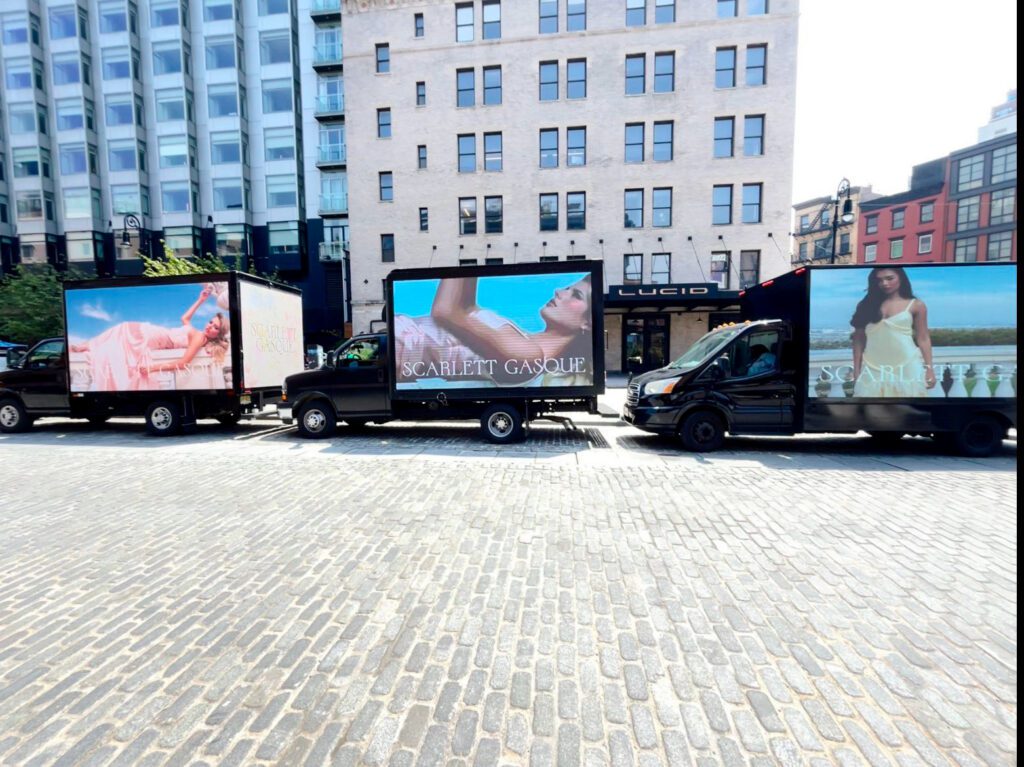
A mobile marketing vehicle is one of the most direct forms of advertising available to a brand today. You take a vehicle. You put your brand on it. You drive it to where your audience is. They see it. That is the core of the concept, and it has been working for brands for decades.
We run mobile marketing vehicle campaigns from coast to coast. Small brands. Large brands. Startups with tight budgets and global companies with full activation teams. The vehicle type changes. The route changes. The creative changes. But the fundamental strategy is the same: go to the consumer instead of waiting for the consumer to come to you.
This guide breaks down everything that makes a mobile marketing vehicle campaign work. We cover vehicle formats, route strategy, creative principles, measurement, and how to integrate a vehicle campaign with the rest of your marketing mix.
A mobile marketing vehicle is any vehicle used as a primary tool for delivering a brand message in public spaces. The vehicle is the medium. It carries the creative. It moves through the market. It generates exposures wherever it goes.
The simplest version is a van with a full exterior wrap. The most complex version is a custom-fabricated experiential unit with an interior experience space, interactive technology, product sampling capability, and social media integration. Between those two extremes is a wide range of formats suited to different goals and budgets.
What unites all mobile marketing vehicles is the principle of meeting the consumer in their world. You do not ask them to visit your website, walk into your store, or click on your ad. You show up where they already are. That proactive presence is what makes mobile marketing vehicles so effective.
We work with brands that have never done a vehicle campaign before and brands that deploy fleets of vehicles in multiple cities at the same time. The learning curve is manageable. The results, when campaigns are planned and executed properly, are consistently impressive.
Why Brands Choose Mobile Marketing Vehicles
Brands choose mobile marketing vehicles for specific reasons. Digital advertising has become noisy. Consumers have developed genuine resistance to digital ads. They use ad blockers. They scroll past banner ads without seeing them. They skip video ads after five seconds.
A mobile marketing vehicle cannot be blocked or skipped. It exists in the physical world. When it drives past a pedestrian on a busy street, the pedestrian sees it. There is no technological filter between the brand and the consumer.
There is also a novelty factor. A striking branded vehicle on a city street commands attention in a way that a digital banner never will. People look at things that are different from their surroundings. A bright yellow branded truck in a sea of ordinary traffic stands out. People notice it. Some of them pull out their phones and take photos.
That organic documentation is a significant added value of mobile marketing vehicles. When consumers photograph and share a branded vehicle on social media, the campaign extends its reach far beyond the physical route. We have seen mobile marketing vehicle activations generate thousands of social media posts in a single day, each one reaching the poster’s entire network without any additional media spend from the brand.
Mobile Marketing Vehicle Formats
There is no single format for a mobile marketing vehicle. The right format depends on the campaign’s goals, the target market, the budget, and the experience the brand wants to create. Here are the main categories.
Wrapped Transit Vehicles
Wrapped vans, trucks, and buses are the most widely deployed form of mobile marketing vehicle. A high-quality vinyl wrap covers the exterior surface of the vehicle. The graphics translate the brand identity into a large-format visual presentation. The vehicle drives planned routes through the target market, generating exposures among pedestrians and other drivers.
This format is cost-effective, scalable, and versatile. A single vehicle can cover an entire city in a day. A fleet of five vehicles can dominate multiple neighborhoods at the same time. For reach and frequency, wrapped transit vehicles deliver strong performance at a relatively accessible price point.
LED and Digital Screen Vehicles
LED screen trucks mount large digital displays on the vehicle’s sides or rear. The screens can cycle through multiple ads, show full motion video, and adjust brightness for day and night conditions. These vehicles are particularly effective for event proximity campaigns where high visual impact is a priority.
Digital screens also allow for content flexibility. You can update the messaging running on the screens without reprinting any physical graphics. For time-sensitive campaigns or multi-client applications, that flexibility is valuable.
Experiential Activation Vehicles
Experiential vehicles go beyond visibility. They create a moment. A consumer steps up to the vehicle. They receive a sample. They interact with a product demo. They take a photo in a branded space. They walk away with a memory of the brand that they never would have formed from a digital ad.
These vehicles typically require more investment in both the build and the activation. A full team of brand ambassadors, product inventory, and a well-planned activation script are all part of making an experiential vehicle work. The return on that investment, measured in direct consumer interactions and brand recall, is consistently high.
Mobile Retail Vehicles
A mobile retail vehicle is a store on wheels. It stocks inventory, accepts payment, and sells directly to consumers wherever it parks. Fashion brands, beauty brands, food brands, and e-commerce companies have all used mobile retail vehicles to reach consumers outside the traditional retail environment.
The appeal is the ability to go where the customers are. A mobile retail vehicle can park at a music festival, a farmers market, a pop culture convention, or a neighborhood block party. It creates a shopping experience that meets consumers in contexts where they are already in a purchasing mindset.
A successful mobile marketing vehicle campaign does not happen by accident. It requires strategic planning at every level.
Start with a Clear Objective
What do you need the campaign to accomplish? Brand awareness in a new market? Product trial through sampling? Driving foot traffic to a nearby store? Direct sales at events? Each objective leads to different vehicle choices, different routes, and different success metrics. Clarity at the outset makes every subsequent decision easier.
Know Your Audience and Where They Are
The best route for a mobile marketing vehicle is the route where your target audience is densest. For a brand targeting young professionals, that might mean financial districts in the morning and entertainment districts in the evening. For a brand targeting families, it might mean suburban shopping corridors on weekend afternoons. Audience knowledge drives route strategy.
Design for the Medium
Vehicle graphics are a distinct design challenge. The canvas is large but the viewing time is short. A pedestrian might have three to five seconds to register the vehicle. The design must communicate the core brand message instantly. Logo recognition, a clear color palette, and a simple headline perform far better on a vehicle than complex, layered creative.
Plan for Dwell Time
A moving vehicle generates exposures. A parked vehicle at a high-traffic location can generate extended engagement. Plan dwell stops at locations where consumers have time to approach, interact, and absorb the brand message. A park, a plaza, a busy pedestrian corridor, or a venue entrance are all strong dwell locations.
Campaign Principle
The best mobile marketing vehicle campaigns combine movement and dwell. The vehicle covers ground to generate broad exposures. It also stops at strategic locations to create deeper, longer engagement. Both modes are necessary for maximum campaign impact.
Markets Where Mobile Marketing Vehicles Excel
Mobile marketing vehicles work in virtually every market. But certain environments produce particularly strong results.
New York City: Manhattan’s grid layout, massive pedestrian foot traffic, and dense concentration of media and consumers make it one of the highest-value markets for mobile marketing vehicles. Midtown, SoHo, the Meatpacking District, and Brooklyn each offer distinct audience profiles.
Los Angeles: LA’s car culture means that vehicle-based advertising is deeply embedded in the daily experience of residents. The city’s sprawl also means that a mobile marketing vehicle is often the most practical way to reach multiple distinct neighborhoods in a single campaign.
Austin: Austin’s event calendar, tech community, and young demographic make it an ideal market for mobile marketing vehicles. South by Southwest alone draws hundreds of thousands of attendees to a concentrated urban area over ten days. A mobile marketing vehicle during SXSW reaches an audience that is influential far beyond the city’s population.
Chicago: Chicago’s mix of dense urban neighborhoods, major event venues, and lakefront recreation areas create multiple distinct audience opportunities in a single market. The Chicago market rewards campaigns that are thoughtful about neighborhood selection and timing.
Miami: Miami’s outdoor lifestyle, tourist economy, and vibrant nightlife create strong conditions for mobile marketing vehicle campaigns. South Beach, Wynwood, and Brickell each attract different audience segments at different times of day and week.
Measuring Mobile Marketing Vehicle Performance
Measurement is not optional. We track and report on every campaign we run. Here is what that looks like in practice.
GPS route tracking creates a verifiable record of where the vehicle was and when. This data is used to generate impression estimates based on pedestrian and vehicular traffic counts for each location. We report on total exposures, exposures by neighborhood and time slot, and coverage against the planned route.
Direct response elements add conversion data to the awareness metrics. A QR code on the vehicle tracks digital touchpoints. A focused phone number tracks calls. A landing page with campaign-specific URL tracks web traffic. These elements connect the physical campaign to measurable digital actions.
For experiential and sampling campaigns, we track direct interactions. How many consumers approached the vehicle? How many samples were distributed? How many sign-ups or opt-ins were captured? These metrics tell you how the campaign performed as a consumer engagement tool, more than as a visibility channel.
Social monitoring tracks organic content creation. We use social listening tools to find and aggregate posts that feature the vehicle. This gives us earned media data and a qualitative sense of how consumers are responding to the activation.
Measurement Checklist
Track GPS route logs, impression estimates, direct response (QR, URL, phone), in-person interactions, social content volume, and lift in branded search. Together these metrics give you a complete picture of campaign performance.
Integrating Mobile Marketing Vehicles with Your Full Marketing Mix
Mobile marketing vehicles perform on their own. They perform even better when integrated with the rest of your marketing activity.
Coordinate the vehicle activation with paid social campaigns running in the same geographic areas. Consumers who see the vehicle and then see a social ad from the same brand register higher brand recall and engagement rates than those who saw only one touchpoint.
Use the vehicle as a content engine. Bring a photographer and videographer on activation days. Capture footage of the vehicle in iconic locations. Film consumer interactions. This content feeds your organic social channels and gives you authentic brand content that studio-produced assets cannot replicate.
Connect the vehicle to your CRM. Every consumer who signs up, scans a QR code, or enters a promotion at the vehicle becomes a data point in your customer database. Mobile marketing vehicle campaigns that capture first-party data extend their value long after the vehicle has moved on to its next stop.
What is a mobile marketing vehicle?
A mobile marketing vehicle is any vehicle modified or branded for marketing purposes. It carries a brand’s creative through public spaces, generating exposures and consumer engagement as it moves through target markets.
What vehicle types are used for mobile marketing?
Common types include wrapped vans and trucks, LED screen trucks, experiential step vans, mobile retail vehicles, trailers, double-decker buses, and custom-built brand experience units. The right type depends on campaign goals and budget.
How many exposures can a mobile marketing vehicle generate?
In a major urban market, a single vehicle running active routes can generate 30,000 to 80,000 exposures per day. Higher dwell times at key locations and nighttime LED campaigns can push that number higher.
How long should a mobile marketing vehicle campaign run?
Campaign length depends on objectives. Event-specific campaigns can be highly effective in one to three days. Awareness-building campaigns typically run two to eight weeks to achieve meaningful frequency in the target market.
Can mobile marketing vehicles be tracked and reported?
Yes. GPS tracking logs vehicle location continuously. Impression estimates are generated from traffic data for each location. Photo documentation confirms vehicle presence. We provide comprehensive campaign reports to all clients.
Do you provide drivers and brand ambassadors?
Yes. We supply experienced drivers and trained brand ambassadors for mobile marketing vehicle campaigns. Staff are briefed on brand messaging, consumer interaction guidelines, and vehicle operation procedures.
Can a mobile marketing vehicle be used for product sampling?
Absolutely. Experiential and sampling configurations are among the most popular applications for mobile marketing vehicles. The vehicle provides a branded platform for distributing samples, running demos, and capturing consumer engagement.
What is the difference between a mobile marketing vehicle and a food truck?
A food truck is a mobile kitchen. A mobile marketing vehicle is built for brand promotion. The vehicle formats can overlap when a brand builds a food-service element into their activation, but a focused mobile marketing vehicle’s primary purpose is brand experience, not food service.
Which cities do you operate in?
We operate in major markets nationwide including New York, Los Angeles, Chicago, Miami, Austin, Houston, Atlanta, Seattle, Boston, Denver, and San Francisco. We also cover secondary markets through our partner network.
Frequently Asked Questions
What is a mobile marketing vehicle?
A mobile marketing vehicle is any vehicle modified or branded for marketing purposes. It carries a brand’s creative through public spaces, generating exposures and consumer engagement as it moves through target markets.
What vehicle types are used for mobile marketing?
Common types include wrapped vans and trucks, LED screen trucks, experiential step vans, mobile retail vehicles, trailers, double-decker buses, and custom-built brand experience units. The right type depends on campaign goals and budget.
How many exposures can a mobile marketing vehicle generate?
In a major urban market, a single vehicle running active routes can generate 30,000 to 80,000 exposures per day. Higher dwell times at key locations and nighttime LED campaigns can push that number higher.
How long should a mobile marketing vehicle campaign run?
Campaign length depends on objectives. Event-specific campaigns can be highly effective in one to three days. Awareness-building campaigns typically run two to eight weeks to achieve meaningful frequency in the target market.
Can mobile marketing vehicles be tracked and reported?
Yes. GPS tracking logs vehicle location continuously. Impression estimates are generated from traffic data for each location. Photo documentation confirms vehicle presence. We provide comprehensive campaign reports to all clients.
Do you provide drivers and brand ambassadors?
Yes. We supply experienced drivers and trained brand ambassadors for mobile marketing vehicle campaigns. Staff are briefed on brand messaging, consumer interaction guidelines, and vehicle operation procedures.
Can a mobile marketing vehicle be used for product sampling?
Absolutely. Experiential and sampling configurations are among the most popular applications for mobile marketing vehicles. The vehicle provides a branded platform for distributing samples, running demos, and capturing consumer engagement.