August 11, 2023
Media planning is the process of deciding where, when, and how to deliver your campaign to the audience you need to reach, and doing so with enough rigor that your budget produces measurable results rather than scattered impressions that nobody can account for afterward. We have planned media for campaigns across 50+ cities and dozens of category types, from regional food and beverage brands to national product launches to local event promotions to multi-market guerrilla campaigns. The process that consistently produces results is not complicated, but it requires discipline at each step and a willingness to make specific decisions rather than staying vague until the last moment. This guide covers the complete media planning process with the specificity that most introductory guides skip.
Every media plan starts with an objective, but “build brand awareness” is not an objective. It is a wish. A real objective is specific, tied to a timeline, and connected to a metric that can be measured after the campaign: “Increase aided brand awareness in the 25 to 34 demographic in the Atlanta metro from 12% to 22% over a 60-day campaign period.” Or: “Drive 500 ticket purchases for [Event] in the 30 days before the event date through a combination of outdoor and digital media.”
The precision of the objective determines the precision of everything that follows. A vague objective produces a vague plan that spreads budget across too many channels in pursuit of an undefinable result. A specific objective tells you what audience to reach, what market to be in, what behavior to drive, and what success looks like in quantifiable terms. Before writing a single channel specification, the objective needs to be documented in measurable terms that everyone on the campaign team, client, planner, buyer, creative, agrees to. If you cannot agree on the objective, you cannot agree on the channel mix, the success metric, or the post-campaign conversation.
Age, income, gender, household composition, and education level are baseline demographic variables. They are necessary but not sufficient on their own. A 28-year-old in Brooklyn with a $55,000 income and a 28-year-old in suburban Dallas with the same income are in identical demographic cells but respond to completely different channels, creative contexts, and messaging frameworks. Demographics tell you who they are. Behavioral and geographic profiles tell you how and where to reach them effectively.
What does your target audience actually do? Where do they shop? What media do they consume, and how do they consume it, actively or passively, with attention or as ambient background? What events do they attend? What apps do they use daily? What content do they engage with voluntarily? The behavioral profile translates demographic data into specific channel touch points. A target audience of 25-to-34 professional males in New York who commute by subway, eat out four or more times per week, and attend two to three live events per month has a very specific set of accessible touch points: subway platform advertising, restaurant and bar point-of-presence media, event-perimeter outdoor, and digital placements on the specific platforms they use during commuting and waiting time.
Where does the target audience actually concentrate in the physical world? Not “New York” but which specific neighborhoods, corridors, and venues in New York. In campaigns we have run for brands targeting young creative professionals, the geographic concentration in Brooklyn’s Williamsburg and Bushwick neighborhoods, Manhattan’s Lower East Side and Bowery, and specific music and art venues produces radically better reach efficiency than a generic “New York metro” buy that distributes budget across all five boroughs proportionally. Geographic precision in the physical world is as important as audience demographic precision in the media plan.
Every channel delivers a different balance of three variables: reach (how many unique people encounter the message), frequency (how many times each person encounters it), and context (the mental state and physical environment in which they encounter it). Media planning is fundamentally about balancing these three variables for your specific objective, then allocating budget to the combination that produces the best outcome rather than the one that looks most complete on a plan document.
Awareness campaigns need reach as the primary variable, getting the message in front of a large number of unique people at least once. Consideration and conversion campaigns need frequency, the same message needs to reach the same people multiple times to move them progressively toward a decision. Context-sensitive objectives, event promotion, retail launch, neighborhood activation, need both reach and the right environmental context, specifically that your message appears where the target audience is in a mental state receptive to your category.
Broad market awareness: Traditional OOH (highway billboards, transit shelters), high-reach broadcast media (radio, connected TV), and high-reach digital platforms. The goal is maximum unique reach with a simple, memorable message across the metro area.
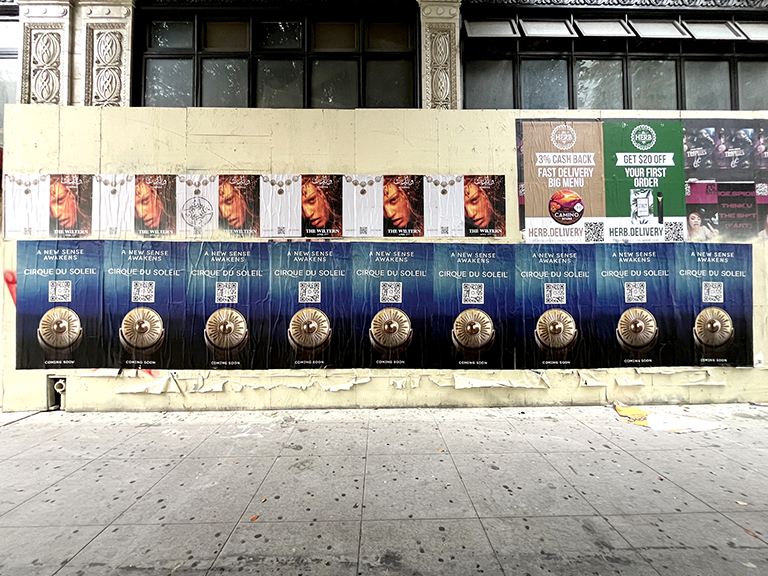
Neighborhood and event-specific reach: Street Poster Advertising, sidewalk stencils, mobile LED trucks, street teams, and brand activations in specific high-value zones. The goal is contextually precise reach in specific geographic zones where the target audience is in the right mental state, arts district, festival grounds, campus, entertainment district.
Direct response: Digital platforms with click-through tracking (Meta, Google), QR-enabled outdoor and street media, email, and SMS. The goal is driving a specific, measurable action, a scan, a click, a form submission, a purchase, with attributable tracking.
Frequency building: Repeated fixed placements in high-traffic environments, social media retargeting audiences who have shown previous engagement, email nurture sequences. The goal is ensuring that people who have seen the message once encounter it again multiple times to deepen recall, build consideration, and move toward conversion.
Budget allocation is where media planning theory confronts commercial reality. The channel mix needs to be funded at levels that make each component meaningful. The most common allocation failure: spreading a $25,000 budget across six channels at approximately $4,000 each so thinly that none of them achieves sufficient reach or frequency to produce a measurable result. A $25,000 budget concentrated in two or three channels at $8,000 to $12,000 each produces two or three substantial, measurable programs. The same budget across six channels produces six underfunded efforts that collectively fail to move any metric.
The practical rule is that every channel in the plan needs enough budget to run a meaningful program at the reach and frequency level that can actually influence behavior. For outdoor media in a major market, meaningful typically means a minimum of $3,000 to $5,000 for a single-format, single-market program. For street poster advertising, meaningful means at least 100 to 150 placements in a concentrated zone rather than 40 scattered across a metro area. For digital, meaningful means enough impressions at the right CPM to achieve multiple exposures per targeted user within the campaign window. Below these thresholds, the reach and frequency are insufficient to build brand memory regardless of how well the creative is executed.
Most effective campaigns have one lead channel that carries the primary reach and awareness objective and one to two support channels that extend and reinforce the lead channel’s impact in complementary contexts. For a brand awareness campaign targeting creative professionals in Chicago, street poster advertising in Wicker Park and the West Loop might be the lead channel (200+ placements over four weeks, building neighborhood-level saturation) supported by digital retargeting to people in those neighborhoods on Instagram and by a street team deployment at two or three specific events during the campaign window.
The lead-and-support architecture prevents budget fragmentation while still enabling multi-format touchpoints that increase the probability of audience exposure across multiple contexts in the same campaign period. An audience that encounters the same creative in the physical environment, on their phone, and from a brand ambassador in person during the same week builds brand memory at a rate that no single-channel program achieves independently.
A media plan is not complete until it is operationally specific. “Outdoor advertising in Chicago” is not a tactical plan. “150 wheat paste poster placements on painted commercial building walls and construction hoarding surfaces in the Wicker Park and Logan Square neighborhoods, concentrated on Milwaukee Avenue between Division Street and Armitage Avenue, beginning October 1, running for four weeks, with a QR code linking to the event registration page, targeting 35,000 estimated weekly impressions, with a 7-day audit and refresh at Day 8” is a tactical plan.
Each channel specification in the plan must include: specific format, specific geography down to neighborhood and street corridor, timing including start date and duration, expected reach and frequency estimates, production requirements, measurement mechanism, and cost. This level of specificity allows the plan to be executed by anyone on the team, evaluated against agreed-upon benchmarks during the flight, and audited after the campaign closes.
Measurement cannot be retrofitted after the campaign, the tracking mechanisms, survey baselines, and attribution parameters need to be in place before the campaign launches. This is the step that most brands skip because it adds pre-launch work, and it is the reason why post-campaign conversations often consist of arguing about whether impression counts were adequate rather than whether the campaign achieved its stated objective.
Pre-campaign measurement setup for a standard campaign: configure QR code tracking platforms (Bitly, custom QR generators with analytics backends), set UTM parameters in all URLs used in campaign creative, establish Google Analytics goals for any web-based conversion objectives, run a baseline brand awareness survey if brand lift is the primary objective, and document the pre-campaign baseline for any business metric you intend to compare post-campaign, website traffic, in-store foot traffic, sales velocity by region, organic branded search volume.
A media plan is a living document during execution, not an archive file after approval. Check early performance signals weekly during the campaign flight, QR scan rates, URL traffic from campaign sources, social sentiment in the posting zones, and adjust within the campaign when signals indicate underperformance. If a specific format or zone is underperforming relative to plan, redirect resources toward what is working rather than maintaining the original plan out of commitment to the document. The plan serves the objective; the objective does not serve the plan.
Fixed-format channels, printed outdoor, posted materials, cannot be changed once installed. Digital placements can be adjusted in real time. Design the plan with enough digital flexibility to enable mid-campaign adaptation based on early performance data while locking in the fixed-format elements whose impact requires the full planned flight duration to accumulate. The combination produces a campaign that is both strategically committed and tactically responsive.
What is the difference between media planning and media buying?
Media planning is the strategic process of determining which channels, markets, audiences, and timing to invest in. Media buying is the executional process of purchasing specific placements at negotiated rates from vendors. Planning sets the strategy; buying executes it. In some agencies, different teams handle each. At AGM, we do both for outdoor and guerrilla media programs.
How much should a campaign budget be for a meaningful outdoor program?
A meaningful single-city, 30-day outdoor program starts at approximately $5,000 to $10,000 for the media placement plus production. Multi-channel campaigns across multiple markets in a major metro range from $25,000 to $100,000 or more depending on format, geography, and flight duration. The key constraint is not total budget but per-channel allocation, each channel needs enough budget to run at meaningful reach and frequency levels.
How do I know if my media plan worked?
You know it worked if it hit the specific objective documented in Step 1. If the objective was 500 QR scans, count the scans. If it was 8% awareness lift, run the post-campaign survey. If it was 300 event ticket sales attributed to campaign channels, count the attributed tickets. Plans without specific measurable objectives cannot be evaluated, which is why Step 1 is not optional.
Does AGM help with full media planning, not just execution?
Yes. We plan and execute outdoor, guerrilla, and street-level media campaigns across 50+ cities, handling the full planning process from objective definition through audience mapping, channel selection, budget allocation, execution management, and measurement reporting. Contact us at americanguerrillamarketing.com/contact.
What channels does AGM manage directly?
Street Poster Advertising and wheat paste, sidewalk stencils and decals, mobile LED billboard trucks, street teams and brand ambassadors, brand activations and pop-up programs, and coordination with traditional outdoor operators for billboard placements. For integrated campaigns combining these street-level formats with digital media, we provide the OOH execution layer and work alongside digital agency partners managing the digital components.
How long does it take to create a media plan?
A single-market, single-format media plan can be developed in 3 to 5 business days with clear objective documentation and audience data. A multi-market, multi-channel media plan with competitive analysis, detailed audience mapping, and full vendor quote collection typically requires 2 to 4 weeks. Campaigns with tight timelines benefit from defining objectives and audience parameters as specifically as possible before the planning process starts, ambiguity early in the process multiplies time and cost at every subsequent stage.
What is the biggest mistake brands make in media planning?
Starting with the channel mix rather than the objective. “We want to do street poster advertising and Instagram ads” is a channel selection, not a media plan. Starting from the objective and working backward to the channel mix that best serves it produces fundamentally different, and consistently better, outcomes than starting from preferred channels and rationalizing them against a post-hoc objective.
How often should a media plan be reviewed during a campaign flight?
Weekly for campaigns with direct response measurement capability (QR scans, URL traffic, conversion data). Bi-weekly minimum for awareness campaigns where the feedback loop is slower. Any campaign producing early signals of significant underperformance relative to plan should trigger an immediate review and adaptation discussion rather than waiting for the scheduled review cycle.
Street-level and guerrilla media require a specific planning approach that differs from traditional media planning in several important ways. The planning process starts with physical geography rather than with media properties. You begin by mapping where the target audience concentrates in the physical world, specific blocks, specific transit stops, specific event venues, and then identify what media formats are accessible in those physical locations, rather than starting from a media channel and working backward to audience delivery.
Street Poster Advertising route planning, for example, requires ground-level knowledge of specific permitted wall surfaces, neighborhood pedestrian traffic patterns, and the seasonal and time-of-day variation in foot traffic density. A posting route that looks efficient on a map may be less effective than a smaller, more concentrated route on the right blocks when evaluated against verified pedestrian count data. Physical scouting of proposed posting zones before finalizing the plan is a non-negotiable step in street-level media planning, we never commit posting routes from a map view alone.
Timing precision matters more in street-level media than in most other formats. A posting campaign that installs one week before an event serves the pre-event awareness function. The same campaign installed the day before serves only the day-of audience, missing the extended awareness-building window. A street team deployment timed to a farmer’s market Saturday reaches 4,000 to 8,000 people in a 6-hour window. The same team deployed Tuesday at 2 PM in the same neighborhood reaches 200. Timing the street-level program to the audience’s natural concentration patterns is as important as location selection.
Documentation is built into the plan from the start. Every street-level placement is GPS-documented with time-stamped photography. This documentation serves three purposes: proof of performance for stakeholder reporting, input data for campaign optimization (which placements generated QR scans vs. which did not), and the foundation for future campaign planning in the same market.
Media Planning 101: How to Create a Successful Campaign From Scratch generates better results when placement, timing, creative, and local execution all work together. These questions cover the details brands usually need before launch, during rollout, and while evaluating performance.
Start by defining the audience, the goal, and the action you want people to take. Media choices are much easier once those three things are clear.
Choose channels based on where the audience actually spends time and which formats best support the objective, budget, and timeline.
Because a weak split can leave every channel underfunded. Concentrated spending behind the most useful channels usually outperforms thin spending everywhere.
Build timing around product launches, seasonality, event dates, audience behavior, and how long the message needs to stay in market to build frequency.
Real plans include production lead times, placement constraints, creative needs, reporting expectations, and contingency options, not just ideal channel ideas.
Often yes, if the channels support each other. Offline can build attention while digital captures and converts that interest.
Detailed enough to guide placement and creative decisions, but practical enough that the plan can still be bought, executed, and measured in the real world.
Measure the outcomes tied to the goal, such as traffic, leads, sales, attendance, or response rate, along with channel-level delivery and pacing.
Adjust when real performance data shows a clear need. Good plans have structure, but they also leave room to improve placements, pacing, or creative.
Building the plan around channels first and strategy second. The audience and goal should shape the plan, not the other way around.
Ready to Run Your Campaign?
Call us or email us. We’ll tell you exactly what we can do in your market and what it costs.
American Guerrilla Marketing — Los Angeles
Street-level campaigns in Los Angeles and nationwide. Wheatpasting, LED trucks, street teams, and more.
(646) 776-2770
Related Services
Explore similar advertising solutions offered by American Guerrilla Marketing.
July 20, 2026
July 20, 2026
July 20, 2026
July 20, 2026
July 20, 2026