The brands that dominate their markets are not always those with the largest advertising budgets. More often, they are the brands with the most strategically intelligent media buying — concentrating investment where it creates genuine share-of-voice advantage, timing campaigns to maximize impact at moments of peak audience receptivity, combining channels in ways that create reinforcing brand presence competitors cannot easily replicate, and accumulating the relationships and market knowledge that compound media buying advantage over time. Media buying done right is not expense management — it is competitive strategy.
American Guerrilla Marketing is a media buying and execution partner for brands that want to dominate their markets through strategic channel selection, timing intelligence, and the combination of traditional media buying with street-level guerrilla tactics that create market presence no digital platform can replicate. We operate out of Industry City, Brooklyn, NY and execute campaigns across 50+ U.S. markets. This guide covers the strategic framework for using media buying as a market dominance weapon — from share-of-voice theory to channel selection to the guerrilla media approaches that create asymmetric competitive advantages.
Share-of-Voice as the Foundational Media Strategy Concept
The most important concept in media buying strategy is share-of-voice. SOV measures your brand’s proportion of total category advertising visibility — impressions, placements, or spend — in a specific market, channel, or time period. The relationship between SOV and market share is one of the most rigorously documented findings in advertising research: brands with SOV above their current market share consistently gain market share over time, while brands with SOV below their market share consistently lose it. This relationship is called excess SOV (eSOV), and it is the strategic foundation of market-dominating media buying.
How eSOV Creates Market Share Gains
When a brand’s SOV exceeds its market share, the brand is building awareness faster than competitors in the relevant market or channel. Over time — typically 6-18 months of sustained SOV advantage — this awareness advantage converts to consideration, trial, and ultimately market share growth. The mechanism is consistent across categories, markets, and brand sizes: brands that achieve and sustain SOV advantages grow; brands that allow their SOV to fall below market share lose. This is why media buying is a competitive weapon: it is the primary mechanism through which SOV is built and maintained.
Finding SOV Opportunities in Your Market
The strategic opportunity in most markets is not competing head-to-head on the channels where large competitors have established SOV dominance — it is finding the specific channels, geographies, time windows, or audience segments where your brand can achieve meaningful SOV advantage at favorable cost. A challenger brand with a limited budget cannot outspend the category leader on national television, but it can dominate a specific geographic market through concentrated OOH investment, create an overwhelming street-level presence in target neighborhoods through guerrilla marketing, or own a specific audience’s media environment by concentrating investment in the specific channels that audience uses rather than spreading thin across all channels.
Timing: When You Buy Is as Important as What You Buy
Timing is the most underutilized dimension of media buying strategy. The same budget deployed at the moment of maximum audience receptivity will outperform the same budget deployed at an arbitrary or habitual time by a significant margin. Understanding timing strategy — at the macro level of seasonal demand cycles and at the micro level of daypart and context — is what separates sophisticated media buyers from mechanical budget deployers.
Category Purchase Cycle Alignment
Every category has a purchase cycle — the pattern of when consumers are most actively considering purchases in the category. Automotive purchases concentrate in spring and fall model-year transitions. Tax preparation services peak in January-April. Summer retail peaks in May-June. Holiday gifts peak in November-December. Aligning media investment to category purchase cycle peaks — increasing investment in the windows when consumers are actively looking, rather than maintaining flat investment year-round — produces dramatically better response metrics than constant-presence strategies at equivalent annual budgets.
Competitive Timing: Buying When Competitors Are Not
An advanced timing strategy is identifying periods when major competitors withdraw investment and capitalizing on the reduced competition for audience attention. When category leaders reduce advertising in Q1 post-holiday budget resets, for example, a brand that sustains Q1 investment achieves temporarily inflated SOV without increasing absolute budget — because the share denominator has shrunk. These competitive SOV windows, captured with consistent investment during competitor withdrawal periods, are disproportionately valuable for building brand recall and consideration relative to the media cost they require.
Channel Combination Strategy: Creating Competitive Moats
Single-channel media strategies are easy to compete against. If your entire media investment is in one channel, a competitor with a slightly larger budget can buy more of the same channel and overwhelm your presence. Multi-channel strategies that combine channels in mutually reinforcing ways are harder to replicate and harder to out-spend, because the combination creates brand surround effects that no individual channel can match.
The OOH Plus Digital Surround Strategy
One of the most effective channel combinations is OOH presence paired with digital retargeting. OOH creates physical-world brand awareness among the geographic audience; digital retargeting reaches those same people online with sequential messaging that reinforces the OOH exposure. Research from the OAAA consistently shows that OOH drives 4-5x higher digital response rates when digital campaigns target the geographic zones where OOH placements are running — because the OOH has pre-seeded recognition that makes digital ads more effective. This OOH-digital combination creates a competitive moat: competitors without OOH presence do not benefit from this amplification effect, even if they match your digital spend exactly.
Street-Level Dominance as a Channel Moat
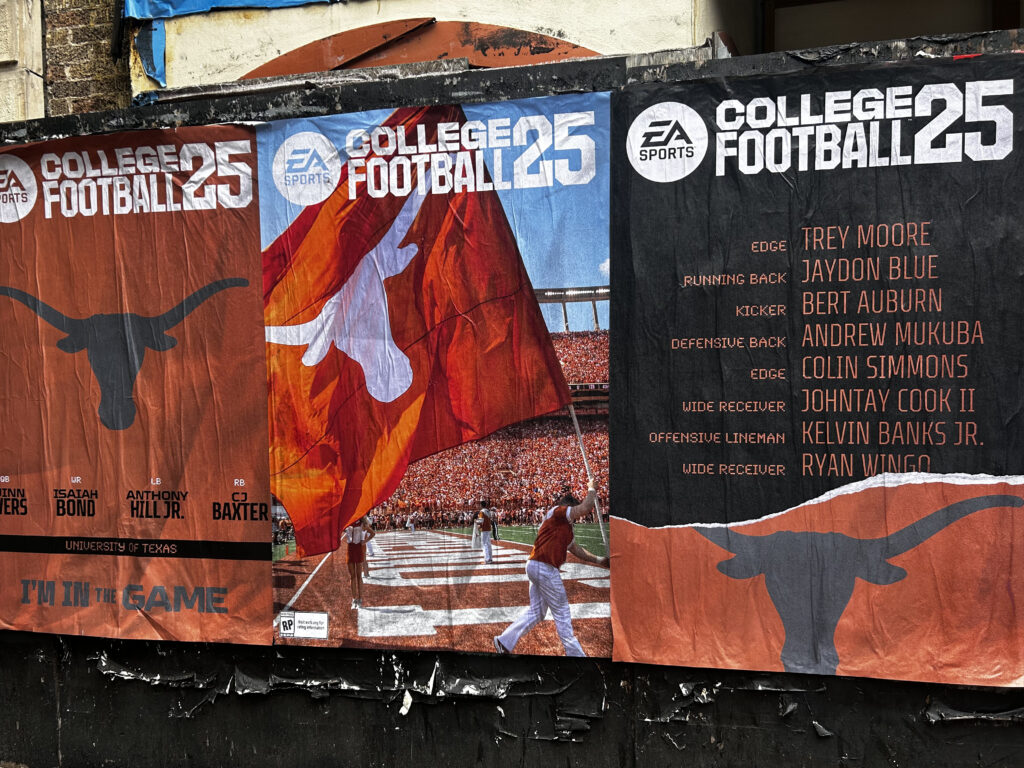
For brands operating in specific cities, neighborhoods, or geographic zones, achieving street-level dominance — owning the visual environment of a target area through concentrated poster campaigns, sidewalk installations, LED billboard trucks, and brand ambassador programs — creates a competitive moat that digital competitors cannot easily replicate. Digital advertising is bidded, scalable, and available to any competitor who wants to pay for it. Physical street-level presence is limited by real geography: if your brand’s posters cover the key walls in a target neighborhood, there is limited space for competitors to achieve equivalent physical presence.
Event Perimeter Dominance
Concentrating media investment in the perimeter of specific high-value events — deploying LED trucks, posting street-level creative, and deploying brand ambassadors around stadiums, festivals, and conventions — creates temporary category dominance at moments of maximum audience concentration. When 50,000 people arrive at a venue and encounter a single brand’s presence at every approach corridor, that brand achieves a category SOV in that environment at that moment that no digital campaign targeting the same audience can replicate in real-world impact.
Guerrilla Media Buying: Asymmetric Competitive Tactics
Guerrilla media buying applies guerrilla marketing’s asymmetric competitive logic to media channel strategy: finding channels, timing windows, and audience environments where a smaller brand can achieve dominant presence at favorable economics because larger competitors have not identified or prioritized those opportunities.
Owning the Niche Channel
Every major category has niche channels — media environments that reach specific audience segments within the category — where dominant players are underinvesting because the audience is too small for their minimum scale requirements. A challenger brand that identifies and owns these niche channels achieves category dominance with the specific audience that the channel reaches, often at far lower CPMs than the category leaders pay for their mass-market placements. The audience quality advantage of reaching a highly relevant niche at dominant SOV frequently outperforms the CPM efficiency of broader placements at fragmented SOV.
Last-Minute Inventory as a Guerrilla Tactic
Sophisticated media buyers track last-minute inventory availability from OOH operators, broadcast stations, and digital publishers — media that is available because other buyers have cancelled or pulled campaigns. Last-minute inventory typically sells at 40-60% below rate card to avoid running empty, creating premium placement access at challenger brand budgets. Building the operational capability to act on last-minute inventory quickly — pre-produced creative ready to go, decision-making authority without lengthy approval processes — is itself a competitive advantage that most brands lack.
Building Long-Term Media Buying Competitive Advantage
The most durable competitive advantages in media buying are relational — accumulated over multiple years of professional, high-volume engagement with media operators, publishers, and platforms. Media sellers prioritize buyers who bring consistent volume, pay reliably, and operate professionally. Over time, these relationships provide competitive advantages unavailable to first-time or infrequent buyers: first access to premium inventory when it opens, rate structures below standard market prices, operator referrals to other premium inventory, and market intelligence about competitive media activity that helps refine strategy.
Frequently Asked Questions: Media Buying for Market Dominance
What is media buying and why is it a competitive weapon?
Media buying is the strategic purchase of advertising placements across channels. It becomes a competitive weapon through market intelligence, timing strategy, and channel combination sophistication that competitors lack — creating more audience impact per dollar than competitors spending equivalent or higher budgets.
How does strategic media buying create market dominance?
Through share-of-voice advantages in specific segments or geographic zones, timing advantages that concentrate investment at maximum audience receptivity, channel combinations creating brand surround effects, and relationship advantages that provide preferential inventory access and better rates over time.
What is share-of-voice and why does it matter?
SOV measures your proportion of total category advertising visibility in a given market or channel. Brands with SOV above market share consistently gain share over time; brands below market share consistently lose it. Strategic media buying concentrates investment to create SOV advantages where winning that battle translates to measurable market share growth.
How do street-level and OOH tactics contribute to media dominance?
OOH and street-level tactics create physical market presence that cannot be blocked by ad filters, competed away by higher bids, or avoided through content filtering. A brand dominating the outdoor environment of key commercial corridors and neighborhood environments creates unavoidable brand presence that compounds awareness and recall beyond what digital channels alone achieve.
What is guerrilla media buying?
The application of guerrilla marketing’s asymmetric logic to media strategy — using unconventional channel combinations, strategic timing, and identification of underpriced inventory opportunities to achieve disproportionate market impact relative to budget. Finding channels where brand can achieve dominant SOV at favorable rates rather than competing head-to-head on major competitors’ preferred battlegrounds.
How do you build a media buying strategy for market dominance?
Identify the specific audience, geographic, or channel opportunity where your brand can achieve meaningful SOV advantage. Gather competitive media intelligence. Identify underpriced channels in target markets. Concentrate investment where it creates dominance rather than distributing evenly across channels at insufficient scale to matter. Build operator relationships that compound advantage over time.
Frequently Asked Questions
What is media buying the secret weapon for dominating markets?
American Guerrilla Marketing provides media buying the secret weapon for dominating markets services across 50+ U.S. markets. Every campaign is planned, scouted, executed, and GPS-documented by our field teams. We work with regional brands and Fortune 500 companies on campaigns that require real street-level execution and documented proof of performance.
How does AGM approach dominating markets?
Our process starts with a market consultation to understand your goals, target audience, and budget. We then scout locations, handle any required permissions or permits, coordinate production and installation with our local crews, and provide a full GPS-tagged photo report after the campaign runs.
What markets does American Guerrilla Marketing cover for dominating markets?
We operate in 50+ U.S. markets including New York, Los Angeles, Chicago, Miami, Houston, Atlanta, Seattle, Denver, Boston, and dozens of secondary markets. Contact us to confirm availability and pricing for your specific market.
How much does a dominating markets campaign cost?
Campaign pricing depends on market, format, quantity, and duration. We work with budgets ranging from targeted single-market runs to national rollouts across multiple cities. Use our RFP Builder or contact us directly for a custom quote based on your specific campaign requirements.
How do I get started with dominating markets through AGM?
The fastest way to get started is to submit your campaign details through our RFP Builder at americanguerrillamarketing.com, or contact us directly at [email protected] or (646) 776-2770. Our team typically responds within one business day with availability and initial pricing.