Marketing & Advertising Agencies in Los Angeles | AGM
Los Angeles is a different problem than any other city in the country. It’s not a single market. It’s fifty smaller markets sitting inside one giant sprawl, connected by freeways and divided by culture, income, and identity. A campaign that dominates Fairfax and Melrose may never be seen by the audience in Echo Park. A push in Silver Lake stays in Silver Lake. You can’t blanket this city with one format or one media buy and call it done.
We’ve been running street campaigns in Los Angeles long enough to know that most marketing and advertising agencies in Los Angeles don’t actually know the street. They know how to buy a billboard on the 405. They know how to place a full-page in the LA Times. They know how to run a sponsored post to a geo-targeted Instagram audience. All of that has its place. But when a brand needs physical presence in the specific neighborhoods where their audience actually eats, shops, and spends time, they need someone who knows Abbot Kinney Blvd as well as they know their spreadsheet.
This guide covers the environment of marketing and advertising agencies in Los Angeles, the neighborhoods where our campaigns perform best, the formats we use, and how we measure results. If you’re planning any kind of street or outdoor campaign in LA, start here.
Why Los Angeles Is the Most Complex Street Marketing Market in America
Los Angeles is the second-largest advertising market in the United States. The LA DMA covers over 5.7 million households and more than 13 million people. But LA’s real complexity isn’t its size. It’s its fragmentation.
Unlike New York, where density forces concentration, LA’s neighborhoods spread across 503 square miles of city. People in Pacific Palisades rarely find themselves on Fairfax Avenue. People in Koreatown don’t spend much time on Abbot Kinney. The city sorts itself by car routes, cultural affinity, and income, not by the kind of geographic compression that makes dense cities easier to carpet-bomb with outdoor advertising.
That fragmentation is actually an advantage for street marketing if you know how to use it. Because LA audiences are clustered, a precise campaign in the right neighborhood reaches exactly the people you want, with almost no wasted exposure. When you post on Fairfax Avenue between Melrose and Beverly, you’re reaching streetwear fans, music industry insiders, and cultural tastemakers. That’s a tight, valuable audience. You didn’t pay for the entire city to see your ad. You targeted exactly the block where your people walk.
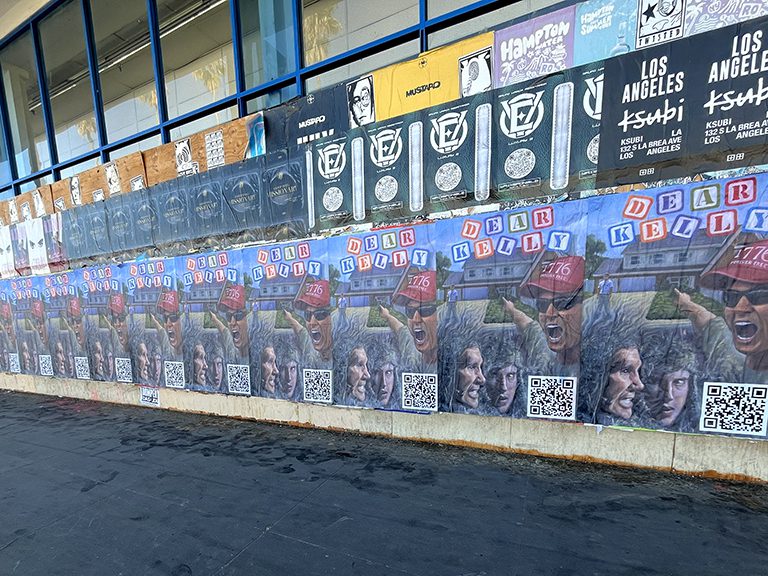
Los Angeles also has a unique relationship with visual culture. This is a city of people who make things, watch things, and notice things. Street-level creative gets photographed. It gets posted. A striking campaign on Traction Avenue in the Arts District or on the walls around the Wiltern on Koreatown’s Wilshire Boulevard can generate earned media that multiplies the campaign’s original reach many times over.
The music industry, the film and television industry, the fashion industry, and the technology industry all converge in Los Angeles. Their audiences live here. Their executives live here. Their tastemakers live here. Brands that want to reach those communities need to show up where those communities are, and that means showing up on the street, in the right neighborhoods, with the right creative.
Traditional advertising in Los Angeles is expensive and imprecise. A Los Angeles Times integrated buy reaches a wide audience but dilutes your message across demographics that don’t match your target. A KABC TV spot during evening news reaches millions but costs accordingly and carries no geographic precision. The 405 billboard runs from the Valley to LAX and serves as many different audiences in a single day as a Chicago campaign serves in a week. Street-level targeting solves the problem that broad LA media buys create.
Types of Marketing and Advertising Agencies in Los Angeles
The Los Angeles agency market is deep and varied. Here’s how to think about the different types of firms you’ll encounter when looking for marketing and advertising agencies in Los Angeles.
Entertainment-Focused Agencies are a category unique to LA. Firms like entertainment marketing specialists handle studio film campaigns, streaming service launches, album cycles, and award season pushes. These agencies know how to position creative work for the entertainment industry and its adjacent audiences. They’re strong on press, publicity, and industry relationships. They’re often less experienced with street-level execution and physical installation work.
Full-Service Creative Agencies in LA range from legacy shops like TBWA Chiat/Day to newer firms on the agency strip in Playa Vista and Culver City. These firms offer integrated campaigns across digital, broadcast, print, and OOH. For brands spending heavily on fully integrated production, they’re worth the cost. For focused outdoor or street marketing work, they’re typically too large and too slow to be practical.
Digital and Performance Agencies have proliferated across LA, particularly in the technology corridor from Santa Monica through Venice and Playa Vista. These shops are strong at paid social, search, and programmatic. They don’t operate on the street. If your brand needs physical presence in the neighborhoods where your audience lives, a digital agency can’t deliver that.
Out-of-Home Specialists manage billboard inventory across the LA market. This includes the freeway boards you see on the 10, the 405, the 101, and Sunset Boulevard. OOH is a powerful format in LA, particularly because so much of the city’s population spends time in cars. But traditional board inventory is expensive, requires long lead times, and doesn’t offer the neighborhood-level targeting that street campaigns can deliver.
Guerrilla and Street Marketing Agencies operate at the block level. We place posters, run wheatpaste campaigns, activate street teams, and move LED mobile billboards through the specific corridors where your audience exists. We know the Fairfax District differently than we know the Arts District, and we build campaigns accordingly. That specificity is the service.
At American Guerrilla Marketing, we’ve run campaigns across LA neighborhoods for brands in music, fashion, film, fitness, food and beverage, technology, and consumer goods. We know this market from the street up.
Los Angeles Neighborhoods Where Street Campaigns Perform Best
Every LA campaign starts with a neighborhood strategy. Here’s how we approach the city’s most productive street marketing corridors.
Fairfax District and Melrose Avenue
The stretch of Fairfax Avenue from Melrose to Beverly Boulevard, and the Melrose Avenue corridor from La Brea to Cahuenga, is arguably the single most valuable street marketing real estate in the country for reaching streetwear, music, and youth culture audiences. Supreme LA, Chinatown merch drops, and major sneaker releases all gravitate to this block for a reason. Posting on Fairfax in this corridor means your brand sits alongside the culture, not outside it. Rosewood Avenue side streets and Gardner Street add density without leaving the zone.
Silver Lake and Echo Park
Sunset Boulevard through Silver Lake, from Fountain Avenue east to Echo Park Avenue, runs through a neighborhood that has been at the center of LA’s independent music scene for thirty years. Hyperion Avenue, Rowena Avenue, and the commercial blocks around Sunset Junction give this area a dense, walkable concentration of bars, coffee shops, record stores, and independent retail. Echo Park’s Sunset Boulevard west of Alvarado Street and Glendale Boulevard extend that reach. These neighborhoods work well for music, lifestyle, food and beverage, and arts brands.
The Arts District
Traction Avenue, 4th Street between Mateo and Santa Fe, Industrial Street, and the surrounding blocks of the Arts District have become one of LA’s most concentrated creative community zones. Galleries, breweries, studios, and tech firms cluster here alongside some of the city’s best restaurants. The Arts District audience skews creative, educated, and brand-aware. Construction barriers and building walls in this neighborhood carry high-impact campaigns for fashion, music, and design brands. We’ve run some of our most visually striking campaigns in this corridor.
Los Feliz and Vermont Avenue
Vermont Avenue from Franklin to Prospect gives access to the Los Feliz Village commercial strip, a walkable zone of independent cinema, restaurants, coffee shops, and bookstores. Franklin Avenue east of Vermont and Hillhurst Avenue south to Sunset form a tight grid that captures the Los Feliz creative and professional community. This neighborhood is effective for cultural, lifestyle, and entertainment brands targeting educated 25-to-40 audiences.
Venice and Abbot Kinney
Abbot Kinney Boulevard from Main Street to Venice Boulevard, and the Venice Beach boardwalk and boardwalk-adjacent corridors, reach a blend of creative professionals, tech workers, and tourists. Abbot Kinney in particular attracts a high-spending lifestyle audience that fashion, wellness, and premium consumer goods brands actively pursue. Main Street through Venice adds residential density to the commercial strip audience.
Highland Park and Boyle Heights
Figueroa Street from York Boulevard to Avenue 50 in Highland Park, and César Chávez Avenue and 1st Street through Boyle Heights, provide access to LA’s evolving east side communities. These neighborhoods are authentic, engaged, and underserved by most traditional advertising campaigns. We’ve run food and music campaigns in these corridors with strong results. Brands that show up here with genuine creative earn loyalty that campaigns in more oversaturated neighborhoods can’t replicate.
Koreatown
Western Avenue, Wilshire Boulevard, and Olympic Boulevard in Koreatown give access to one of LA’s densest and most economically active urban neighborhoods. Koreatown runs 24 hours. The foot traffic on Wilshire between Western and Vermont is exceptional for an LA neighborhood. The demographic here is broad and includes entertainment industry workers, young professionals, and a strong Korean-American community. Brands in food, entertainment, and lifestyle perform well in this corridor.
How We Build and Execute LA Campaigns
Every Los Angeles campaign starts with geography. We talk through your audience profile, identify the neighborhoods they actually inhabit, and build a location strategy from those anchor points outward. We don’t assume. We research, we scout, and we confirm before anything gets printed.
Location scouting in LA involves more logistics than most other cities because of the distances involved. A campaign that covers Fairfax and the Arts District and Silver Lake spans roughly 10 miles and multiple distinct neighborhoods. Our scouting teams work each zone independently, identifying available surfaces, evaluating sight lines, and confirming access before we commit to a placement map.
Production for LA campaigns typically runs one to two weeks. Paper selection is critical in LA. The city’s weather is mostly dry, but coastal moisture near Venice and Santa Monica, along with the occasional rain period, affects how campaigns hold. We select materials that perform across the full range of LA conditions.
Installation runs overnight, following the same timing protocol we use in other markets: midnight to 5 AM, working in teams, moving neighborhood by neighborhood. A major multi-neighborhood LA campaign may stage across two consecutive nights to maintain installation quality. Every placement is photographed during installation and checked at the campaign midpoint.
LA Campaign Formats and Investment Overview
Los Angeles Street Campaign Format Comparison
Format
Best For
Typical Size
Campaign Duration
Starting Budget
Wheatpaste Posters
Music, fashion, events, consumer brands
24″x36″ to 60″x90″
2-4 weeks
$5,500
Snipe Posters
Neighborhood saturation, event drives
11″x17″ to 24″x36″
1-2 weeks
$3,500
Street Team Activation
Sampling, handouts, in-person brand moments
Custom
Single day to 1 week
$3,000
LED Mobile Billboard
High-impact route-based awareness
14’x48′ digital display
1 day minimum
$1,800/day
Mural
Long-term brand landmark, social content
Custom
6-24 months
$18,000
Multi-Format LA Campaign
Multi-neighborhood brand saturation
Mixed
2-4 weeks
$22,000
Every campaign gets custom-scoped. We’ll provide a full proposal with itemized costs before you commit to anything.
Measuring Your Los Angeles Campaign
Measurement in Los Angeles presents the same challenge it does in any physical advertising market. The results are real. Proving them requires a framework built before the campaign goes up, not after.
We offer focused location scouting, digital or in-person, to identify the exact locations that are right for your campaign. A market scout runs $3,000 per market and delivers a ranked placement report before you spend on production. Post-campaign, we run brand recall surveys to measure awareness lift in your target markets.
Brand recall surveys are the most meaningful post-campaign metric we use. We partner with survey vendors who deploy to verified residents and regular visitors in your campaign’s specific neighborhoods. Those surveys ask about unaided brand recall, whether respondents saw something specific, message association, and purchase consideration. The data reflects what happened in people’s minds as a result of the campaign, which is the only measurement that actually matters.
We also track earned coverage when campaigns generate organic social media attention. Los Angeles campaigns frequently earn coverage from streetwear, music, and culture accounts that photograph striking street art and poster campaigns. When that happens, we document it and include it in your post-campaign report.
Full GPS-tagged photo documentation covers every placement from installation through the campaign window. That documentation travels with you as a record of performance and as creative assets for social media or future campaign reference materials.
What Makes American Guerrilla Marketing Different in Los Angeles
Most marketing and advertising agencies in Los Angeles don’t actually work the street. They can buy a Sunset Boulevard billboard because the inventory is managed by a national OOH company and the transaction is straightforward. But putting a campaign on the walls of the Fairfax District or across the Arts District requires ground-level knowledge, local relationships, and crews that show up at 1 AM with paste and paper.
We do that work. We have for over a decade. And we bring the same documentation standards, the same strategic planning discipline, and the same measurement framework to every LA campaign that we bring to our New York and Chicago work.
We’re also honest about what street campaigns can and can’t do. If your goals require broadcast reach or digital performance tracking, we’ll tell you that a street campaign alone isn’t your answer. But if you need to own a neighborhood, create street-level buzz for a launch, or build the kind of physical brand presence that online ads can’t replicate, we know exactly how to get there in this city.
LA also rewards consistency. Brands that show up on the street in Silver Lake for a month generate more lasting awareness than a brand that does a single campaign in any format and disappears. We help clients think through campaign strategy across a season or a product cycle, far beyond a single week’s installation.
Frequently Asked Questions
Why is Los Angeles such a difficult advertising market to navigate?
LA’s size and fragmentation make it unlike any other city. Its 503 square miles and dozens of distinct neighborhoods mean that a single campaign format or placement can’t reach the city broadly. The right approach combines deep neighborhood knowledge with precise audience targeting. That’s what separates effective LA campaigns from media buys that scatter spend across a city too large to blanket.
Which Los Angeles neighborhoods work best for street marketing campaigns?
The Fairfax District on Fairfax Avenue between Melrose and Beverly is a major streetwear and youth culture corridor. Silver Lake and Echo Park along Sunset Boulevard reach independent music and lifestyle audiences. The Arts District on Traction Avenue and 4th Street serves creative and design communities. Los Feliz on Vermont Avenue, Venice and Abbot Kinney, and Highland Park on Figueroa Street can also be effective depending on the target audience and campaign objectives.
How long do street campaigns run in Los Angeles?
Most LA campaigns run two to four weeks. LA’s drier weather compared to New York or Chicago means posters often hold longer. In high-competition corridors like Fairfax and Melrose, new campaigns may overlap yours faster than in lower-traffic streets. We account for location competition in our placement scheduling and can plan refreshes if your timeline extends beyond the initial campaign window.
What advertising formats work best in Los Angeles?
Large-format wheatpaste posters work exceptionally well in LA’s visual culture. The city has a strong street art tradition, and large-format creative on construction barriers or building walls in neighborhoods like the Arts District or Fairfax earns attention and organic photography. Snipe posters in smaller formats work for high-density saturation in commercial corridors. LED mobile billboards are another option when brands need flexible, high-visibility exposure across multiple neighborhoods.
Does American Guerrilla Marketing cover all of Greater LA?
We cover the core city neighborhoods where street campaigns deliver the highest audience concentration: Fairfax, Silver Lake, Echo Park, the Arts District, Los Feliz, Venice, Koreatown, Highland Park, and Boyle Heights. We also cover West Hollywood, Culver City, Santa Monica, and portions of the San Fernando Valley for clients with audiences in those areas. We scope each campaign around your actual target audience and geographic priorities.
What’s the typical budget for a Los Angeles poster campaign?
Single-neighborhood focused campaigns start around $3,500 to $5,500. Multi-neighborhood LA campaigns covering three to five zones typically start at $15,000 to $22,000. Full-market, multi-format campaigns with wheatpaste posters, street teams, and LED mobile elements can run $40,000 or more. We provide a full itemized proposal before you commit to any spending.
How do you measure campaign results in Los Angeles?
We use brand recall surveys deployed to verified residents and frequent visitors in your specific campaign neighborhoods. Surveys measure unaided and aided brand recall, message association, and purchase intent. We also track earned social media coverage when campaigns generate organic sharing, which happens regularly in LA’s visually active neighborhoods. Full GPS-tagged photo documentation of every placement provides additional campaign verification.