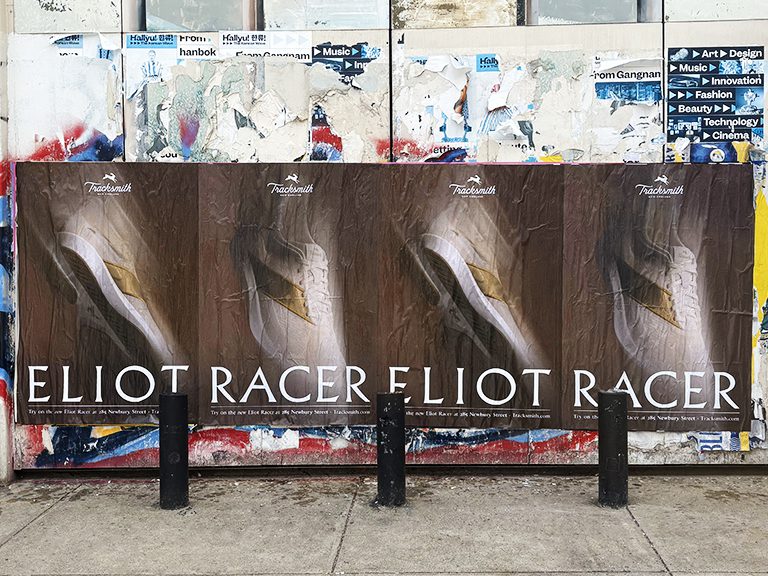
Luxury brand marketing has a street-level problem. The tools that make guerrilla marketing effective for mass-market brands — high volume placements, saturated coverage, ubiquitous presence — are antithetical to the scarcity, exclusivity, and precision that luxury brand equity requires. A luxury fashion house that plasters its name on 500 walls across a city is not running a luxury campaign. It is running a volume campaign in a luxury skin, and the result is brand devaluation rather than presence building.
The solution is not to avoid street-level marketing. It is to execute it differently. Luxury brand guerrilla marketing requires restraint in volume, precision in location, and an uncompromising standard in execution quality that is measurably higher than mass-market campaigns. A single wheat paste poster printed on premium stock, placed on the right surface in the right neighborhood in front of the right audience, does more for a luxury brand than 300 lower-quality placements scattered across the same city. The principle of less-is-more applies to every decision in a luxury street-level program.
Our team works with luxury fashion, jewelry, automotive, hospitality, and consumer goods brands on street-level programs that build premium presence without compromising brand equity. This guide covers the specific formats, surface standards, neighborhoods, creative requirements, and campaign architectures that make luxury brand guerrilla marketing work.
The Premium Street Marketing Principle: Restraint as Brand Signal
In luxury brand positioning, scarcity is a value signal. Brands that are everywhere are, by definition, not exclusive. Street-level marketing programs for luxury brands must embody this principle operationally: fewer locations, higher quality, better context. A campaign that places 20 premium-quality posters in 20 precisely selected locations in a single premium neighborhood will outperform a campaign that places 200 standard-quality posters across the full city for a luxury brand, because the precision and quality signal exclusivity while the volume signals commodity.
This restraint extends to neighborhood selection. Luxury brand street campaigns should concentrate exclusively in the corridors where the luxury consumer actually walks and spends time — not in the corridors with the highest general foot traffic. The SoHo shopping district in New York is appropriate for a luxury fashion brand; Times Square is not. The Abbot Kinney corridor in Venice is appropriate; the Venice Boardwalk is not. The Design District in Miami is appropriate; the Wynwood main gallery strip during peak hours might be, but the tourist-heavy sections are not. The selection criterion is always “does the ambient audience in this corridor include a high concentration of our specific luxury consumer?” — not “is there a lot of foot traffic here?”
Format Selection for Luxury Brand Campaigns
Premium Wheat Paste Campaigns
High-quality wheat paste poster campaigns are the core format for luxury brand street marketing. The critical differentiators from mass-market wheat paste programs are: premium print stock (heavyweight paper with correct color matching to brand standards), professional graphic design that matches the brand’s existing visual communication standard, precise surface selection that puts the poster in the right context, and a low total placement count that communicates curation rather than volume.
Luxury brand wheat paste creative should be indistinguishable in quality from the brand’s gallery-quality print advertising. If the poster looks obviously like a street-level production, it has failed the luxury standard. The goal is a brand impression that feels deliberate, refined, and surprising in its quality — “I can’t believe how beautiful this is on a wall” rather than “there’s another brand poster.”
Mural Advertising in Premium Arts Districts
Mural advertising in premium arts districts — where the execution quality meets gallery standards — creates the most powerful physical brand presence available in the street environment for luxury brands. A luxury automotive brand’s custom mural in the Arts District in Los Angeles, the Design District in Miami, or the SoHo gallery corridor in New York creates a brand moment that is qualitatively different from any other outdoor format. The scale, the craft, and the permanence communicate luxury positioning in a way that transient formats cannot.
Our mural advertising service includes artist sourcing, surface negotiation, and production management for luxury-standard mural programs. We pre-qualify artists and surfaces for luxury brand standards and manage the creative collaboration process between the brand’s creative direction and the mural artist’s execution.
Event-Adjacent LED Mobile Presence
LED billboard trucks deployed at premium event windows — Art Basel Miami Beach, New York Fashion Week, major cultural museum openings, high-end real estate launches — create mobile brand presence that reaches the luxury consumer at the highest-concentration moments in the market calendar. The key is deployment precision: the truck runs the specific approach corridors to the specific events where the specific luxury consumer is concentrated, not as a general market reach vehicle.
Art Basel Miami Beach is the most valuable single event window for luxury brand LED truck campaigns in the U.S. market. The audience — 80,000 high-income art collectors, gallerists, fashion figures, and creative influencers concentrated in South Beach and Wynwood simultaneously — represents a higher density of luxury brand target consumers per square mile than any other event in the country. Brands that plan their Art Basel presence 10-12 weeks in advance secure the best positioning in this window.
Surface Standards for Luxury Brand Placements
Surface selection for luxury brand campaigns is a discipline distinct from standard guerrilla marketing scouting. The criteria for a premium placement location include: clean, smooth surface with no existing visual noise or competing graphics; neighborhood context that aligns with the brand’s positioning (a surface visible from a luxury retail corridor is appropriate; the same surface behind a fast-food restaurant is not); architectural character that complements rather than undermines the creative (a historic building facade or a clean gallery wall enhances the creative context; a corrugated metal fence does not).
We reject surfaces that do not meet luxury brand standards, even when they represent high-foot-traffic locations. A technically high-impression location in a neighborhood context that undermines the brand’s positioning generates a negative impression — the brand association with the wrong environment is itself a brand equity risk. For luxury campaigns, we maintain a shorter list of qualified surfaces with a higher standard than we would apply to a mass-market campaign, and we pre-approve the full placement list with the client before production begins.
Premium Neighborhoods by Market
New York City
SoHo’s Mercer, Greene, and Prince Street corridors are the primary luxury brand wheat paste environments in New York. The audience is high-income, fashion-aware, and social-media-active. Tribeca’s residential streets carry the most affluent neighborhood demographic in the city. The West Village retail corridors on Bleecker and Hudson Streets reach the high-income residential and professional audience of the city’s most expensive neighborhood. Madison Avenue adjacent areas in the Upper East Side reach the traditional luxury consumer in their primary shopping environment.
Los Angeles
Beverly Hills adjacent corridors — particularly Melrose Avenue between La Cienega and San Vicente — reach the luxury fashion consumer in their shopping environment. The Abbot Kinney corridor in Venice attracts the creative-affluent consumer who skews younger than traditional luxury but has significant purchasing power and high social media reach. West Hollywood’s Sunset Strip creates a high-profile entertainment-industry-facing placement environment for luxury automotive and lifestyle brands.
Miami
The Miami Design District between NE 38th and 42nd Streets is the highest-density luxury retail corridor in Florida, anchored by Louis Vuitton, Dior, Cartier, Prada, and other flagship luxury retailers. Campaign placements in and around the Design District reach the luxury consumer at the moment of highest purchase intent. South Beach’s northern hotel corridor (Collins Avenue above 20th Street) reaches the luxury hotel guest audience. Wynwood during Art Basel creates the premium arts-and-culture audience concentration.
Creative Execution Standards
Luxury brand creative for street-level campaigns requires the same treatment as any other brand communication: brand guideline compliance, correct color matching, typographic precision, and a visual quality that communicates the brand’s premium positioning. We review all luxury brand creative before production specifically for street-level performance — checking that the design maintains its visual quality at the specific print dimensions and viewing distances of the planned placements.
The street-level viewing context is different from print advertising, digital advertising, and OOH. The lighting is natural and variable. The viewing angle is oblique. The surrounding visual environment provides context that can enhance or undermine the creative. We evaluate these variables for every luxury brand placement and flag creative adjustments that improve street-level performance without deviating from brand guidelines.
For luxury brands running their first guerrilla marketing program, we recommend beginning with a small-scale pilot in a single market — 10-15 premium placements in a single premium neighborhood — that can be evaluated for brand standard compliance and market response before scaling to a full program. This conservative approach protects brand equity while building internal proof-of-concept for street-level marketing as a format.
Contact our team at (646) 776-2770 to discuss a luxury brand street marketing program. We operate from Industry City, Brooklyn, NY, and deploy premium street-level campaigns across all major U.S. luxury markets. Our full guerrilla marketing service portfolio and our capabilities deck cover the full scope of what we execute for premium brand clients.
Frequently Asked Questions
Can luxury brands use guerrilla marketing without compromising brand equity?
Yes. Luxury brand guerrilla marketing succeeds when format quality, surface selection, creative execution, and neighborhood context all meet the brand’s premium standard. The key is restraint in volume, precision in location, and an execution quality standard that is measurably higher than mass-market campaigns. A single beautifully produced placement in the right location serves a luxury brand better than hundreds of standard placements.
What guerrilla marketing formats work best for luxury brands?
High-quality wheat paste posters printed on premium stock deployed in precise, high-value locations. Mural advertising in premium arts districts where creative execution meets gallery standards. Sidewalk stencils in luxury retail corridors. Event-adjacent LED truck deployments at Art Basel, Fashion Week, and major cultural openings. The unifying standard is execution quality that matches the luxury brand’s other communications.
What neighborhoods are appropriate for luxury brand street marketing?
New York: SoHo, Tribeca, the West Village, Madison Avenue adjacent corridors. Los Angeles: Beverly Hills adjacent corridors, Abbot Kinney, West Hollywood Sunset Strip. Miami: the Design District, South Beach’s northern hotel corridor, Wynwood during Art Basel. Chicago: River North and the Gold Coast retail corridor.
How does surface selection differ for luxury brand guerrilla marketing?
Surface quality is the most critical variable. Premium brands require smooth, clean surfaces in visually appropriate contexts — gallery-adjacent walls, clean concrete in design districts, premium retail corridor surfaces free of competing graphics. We pre-qualify every surface for luxury campaigns, rejecting locations with adjacent visual noise or neighborhood context that does not align with the brand’s positioning.
What print quality standards does luxury brand street marketing require?
Premium print stock with correct color matching to brand standards, professionally mounted application, and consistent finish quality across all placements. The physical poster should be indistinguishable in quality from the brand’s other visual communications — not obviously a low-budget street production.
How does luxury brand guerrilla marketing create organic social amplification?
High-quality, unexpected creative in the right neighborhood creates the “I can’t believe how good this looks” social share that amplifies luxury brand campaigns. The audience that encounters genuinely beautiful street-level creative in a premium neighborhood will photograph and share it precisely because the quality is surprising in the context.
How do I start a luxury brand guerrilla marketing campaign with AGM?
Contact our team at (646) 776-2770 or visit our contact page. We will discuss your brand’s positioning, target audience, and creative standards, then design a campaign architecture that meets luxury brand quality requirements — including surface selection, print standards, neighborhood context, and execution quality review.