🚀 NEW WHEATPASTING MARKETS Discover our wheatpasting campaigns in : 🇬🇧 London 🇨🇦 Canada 🇲🇽 Mexico City

Las Vegas Convention Marketing: The Street-Level Playbook for the LVCC and the Strip Corridor

City takeover wheatpaste campaign in Chicago - American Guerrilla Marketing

Las Vegas is not just a convention city. It is the convention city. The Las Vegas Convention Center draws roughly six million convention attendees per year. Add the satellite venues—Mandalay Bay, MGM Grand, Caesars Forum, the Venetian Expo, the Wynn—and you have a market where, at almost any given moment, tens of thousands of people are moving through a predictable geographic corridor wearing badge lanyards, rolling carry-ons through casino lobbies at 8am, and looking for coffee and breakfast on Convention Center Drive.

That concentration is the opportunity. When 40,000 people converge on the same few blocks for three days, street-level marketing becomes one of the most efficient impression-per-dollar plays in the whole outdoor toolkit. The challenge is knowing the geography well enough to place your campaign where it actually intercepts that foot traffic—not just somewhere near the Strip.

This guide covers everything we know about running street-level marketing around Las Vegas conventions: the layout of the LVCC campus and its surrounding streets, the rideshare and shuttle zone patterns, the restaurant corridor where attendees eat dinner, the hotel walkway patterns from major Strip properties, and what different marketing formats look like deployed in each of those zones. We have run activations here. This is what we actually saw and learned.

Table of Contents

  19 Minutes Read

Understanding the Geography: The LVCC Is Not on the Strip

The single biggest mistake companies make when planning Las Vegas convention marketing is treating “Las Vegas” as a monolith. The Strip—Las Vegas Boulevard—is where the famous hotel-casinos are. The Las Vegas Convention Center is not on the Strip. It sits on Paradise Road, roughly a mile east of Las Vegas Boulevard, between Convention Center Drive to the south and Desert Inn Road to the north.

That mile is critically important for campaign planning. Attendees who stay at Caesars Palace, the Bellagio, the ARIA, or the MGM Grand have to cover real ground to get from their hotel room to the convention floor. Some of them walk—a long walk, often in 100-degree heat. Most of them take the LVCVA-operated shuttle system, Ubers, or the Las Vegas Monorail, which runs parallel to the Strip and has a stop at the Convention Center station at Paradise Road and Swenson Street.

Understanding those movement patterns is the foundation of any smart Las Vegas convention marketing strategy. The attendee is not stationary. They are moving—from hotel to shuttle stop, from shuttle stop to LVCC entrance, from LVCC back to the Strip for lunch and dinner, from the Strip back to the convention for evening sessions. Every leg of that movement is a touchpoint opportunity if you know where to stand.

Field note: The LVCC West Hall expansion, which opened in 2021, extended the convention center footprint significantly toward the Resorts World side of Paradise Road. If your event is in the West Hall, the arrival patterns shift northward compared to the Central or South Hall. Know which hall your target event is using before finalizing placement strategy.

The Paradise Road Corridor: Primary Artery for Convention Traffic

Paradise Road is the spine of Las Vegas convention geography. The road runs north-south, bordered by the LVCC campus on its western side from roughly Wynn Road in the north down to Convention Center Drive in the south. The eastern side of Paradise Road in this stretch contains a mix of hotels, restaurants, and commercial properties that serve the convention market directly.

The rideshare pickup and dropoff zones for the LVCC are concentrated along Paradise Road and in the lots accessed from it. During peak convention arrival and departure times—Monday and Tuesday mornings at major events, Wednesday and Thursday afternoons when exhibitors start moving out—Paradise Road carries extremely heavy pedestrian traffic from attendees navigating between rideshare vehicles and convention hall entrances. The crossing at Paradise Road and Convention Center Drive is one of the highest-volume pedestrian intersections in the entire convention corridor.

Street team deployments on Paradise Road during peak traffic windows are highly efficient. An eight-person brand ambassador team working the crosswalks at Convention Center Drive and Paradise Road during the morning badge-pickup rush at a major show can put materials in front of thousands of targeted attendees in under two hours. The geometry works in your favor: attendees are on foot, badge in hand, walking a defined path, and they have a moment of dwell time at the crosswalk signal.

The East Side Hotels on Paradise

The Courtyard by Marriott Las Vegas Convention Center, the Renaissance Las Vegas, and the Hilton Grand Vacations Club on Paradise Road are all positioned within a few hundred feet of the LVCC entrance. Attendees staying at these properties have a two-minute walk to the convention floor, and they do it multiple times a day. The sidewalks between these properties and the LVCC main entrances are extremely high-value street marketing territory during convention hours because every person walking them is definitely going to or coming from your target event.

The approach sidewalk on the east side of Paradise Road, from Convention Center Drive heading north toward the main LVCC South Hall and Central Hall entrances, is one of the most targeted single-block stretches in the Las Vegas convention marketing toolkit. It is narrow enough that street teams can make direct eye contact with every passerby and wide enough to work without creating congestion.

Convention Center Drive: The Restaurant and Service Block

Convention Center Drive runs east-west, connecting Paradise Road on the east to the back of the Strip hotel properties on the west. This street is where Las Vegas convention attendees eat lunch, grab coffee between sessions, and decompress after the floor closes for the day. The restaurants, fast-casual spots, and convenience retailers on and immediately adjacent to Convention Center Drive serve a captive convention audience that has very few other options within walking distance.

The Starbucks locations on Convention Center Drive are effectively informal gathering points during morning break windows. The same is true for the lunch spots on the east side of Convention Center Drive near the intersection with Paradise. During major shows, lines form outside these places and the surrounding sidewalks turn into a slow-moving stream of badge-wearing professionals who are neither in a rush nor in a car. That creates a dwell-time environment that is very different from the morning crosswalk rush on Paradise—slower, more conversational, better for sampling and direct engagement activations.

We have run product sampling campaigns on Convention Center Drive during lunch windows at trade shows with attendance of 20,000 to 50,000. The targeting precision is striking—because the only pedestrians on this block during a convention are convention attendees, every sample you hand out is going directly to the person you came to reach.

Field note: Convention Center Drive west of Paradise Road transitions into the back-of-house areas for the Wynn and Encore properties. Attendees who are walking from those hotels to the LVCC will cross Convention Center Drive on foot. This western stretch of the block—between Las Vegas Boulevard and Paradise—carries hotel-to-convention foot traffic that the standard Paradise Road / LVCC entrance focus misses entirely.

The Strip Hotel Corridor: From the Wynn to Caesars to the Bellagio

The major Strip hotel-casinos are roughly 0.8 to 1.2 miles west of the LVCC entrance via Convention Center Drive. The distance varies depending on which hotel and which LVCC entrance you are measuring between. That distance is short enough that some attendees walk it—particularly in the early morning when taxi and rideshare waits are long—and long enough that most use the shuttle system or rideshare.

The LVCVA shuttle system runs dedicated routes between the major Strip properties and the LVCC during large conventions. The shuttle pickup points are positioned near the main hotel driveways—typically the taxi/rideshare curb areas rather than the main casino entrance—and they run on a frequency that varies by show attendance. At CES in January, the shuttles run nearly continuously. At smaller industry shows, they may run every 20-30 minutes.

The shuttle boarding zones are high-value dwell environments. Attendees waiting for a shuttle at the Caesars Palace side entrance, the Wynn’s rideshare curb on Las Vegas Boulevard, or the ARIA-to-LVCC shuttle stop are standing in one place for 5 to 15 minutes with nothing to do but look at their phones and whatever else is in their immediate environment. A well-positioned street team at a shuttle boarding zone can put branded materials into the hands of virtually every person in the queue.

The Wynn and Encore

The Wynn Las Vegas and Encore are the closest major Strip hotel-casinos to the LVCC. The walk from the Wynn’s front entrance on Las Vegas Boulevard to the LVCC South Hall entrance is approximately 12 to 15 minutes on foot via Convention Center Drive, walking east. Wynn and Encore are popular convention hotels because of this proximity, and attendees who stay there often walk rather than waiting for shuttles. The Convention Center Drive pedestrian route—east on Convention Center Drive from Las Vegas Boulevard, past the convention-area restaurants, to the LVCC entrance—is one of the most walked segments of convention attendee foot traffic in the entire city.

Caesars, Harrah’s, and the Mid-Strip Zone

Caesars Palace and Harrah’s are further south on the Strip, and their convention attendee pedestrian traffic typically flows via Flamingo Road or Convention Center Drive to reach Paradise Road. Caesars Forum—Caesars Palace’s dedicated convention and meeting facility—handles significant convention business independent of the LVCC, and the foot traffic in the Caesars Forum entrance area on Harmon Avenue is its own distinct marketing zone. Attendees at Caesars Forum events never go to the LVCC at all; they move between the Forum and the casino floor, the restaurants on the Caesars property, and the Bally’s/Paris hotel zone just to the south on Las Vegas Boulevard.

The Bellagio, MGM, and the South Strip

The Bellagio, MGM Grand, and Mandalay Bay are at the southern end of the Strip, significantly further from the LVCC. Attendees staying at these properties typically use rideshare or the monorail rather than walking. Mandalay Bay has its own convention center—the Mandalay Bay Convention Center—which hosts major events separately from the LVCC, and the foot traffic pattern there is entirely self-contained within the Mandalay-to-Luxor corridor on the south Strip.

The Las Vegas Monorail Stop: Convention Center Station

The Las Vegas Monorail’s Convention Center station sits at roughly Paradise Road and Swenson Street, just north of the main LVCC campus. The monorail connects this station to the MGM Grand at the south end and to the Sahara at the north end, with stops at Bally’s/Paris, Flamingo/Caesars, Harrah’s, and the Las Vegas Hilton (Westgate) along the route.

For convention attendees staying at mid-Strip properties—Flamingo, Harrah’s, the Cromwell, the Linq—the monorail is a standard commute option to and from the LVCC. The Convention Center station is the destination stop, and the crowd exiting at that station during morning show-floor open hours is entirely composed of convention-goers. The station exit walkway—the ramp and stairs that bring passengers down from the elevated platform to the street level on Paradise Road—creates a natural funnel that a street team positioned at the base can work very efficiently.

The monorail platform itself is an enclosed waiting environment with dwell time. Attendees waiting on the platform heading back toward the Strip after a day on the floor are tired, checking their phones, and fully captive. Street team activity at the station entrance (not on the platform itself, but in the immediate surrounding area) catches people in both the inbound and outbound flow.

The Venetian Expo and Palazzo Convention Center

The Venetian Expo—the convention facility attached to The Venetian and Palazzo on Las Vegas Boulevard—is one of the largest convention facilities on the Strip itself and hosts some of the biggest shows in Las Vegas that do not use the LVCC. When the Consumer Electronics Show (CES) is running, the Venetian Expo serves as one of the key CES satellite venues, and the pedestrian flow between the Venetian Expo and the LVCC runs directly along Convention Center Drive and Sands Avenue.

The Sands Avenue connection—a one-block street running east from Las Vegas Boulevard between the Venetian property and the Wynn property, connecting to Convention Center Drive and then to Paradise Road—is a high-traffic pedestrian route during events that span both the LVCC and the Venetian Expo simultaneously. At CES, this corridor carries thousands of attendees moving between the two show locations, and marketing activity positioned at the intersection of Sands Avenue and the LVCC North Hall entrance can intercept traffic from both venues.

Field note: CES is the single largest convention in Las Vegas by total attendee geography. It uses the LVCC (all halls), the Venetian Expo, and satellite hotels along the full length of the Strip. Marketing around CES requires a multi-zone approach—no single street position covers the full attendee flow. We plan CES activations with at least three simultaneous locations working in rotation.

The Resorts World Corridor: The North LVCC Zone

The LVCC West Hall expansion, connected to the main campus via the LVCC underground tunnel, brought the convention center’s footprint significantly closer to the Resorts World Las Vegas property at the north end of the Strip. Resorts World, which opened in 2021, sits on Las Vegas Boulevard at the intersection with Circus Circus Drive, directly accessible from the LVCC West Hall via the tunnel and a short surface-level walk.

For events using the West Hall, the attendee flow from Resorts World and the Sahara to the north is a distinct movement pattern. The Sahara Las Vegas, positioned on Las Vegas Boulevard at the northern end of the Strip, is connected to the monorail and attracts convention overflow accommodation. Attendees from the Sahara walking or ridesharing to the LVCC West Hall pass through a stretch of Las Vegas Boulevard that is different in character from the mid-Strip hotel corridor—lower pedestrian density, wider sidewalks, and fewer competing street-level marketing efforts.

What Street-Level Marketing Formats Work Best in Las Vegas

Las Vegas convention marketing is not a one-format proposition. The city’s geography and the specific movement patterns of convention attendees create distinct zones that favor different activation types.

Street Teams and Brand Ambassadors

Street teams are the highest-efficiency format for the Las Vegas convention corridor because the foot traffic is so targeted. Every person on Convention Center Drive during a show is a convention attendee. Every person exiting the monorail at the Convention Center station is a convention attendee. Placing a well-briefed brand ambassador team at these locations during peak traffic windows produces impression quality that no billboard or paid media placement can match.

Our teams working Las Vegas conventions carry brand materials sized for the convention context: items that fit in a badge holder, materials that can go in a rolling carry-on, sample products that airport TSA will not confiscate on the trip home. Those practical constraints shape what we hand out and how we pack it for distribution. A team handing out something bulky or heavy on Convention Center Drive at noon will have most of it left at the end of the day. A team handing out something genuinely useful—a portable charger, a good pen, a small sample of a product that travels well—will be empty-handed in 90 minutes.

Mobile Billboards

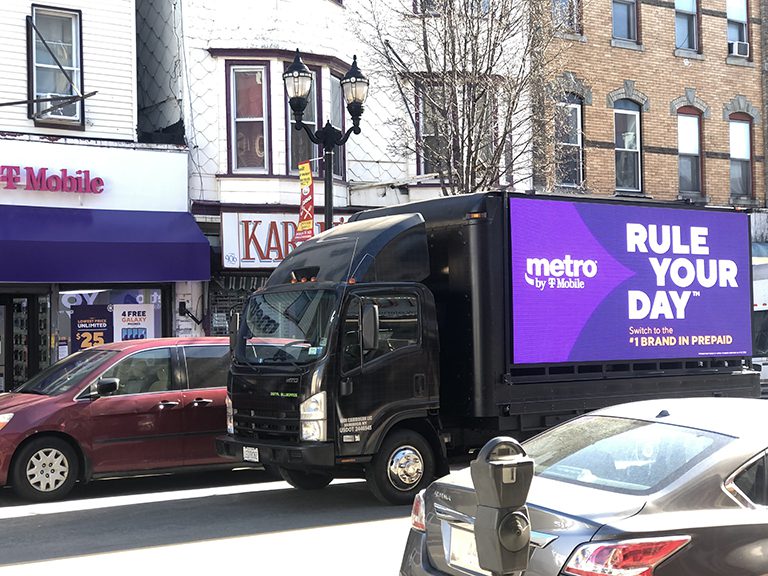
Mobile billboard trucks running the Paradise Road loop—north on Paradise from Convention Center Drive to Desert Inn Road, west on Desert Inn to Las Vegas Boulevard, south on the Strip to Flamingo, east on Flamingo back to Paradise—create a rotating presence that hits the hotel zone, the rideshare areas, and the LVCC approach multiple times per hour. During major shows, this route keeps a branded vehicle in the field of vision of convention attendees throughout their daily transit cycle.

The Strip itself has significant vehicular advertising exposure, but the traffic on Las Vegas Boulevard can be extremely slow, which is both a benefit (dwell time for the ad) and a challenge (the truck cannot complete the loop efficiently). We typically optimize mobile billboard routing for the less-congested parallel corridors—Paradise Road and Koval Lane—rather than the main Strip, using Las Vegas Boulevard sections strategically during lower-traffic windows.

Poster and Flyposting Campaigns

The blocks around Convention Center Drive and Paradise Road have commercial infrastructure—utility boxes, construction hoarding, vendor boards—that supports poster placement. High-visibility locations near the LVCC entrance approaches are premium positions during major conventions. A well-produced poster in the right spot on the Convention Center Drive / Paradise Road corner becomes part of the visual environment that every attendee walks past multiple times over the course of a multi-day show.

Experiential Pop-Ups

Pop-up activations in the Convention Center Drive restaurant zone during lunch windows are a format we have seen work extremely well for the right brand. A setup that creates a line—free coffee, a compelling product demo, a giveaway with real perceived value—generates organic social content in a context where attendees are actively posting from the show. A brand activation that shows up in convention attendee social posts alongside session content and exhibit floor photos benefits from association with the event without being official show presence.

Timing Your Las Vegas Convention Campaign

Las Vegas convention season runs year-round, but the calendar has distinct peaks. January is dominated by CES—Consumer Electronics Show—which consistently draws 100,000+ attendees and takes over the city’s entire convention infrastructure. The LVCC, the Venetian Expo, and virtually every major hotel ballroom in the city are part of CES in some capacity.

Spring brings a range of industry shows: National Association of Broadcasters (NAB) in April at the LVCC, which draws 90,000+ media and technology professionals. Fall brings SEMA (Specialty Equipment Market Association) in November, one of the largest trade shows in the world by square footage, drawing automotive industry professionals from around the globe to the LVCC.

The magic of the Las Vegas market is that the convention calendar rarely goes cold. Even in summer, when the heat makes outdoor activations in street teams genuinely challenging, major shows continue at the interior LVCC and satellite hotel venues. Understanding the specific show calendar, attendance estimates, and the profile of who is attending is the prerequisite to knowing when and where to deploy.

Convention / ShowTypical MonthPrimary VenueEstimated Attendance
CES (Consumer Electronics Show)JanuaryLVCC + Venetian Expo100,000+
NAB ShowAprilLVCC90,000+
HIMSS (Healthcare IT)March (varies)LVCC or Orlando (alternates)40,000+
SEMA ShowNovemberLVCC160,000+
AWS re:InventDecemberMultiple Strip Hotels50,000+
Money20/20OctoberVenetian Expo13,000+

Layering Formats for Multi-Day Campaigns

The most effective Las Vegas convention marketing campaigns we have run are multi-format and multi-day. A single-day street team push is a spike—visible but not sticky. A three-day campaign that layers street team activity, poster placements, and a mobile billboard run creates the kind of frequency effect that drives actual brand recall after attendees return home.

Day one of a three-day show is arrival day—attendees are checking in, picking up badges, orienting themselves. The morning badge-pickup rush at the LVCC registration area is a prime moment for first impressions. Day two is the heaviest floor traffic day—the most attendees are in motion on the floor and between the floor and hotel restaurants. Day three, exhibit traffic starts to thin but decision-makers who stayed for the full run are often in a more reflective, post-meeting mindset that is receptive to brand materials.

We typically front-load our street team hours on day one and day two, shift to mobile billboard on day three when the street team’s full-day efficiency declines, and maintain poster placements throughout. The result is a campaign that creates a consistent brand presence across the full convention window rather than a single impact moment that fades.

Working with Trade Shows That Restrict Floor Marketing

Most major trade shows restrict or prohibit non-exhibitor marketing activity inside the convention center. Passing out materials on the floor, running activations in the hall without an exhibit contract, and ambushing traffic inside the building are typically restricted. We are very clear about this with clients: the formats we run are outside the building, in the public geography surrounding the convention.

That outside-the-building position is, in many ways, more valuable than floor presence for brand awareness purposes. Inside the floor, you are competing with hundreds or thousands of exhibitors for attention in an environment where attendees are already in brand-evaluation mode. Outside—on the sidewalk at the crosswalk, at the rideshare pickup zone, at the shuttle stop—you are the only brand in their field of vision. The impression quality is qualitatively different.

The other advantage of street-level work is that it reaches attendees who never make it to your booth. At a show like CES, with 100,000 attendees spread across multiple venues, the percentage of total attendees who visit any single exhibitor’s booth is small. A street team working the Convention Center Drive / Paradise Road corridor reaches every attendee who walks that route, regardless of their planned booth visit list.

Field insight: The Las Vegas heat is a real logistical factor in outdoor activations. Summer convention campaigns require shaded positioning, hydration logistics for street team staff, and time-of-day scheduling that keeps the team out of peak midday heat. We shift street team hours earlier—7:30am to 11am—and add a late-afternoon window (5pm to 7pm) rather than running through the midday peak. January through March and October through November are the most comfortable windows for extended outdoor work.

What AGM Brings to Las Vegas Convention Activations

We have deployed street teams, mobile billboards, and poster campaigns around Las Vegas conventions for clients in technology, automotive, healthcare, and media. Our field experience in this market means we know the specific logistics that catch first-time operators off guard: where rideshare vehicles actually stage versus where the official pickup zones are marked, which side of Paradise Road has the useful shade in the morning, which restaurant blocks on Convention Center Drive have the most outdoor dwell time at noon, how the shuttle timing at major shows affects the rhythm of foot traffic at the LVCC entrance.

That operational knowledge is not in any guide. It comes from standing on Convention Center Drive at 7:45am when the badge lines are forming and watching how 1,500 people move from a parking garage and four different rideshare staging areas toward the same three entrance doors. We have done that enough times to know where to be and when.

We manage our own field staffing in Las Vegas rather than using local subcontractors for brand ambassador work. The team we send to run a Las Vegas activation has been briefed on the brand, trained on the messaging, and selected for the professional appearance standards that convention contexts require. In a convention environment, where your brand is competing for credibility with every other exhibitor on the floor, the street-level experience of your marketing is a direct reflection of your brand’s positioning.

Frequently Asked Questions

What does “Las Vegas convention marketing” actually mean for a non-exhibitor brand?

It means running street-level marketing—street teams, mobile billboards, brand ambassador programs, experiential pop-ups—in the public geography around the Las Vegas Convention Center and the Strip hotel corridor during a major convention. You do not need to exhibit at the show to reach the attendees. The public streets around the LVCC are where those 40,000 to 100,000 people walk, rideshare, eat lunch, and wait for shuttles every day of the show.

Where is the best location for street teams during an LVCC convention?

The intersection of Paradise Road and Convention Center Drive is the highest-value position for most LVCC events. The Convention Center Drive restaurant block during lunch windows is close behind. For events in the West Hall specifically, the approach from Resorts World and the Wynn toward the West Hall entrance adds a strong secondary position. The monorail Convention Center station exit is excellent for intercept marketing in the inbound morning flow.

How far is the Las Vegas Convention Center from the Strip?

The LVCC’s main South and Central Hall entrances on Paradise Road are roughly 0.8 to 1.2 miles east of Las Vegas Boulevard, depending on the measuring point. The walk from Caesars Palace to the LVCC is approximately 20-25 minutes on foot. From the Wynn, it is closer to 12-15 minutes via Convention Center Drive heading east. Most attendees use the LVCVA shuttle or rideshare for this stretch rather than walking.

What conventions are best to target in Las Vegas?

CES in January is the largest and most marketable—100,000+ attendees, heavily tech and media focused. NAB in April targets broadcast, media, and AV technology professionals. SEMA in November is the largest automotive aftermarket industry show in the world. AWS re:Invent in December draws 50,000+ cloud computing and technology professionals. Each event has a distinct attendee profile, so the best target depends on who you are trying to reach.

Does AGM manage its own Las Vegas field staff or use subcontractors?

We manage our own field staffing for Las Vegas activations. We do not hand off brand ambassador work to local subcontractor agencies. The team that runs your campaign is briefed and trained on your brand by AGM and held to the appearance and performance standards we set for every activation we operate.

How does Las Vegas heat affect outdoor street team campaigns?

It is a real operational consideration. During the summer convention season, we shift street team hours to 7:30-11am and a late-afternoon 5-7pm window rather than running through the midday heat. We ensure shaded positioning where available and provide hydration logistics for field staff. October through April is generally comfortable for full-day outdoor work without scheduling modifications.

Can you run street-level marketing at satellite venues like the Venetian Expo or Mandalay Bay?

Yes. Each satellite venue has its own surrounding geography—driveways, sidewalks, rideshare staging areas, and connecting pedestrian routes—that support street-level marketing activity. The Venetian Expo’s Convention Center Drive connection and the Mandalay Bay Convention Center’s approach from the south Strip both have distinct traffic patterns we have studied and worked in.

How much lead time do I need to plan a Las Vegas convention campaign?

For most campaigns, three to four weeks is the minimum for clean execution—enough time for staffing, materials production, and logistics coordination. For major shows like CES or SEMA where our calendar fills early, six to eight weeks is a better planning window. Contact us with your show date and we will tell you what is achievable in your timeframe.

What makes Las Vegas convention marketing different from other cities?

The scale and concentration. No other US city puts 40,000 to 160,000 same-industry professionals into a two-mile geographic corridor for three or four days with the same frequency as Las Vegas. The hotel-to-venue movement patterns are highly predictable. The attendee profile is tight—badge wearers from a specific industry, in Las Vegas specifically to engage with brands and ideas. That combination of scale, concentration, and receptivity to brand engagement is unique to the Las Vegas convention market.

Ready to Run Your Campaign?

Call us or email us. We’ll tell you exactly what we can do in your market and what it costs.

American Guerrilla Marketing — Los Angeles

★★★★★ 5.0 · 34 Google reviews

Street-level campaigns in Los Angeles and nationwide. Wheatpasting, LED trucks, street teams, and more.

(646) 776-2770

Related Services

Explore similar advertising solutions offered by American Guerrilla Marketing.