Consumer packaged goods brands compete for attention on shelves, on screens, and on the street. Knowing how to buy the right ads in the right places changes everything about your sales velocity.
Buying CPG ads is not like buying a billboard for a car dealership or a display ad for a software product. Consumer packaged goods brands face a different set of pressures. You compete at the shelf level. You fight for trial. You need consumers to see your product repeatedly before they pick it up and put it in their cart. That means your media strategy has to work in layers.
At American Guerrilla Marketing, we have planned and executed CPG advertising campaigns for food and beverage brands, personal care companies, supplements, and household products. We know which formats drive trial, which ones build long-term awareness, and how to put together a media mix that actually moves product.
This guide walks you through every major format you can buy, how to think about budget allocation, what to expect in terms of results, and how to make decisions that connect advertising spend to actual sales lift.
Most advertising is designed to get someone to take a high-consideration action. Book a flight. Download an app. Schedule a demo. CPG advertising has a fundamentally different goal. You are trying to interrupt a habit. You want someone who has bought the same brand of energy drink for three years to pick up a different one. That is a hard job.
The average consumer makes grocery purchasing decisions in seconds. Research consistently shows that most shoppers make product choices at or near the shelf without much deliberate thinking. That means your advertising job is more than to inform. It is to create enough brand recognition and positive association that your product triggers a familiar response when the shopper is standing in the aisle.
This requires reach. It requires frequency. It requires consistency across multiple touchpoints. And it requires showing up in the places where your target consumer actually spends time, more than the places that are easiest to buy.
The CPG Advertising Reality: Most CPG brands underinvest in upper-funnel awareness and over-rely on digital retargeting. But you cannot retarget someone who has never heard of you. A strong CPG media plan builds awareness first, then closes with purchase-intent formats.
CPG Ad Formats and How to Buy Them
There is no single right format for CPG advertising. The best campaigns use a combination. Here is a breakdown of the main categories and what buying looks like in each one.
Out-of-Home Advertising
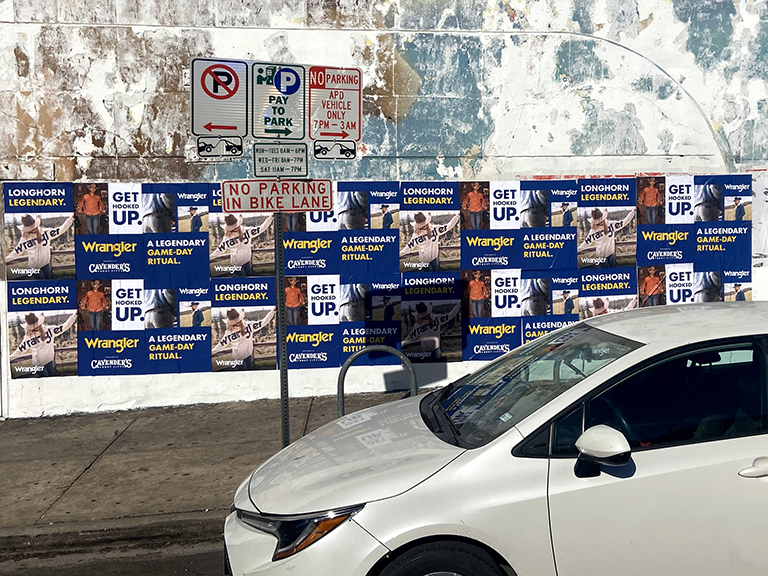
Out-of-home (OOH) advertising covers any format that reaches people while they are moving through the world. Billboards, transit ads, street-level posters, and murals all fall into this category. For CPG brands, OOH is especially powerful because it reaches consumers close to the point of purchase.
A billboard near a grocery store chain creates exposures at the exact moment a shopper is deciding where to spend their food budget. A poster campaign in a dense urban neighborhood can generate thousands of exposures per day at a cost that makes digital formats look expensive on a per-impression basis.
To buy OOH, you can work directly with operators like national OOH operators, large outdoor media networks, or major OOH operators for traditional billboards. For street-level formats including postering and murals, you work with a ground-level marketing firm like AGM. We source locations, handle installation, and document the campaign so you have proof of placement.
Retail and In-Store Advertising
For CPG brands, the shelf itself is a media channel. End caps, floor graphics, shelf talkers, and in-store digital screens all drive trial at the moment of decision. Many major retailers sell advertising directly through their retail media networks. Walmart Connect, Kroger Precision Marketing, and Target’s Roundel all let brands buy placements that appear when shoppers search or browse on the retailer’s app and website.
Retail media is expensive but often highly measurable. You can frequently tie spend to actual sales data through the retailer’s closed-loop attribution. For CPG brands trying to prove ROI on ad spend, this is one of the cleaner formats available.
Digital Display and Social
Digital advertising for CPG brands works best when it is part of a larger media mix, not the whole strategy. Meta, TikTok, and YouTube all let you reach highly specific demographic and interest-based audiences. You can target people who follow cooking content, who have bought similar products, or who live near specific retail locations.
The challenge with digital CPG advertising is attribution. If someone sees your snack brand ad on Instagram on Tuesday and buys it at Whole Foods on Saturday, that purchase rarely gets credited to the ad. CPG brands that rely on digital performance metrics often undervalue their campaigns simply because the attribution model cannot capture the full process.
Sampling and Experiential
Sampling is one of the highest-ROI tactics available to CPG brands. Getting a product into someone’s hands drives trial at a rate that no media format can match. Experiential activations that include sampling, games, demonstrations, or interactions build brand memory more effectively than passive advertising.
We run sampling campaigns for CPG brands at street corners, transit hubs, events, and retail entrances. A well-executed sampling day in a dense urban location can generate thousands of product trials in a single day. Many brands see measurable sales lift in the stores nearest to sampling locations within the following weeks.
Influencer and Content Partnerships
Creator partnerships have become a standard part of CPG media buying. A food creator with 500,000 engaged followers who genuinely uses and recommends your product can drive more trial than a national TV spot for certain target audiences. Buying influencer content means negotiating usage rights, deliverables, and exclusivity. You can either work with creators directly or through agencies that manage influencer networks.
How to Build a CPG Media Plan
A good CPG media plan starts with the consumer, not the media. You need to know who buys your product, where they live, where they shop, and how they move through their day. Every media format you choose should be justified by how well it reaches that specific person in a relevant context.
The second step is setting clear objectives. Are you trying to drive trial among new consumers? Increase purchase frequency among existing customers? Defend shelf space by maintaining brand salience? Each objective calls for a different media mix.
The third step is budget allocation. A general framework that works well for mid-size CPG brands looks something like this:
Budget Tier
Monthly Spend
Recommended Focus
Entry Level
$5,000 – $20,000
OOH postering + sampling in key markets
Growth
$20,000 – $75,000
OOH + digital social + influencer + in-store
Expansion
$75,000 – $250,000
Multi-market OOH + retail media + experiential
Scale
$250,000+
Full-funnel national with local activation layers
Targeting Strategies for CPG Brands
CPG advertising works best when it is hyper-relevant to the consumer’s context. There are several targeting approaches that consistently outperform generic broad campaigns.
Geographic Concentration
Instead of spreading budget thin across the entire country, concentrate spend in the markets where you have distribution. If your product is in Whole Foods locations in New York, Los Angeles, and Chicago, your advertising dollars should be concentrated in those three cities. Advertising in markets where consumers cannot buy your product burns budget and generates no return.
Channel-Specific Strategies
If you are trying to drive velocity at a specific retailer, align your advertising to the neighborhoods where that retailer has the most locations. A poster campaign near Target stores outperforms a general city-wide campaign for brands that sell through Target. This sounds obvious, but many CPG brands skip this level of planning.
Dayparting and Seasonality
Some CPG categories are deeply seasonal. Sunscreen, cold medicine, sports drinks, and grilling products all have clear demand peaks. Aligning advertising spend to those peaks is basic but frequently overlooked. Digital formats let you daypart within a single day. Transit advertising lets you reach commuters at rush hour. Different contexts call for different timing.
The Neighborhood Rule: We always tell CPG brands to think in a six-block radius around their key retail doors. Consumers within that radius are your most likely buyers. OOH placements in those zones drive measurable lift in those specific stores. Think small, think dense, think repeated exposure.
CPG Co-Op Advertising: When Retailers Share the Cost
Many CPG brands overlook co-op advertising funds as part of their media budget. Co-op programs are arrangements where a retailer agrees to contribute to the brand’s advertising cost in exchange for featuring the retailer in the creative. A poster campaign that includes a “Available at Whole Foods” tag line near a specific store may qualify for co-op contribution from the retailer. A sampling program that drives consumers into a specific chain can sometimes be partially funded through trade promotion agreements.
The mechanics vary by retailer. Walmart, Kroger, Target, Whole Foods, and most major chains have formal trade spending frameworks that govern what brands can and cannot count as trade promotion. Food brokers and category buyers can tell you what specific promotional formats qualify for co-op credit in your retailer agreements. Many brands leave co-op dollars on the table because their marketing team is not coordinating with the sales team on what formats qualify.
Street-level advertising near a retailer’s locations can qualify under some trade promotion frameworks if it is tied to a specific promotion or price point and branded with the retailer’s logo. Work with your buyer and your broker to understand what qualifies. Even a 20 percent co-op contribution on a $20,000 OOH campaign meaningfully improves the effective cost of reaching the consumer nearest to the point of purchase.
Measuring CPG Ad Performance
Measurement is one of the hardest parts of CPG advertising. Unlike direct-to-consumer brands, CPG companies often do not have a direct relationship with the end buyer. You sell to retailers, retailers sell to consumers, and the data loop is incomplete.
The most useful measurement tools for CPG advertising include:
Retail scanner data: Services like SPINS, IRI, or Nielsen track actual point-of-sale data at the category and brand level. You can compare sales velocity in markets where you are advertising versus control markets where you are not.
Retailer media attribution: If you are running retail media through a retailer’s network, they typically provide closed-loop attribution that ties ad spend to actual purchases.
Brand lift studies: These measure changes in awareness, purchase intent, and brand perception before and after a campaign. They do not directly measure sales but establish that the advertising is changing consumer attitudes.
Foot traffic analysis: For OOH campaigns, companies like Placer.ai can measure whether foot traffic to stores near your placements increased during the campaign period.
Direct consumer surveys: Post-campaign surveys in treated versus untreated markets can reveal whether your campaign reached and resonated with your target audience.
No single measurement approach captures the full picture. The best CPG marketers use a combination of methods and look for consistent signals across multiple data sources.
Common CPG Advertising Mistakes
We have seen these mistakes repeat themselves across dozens of CPG campaigns. Knowing what to avoid is as important as knowing what to do.
Buying Reach Without Relevance
A national cable TV buy reaches millions of people. But if only 2% of those viewers have ever bought a product in your category, the other 98% of exposures are pure waste. Highly targeted formats with lower absolute reach often outperform mass formats for CPG brands with specific consumer profiles.
Ignoring the Path to Purchase
Your advertising should meet the consumer at the right moment in their decision process. An awareness campaign that runs with no call to action or no proximity to purchase locations will not drive trial. Think about where your consumer is when they are most likely to act, and put your advertising there.
Underinvesting in Creative
The best media plan in the world fails with weak creative. CPG creative needs to do a lot of work fast. A shopper walking past a poster has two seconds. A commuter glancing at a transit card has one. Your image, your color, and your message all have to land instantly. Invest in creative that stops people. Generic product shots do not stop anyone.
Measuring Too Early
CPG advertising builds over time. A brand that runs a two-week campaign and sees no measurable sales lift often concludes the campaign failed. But consumer behavior changes slowly. The effects of a consistent six-month campaign are much more measurable than a brief burst. Patience is part of the strategy.
How AGM Works With CPG Brands
We specialize in the ground-level, street-facing work that most traditional media buyers do not handle. Postering campaigns, street team sampling, mural partnerships, experiential pop-ups, and urban outdoor placements are our core work. These are the formats that put your brand in the hands and field of vision of actual consumers in the neighborhoods where they shop.
We have worked with food and beverage brands looking to drive trial in New York, Los Angeles, Chicago, Miami, and other major urban markets. We help brands plan the geographic concentration of their campaigns, source and book locations, execute the physical installation or activation, and provide photo documentation of every placement.
Our campaigns integrate with whatever digital and retail media strategy you already have running. We fill the gap between your national digital buy and the actual moment a consumer decides to put your product in their cart.
Frequently Asked Questions
What is the minimum budget to run a CPG advertising campaign?
A meaningful street-level campaign in one market can start around $5,000 to $10,000. That covers postering, some sampling, and documentation. To see real sales lift, most brands need at least three to six months of consistent investment at meaningful scale.
Which ad format drives the most CPG trial?
Sampling consistently drives the highest trial rate of any format. Getting the product into someone’s hands beats any media impression. After sampling, street-level OOH near retail locations tends to have the strongest impact on purchase behavior.
Should CPG brands use digital advertising?
Yes, but as part of a mix, not a standalone strategy. Digital works well for retargeting, building brand communities, and reaching specific interest-based audiences. It struggles with CPG attribution and tends to undercount impact. Use it alongside OOH and experiential, not instead of them.
How do I measure CPG advertising ROI?
The most reliable approach combines retail scanner data, brand lift studies, and market-level sales comparisons. Compare sales velocity in markets where you are advertising against comparable markets where you are not. Over time, the advertising-exposed markets should show higher velocity.
What is retail media and should I buy it?
Retail media refers to advertising sold by retailers themselves. Think Walmart Connect or Kroger Precision Marketing. These placements appear in-app, on the retailer website, and sometimes in-store. They offer strong attribution because the retailer can tie ad exposure directly to purchase. Worth buying if your distribution is concentrated in that retailer.
How do I choose which markets to advertise in?
Start with your distribution footprint. Advertise where you have product on shelves. Then prioritize the markets where your target consumer is most concentrated. A premium health food brand should concentrate in urban markets with Whole Foods density before expanding to mass market channels.
What formats work best in urban markets for CPG?
Street-level postering, transit advertising, and sampling all perform exceptionally well in dense urban markets. Urban consumers are exposed to high volumes of advertising and have developed selective attention. Ground-level placement at eye height tends to cut through better than elevated formats in urban environments.