
July 20, 2026
Hand-Painted vs Printed Murals for Brand Campaigns
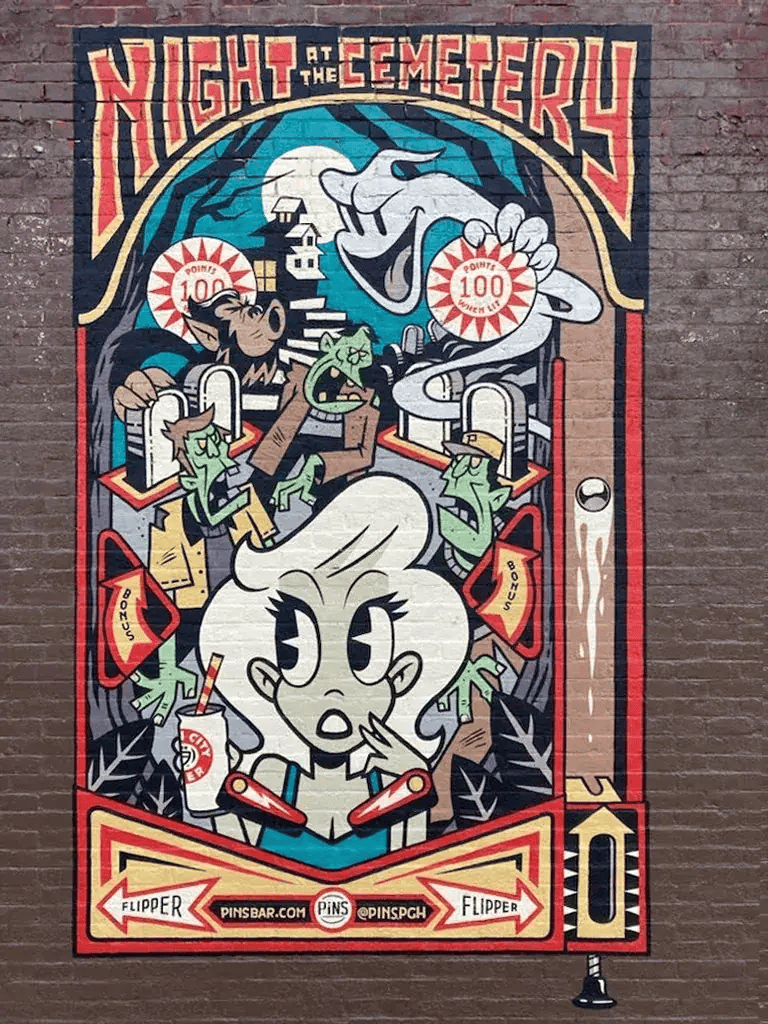
A mural campaign gets the decision backward when it starts with the format instead of the objective. “We want a hand-painted mural” and “we want a printed mural” are both answers to a question that should come before format: what does this mural need to accomplish, how long does it need to last, and what does the surface allow?
At American Guerrilla Marketing, based in Industry City, Brooklyn, NY, we execute both hand-painted and printed mural programs. We have placed murals on warehouses in Bushwick, retail corridors in Chicago, and building facades in Los Angeles. The format decision is made based on surface, budget, timeline, campaign objective, and location context, not based on which format sounds better in a creative brief. Call (646) 776-2770 to talk through your specific project.
This guide covers how we think about that decision, what each format genuinely costs, how they perform differently in the field, and when the choice is obvious versus genuinely difficult.
What Hand-Painted Murals Actually Are
A hand-painted mural is produced directly on the wall surface by an artist using exterior paints, brushes, rollers, and spray equipment. The design may be transferred to the wall using a projector or a grid system, but the final rendering is done by hand. The result has texture, depth, and subtle variation that a printed image does not replicate, even at very high print quality.
The hand-painted format carries an embedded narrative: someone made this. That narrative is not incidental. It is one of the primary drivers of social media engagement and press coverage for mural campaigns. The act of painting a mural in public is a performance. Artists working on a wall draw crowds. Crowds photograph the process. Those photographs circulate before the mural is finished. The finished mural then generates its own second wave of content from people who encounter it later.
When Hand-Painted Makes Sense
Hand-painted murals make sense when the artistic quality of the execution is a core part of the brand message, when the campaign is intended to be permanent or semi-permanent, when the surface is irregular or three-dimensional in a way that printed vinyl cannot accommodate, or when the campaign objective includes community engagement and press generation around the creation process.
They also make sense for brands that want to be associated with craft, creativity, and local culture. A hand-painted mural in a neighborhood signals that the brand made an investment in that specific place. A printed vinyl panel signals that the brand shipped something in. The distinction may seem subtle but is felt at the neighborhood level where murals are evaluated by the community as well as the advertiser.
What Printed Murals Actually Are
A printed mural is produced on a large-format substrate, typically vinyl, mesh, or canvas, using inkjet printers capable of very high resolution at very large scales. The substrate is then transported to the wall and applied using adhesive, mechanical fasteners, or a combination. The installation process can happen in a day or two for a surface that would take a week or more to hand-paint.
Printed murals can achieve photographic precision that hand-painting cannot. If the design requires a specific person’s face, a product photograph, or fine typographic detail, printed vinyl reproduces it exactly. The color accuracy is also better for designs that require precise brand color matching. A hand-painted mural involves human interpretation of color values that will vary slightly from painter to painter.
When Printed Makes Sense
Printed murals make sense when the campaign timeline is tight, when the design requires photographic detail, when the installation needs to be temporary and removable without damage to the surface, when the design is already locked and cannot accommodate the natural variation of hand-painting, or when cost efficiency at large scale is the primary concern.
They also make sense when the brand’s visual identity depends on exact reproduction. Certain brand marks, photographs, and typographic systems look wrong when rendered by hand. The printed format delivers the brand standard exactly every time.
Cost Comparison: Where the Math Lands
The cost comparison between hand-painted and printed murals is more nuanced than it appears. Several variables affect the crossover point where one format becomes more cost-effective than the other.
For Smaller Murals
At small scale, roughly under 400 square feet, hand-painting and printed vinyl are often cost-competitive. Hand-painting may have higher labor cost but no material costs beyond paint. Printed vinyl has significant material costs (substrate, ink, adhesive, installation hardware) but the labor for application is less than the labor for painting. At this scale, the format decision should be driven by objective and surface rather than cost.
For Large Murals
At large scale, above 1,000 square feet, printed vinyl often becomes more cost-effective than hand-painting because the labor cost of painting scales linearly while print production costs scale sublinearly. A wall that takes four artists three weeks to paint can be printed and installed in a week. The labor savings often outweigh the material costs at large scale.
However, this calculation changes when you factor in longevity. A hand-painted mural using quality exterior paints will outlast a vinyl installation by years. If the building owner wants a semi-permanent installation, the life-cycle cost of hand-painting, amortized over 10 years, may be lower than multiple cycles of vinyl installation and removal.
Other Cost Factors
Surface preparation affects both formats. A wall that needs priming, surface repair, or anti-graffiti base coating adds cost regardless of the application method. Access equipment, scaffolding, boom lifts, and rigging, is a significant cost for any large-scale work and is often equivalent between formats. Permit fees depend on location, not format, and apply equally.
Longevity and Durability
A well-executed hand-painted mural using quality UV-resistant exterior latex or enamel on a properly prepared surface, finished with a UV topcoat, can last 10-15 years with minimal fading or deterioration. The paint becomes part of the surface rather than sitting on top of it. Graffiti applied over a hand-painted mural can be removed without damaging the underlying image if an anti-graffiti coating was applied during installation.
Printed vinyl has a typical outdoor life of 3-7 years depending on UV exposure, climate, and substrate quality. Mesh substrates that allow wind permeability last longer on exposed surfaces. Solid vinyl panels can delaminate, bubble, or peel in extreme heat or cold. In direct sun, fade can become visible within 2-3 years even on quality materials.
For campaigns intended to run longer than 3 years on a surface with significant sun exposure, hand-painting is almost always the better long-term investment. For campaigns with a defined end date under 2 years, printed vinyl’s removability makes it the practical choice.
Press, Social Media, and Community Engagement
The narrative value of a hand-painted mural campaign consistently outperforms printed vinyl in press coverage and social media engagement. The reasons are clear when you think about the content opportunities each format creates.
A hand-painted mural creates content at every stage: the surface being prepped, the sketch being projected, the artists working in the early stages, the mid-point progress, the finished work, the crowd watching, and the reveal moment. Each stage is a content opportunity. Brands that document and share the process consistently see higher engagement than brands that simply post a photo of the finished wall.
A printed vinyl installation creates content at the reveal. That is essentially one content moment. The process is not visually interesting. Watching someone roll a vinyl panel onto a wall with a squeegee does not draw a crowd. The finished wall may be beautiful, but the production of it is not.
For brands whose campaign objectives include earned media, influencer engagement, or community presence, the hand-painted format has structural advantages that the printed format simply cannot replicate.
Surface Considerations
The surface itself often makes the format decision. Some surfaces are simply not suitable for vinyl application. Rough brick, aged concrete with significant texture variation, and surfaces with complex profiles cannot support a smooth vinyl application. The adhesive requires flat, consistent contact to bond properly. On a rough surface, vinyl will lift at the edges and fail within months.
Hand-painting works on almost any outdoor surface that can accept primer and exterior paint. Rough brick, smooth concrete, corrugated metal, wood, and even some plastics can be painted. The artist adapts to the surface rather than requiring the surface to conform to a standard substrate.
The inverse situation, a surface that is too smooth or too non-porous for paint adhesion, is rare for exterior building applications but does occur with certain coated or glazed surfaces. In those cases, printed vinyl with a mechanical fastening system is the more practical approach.
Connecting Murals to a Broader Campaign
A mural, regardless of format, performs best when it is integrated with the broader campaign rather than treated as a standalone placement. Our guerrilla marketing services team builds mural campaigns that connect to ground-level activations, ambassador programs, and digital amplification.
A mural location that also hosts a brand ambassador activation on launch day creates an event around the installation that draws additional foot traffic and content. Pairing the mural with wheatpaste posters in the surrounding blocks extends the visual narrative beyond the single wall. And a mobile LED billboard routing past the mural location creates moving impressions that connect the same visual across multiple formats in the same geographic zone.
Frequently Asked Questions
What is the main difference between hand-painted and printed murals?
Hand-painted murals are created directly on the wall surface by artists using brushes and outdoor paints. Printed murals use large-format vinyl or mesh substrates printed and then applied to the surface. Hand-painted murals have a craftsmanship quality; printed murals offer photographic precision and faster installation.
Which is more expensive: hand-painted or printed murals?
Hand-painted murals typically cost more for smaller sizes and complex artwork because of the labor involved. For very large surfaces, printed vinyl can be more cost-effective than the equivalent hand-painting time. The cost crossover point depends on complexity and surface size.
How long do hand-painted murals last?
A professionally painted outdoor mural using quality UV-resistant exterior paints on a properly prepared surface can last 5-15 years. UV topcoats and anti-graffiti coatings extend longevity further. Murals on shaded or sheltered walls last longer than those in direct sun.
Do hand-painted murals get more press and social media attention than printed ones?
Generally yes. The craftsmanship narrative and the process documentation of a hand-painted mural creates more organic content opportunities. Watching artists work draws crowds and cameras. A finished printed vinyl installation is less inherently shareable than the process of a mural being created in real time.
Which format is better for temporary brand campaigns?
Printed vinyl is typically better for campaigns with a defined end date because it can be removed cleanly from the wall. Hand-painted murals are more permanent and may require painting over when the campaign ends, which has associated cost and may require the building owner’s cooperation.
Can you get permits for both types of murals?
Yes. Both types require the same fundamental permissions: building owner consent, and in many cities, a mural permit or sign permit depending on whether the mural contains commercial content. The permitting process does not typically distinguish between hand-painted and printed formats.

Ready to Run Your Campaign?
Call us or email us. We’ll tell you exactly what we can do in your market and what it costs.
Related Services
Explore similar advertising solutions offered by American Guerrilla Marketing.
American Guerrilla Marketing — Los Angeles
Street-level campaigns in Los Angeles and nationwide. Wheatpasting, LED trucks, street teams, and more.
(646) 776-2770
Related Articles
-
Street Poster Advertising Ottawa: A Complete Campaign Guide
September 17, 2026
-
Activation Marketing: How Brands Win at Street Level
September 13, 2026
-
Experiential Marketing Firms Chicago | American Guerrilla Marketing
September 12, 2026
-
Pop Up Experiential
September 12, 2026
-
Mobile Pop Up
September 12, 2026