Guerrilla Brand: How to Build Street-Level Brand Presence That Sticks
The brands people remember on the street earned that recognition through physical presence. Here is how we help brands build it city by city.
There is a category of brand that everyone in a city seems to know before they can explain why. They have seen the logo on a wall on their morning commute. They walked past a stencil of it near their favorite coffee shop. A friend handed them a product sample from a crew wearing branded t-shirts outside a concert. The brand never bought their attention through a standard ad placement. It placed itself in their daily environment until recognition became inevitable.
That is guerrilla branding. It is the sustained, intentional use of street-level advertising formats to build a physical brand identity in public spaces. We do this for companies across the country. Our team has built guerrilla brand presence for music labels in Brooklyn, streetwear companies in Los Angeles, food and beverage startups in Chicago, tech platforms in Austin, and film studios in New York. Every one of those campaigns had a different format mix and a different geographic strategy, but they all shared the same core logic: the brand goes to the audience rather than waiting for the audience to come to it.
This guide covers what guerrilla branding actually means, how we structure campaigns that build real recognition, what formats work for different brand types, and how to measure the results of a physical brand presence strategy.
A guerrilla brand is not defined by a single campaign. It is defined by a consistent approach to brand-building that uses physical, unconventional advertising as its primary channel for building public recognition.
Most brands think about physical advertising as a supplement to digital. They run Facebook and Google campaigns as the primary engine of awareness and add outdoor elements when budget allows. A guerrilla brand inverts that logic. The street is where the brand lives. The digital presence supports and amplifies what is happening on the ground.
This inversion matters for a specific reason. Digital advertising has a reach problem that is getting worse every year. Ad blockers, algorithm changes, rising CPMs, and audience fatigue make it harder and more expensive to build genuine awareness through digital channels. Physical advertising in unexpected locations does not have that problem. A stencil on the sidewalk outside the Bedford Avenue subway station in Williamsburg cannot be blocked or skipped. It is there every morning when thousands of people walk out of the station. If the brand is on that stencil for three weeks, thousands of people in a specific demographic have seen that brand in their actual physical environment. That is a different quality of impression than a digital banner they scrolled past.
Guerrilla branding compounds over time. Each campaign adds to the recognition base the previous one built. By the third or fourth campaign in a given market, some members of the target audience start to look for the brand’s physical presence because they have been conditioned to encounter it. That expectation is one of the most valuable things a brand can build.
The Formats That Build a Guerrilla Brand
Guerrilla branding draws on a set of running physical advertising formats. Each format has different strengths, different duration characteristics, and different budget requirements. The best guerrilla brand strategies layer multiple formats to create a presence that is seen in multiple contexts by the same audience.
Stencil Campaigns
Stencil campaigns are the workhorse of guerrilla branding. We cut custom stencils from Mylar, deploy a crew overnight, and cover a set of pre-scouted locations with a consistent brand mark, logo, or campaign message. A well-planned stencil campaign can achieve 20 to 50 installations in a single night across a concentrated geographic zone.
The strength of stencils is saturation. When a brand is on 40 sidewalks within a 12-block radius of a target neighborhood, the target audience in that neighborhood encounters the brand repeatedly across their normal movement patterns. They see it outside the subway. They see it near the coffee shop. They see it on the way to work. That repetition builds familiarity faster than any single high-visibility placement.
We run the most stencil campaigns in New York City, particularly in the Williamsburg corridor from the Bedford Avenue station south to the Metropolitan Avenue stop, in the SoHo and NoLita blocks between Broadway and Lafayette, and on the approach routes to major venues like Madison Square Garden and Barclays Center. Each of those zones has a distinct demographic profile that matches specific brand targets.
Poster and Wheatpaste Campaigns
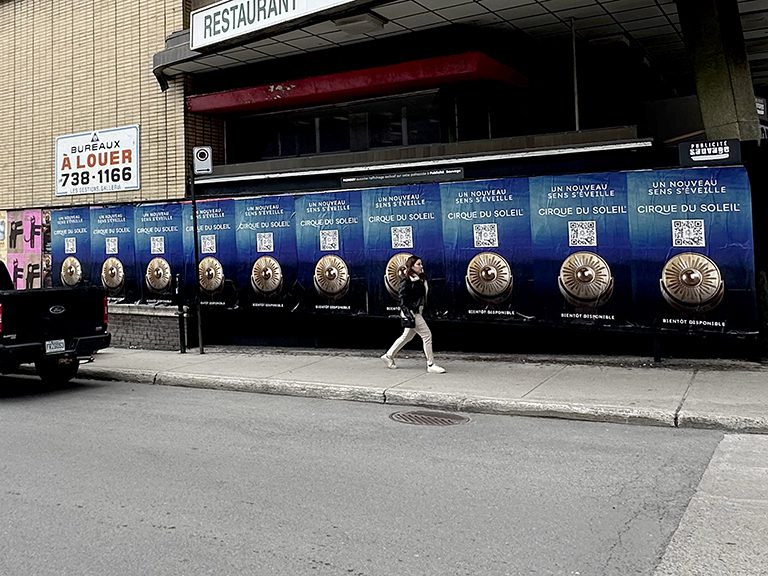
Poster and wheatpaste campaigns occupy a middle ground between the brevity of stencils and the permanence of murals. A properly installed wheatpaste poster on a brick or concrete surface lasts two to six weeks depending on weather and surface conditions. A campaign that covers 30 to 60 locations with a bold visual poster creates a brand visual identity that persists in the environment for weeks after installation.
The creative format for poster campaigns allows more visual complexity than stencils. A full-color printed poster can carry an image, a brand mark, a campaign slogan, and a URL or social handle. The larger surface area rewards slightly more design investment. But the same principle applies: the message has to work in a single glance from someone moving at walking pace.
Mural Installations
Murals are the long-term anchor of a guerrilla brand strategy. A branded mural on a high-visibility wall in the right neighborhood becomes a landmark. People use it for directions. Photographers use it as a backdrop. It generates organic social media content every week for as long as it remains on the wall.
The best mural locations for guerrilla branding combine high daily foot traffic with wall visibility and a demographic match to the target audience. The walls along the Bowery in lower Manhattan, the building facades on Fairfax Avenue in Los Angeles, and the Wicker Park walls on Milwaukee Avenue in Chicago are examples of locations where brand murals have genuine cultural weight. A brand that places a mural in one of those locations is more than advertising. It is participating in the visual culture of the neighborhood.
Street Team Activations
Street teams put humans in the audience’s path. A trained team at a festival entrance, a concert queue, or a transit hub creates direct brand encounters that no other format can produce. The team hands out samples, distributes branded materials, and represents the brand in real conversation with real people.
For guerrilla brand building, street team deployments are most effective when they are timed to moments of high audience concentration. Festival season, major sports events, film openings, and product launch dates are all windows when a concentrated street team deployment can create a density of brand encounters that would be impossible to achieve through any passive format.
Projection Campaigns
Projection campaigns are the high-drama format of guerrilla branding. A commercial projector aimed at a large building surface at night creates a brand visual at scale that is visible from significant distance. A single well-positioned projection can reach every person on a busy street block at the same time.
We use projection campaigns for product launches, film and album release weeks, and major event tie-ins. The format is time-limited by definition, which actually helps create urgency. A projection that appears for three nights creates a reason to pay attention that a permanent installation does not have. People share it because they know it will not last.
Location Strategy for Guerrilla Brand Building
Location is the most important variable in guerrilla branding after the creative itself. The wrong location means the right message reaches the wrong people or no one at all. The right location means every dollar of campaign spend generates exposures from exactly the audience the brand needs to reach.
We start every location strategy session with a demographic mapping exercise. We identify where the target audience is concentrated in the target city, what transportation corridors they use, what entertainment and retail destinations they visit, and what times of day they are most present in those locations. From that map, we build a location list that maximizes audience-specific exposures rather than raw foot traffic.
Raw foot traffic is not the goal. A Times Square installation gets enormous foot traffic, but the audience composition is heavily tourist-skewed and changes completely by market segment every 20 minutes. For most brand targets, that diffuse audience is less valuable than a smaller, concentrated audience in a neighborhood where the actual target demographic lives, works, and spends time.
Location principle: We always choose a location where 500 people from the target demographic will see the installation over a smaller location where 5,000 general-population pedestrians will see it. Brand recognition builds through repeated exposure by the right people, not from a single exposure by the wrong ones.
Guerrilla Branding by Industry
Different industries use guerrilla branding in different ways depending on their audience, their geography, and what kind of brand association they want to build. Here is how the format mix typically works across the sectors we work with most frequently.
Industry
Primary Formats
Key Brand Goal
Top Markets
Music Labels and Artists
Stencil, Poster, Projection
Release awareness and cultural credibility
NYC, LA, Chicago, Nashville
Streetwear and Sneakers
Mural, Stencil, Street Team
Subcultural authenticity and drop launches
NYC (SoHo), LA (Fairfax), Chicago
Food and Beverage
Street Team, Sampling, Stencil
Trial and neighborhood-level familiarity
Citywide, festival-targeted
Tech and Apps
Stencil, Poster, Street Team
User acquisition in specific urban demos
NYC, SF, Austin, Seattle
Film and Streaming
Mural, Projection, Stencil
Opening weekend buzz and social sharing
NYC, LA, major markets
Health and Wellness
Street Team, Sampling, Poster
Product trial and category education
NYC, LA, Miami, Austin
Creative Principles for Guerrilla Brand Identity
Building a consistent guerrilla brand requires creative discipline that is different from conventional brand identity work. The standard brand guidelines document is built around how a logo and visual system work in controlled environments: print, digital, packaging, signage. Guerrilla branding takes that visual system and drops it into completely uncontrolled physical environments. The creative has to survive that transition.
The first principle is recognition over explanation. A guerrilla brand element should communicate brand identity before it communicates any campaign message. The logo or brand mark has to be dominant. A passerby who sees the installation for one second should come away with a brand impression even if they did not read the text.
The second principle is contrast. Physical environments are visually complex. Sidewalks, walls, and urban streetscapes are full of competing visual information. A guerrilla brand element needs enough contrast with its environment to register before it reads. White on dark pavement works. Neon yellow on brick works. Mid-tone gray on concrete disappears.
The third principle is consistency. A guerrilla brand is built through repetition across multiple campaign executions. The brand element that appears in the stencil campaign needs to be recognizably the same brand element that appears in the mural and the poster campaign. That visual consistency is what converts repeated encounters into genuine brand recognition.
Creative test: Before finalizing any guerrilla brand creative, we walk the client through what we call the motion test. We print the creative at actual installation size, place it on the floor or against a wall, and walk past it at normal pedestrian speed. If the brand mark does not register in that test, the creative needs to be simplified. Every guerrilla brand element we produce passes this test before it goes into the field.
Measuring Guerrilla Brand Growth
Measuring the impact of guerrilla branding requires different tools than measuring direct response campaigns. There is no click-through rate for a sidewalk stencil. The measurement framework has to reflect what guerrilla branding is actually delivering: awareness, recognition, and cultural presence.
Impression Tracking
We estimate exposures for every installation location using foot traffic data from pedestrian count databases and transit authority public reports. For each location, we calculate daily exposures based on the foot traffic count and the installation’s visibility from the primary pedestrian path. We multiply by installation duration to produce a total impression figure for the campaign.
Those figures are conservative estimates, not claimed precision. But they allow clients to compare the cost per impression for guerrilla branding against equivalent paid media costs in the same markets. The comparison is typically favorable for guerrilla formats in high-traffic urban environments.
Social Amplification Tracking
We monitor organic social media during every campaign for photos, mentions, and tagged posts from installation locations. Installations that generate social sharing extend the campaign’s reach beyond the physical footprint at zero additional cost. We include social amplification data in the post-campaign reporting for every client.
Brand Lift Surveys
For clients running sustained multi-campaign guerrilla brand strategies, we recommend periodic brand awareness surveys in the target market. These surveys measure unaided brand awareness and brand association in the target demographic before a campaign cycle and again six to eight weeks after. The delta is the measurable brand lift attributable to the guerrilla brand activity.
Direct Attribution Signals
Some guerrilla brand campaigns include traceable elements. A unique URL, a QR code on a poster installation, or a promo code distributed by a street team allows direct attribution of downstream actions to the physical campaign. We recommend including at least one attribution element in every campaign specifically to demonstrate the connection between physical brand presence and measurable business outcomes.
How We Structure a Guerrilla Brand Campaign at AGM
Every guerrilla brand campaign we run starts with a brief review. We want to understand the brand’s current awareness level in the target market, the specific demographic the campaign needs to reach, the geographic footprint, the timeline, and the budget. From that brief, we build a format recommendation and a location plan.
Format recommendation comes first because it drives everything else. If the campaign goal is rapid saturation awareness ahead of a product launch, stencils are the right format. If the goal is sustained brand presence over a six-month window, a mural plus periodic stencil or poster refreshes is the right structure. If the goal is direct audience engagement, street teams are the right primary format. We do not have a default recommendation. We build the recommendation to the goal.
Location scouting is our second deliverable. Once the format is confirmed, our field team goes into the market and scouts specific installation locations that match the demographic brief and the format requirements. We provide location maps, surface photos, and foot traffic estimates for every proposed location. Clients approve the location list before any production begins.
Production and installation come next. We manage all production in-house or through trusted vendors for format-specific production needs. Our installation crews are experienced in each format and work to the deployment timeline the campaign requires.
Documentation and reporting close the loop. Within 24 hours of installation, we deliver a photo report with GPS timestamps showing every location, every installation, and every surface. The report includes the impression estimate for each location and a social monitoring summary if the campaign generated organic sharing. Clients have full visibility into what they bought and where it went.
Guerrilla Brand Campaigns for National Rollouts
Many of the brands we work with need guerrilla brand presence in multiple markets at the same time. A CPG company launching a new product needs street-level brand presence in New York, LA, Chicago, and Miami in the same two-week window. A streaming platform releasing a new show needs projections and posters in five major cities the week of the release.
We coordinate multi-market campaigns from a single client brief. Our team manages crews in each market, ensures creative consistency across all installations, and delivers a consolidated photo documentation report that covers every market in a single package. Clients deal with one point of contact regardless of how many markets the campaign covers.
Multi-market campaigns also allow us to do something that single-market campaigns cannot: demonstrate that the brand is everywhere. When a consumer in Brooklyn sees the brand on a stencil and then their friend in LA sends them a photo of the same brand on a mural on Fairfax, the brand registers as a national presence with street-level credibility. That combination of scale and authenticity is very difficult to achieve through digital media alone.
Brand Identity Consistency at Street Scale
One of the most common problems we see in guerrilla brand campaigns is creative inconsistency across formats. A brand will have a strong logo and color system that works on a business card or a digital banner, and then watch it fall apart when scaled to a 15-foot wall or reduced to a two-color chalk stencil. Street-scale brand execution requires a different kind of design discipline than screen-scale work, and brands that do not adapt their visual identity for physical environments pay the price in campaigns that look fragmented rather than cohesive.
We run a format review on every creative asset before production begins. We are checking three things: legibility at distance, color contrast on the most common surface colors in the target market, and logo simplicity. A logo with fine serifs or thin connecting strokes that looks elegant on screen becomes illegible when cut as a stencil or painted at scale by a muralist. We catch those problems before production, not after 40 stencils have been cut and the crew is standing on a sidewalk at 2 AM realizing the design is not going to read.
The brands that build the strongest guerrilla brand recognition over time are the ones with simple, high-contrast visual marks that work across every format without modification. Think of the brands you recognize on a Williamsburg wall without a second look. The mark is always simple, high-contrast, and instantly attributable. That is not an accident. It is a deliberate design choice that compounds over years of consistent physical presence.
Applying Brand Voice to Physical Copy
Visual identity consistency is only half the equation. Brand voice in copy that appears on physical formats is equally important and equally variable in execution quality. A street poster with copy that sounds like it was written by the legal department destroys the credibility that the street placement was supposed to build. Physical copy needs to sound like a person said it, not like a brand committee approved it.
Our copy review for guerrilla brand campaigns focuses on three things: does it sound human, does it work without context, and does it reward reading at walking pace. Street copy has a reading window of two to four seconds from a pedestrian moving at normal pace. Every word has to earn its place in that window. Long copy, subordinate clauses, and qualifications all work against the format. Declarative, specific, and concrete copy works with it.
Guerrilla Brand Building Across Multiple Markets
Most of the brands we work with on sustained guerrilla brand campaigns start in a single city and expand over time. The most common sequence is New York first, then Los Angeles, then Chicago or Miami depending on the category. Each city adds a new dimension to the brand’s street presence and introduces the brand to a new audience that communicates across geographic lines through social media.
The multi-market guerrilla brand strategy requires thinking carefully about which cities are actually worth the investment for a specific brand category. Not every brand has a meaningful audience in every major city. A streetwear brand might have its most important audience in New York and LA with Chicago as a strong secondary. A food brand might have its critical mass in Chicago and Miami before either coast. A music brand might need to be in Austin and Nashville ahead of anywhere else. Category shapes market priority, and market priority shapes the order of expansion.
When we build a multi-market guerrilla brand campaign, we start with a priority city analysis: which markets have the highest concentration of the target audience, which have the most influential tastemakers for the category, and which have the social amplification infrastructure to take a street-level moment and make it nationally visible. The answers vary significantly by brand type, and they change over time as both the brand and the market environment evolve.
City
Strongest Brand Categories
Top Guerrilla Brand Zones
Social Amplification Strength
New York City
Fashion, music, food, tech, entertainment
SoHo, Williamsburg, Bushwick, Harlem
Very High
Los Angeles
Streetwear, beauty, entertainment, wellness
Fairfax Ave, Arts District, Melrose Ave, Venice
Very High
Chicago
Food, music, sports, consumer goods
Wicker Park, Logan Square, Pilsen, River North
High
Miami
Luxury, nightlife, fashion, consumer goods
Wynwood, Brickell, South Beach approach
High
Austin
Music, food, tech, outdoor
South Congress, Rainey Street, East 6th
Medium-High
Measuring Guerrilla Brand Equity Over Time
Measuring guerrilla brand building is harder than measuring a direct response campaign, but it is not unmeasurable. The metrics that matter are different from click rates and conversion percentages, but they are real and trackable.
The most direct measure is organic social mention rate for the brand in the target markets before, during, and after a campaign window. A guerrilla brand campaign that is working generates a measurable uptick in organic social mentions, user-created content from campaign locations, and brand hashtag activity that tracks to the campaign geography. We monitor this in real time during active campaigns and build before-and-after comparisons for post-campaign reporting.
Street-level brand recognition surveys, run in the target neighborhoods with small panels of target audience members, measure whether the campaign has generated the recognition it was designed to create. These surveys are simple and inexpensive to run in comparison to their information value. A survey of 50 people in a campaign neighborhood asking whether they recognize the brand, where they encountered it, and what they associate with it returns data that no social media metric can provide.
Sales data in the target geography, when available, provides the most compelling evidence of guerrilla brand impact. When a brand runs a sustained guerrilla campaign in Williamsburg for six months and tracks sales data from the Brooklyn ZIP codes that include that neighborhood, the correlation between campaign activity and sales lift is usually visible in the data. We help clients build those tracking frameworks at the start of a campaign rather than trying to reconstruct them after the fact.
AGM Field Note: The most convincing guerrilla brand metric we have seen from a client is not social exposures or press mentions. It is unprompted brand recognition by members of the target audience who have never interacted with the brand’s digital presence. When someone in Bushwick can name your brand without having seen a digital ad, your guerrilla brand strategy is working.
Frequently Asked Questions
What is a guerrilla brand?
A guerrilla brand is a company that builds recognition and cultural relevance through street-level physical advertising rather than conventional paid media. The brand appears in unexpected places, uses unconventional formats, and earns attention rather than buying it from standard ad inventory.
marketing“>How does guerrilla branding differ from guerrilla marketing?
Guerrilla marketing is the tactic. Guerrilla branding is the sustained application of those tactics to build a consistent brand identity in physical public spaces over time. A single stencil campaign is guerrilla marketing. A brand that does stencils, murals, posters, and street team deployments consistently across multiple markets for months or years is building a guerrilla brand.
What types of brands benefit most from guerrilla branding?
Brands that sell to urban consumers, creative audiences, or young professionals benefit most. Music labels, streetwear companies, food and beverage brands, tech startups, film studios, and lifestyle brands all use guerrilla branding to build the kind of street credibility that paid digital ads cannot manufacture.
How much does a guerrilla brand campaign cost?
Costs vary by format and market. A single-market stencil campaign starts around $3,500. A multi-format guerrilla brand campaign covering stencils, posters, and a mural in two or three cities typically runs $15,000 to $40,000. Sustained quarterly campaigns across multiple markets scale from there.
Can a guerrilla brand strategy work for B2B companies?
Yes, but the format has to match the audience. B2B guerrilla branding works best when the target audience is geographically concentrated, such as around a convention center during a major industry event, or in a specific business district where decision-makers commute. Conference and trade show perimeter activations are a strong B2B guerrilla brand tactic.
How long does it take to build a guerrilla brand?
Genuine street-level brand recognition builds over several months of consistent physical presence. A single campaign creates a moment. Repeated campaigns in the same markets build a visual identity that locals start to recognize and associate with the brand. Most brands we work with see meaningful recognition shift after three to five campaigns in a given market.
Does guerrilla branding work alongside digital advertising?
Yes. The two channels reinforce each other. Physical guerrilla brand installations generate organic social media content when people photograph and share them. That organic reach extends the campaign well beyond the footprint of the physical installation. Brands that run guerrilla campaigns alongside paid digital often see stronger digital engagement during the campaign window.
What cities does AGM run guerrilla brand campaigns in?
We run guerrilla brand campaigns in New York City, Los Angeles, Chicago, Miami, Austin, Boston, Atlanta, Seattle, San Francisco, Denver, and Washington DC. We also coordinate multi-market guerrilla brand campaigns from a single client brief.