Guerilla Marketing Strategy: The Complete Campaign Playbook for 2026
Strategy is what separates a guerilla marketing campaign that generates real awareness, recall, and conversion from one that burns through a budget and produces nothing but a pile of flyer trash. We’ve executed campaigns that worked better than any paid digital channel in the same market window. We’ve also seen campaigns, not ours, that had impressive creative and terrible strategy, and the results showed it.
This is our full approach to building a guerilla marketing strategy from the ground up. Not the theoretical version. The actual version: the one we use when a client comes to us with a launch date, a target audience, and a city they want to own. We’ll cover the strategic framework, the tactical selection process, the execution layer, the measurement approach, and the lessons we’ve accumulated from running real campaigns on real streets.
A guerilla marketing strategy is a structured plan for achieving a specific marketing objective through unconventional, street-level, and experiential tactics that operate outside the traditional paid media framework. The strategy defines who you’re reaching, where they physically are, what you want them to know or do, which tactical formats best serve that objective in that environment, and how you’ll measure whether it worked.
The word “guerilla” comes from the military concept of asymmetric warfare: achieving outsized results with limited resources through speed, agility, and the element of surprise. That framework translates directly to marketing. Instead of matching a competitor’s billboard spend, you find the spaces they’re not using. Instead of competing in the same digital auction, you own the physical environment your shared audience moves through every day.
The Six Core Principles of Guerilla Marketing Strategy
Audience first, channel second: Start with where your audience physically is. The tactic follows the geography, not the other way around.
Surprise creates recall: Unexpected placements and interactions generate stronger memory encoding than expected ad formats. Design for the moment of surprise.
Context is content: A great campaign fits its environment. A stencil that looks like it belongs on the pavement in Williamsburg works better than one that looks imported from a brand deck.
Repetition through place: Consistent presence in a specific location over time builds familiarity faster than broad, thin coverage.
Physical triggers digital: Every street-level impression is an opportunity to bridge to a digital action. A QR code, a hashtag, a memorable URL, build the bridge in.
Document everything: Guerilla marketing without documentation is invisible. Geo-tagged photos, interaction logs, and performance tracking turn an experience into a reportable campaign.
Building Your Guerilla Marketing Strategy: A Step-by-Step Framework
Every campaign we build starts with the same strategic foundation. Here’s the process in detail.
Step One: Define the Objective With Precision
Vague objectives produce vague campaigns. “Increase brand awareness” is not an objective, it’s a direction. An objective is: “Drive 500 new users to download the app in a two-week window in Williamsburg and Greenpoint.” Or: “Generate foot traffic to the new Spring Street location in SoHo in the two weeks following the soft opening.” Or: “Create a visible presence at Art Basel Miami Beach that positions the brand alongside the arts community.”
The more specific the objective, the more precisely we can design the campaign to achieve it. Specificity also gives you a measurement framework: you know what success looks like before you start, so you know whether you got there when you finish.
Step Two: Map the Audience to Physical Space
Audience mapping in guerilla strategy isn’t demographic profiling in the abstract. It’s asking: where is this person, physically, on a Tuesday at noon? On a Friday at 8 PM? On a Saturday morning? For a 25-to-35-year-old creative professional in New York, that might be the Bedford Avenue L train at 9 AM, the blocks around the coffee shop on Grand Street in Williamsburg at 11 AM, and the bars near the Morgan Avenue L at midnight on a Friday. Each of those moments is a campaign opportunity with a different format requirement.
We use foot traffic data, neighborhood demographic overlays, event calendars, and our own years of crew-level knowledge of how specific streets move at specific times to build this map. It’s not guesswork. It’s geography as a targeting layer.
Step Three: Identify the Tactical Format Mix
The objective and the audience map together determine which tactical formats are right. Here’s how the selection logic works:
Stencil perimeter, street team at venue approaches
Concentrated foot traffic, audience is already present
Competitive conquest
Stencils and teams near competitor locations
Intercept audience at the competitor’s doorstep
Step Four: Develop the Creative Brief
Street-level creative lives in a different context than screen-based creative. It has to work at walking pace, in changing light, against the visual noise of the urban environment, and it has to be immediately legible to someone who didn’t choose to see it. Our creative brief for guerilla campaigns answers four questions:
What’s the single message this person needs to receive in the three seconds of attention we get?
What visual element makes this impossible to walk past without noticing?
What action do we want them to take after seeing it?
What about this is worth photographing and sharing?
Every format has specific technical requirements. Stencil art needs to work in two or three colors at street scale. Wheat paste needs to hold up to wind, sun, and close-up inspection. Street team materials need to be light, durable, and useful enough that someone keeps them rather than dropping them at the next corner. We build all of this into the creative development process.
Step Five: Build the Location and Timing Plan
Location and timing are where strategy becomes execution. For a stencil campaign, we produce a location list with specific addresses, cross-streets, and sightline notes. For a street team activation, we produce a deployment schedule: where the team starts, how they rotate through zones, what their lunch break protocol is, and how they document interactions.
Timing within a campaign window matters enormously. A Thursday morning stencil placement in front of the 6 train exit at 77th Street on the Upper East Side is seen by a completely different population than the same placement on a Sunday afternoon. We build timing into the location plan based on the audience’s movement patterns.
Step Six: Execute, Adapt, Document
The best strategy breaks on contact with reality. A location that looked perfect on a map turns out to have a construction scaffolding that blocks the sightline. A street team’s assigned corner has a competing brand activation that showed up the same morning. A chalked surface that we thought was porous holds the stencil poorly and needs to be rerouted to an adjacent block. Our crews are trained to adapt. We build contingency locations into every plan, give crew leads the authority to make real-time decisions, and document all deviations in the post-campaign report.
Guerilla Marketing Strategy by Campaign Type
Different campaign objectives require different strategic emphases. Here’s how we approach the most common types.
Product Launch Strategy
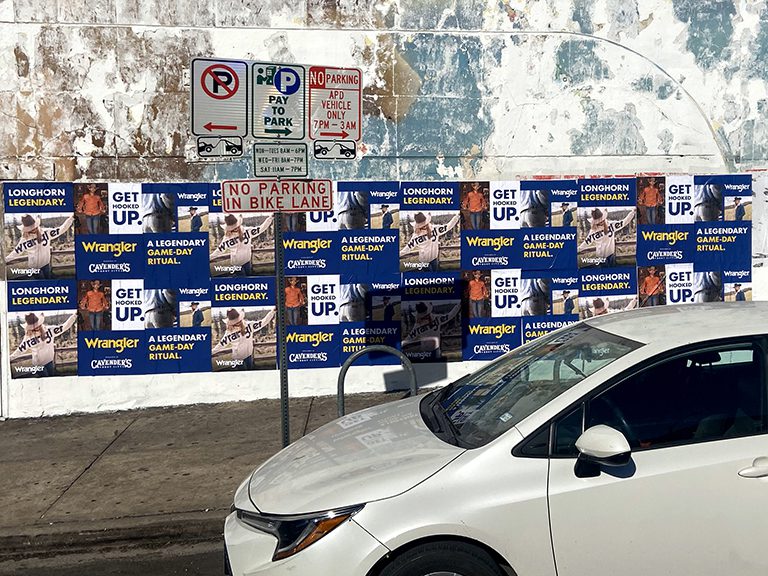
A product launch campaign needs to create concentrated awareness in a specific target community within a defined time window. Our launch strategy typically combines a stencil grid deployed across the 30 to 50 most relevant foot traffic locations in the target neighborhood the week before launch, a street team activation at 3 to 5 key locations on launch day, and brand ambassador presence at recurring locations in the week following. The stencil sets the environment. The team creates the direct interaction moment. The ambassador sustains awareness through the critical adoption window.
Event Amplification Strategy
Event campaigns have a built-in audience concentration advantage: we know where the people will be and when they’ll be there. Our event strategy focuses on approach paths rather than the event perimeter itself. The people walking from the 7 train to the entrance of Citi Field, or from the A/C/E train exit on 42nd Street toward the Javits Center, or from their hotel on Collins Avenue toward the festival entrance at Bayfront Park, those approach corridors are where we place stencils and position street team members. We capture the audience in transit, when they’re alert, moving, and not yet in event-mode.
Sustained Neighborhood Presence Strategy
For brands that want to build long-term awareness in a specific neighborhood, a new restaurant in the West Village, a boutique retail store on Smith Street in Carroll Gardens, a service business in Astoria, we build a rolling presence strategy. This combines monthly stencil refreshes at key pedestrian nodes within a half-mile of the location, weekly ambassador presence at the neighborhood’s highest-traffic recurring moments (farmers markets, Saturday morning pedestrian peaks), and wheat paste placements on approved walls in the neighborhood at 6-week intervals. The accumulated effect over 3 to 6 months produces genuine local recognition.
National Campaign Coordination Strategy
For brands executing simultaneous campaigns in multiple cities, the strategic layer includes market sequencing (which city launches first and why), creative adaptation for local cultural context, crew coordination across time zones, and unified reporting that lets a central marketing team see all markets in a single dashboard. We’ve run concurrent campaigns in New York, Los Angeles, and Chicago in the same week, with separate location plans and timing schedules for each market built against a unified campaign objective.
Guerilla Marketing Strategy vs. Paid Digital: When Each Wins
We’re not anti-digital. Some of our best-performing campaigns combine street-level tactics with geo-targeted social advertising in the same zip codes. But the honest answer to “when should I choose guerilla marketing over paid digital?” is more nuanced than most agencies will tell you.
When Guerilla Wins
Guerilla marketing outperforms paid digital when the objective requires physical presence, when the target neighborhood is geographically concentrated, when the audience is experiencing significant digital ad fatigue in your category, when you need earned media amplification rather than purchased reach, when your category has high audience distrust of digital advertising, and when the campaign timeline is short enough that digital campaigns haven’t had time to optimize.
When Digital Wins
Paid digital outperforms guerilla when the audience is geographically dispersed, when precise demographic targeting trumps geographic targeting, when the campaign needs to produce attributable last-click conversion at scale, and when the budget is below the threshold where street-level coverage produces meaningful density.
When They Work Together
The strongest campaigns we’ve run combine both. A geo-targeted Instagram campaign in the same zip codes as an active stencil campaign produces cross-channel repetition: the person who sees the sidewalk stencil at the 1st Avenue L train exit and then sees the matching digital ad in their feed at 9 PM has encountered the brand twice in the same day in two different contexts. That repetition drives recall in a way that neither channel achieves alone.
The measurement question is the one most clients ask and most agencies dodge. Here’s how we actually measure results.
Campaign Documentation as Baseline
Before anything else, you need clean documentation of what was placed, where, and when. Our geo-tagged photo reports serve as the baseline record. They prove the campaign happened at the stated scale and in the stated locations. Without this, you have no foundation for any performance analysis.
Digital Bridge Conversion Tracking
Every campaign we run that includes a QR code or short URL uses unique tracking codes so we can isolate traffic generated by street-level exposures. This is the cleanest attribution signal available in guerilla marketing. Scan rates on well-placed QR stencils typically run 0.3 to 1.2 percent of estimated daily foot traffic past the placement, a strong number compared to digital display CTR at equivalent budget levels.
Foot Traffic Analysis
For retail and location-based clients, we compare foot traffic counts at target locations during the campaign window against a matched baseline period from the prior year or a matched control period. Brands with loyalty program data or POS transaction records can run this analysis with high precision. Brands without that data can use third-party foot traffic measurement tools to generate estimates.
Social Listening
Monitoring branded keywords, location tags, and campaign hashtags during and after the campaign period captures the organic social amplification signal. We track mentions in the campaign geography and compare volume against pre-campaign baseline. A significant spike in location-tagged social content featuring campaign creative is a clear signal of earned media generation.
Recall Research
For clients with budgets that support it, a simple post-campaign recall survey in the campaign geography measures aided and unaided brand awareness against a control population who weren’t in the campaign area. This produces the clearest picture of awareness lift attributable to the campaign. It adds cost but it’s the most defensible measurement methodology.
Common Guerilla Marketing Strategy Mistakes
We’ve seen these mistakes sink campaigns that had good creative and bad strategy.
Picking Locations by Instinct Alone
A corner that seems busy might have foot traffic that moves too fast, or in the wrong direction, or skews to a demographic that’s not your audience. Location selection based on crew feel alone, without foot traffic data and audience-mapping logic, produces inconsistent results. We use data to validate instinct, not replace it.
One Format, No Amplification
A street team with no complementary environmental presence is a point of contact with no context. A stencil with no human interaction component is a visual impression with no direct engagement. The most effective guerilla campaigns layer at least two formats so each one amplifies the other. Budget permitting, three formats create the environmental saturation that drives strong recall.
Creative That Doesn’t Travel
Creative that looks great on a monitor and falls apart on a sidewalk is a production failure with strategic consequences. Stencil art needs to hold its line quality on real concrete. Poster art needs to read from 15 feet away in bright sun. Ambassador scripts need to sound like real people talking, not brand copy read aloud. We test every creative format in realistic conditions before deployment.
No Measurement Plan
The absence of a measurement plan before the campaign launches means you can’t prove results afterward. This is a strategic error, not an operational one. The measurement approach needs to be decided at the strategy phase so the right tracking infrastructure is in place before the first crew hits the street.
FAQ: Guerilla Marketing Strategy
Let’s Build Your Strategy
A guerilla marketing strategy that actually works starts with a clear objective and an honest conversation about what the campaign can realistically achieve in your market and timeline. We’ve had that conversation with startups and global brands, with one-city clients and national rollouts. Every time, it takes about 20 minutes and it produces a clear starting picture of what we’d build for you.
American Guerrilla Marketing. Strategy first. Streets second. Results always.
Frequently Asked Questions
What is a guerrilla marketing strategy?
A guerrilla marketing strategy uses unconventional, low-cost tactics deployed in public spaces to generate outsized brand awareness. It relies on creativity, timing, and location rather than large media budgets.
What are the core elements of an effective guerrilla marketing strategy?
An effective guerrilla strategy requires a clear target location, a format that fits the environment, a message that works at the scale and speed of street viewing, and a documentation plan that captures the campaign for earned media use.
How does AGM build a guerrilla marketing strategy for a client?
AGM starts with the campaign objective, then maps target markets, selects formats based on local conditions, schedules execution around foot traffic peaks, and documents every placement for post-campaign reporting.
What is the difference between guerrilla marketing and standard OOH advertising?
Standard OOH advertising uses permitted, paid placements in fixed locations. Guerrilla marketing uses unexpected, often temporary tactics in unconventional locations to create surprise and drive word-of-mouth amplification.