Guerilla Marketing Miami: Street Campaigns That Actually Land in 2026
Miami doesn’t reward timid advertising. This is a city where the visual temperature is already maxed out. The colors are saturated. The buildings are loud. The people are stylish and fast-moving and genuinely hard to impress. If you show up with a generic poster campaign or a flyer distribution that looks like it was designed in 2011, you’ll be invisible. We’ve learned this the hard way, which is why we don’t do generic.
We are American Guerrilla Marketing, and we’ve been executing street-level campaigns in Miami and across South Florida for years. We know the neighborhoods. We know the foot traffic patterns on Lincoln Road at 8 PM on a Friday versus 11 AM on a Tuesday. We know which blocks in Wynwood get photographed 400 times a day and which ones are dead zones. We know when Art Basel changes everything, and how to position a brand inside that chaos without looking like you’re chasing it.
This guide covers our full approach to guerilla marketing in Miami. What works, what doesn’t, where we place campaigns, what formats we use, and what you can expect to invest.
Most cities have one or two cultural centers where street-level campaigns can live. Miami has several, and they’re dramatically different from each other. Wynwood is an outdoor gallery district where murals cover every surface and the typical visitor is there specifically to look at things. South Beach along Ocean Drive and Collins Avenue is tourist-heavy, international, and extremely Instagram-active. Brickell and downtown Miami are professional, fast-paced, and targeted at a different economic tier. Little Havana on Calle Ocho is culturally specific, community-oriented, and requires a different creative voice entirely. Midtown Miami and the Design District bring a luxury retail and hospitality demographic that responds to prestige framing.
Any agency that treats all of Miami as one market is giving you a subpar campaign. We don’t do that. We map the campaign to the neighborhood, and we adjust the creative and the format for each zone we enter.
The Tourism Factor
Miami sees over 26 million visitors annually. A campaign in the right spot at the right time puts your brand in front of people from Chicago, London, Bogotá, São Paulo, and Buenos Aires, all in the same week. That’s extraordinary reach for a street-level spend. We’ve had clients track social posts from their Miami campaigns landing in international feeds because the tourist-heavy zones are permanently social-media-active. Every impression has a shadow audience.
The Local Audience Is High-Value
Miami’s permanent population punches above its weight in income, cultural influence, and consumer spending. The Brickell corridor is home to finance professionals, tech transplants from the Northeast, and a young professional class with real disposable income. The Design District draws the kind of shopper who buys without a coupon. Even Wynwood, which feels more bohemian, has seen significant gentrification and income growth. The locals we reach in this market are buyers.
Core Guerilla Marketing Formats We Use in Miami
We don’t walk into Miami with one format and apply it everywhere. We build campaigns from a toolkit of tactics and select the right combination for each objective and neighborhood.
Wheat Paste Poster Campaigns
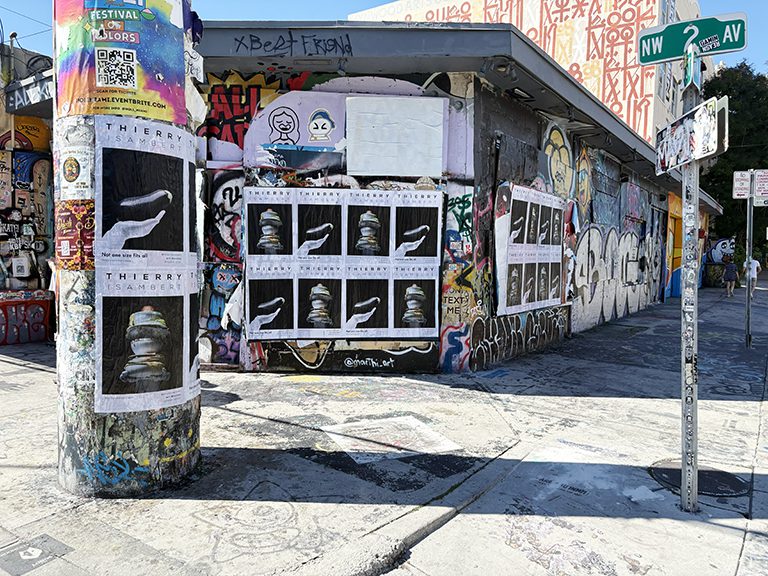
Wynwood is the obvious home for wheat paste in Miami, but we’ve executed strong placements on approved walls in Midtown, in the Allapattah neighborhood where arts infrastructure is still emerging, and along the industrial corridors near the Miami River. Wheat paste gives you a large-format visual presence on vertical surfaces where paint murals are the context. The creative has to be as strong as what surrounds it. We work with our design team and, when appropriate, with local Miami artists to produce artwork that fits the visual culture of the street rather than looking imported.
We’ve run street teams on Lincoln Road for product launches, in South Beach for app-driven campaigns, and on the outdoor mall areas around Coconut Grove’s CocoWalk for consumer goods brands. Miami’s climate means outdoor foot traffic year-round, there’s no January dead zone here. Our teams are trained to approach, not pursue. They read body language. They know when someone is open to a brief interaction and when to let them pass. The difference between a street team that generates goodwill and one that generates resentment comes down to training.
Stencil and Chalk Pavement Campaigns
The sidewalks on the blocks approaching Bayfront Park, the pedestrian crossings near the Adrienne Arsht Center on Biscayne Boulevard, and the foot-traffic corridors around the Frost Museum of Science have all seen our stencil work. Miami’s pavement surface quality varies more than New York’s, so we always do a pre-campaign surface assessment. The tourist foot traffic in beach-adjacent areas means our chalk stencil exposures on the Ocean Drive sidewalk or the boardwalk near 10th Street see tens of thousands of people on a weekend day.
Brand Ambassador Programs
For longer-run campaigns, we place brand ambassadors at recurring locations over multiple weeks. The regularity builds familiarity. A person who sees the same branded presence at the Brickell City Centre outdoor plaza on three consecutive Wednesday lunches starts to develop genuine awareness of the brand, not because they were interrupted, but because the brand became part of their environment. We staff and manage these programs, including training, scripting, and daily reporting.
Mobile Billboard and Street Advertising Vehicles
Miami’s road infrastructure and the density of both tourist and professional traffic on Biscayne Boulevard, on the MacArthur Causeway connecting Miami Beach to the mainland, and on US-1 through Coral Gables makes mobile billboard routes highly effective. We plan routes based on time-of-day traffic patterns, ensuring our vehicles hit peak-density windows on the arteries that matter for a given client’s target demo.
Miami Neighborhoods Where We Execute Campaigns
Geography is strategy in Miami. Here’s how we think about the major zones and what we use them for.
Wynwood
Every block between NW 2nd Avenue and NW 5th Avenue in the 20s is a visual canvas. Wynwood is already a destination for people who are looking for things to look at, which means your brand impression arrives in front of an audience that is, by choice, in a receptive visual mode. We focus on NW 2nd Avenue between 25th and 28th Street for street team deployment, and on approved wall space for large-format poster placements. The clientele skews young, affluent, and culturally engaged. Brands in fashion, tech, beverage, and entertainment consistently see strong response here.
South Beach / Ocean Drive
The pedestrian traffic on Ocean Drive between 5th and 15th Street is relentless from 10 AM through midnight. Tourist volume here creates extraordinary impression counts but requires creative that speaks to an international, diverse audience rather than a hyper-local one. Our approach in South Beach is high-impact, bold visual, and low-friction: something you see and understand in three seconds because you’re walking at vacation pace and have zero patience for a pitch. We use this zone for brand awareness and QR-driven digital-physical bridges.
Brickell and Downtown
The financial district along South Miami Avenue and the blocks surrounding Brickell City Centre give us access to a professional demographic that’s hard to reach through traditional outdoor because they consume it passively and tune it out. Street-level, ground-to-eye messaging and brand ambassador programs that offer genuine utility, a sample, a relevant piece of information, a useful handout, break through here in ways that a billboard doesn’t. The lunch hour window between 11:30 AM and 1:30 PM on Brickell Avenue is a concentrated foot traffic opportunity.
Design District
The Miami Design District, anchored by the luxury retail and restaurant blocks between NE 38th and 42nd Street, is where prestige brands live in this city. Guerilla marketing here has to match the aesthetic of the environment. Crude or rough executions will read wrong. We use this zone for high-craft wheat paste, carefully placed stencil work, and brand ambassador programs that are styled and trained to fit the visual register of a district where Dior, Prada, and Louis Vuitton are your neighbors.
Little Havana
Calle Ocho between SW 8th Street and SW 17th Avenue is one of the most culturally distinct corridors in South Florida. Campaigns here work best when they’re genuinely bilingual, culturally aware, and community-rooted rather than imported. We’ve worked with clients in food, beverage, and community services who wanted to reach this neighborhood authentically, and we staff our Little Havana teams with bilingual brand ambassadors who know the community. This zone rewards respect and penalizes condescension.
Miami Campaign Timing: When to Activate
Miami’s event calendar is a guerilla marketer’s planning document. The city’s biggest foot traffic spikes are tied to predictable recurring events, and the brands that plan around them get an amplified return on their street spend.
Art Basel Miami Beach
The first week of December transforms Miami Beach and Wynwood into the most photographed square mile in the country for seven days. Hundreds of thousands of art world visitors, collectors, journalists, and curious consumers fill the streets. Every impression from a well-placed campaign during Art Basel has a multiplied reach because the audience is actively documenting and sharing the environment. We recommend clients who want to compete during this window book at least six weeks in advance. Crew availability tightens dramatically as the date approaches.
Miami Music Week and Ultra
Late March in Miami sees Ultra Music Festival bring 165,000 attendees to Bayfront Park. The week surrounding Ultra, known as Miami Music Week, fills hotels across Miami Beach and Brickell with an international music audience. Campaigns in the corridors connecting hotels to the venue, along Biscayne Boulevard approaching Bayfront Park, and across South Beach during the week generate enormous reach with a specific, valuable demographic.
Winter Tourist Season
November through April is Miami’s peak tourist window. The sidewalks on Lincoln Road, the beach paths, and the restaurant corridors of Coconut Grove and Coral Gables see their highest volumes. We run sustained campaign programs for clients during this window and see consistently higher engagement and recall rates than we see in the off-peak summer months.
Summer Activations
Don’t write off Miami summers. The local population is there and active, the tourist competition drops, and the streets feel different, more neighborhood, less spectacle. This is the right time for campaigns aimed at Miami residents rather than visitors. The Brickell lunch crowd doesn’t disappear in July. The Wynwood gallery openings still happen. The neighborhood-level foot traffic on Miracle Mile in Coral Gables or on Bird Road through West Miami runs year-round.
Guerilla Marketing Miami Pricing
Pricing for Miami campaigns reflects crew travel and accommodation if we’re deploying from New York, or local crew coordination costs if we’re staffing on-the-ground resources. Here’s a general range:
Campaign Type
Duration
Scope
Starting Price
Street Team Activation
1 day
1 – 2 zones, 4-person team
$3,500
Wheat Paste Campaign
1 – 2 days install
20 – 40 locations, Wynwood + Midtown
$4,800
Chalk Stencil Grid
1 day
25 – 50 locations city-wide
$3,200
Multi-Week Ambassador Program
2 – 4 weeks
Daily staffing, 2 – 4 zones
$8,000+
Art Basel Activation Package
7 days
Multi-format, Wynwood + Beach
Custom
Full Market Campaign
2 – 3 weeks
All formats, all major zones
Custom
Every campaign starts with a brief call where we understand your objective, your target audience, your timeline, and your budget. We build from there. We don’t have packages that don’t fit, we build the campaign that fits your goal.
What Sets Our Miami Campaigns Apart
We’ve done this long enough to have opinions about what fails in this market. Generic creative fails. Crews who don’t speak Spanish in neighborhoods where Spanish is the first language fail. Campaigns that pick the obvious Wynwood wall and stop there fail. Miami is a city that rewards specificity, cultural intelligence, and creative ambition. We bring all three.
Local Knowledge, Not Tourist Maps
We know that the stretch of Española Way between Washington and Drexel Avenues in South Beach is a foot-traffic gem that most campaigns ignore because it’s one block off the main drag. We know that the Saturday afternoon farmer’s market crowd at the parking lot behind Sunset Harbour shops skews exactly right for certain CPG brands. We know that the Pérez Art Museum Miami plaza on MacArthur Causeway frontage is a waiting area for people with time and curiosity. These micro-locations are where we find margin that city-wide competitors miss.
Bilingual Creative Execution
Miami is 70 percent Hispanic or Latino in terms of population. A campaign that doesn’t at minimum acknowledge this, in tone, in language, in cultural reference, is operating at a significant disadvantage in most neighborhoods. We build bilingual creative by default for Miami campaigns unless a client’s audience is specifically and exclusively English-first. Spanish-language street presence in Little Havana, Hialeah, and Doral isn’t a niche, it’s the baseline for reaching the actual community.
Miami-Specific Formats That Outperform in This Market
Not every guerrilla format works equally well in Miami. The city’s climate, demographics, and visual culture all shape what lands and what does not. Here is what we know works best from running actual campaigns in this market.
Street poster campaigns in Wynwood. Wynwood is one of the most photographed neighborhoods in the entire southeastern United States. Every wall that is not a commissioned mural is a potential brand placement that gets organically photographed and shared on social media every weekend. A well-designed 24×36 or 18×24 poster on the right wall in Wynwood appears in tens of thousands of Instagram posts from tourists and locals annually. The social media value from Wynwood placements extends campaign reach far beyond the direct impression count.
Chalk stencil work on Ocean Drive and Lincoln Road. South Beach’s pedestrian zones, especially the closed sections of Lincoln Road between Collins and Alton, create high-dwell environments where pavement messaging gets read. A chalk stencil campaign applied on a Friday evening remains visible through the heavy weekend foot traffic, reaching both the tourist crowd on Ocean Drive and the local and visitor mix on Lincoln Road. The visual contrast of chalk on the paving stone surface of Lincoln Road is particularly strong.
Ambassador programs during Art Basel and Ultra. The weeks surrounding Art Basel in December and Ultra Music Festival in March are among the highest foot traffic periods of the year. Both events concentrate an international, high-income, brand-receptive audience into a relatively contained geographic area. Ambassador programs during these windows reach audiences that would be prohibitively expensive to target through digital channels at this same quality and density.
Brickell and Downtown commuter intercepts. Miami’s growing downtown business district now has a genuine commuter base using the free Metromover and the Miami Brightline station. Ambassador programs at Brickell City Centre, around the Brightline station at NW 2nd Avenue, and along the Metromover stops on Biscayne Boulevard reach the growing population of young professionals who live and work in Miami’s urban core. This audience is underserved by traditional Miami advertising, which focuses heavily on the tourist and entertainment market.
FAQ: Guerilla Marketing in Miami
Let’s Put Your Brand on Miami’s Streets
Miami moves fast and it rewards brands that show up at ground level with something worth noticing. We’ve placed campaigns on the sidewalks of Wynwood, in front of the clubs on Collins Avenue, across the Design District, and down the blocks of Calle Ocho. Every one of those campaigns started with a call.
American Guerrilla Marketing. We know Miami because we’ve worked it.
Frequently Asked Questions
What makes Miami a strong guerrilla marketing market?
Miami combines year-round outdoor foot traffic, a culturally engaged population, and a major events calendar — Art Basel, Ultra Music Festival, Miami Open, Super Bowl rotations — that creates consistent high-traffic windows for street-level campaigns.
What neighborhoods work best for guerrilla marketing in Miami?
Wynwood, Little Havana, the Design District, South Beach, and Brickell are the highest-value zones for street-level marketing in Miami based on foot traffic, media coverage, and audience demographics.
What guerrilla marketing formats perform best in Miami?
Wheatpaste murals, stencil work, street teams, wild posting, and experiential activations all perform well in Miami. The city’s visual culture makes high-quality creative especially important — generic execution gets ignored.
Does AGM operate guerrilla marketing campaigns in Miami?
Yes. AGM has run street-level campaigns across Miami’s core markets. Contact us at [email protected] or (646) 776-2770 to discuss your Miami activation.