GSP Campaigns NYC: Geo-Targeted Marketing in New York | American Guerrilla Marketing
New York City is not one market. It’s 50+ distinct neighborhood markets within one city. The brands that win here do it by treating specific neighborhoods as specific communities — not by broadcasting to the city as a whole.
Geo-specific promotional campaigns — marketing programs designed specifically for a defined geographic area rather than a broad market — are one of the most effective approaches to building genuine brand presence in New York City. The city’s extreme neighborhood heterogeneity makes city-level campaign targeting genuinely inefficient: the demographic, cultural, and behavioral differences between SoHo and the South Bronx, between Williamsburg and Bay Ridge, between Astoria and the Upper East Side are larger than the differences between many different cities across the country.
Brands that recognize and respond to this heterogeneity — designing campaigns specifically for specific neighborhoods rather than applying generic “NYC” positioning to everything — consistently outperform brands that treat the entire city as one audience. This page covers how geo-specific promotional campaigns work in New York City, which neighborhoods they work best in for specific brand objectives, and how physical and digital elements of these campaigns can be coordinated for maximum effect.
The case for neighborhood-level targeting in New York City is supported by the actual demographic data. New York City’s 300+ official neighborhoods vary enormously in household income, age distribution, educational attainment, cultural composition, consumer behavior, and relationship to brands and advertising. A campaign designed for the median New York City consumer is actually designed for no specific consumer — because the median NYC resident doesn’t live in any actual NYC neighborhood.
Consider: the median household income in Tribeca is over $150,000. In Mott Haven in the South Bronx, it’s around $25,000. The 22-year-old creative professional who moved to Bushwick from the Midwest has entirely different consumer needs and cultural references than the third-generation family in Howard Beach. A fashion brand whose target consumer is the Bushwick creative doesn’t need to be in Howard Beach; a home goods brand targeting established families in Queens doesn’t need to invest in SoHo. Geo-specific campaigns start from this truth and design accordingly.
Key NYC Neighborhoods for Geo-Specific Campaigns
For brands doing geo-specific promotional work in New York City, understanding the character of specific neighborhoods allows for genuinely targeted campaign design. Here are the neighborhoods with the most distinct marketing profiles:
SoHo (Manhattan)
SoHo is the most fashion-forward and brand-active neighborhood in New York City. The concentration of major retail flagships, art galleries, and design-adjacent businesses creates a consumer who is actively engaged with brand culture and accustomed to high-production marketing activity. The neighborhood’s foot traffic peaks on weekends and draws a mix of local residents, outer-borough visitors, and tourists — all overlapping in a relatively compact area.
Geo-specific campaigns in SoHo compete in the most crowded brand marketing environment in the city. The quality bar is correspondingly high. A street activation or poster campaign in SoHo needs to meet the visual standard set by the major brands that have permanent flagship presence here. An activation that looks impressive in most contexts looks ordinary in SoHo. The neighborhood rewards quality investment and punishes cutting corners more visibly than almost anywhere else in New York.
Williamsburg (Brooklyn)
Williamsburg’s transformation from an industrial waterfront to one of the most culturally influential neighborhoods in the country is one of the defining urban stories of the past 20 years. The neighborhood’s demographic — young, creative, independently minded, with above-average cultural capital and below-average tolerance for corporate brand activity — creates a specific marketing challenge. Campaigns that work in Williamsburg don’t look corporate; they look like they belong.
Geo-specific work in Williamsburg benefits from the neighborhood’s strong social media culture. Williamsburg residents document their neighborhood actively and share constantly — a genuinely interesting brand presence in the right location gets organic documentation from people who weren’t hired to provide it. This organic documentation multiplier makes Williamsburg one of the highest-return physical marketing locations in the city for brands that earn the neighborhood’s approval.
Harlem (Manhattan)
Harlem is one of the most historically significant Black American neighborhoods in the country and one of New York’s most culturally distinct communities. Brands that engage with Harlem’s cultural identity authentically — through genuine community partnerships, culturally appropriate creative, and real investment in the neighborhood rather than extraction of its cachet — earn access to a community with strong internal communication networks and high peer influence.
Brands that treat Harlem as a demographic target to be reached rather than a community to be respected get called out by exactly the community they’re trying to reach. Authentic community engagement in Harlem requires cultural humility, genuine relationship investment, and creative that reflects the neighborhood’s specific identity rather than generic “urban” aesthetics. When brands get this right, the community response can be extraordinarily positive. When they get it wrong, the response is equally strong in the opposite direction.
The Lower East Side (Manhattan)
The LES is New York’s most culturally layered neighborhood — historically a Jewish immigrant neighborhood, later a Puerto Rican and Chinese community, and now a mix of longtime residents, recent creative class arrivals, and nightlife-adjacent culture. The neighborhood’s visual culture is dense with street art, poster campaigns, and independent business marketing. A brand’s presence in the LES needs to be designed with this visual context in mind — competing with or building on it rather than ignoring it.
Jackson Heights (Queens)
Jackson Heights is one of the most ethnically diverse neighborhoods in the United States and one of the city’s strongest local commercial corridors serving immigrant communities from South Asia, Latin America, and East Asia. For brands with genuine relevance to these communities — food, cultural products, remittance and financial services, community-oriented brands — Jackson Heights is an underserved opportunity for geo-specific campaigns that reach highly specific consumer communities that are largely inaccessible through conventional NYC-wide marketing approaches.
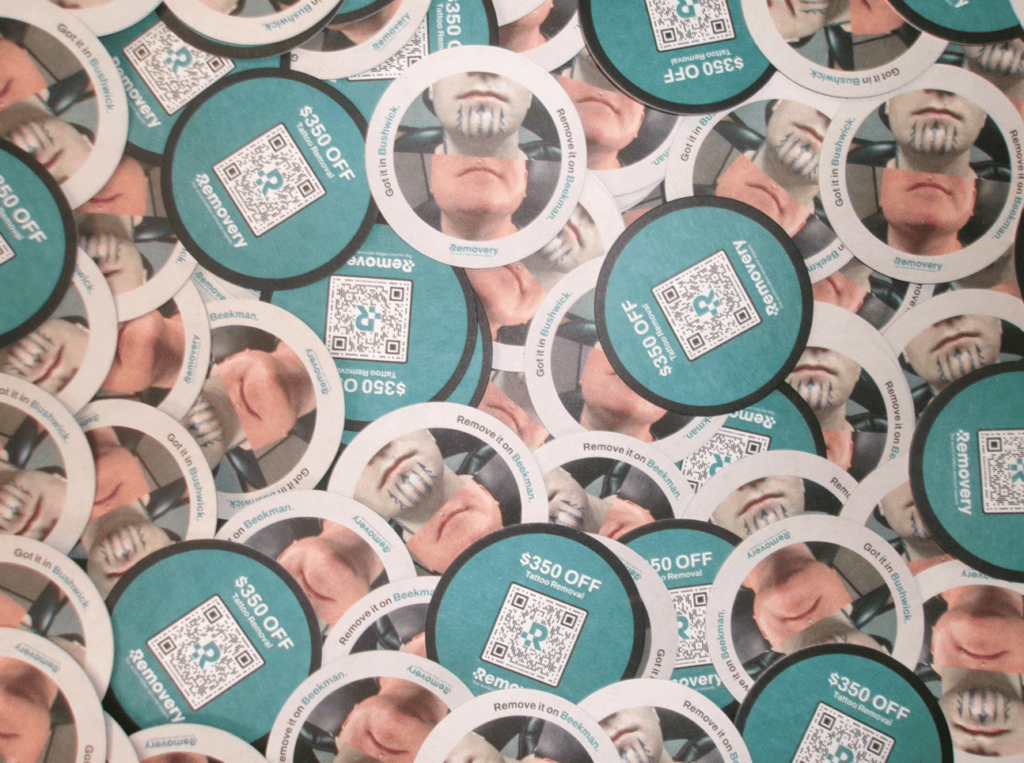
AGM Field Note: The mistake we most commonly see brands make in NYC geo-specific campaigns is designing for the neighborhood they want to be associated with rather than the neighborhood where their target consumer actually is. SoHo is aspirationally appealing as an association; Bushwick is where the target consumer actually spends their time. Designing for the neighborhood where the consumer is produces results; designing for the neighborhood where the brand wants to be seen produces documentation but not consumer relationships.
Combining Physical and Digital in NYC Geo-Specific Campaigns
The most effective NYC geo-specific campaigns coordinate physical and digital elements targeting the same neighborhoods simultaneously. The combination creates multi-touchpoint brand experiences that neither channel alone achieves.
Physical Campaign Components
Physical geo-specific campaigns include: street activations at high-foot-traffic locations within the target neighborhood, poster campaigns covering the specific blocks and corridors where the target consumer moves, sampling programs at neighborhood markets, coffee shops, or gyms, and branded presence at neighborhood events and cultural moments. Each of these creates physical brand presence in the specific environment where the target consumer is most receptive.
The physical campaign’s primary outputs are: direct consumer contacts (the people who physically encounter the brand), documentation (professional photos and video that capture the campaign in context), and the intangible of community presence (the brand is now associated with this neighborhood in the minds of the people who live and spend time there).
Digital Campaign Components
Digital geo-specific campaigns include: Facebook and Instagram ads targeted to specific NYC zip codes matching the target neighborhood, Google ads targeted to searches originating from the neighborhood’s geographic area, geofence advertising that reaches mobile users physically within the target neighborhood, and retargeting campaigns that follow consumers who engaged with brand content digitally after any physical encounter.
The digital campaign’s primary outputs are: awareness with consumers who didn’t physically encounter the brand but are geographically adjacent to those who did, retargeting of consumers who had physical encounters with digital follow-up, and measurable conversion actions (website visits, email sign-ups, purchase completions) from the neighborhood-level audience.
The Integration Benefit
When physical and digital run in the same neighborhood simultaneously, the combined effect is greater than the sum of each independently. A consumer who physically encountered the brand in their neighborhood on Saturday and then sees a digital ad from the same brand on their phone on Sunday has had two brand encounters in 48 hours in a context they feel connected to. The physical encounter provides credibility and memory that makes the digital encounter more effective; the digital encounter provides the follow-up that extends the physical encounter’s influence past the day it happened.
Zip 10010; professional interests, weekday targeting
Astoria/LIC (Queens)
Young professional, diverse, local business community
Less competitive than Manhattan; community-focused
Zip 11106/11101; lower CPM, high quality audience
Measuring Geo-Specific Campaign Effectiveness
Measuring the effectiveness of neighborhood-level campaigns in NYC requires metrics that are specific to the geographic and consumer context. City-wide brand awareness surveys miss the neighborhood-level brand recognition that’s the actual output of a geo-specific campaign. The right measurement framework for geo-specific NYC campaigns includes:
Consumer contact counts by location during physical activations
Documentation quality and volume from each neighborhood location
Organic social sharing and documentation from neighborhood residents (trackable through social listening with geographic filters)
Digital campaign performance metrics segmented by the specific geo-targeted zip codes
Any earned media coverage that references the specific neighborhood where the campaign ran
Direct consumer feedback and qualitative observation from field leads during activations
These metrics, compiled into a post-campaign report that’s neighborhood-specific rather than aggregated across all of NYC, give brands a genuine picture of how the geo-specific campaign performed in each location. This neighborhood-level performance data is what drives smarter planning for subsequent campaigns — knowing that the Williamsburg activation dramatically outperformed the Flatiron activation allows the brand to allocate budget toward Williamsburg in the next campaign rather than splitting evenly based on assumptions about each neighborhood.
AGM delivers neighborhood-specific post-campaign reporting for all geo-specific NYC campaigns, including coverage maps showing exactly where the campaign ran, photo documentation organized by location, and written summary reports that provide field-level observations about consumer response in each neighborhood. This neighborhood-granular reporting is what makes geo-specific campaign investment compoundingly more efficient over time as the brand learns what works in each specific community.
What the Next Version of the Campaign Should Improve
Once a campaign has run, the smartest move is not to admire it. The smartest move is to ask what the next version should do better. We look at where attention formed fastest, where the message needed too much explanation, and which parts of the field plan created drag for the crew. Those notes are usually more valuable than broad praise because they show where the format can become easier to repeat. A mature marketing operator wants the second run to be cleaner than the first, not merely larger.
That improvement work often has less to do with adding new features and more to do with tightening the sequence. Maybe the brand cue needs to appear earlier. Maybe the route should drop one stop and spend more time in the strongest zone. Maybe the exterior needs less copy and a stronger visual anchor. Maybe the staff needs one better opening line instead of five optional ones. The audience rarely asks for complexity. They respond to confidence and legibility. Most campaign gains come from making the work easier to read and easier to deliver.
We also compare the public experience with the internal expectation. If the client hoped for long conversations but the environment only allowed fast exchanges, the next version should respect that reality instead of fighting it. If the event produced better photos than expected but weaker dwell time, the campaign might need a different call to action on the next pass. This is why honest field notes matter. They stop the team from repeating assumptions that the street already disproved.
There is also value in asking what should stay exactly the same. Strong location choices, useful staffing roles, good documentation habits, and a clear creative hook should be preserved when they work. Not every lesson is a correction. Some lessons are confirmations. Over time, those confirmations help the brand develop a real operating playbook rather than a loose archive of one-off events.
That long view is part of how AGM approaches campaign work. We want the client to leave with proof of execution, yes, but also with a more usable understanding of how the market responded. The best street-level campaigns do not end when the crew wraps. They become the source material for a sharper next move, a cleaner rollout in another city, or a stronger local return when the brand comes back to the same audience again.
The Multi-Borough Approach: Reaching Beyond Manhattan
Manhattan-centric marketing misses a significant portion of the New York City consumer market. Brooklyn alone has nearly 2.7 million residents — more than the population of Chicago. Queens has 2.3 million. The Bronx has 1.4 million. Staten Island has 475,000. Together, the four outer boroughs have over 6.5 million people, substantially outnumbering Manhattan’s 1.6 million. A brand that markets exclusively in Manhattan is reaching a fraction of New York City’s actual consumer population.
More importantly, the outer boroughs contain some of the most interesting consumer communities in the city for specific brand categories. Brooklyn’s design and creative community. Queens’ extraordinary ethnic diversity and immigrant consumer communities. The South Bronx’s hip-hop and street culture heritage. These are distinct, engaged communities with their own cultural identities that respond differently than Manhattan’s populations to brand marketing approaches.
Brooklyn: The Most Developed Outer Borough Marketing Environment
Brooklyn has developed into one of the most important marketing environments in the country — not just in New York City — for brands targeting creative, independent, and culturally forward consumers. The neighborhoods of Williamsburg, Greenpoint, DUMBO, Bushwick, Crown Heights, and Park Slope each have distinct demographic and cultural identities within Brooklyn’s broader identity as an alternative to Manhattan’s brand culture.
Geo-specific campaigns in Brooklyn require the same neighborhood-level specificity that Manhattan campaigns do. Williamsburg and Bushwick are adjacent but culturally distinct. Park Slope and Crown Heights are both family-oriented but with very different demographic profiles. DUMBO’s design and tech professional community is different from the working-class legacy of Bay Ridge. Brooklyn is not a monolith any more than Manhattan is, and geo-specific campaign design needs to account for the specific character of each neighborhood rather than treating all of Brooklyn as one market.
Queens: New York’s Overlooked Marketing Opportunity
Queens is systematically underinvested in by brands doing geo-specific NYC campaigns, which creates opportunity for brands that are willing to engage with the borough’s specific communities. The concentration of Korean-American businesses and consumers in Flushing, the Indian and South Asian community in Jackson Heights, the Greek-American community in Astoria, the Latin American community in Corona — these are substantial, engaged consumer communities with specific purchase behaviors and strong internal community networks.
Brands that have built genuine relationships with specific Queens communities — through culturally appropriate presence, community partnership, and consistent engagement — have access to consumer audiences that their competitors aren’t reaching. The effort required to build these relationships is real, but the competitive advantage created by being genuinely known in Jackson Heights or Flushing when competitors have never been there is equally real.
Building a NYC Geo-Specific Campaign Brief
The most effective geo-specific NYC campaigns start with specific briefs that define the geographic scope clearly and justify it with genuine audience logic. The brief questions that distinguish good geo-specific campaign planning from generic NYC campaign planning:
Which specific neighborhoods contain the highest concentration of our target consumer? (Supported by demographic data, not assumptions)
What is the cultural character of each target neighborhood and how does it relate to our brand’s identity?
What physical locations within each target neighborhood have the foot traffic and demographic profile we need for physical campaign components?
What zip codes should we target for digital campaign components in each neighborhood?
What’s the right physical campaign format for each neighborhood’s specific character?
How will we measure performance specifically at the neighborhood level rather than aggregated across all of NYC?
These questions can’t be answered adequately without genuine NYC neighborhood knowledge — either developed through direct market experience or obtained through partnerships with agencies that have that experience. The brands that brief geo-specific NYC campaigns without genuine local knowledge tend to default to the most obvious neighborhoods (SoHo, Williamsburg) without assessing whether those neighborhoods actually have the highest concentration of their specific target consumer. Sometimes they do; often they don’t. The brief should determine which neighborhoods are right for the specific brand, not which neighborhoods are generally known to be interesting.
Seasonal Timing for NYC Geo-Specific Campaigns
New York’s seasonal dynamics affect geo-specific campaign planning in ways that vary by neighborhood. Some of these variations are intuitive; others are less obvious and require specific local knowledge.
SoHo and other tourist-heavy Manhattan neighborhoods have higher foot traffic in summer and during holiday season, but the composition of that traffic shifts toward tourists rather than locals in peak tourist periods. For brands targeting NYC locals rather than tourists, the shoulder seasons — spring and fall — often provide better local-to-tourist ratios in these neighborhoods.
Brooklyn’s neighborhoods tend to peak in spring and fall rather than summer, when heat and humidity push residents toward the waterfront and parks rather than the commercial corridors where most street-level marketing is most effective. The late September through early November window is often the strongest Brooklyn street marketing season of the year.
Harlem’s commercial corridors have distinct seasonal rhythms tied to the neighborhood’s cultural calendar — summer events around Marcus Garvey Park, the Harlem Jazz Festival, and other neighborhood cultural moments create concentrated audience windows that smart campaigns can use well.
Queens’ markets and commercial corridors have seasonal patterns tied to the specific communities they serve. The Flushing night market operates primarily in summer; Jackson Heights’ Roosevelt Avenue is active year-round but has peak periods tied to the community’s cultural calendar. Understanding these seasonal dynamics within each target neighborhood is part of the planning sophistication that separates effective geo-specific campaigns from generic ones.
Turning One Market Lesson Into a Repeatable Playbook
When a campaign under review is strong enough to repeat, the next question is not whether to clone it exactly. The next question is which elements belong to the core idea and which elements only worked because of a specific block, specific weather pattern, specific staff mix, or specific moment in the calendar. Brands that separate those two layers quickly build better playbooks. Brands that do not usually repeat the surface of a campaign while missing the reason it worked in the first place.
AGM approaches repeatability by breaking the program into visible and invisible parts. The visible parts are easy to notice: creative, setup, route, and documentation style. The invisible parts are just as important: how the field lead briefed the team, how the daypart affected the stop rate, how the brand invitation was phrased, and how the surrounding neighborhood either helped or fought the message. Those details become the operating notes that make future runs stronger instead of merely similar.
For clients, this distinction is useful because it turns subjective reactions into practical choices. If one neighborhood produced the best photos but another produced better conversations, the next run can be designed around the true priority. If the route felt too ambitious, the next version can simplify and still look confident. If the audience needed a faster explanation, the copy can shrink without changing the concept. Improvement usually comes from small decisions that reduce friction.
There is also a broader organizational value in this kind of review. Teams across brand, sales, retail, partnerships, and leadership often need to understand the same campaign from different angles. Some care about visuals. Some care about audience behavior. Some care about what can scale to another city. A well-structured playbook gives each of those groups a way to read the campaign without forcing them to guess what mattered. That is one reason we care so much about post-campaign materials.
The strongest playbooks are written in plain language. They do not hide behind inflated marketing phrases. They say what happened, why it happened, and what should change next time. They identify the block that worked, the visual that pulled people in, the staffing move that kept the line from slowing down, and the adjustment that saved the day when conditions shifted. When those notes exist, the campaign has a useful afterlife.
This matters because most street-level marketing is judged twice. It is judged once by the public in the live moment, and again by the internal team later when budget and expansion decisions come up. A campaign that felt lively in person can still be hard to defend if the operating notes are thin. On the other hand, a campaign with strong field records often becomes easier to support even if the client wants several changes before the next run. Good documentation gives the work room to evolve.
We also encourage brands to identify what should stay intentionally local. Not every winning detail should be standardized. Some staff language belongs to one neighborhood and would sound wrong somewhere else. Some route timing belongs to one city’s traffic pattern. Some visual cues belong to a local retail culture. The goal is not to flatten the campaign into sameness. The goal is to preserve the spine of the idea while giving each market room to feel honest.
That balance between consistency and local judgment is where experienced operators earn their keep. Anybody can copy a layout file or repeat a route on paper. Fewer teams can tell which parts of the route mattered, which parts were luck, and which parts need to be rebuilt from scratch in a new environment. Those are the calls that keep a campaign from becoming a stale template after one good outing.
Over time, a brand that works this way develops more than a collection of campaigns. It develops field memory. It knows what kinds of blocks suit the product, what staff tone fits the customer, what creative scale reads best in public, and what recap structure makes leadership comfortable saying yes again. That accumulated memory reduces waste and gives the brand more confidence when it has to move fast.
For that reason, we see every campaign as both an activation and a source of operating knowledge. The live audience gets the immediate brand experience. The client gets photos, route notes, and a clearer understanding of how the market responded. The next campaign gets a better starting point. When the work is handled properly, each run pays for more than a single day of attention. It pays for a sharper next move.
Campaign Architect — American Guerrilla Marketing
Frequently Asked Questions
What is a geo-specific promotional campaign in NYC?
A geo-specific promotional campaign in NYC targets a specific neighborhood or geographic area rather than the city as a whole. This might be a physical activation in a specific neighborhood, a poster campaign covering a specific set of blocks, a sampling program at specific location types, or a digital campaign geo-targeted to specific NYC zip codes. The specificity allows the campaign to speak to the specific cultural context of that neighborhood rather than trying to be relevant to all of NYC simultaneously.
Why is neighborhood-level targeting important in NYC marketing?
New York City’s neighborhoods have dramatically different demographic profiles, cultural identities, and consumer behavior patterns. A campaign targeting ‘NYC consumers’ as a monolith is likely speaking inadequately to all of them. A campaign designed for the specific consumer in Williamsburg — with knowledge of the neighborhood’s creative culture, demographic profile, and consumer behavior — is more relevant and more effective with that specific audience.
How do you choose which NYC neighborhoods to target for a GSP campaign?
By matching the brand’s target consumer profile to the neighborhood’s actual demographic and cultural character. Where does the target consumer live, work, and spend leisure time? Which neighborhoods’ cultural identities align with the brand’s own identity? Where will the brand’s presence feel native rather than imposed? AGM scouts locations based on specific brand briefs rather than generic ‘cool neighborhood’ criteria.
How do physical and digital geo-specific campaigns work together in NYC?
A physical campaign in a specific NYC neighborhood (a street activation, poster campaign, or sampling program) creates on-the-ground brand presence and documentation. A digital campaign geo-targeted to the same neighborhood’s zip codes reaches the same consumer digitally, reinforcing the physical encounter. Combined, the two channels create multi-touchpoint brand experiences for specific neighborhood consumers that neither channel alone achieves.
Does AGM run geo-specific campaigns across multiple NYC neighborhoods simultaneously?
Yes. AGM has executed simultaneous multi-neighborhood campaigns in NYC with dedicated field leads at each location. Coordination is managed centrally so all locations hit the same messaging and documentation standards at the same time, while allowing each location’s approach to be calibrated to its specific neighborhood context.