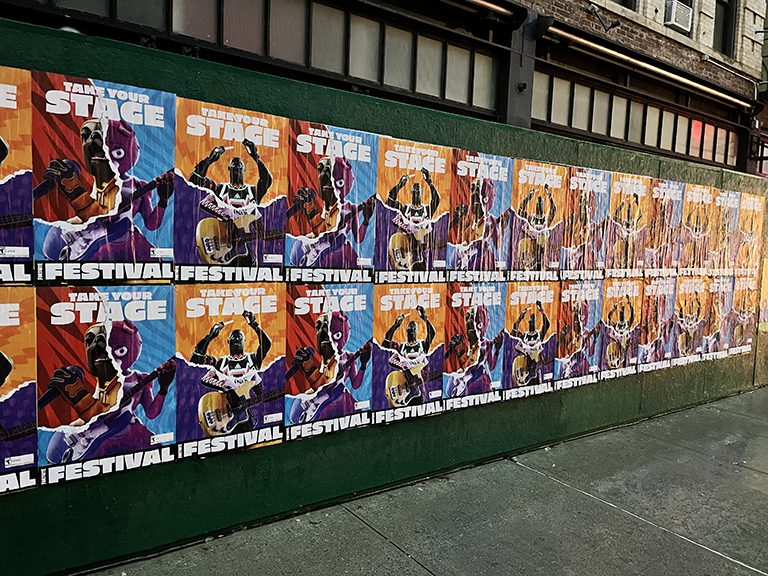
Gaming companies face a media paradox. Their audiences are among the most digitally sophisticated consumers in existence, capable of blocking ads, skipping pre-rolls, and tuning out banner placements with barely a conscious thought. Yet those same audiences respond with genuine enthusiasm to physical activations that show up in their real-world environment, particularly when the execution is creative, unexpected, and worth sharing. Gaming company street marketing works because it catches the gaming audience off-guard in the physical world, where their defenses against commercial messaging are significantly lower.
Our team runs street-level campaigns for brands in the gaming, esports, and interactive entertainment categories across 50+ U.S. markets. We have executed wheat paste poster campaigns around major convention windows, coordinated experiential activations for game launches, deployed brand ambassador teams at PAX, GDC, and other industry events, and managed LED billboard truck campaigns that circled convention centers during peak attendance hours. This guide covers the full physical activation playbook for gaming brands, from the formats that work to the metrics that matter.
We operate from Industry City, Brooklyn, NY. For gaming companies planning launch campaigns, convention activations, or sustained market presence programs, the formats and strategies below represent what we have seen work repeatedly in this category. Contact our team at (646) 776-2770 to discuss a specific campaign, or use this guide to build the brief.
Why Physical Activation Works for Gaming Brands
Gaming audiences are sophisticated ad avoiders. Years of exposure to digital advertising, combined with the ad-blocking tools baked into modern browsers and the skip functionality on video platforms, have trained gaming audiences to filter commercial messages with remarkable efficiency. Street-level activations bypass this filter entirely by showing up in an environment where the audience is not primed to be skeptical: the physical world.
A wheat paste poster outside a PAX convention center. A street team distributing limited-edition physical goods on a street corner in a gaming-adjacent neighborhood. An LED truck circling the block during peak E3 hours with a launch teaser that plays like a game cutscene. These executions land differently than a digital ad because the audience did not expect them there, and the unexpectedness is part of what drives the sharing behavior that amplifies the reach far beyond the physical placements themselves.
The Social Amplification Loop
Gaming audiences are active content creators. When a physical activation is compelling enough, players photograph it, video it, and post it to Twitter, TikTok, Reddit, and Discord before the brand’s own social team has had a chance to document it. This user-generated amplification is not a lucky side effect. It is a strategic output that can be designed for by choosing the right format, the right location, and the right creative approach for the audience’s natural documentation habits. Our team advises on activation design specifically to optimize for this social loop.
The Formats That Work for Gaming Company Street Marketing
Not every street marketing format performs equally for gaming brands. The formats below have demonstrated consistent results for gaming company campaigns based on our direct experience running activations in this category.
Wheat Paste Poster Campaigns Around Convention Windows
Convention season is the highest-leverage window for gaming company street marketing. PAX East in Boston, PAX West in Seattle, GDC in San Francisco, and major esports tournaments in various markets create concentrated moments where the gaming audience is physically present in specific urban neighborhoods at high density. A wheat paste campaign deployed in the blocks surrounding a convention center reaches that audience as they move between the venue and their hotels, restaurants, and evening activities.
The creative for convention-adjacent campaigns should be designed for an audience that knows the category. Generic gaming advertising does not cut through the visual environment of a convention city during a major event. Creative that demonstrates genuine knowledge of the game, the genre, or the culture performs significantly better. Bold, graphic, and specific works. Safe and broad does not.
Drop Events and Physical Goods Distribution
Drop events are among the highest-engagement formats for gaming audiences because they combine physical scarcity, location-based discovery, and social sharing into a single activation. The typical structure: a limited quantity of physical goods, merchandise, or collectibles is distributed at a surprise location announced through the game’s social channels or Discord server. The announcement drives a physical rally, which drives social content from the attendees, which drives awareness of the campaign to the broader online audience.
Our team manages the street-level logistics for gaming drop events including location scouting, crew coordination, permit handling, and post-event documentation. We have run drop events in major gaming markets including New York, Los Angeles, Chicago, and San Francisco, and can coordinate simultaneous drops across multiple cities for national launch campaigns.
LED Billboard Trucks at Convention Centers
An LED billboard truck circling the block outside a gaming convention during peak attendance hours delivers a moving, high-resolution visual presence that functions like a premium outdoor placement at a fraction of the cost of a static digital billboard. The mobility of the format allows the truck to follow the crowd, moving between the convention entrance, the nearest hotel cluster, and the restaurant corridors where attendees concentrate during breaks and evening hours.
For gaming companies, LED truck creative should run at least 10 to 15 seconds and include gameplay footage or cinematic game content rather than static brand imagery. The motion of the display, combined with the motion of the truck itself, creates a presence that draws attention in the convention environment more effectively than static placements.
Street Team Deployments at Conventions and Events
Our brand ambassador teams at gaming conventions deliver direct audience engagement that no passive format can replicate. Street teams distribute physical goods, conduct product demonstrations, collect leads, and create the kind of personal brand interaction that drives social sharing and word-of-mouth in a way that banner ads fundamentally cannot. Convention environments concentrate the target audience in a physically accessible space, and street teams are the most efficient tool for converting that physical proximity into direct engagement.
We manage all aspects of street team programs including talent recruitment and training, briefing and brand alignment, activation logistics, and post-campaign reporting on interactions, distribution, and leads collected.
Sidewalk Stencil Campaigns
Sidewalk stencil campaigns work particularly well for gaming brands as a directional and teaser format. A stencil on the sidewalk leading from a hotel to a convention center that references a game character, a campaign hashtag, or a product launch creates a breadcrumb trail that drives foot traffic and generates organic photography from attendees following the stencils toward the activation. The format’s interactive discovery quality aligns naturally with gaming culture’s affinity for ARGs and environmental storytelling.
Campaign Planning for Gaming Brand Activations
Effective gaming company street marketing requires earlier planning than most brands assume. Print production, crew coordination across multiple cities, permit handling, and creative finalization all have lead times that compress when campaigns are planned too close to the launch date. Below is the standard planning framework for gaming campaigns.
Standard Lead Time by Campaign Type
- Wheat paste poster campaign: 2 to 4 weeks from confirmed brief to installation
- Multi-city launch campaign: 4 to 6 weeks to coordinate markets, production, and crews
- Convention activation with street team: 4 to 6 weeks for crew recruitment, training, and logistics
- Drop event: 2 to 3 weeks with confirmed goods available for distribution
- LED truck campaign: 1 to 2 weeks from confirmed brief to deployment
Market Selection for Gaming Campaigns
Market selection for gaming company street marketing should be driven by three factors: where the target audience is concentrated, where conventions or events create amplification windows, and where the brand has existing brand awareness that physical activation can reinforce. For broad gaming audiences, New York, Los Angeles, Chicago, and San Francisco deliver the largest concentrations of gaming-adjacent young adults in walkable urban environments. For esports-specific campaigns, cities with strong esports venue infrastructure, including Los Angeles, New York, and Chicago, offer the best combination of audience density and activation infrastructure.
Measurement and Reporting for Gaming Street Marketing
Every gaming company street marketing campaign we run includes a documentation package that supports both internal reporting and earned media. GPS-tagged installation photos, impression count estimates, and social monitoring data are standard deliverables. For drop events and street team activations, we also report direct engagement counts, goods distributed, and qualitative observations from the field on audience response.
We also advise clients on how to structure campaign monitoring to capture organic social amplification triggered by physical placements. Monitoring brand hashtags, geographic tags, and specific campaign creative identifiers in the days and weeks following installation provides the data needed to quantify the social multiplier on physical campaign reach.
Cross-Channel Integration: Connecting Street-Level to Digital
The most effective gaming company street marketing campaigns are not isolated physical executions. They are designed as components of an integrated campaign where street-level activations generate the content and buzz that paid digital channels amplify and extend. The street team distributes a QR code. The wheat paste campaign drives a specific landing page. The LED truck runs a hashtag that fans on social can follow in real time. These connections transform physical activations from awareness-only executions into trackable, measurable campaign components with clear attribution pathways.
Our team advises on cross-channel integration architecture as part of campaign planning, working with clients’ internal digital teams to ensure physical and digital components reinforce each other rather than operating in parallel without connection.
Frequently Asked Questions
What types of street marketing work best for gaming companies?
The most effective street marketing formats for gaming companies include wheat paste poster campaigns around conventions and launch windows, experiential pop-ups at gaming events, brand ambassador deployments at conventions like PAX and E3, LED billboard trucks outside convention centers, and sidewalk stencil campaigns in gaming-adjacent urban neighborhoods. Format selection depends on campaign objective, audience, and timeline.
How do gaming companies use drop events in street marketing?
Drop events for gaming brands typically involve creating limited physical goods, merchandise, or collectibles that are distributed at surprise locations announced through social media. The combination of physical scarcity, location-based discovery, and social sharing creates organic amplification that paid advertising cannot replicate. Our team coordinates the street-level logistics, location scouting, and crew management for these events.
How do you measure ROI for gaming company street marketing campaigns?
We measure gaming street marketing ROI through GPS-documented impression counts, social media monitoring for organic sharing triggered by campaign placements, foot traffic analysis using mobile device data, and client-side conversion tracking linked to campaign timing. Every campaign includes a documentation package that supports internal ROI reporting.
What cities are best for gaming company street marketing campaigns?
The strongest markets for gaming company street marketing depend on the title and target demographic. For broad reach, New York, Los Angeles, Chicago, and San Francisco are the primary markets. For convention-driven campaigns, the campaign city should align with PAX East, PAX West, GDC, or other major gaming events. Our team deploys across 50+ markets and can target any city or market combination.
How far in advance should a gaming company book a street marketing campaign?
Standard lead time for gaming street marketing campaigns is 2 to 4 weeks from confirmed brief to installation. For major campaigns around launch dates or conventions, 4 to 6 weeks is ideal to allow for creative development, print production, and market coordination. Rush timelines at 5 to 7 days are possible with print-ready files.
Can street marketing campaigns be coordinated across multiple cities simultaneously?
Yes. We coordinate multi-market gaming street marketing campaigns across any combination of U.S. cities from a single brief. Multi-market campaigns are common for major game launches where national presence is the goal. Unified documentation across all markets is delivered as a single campaign report.