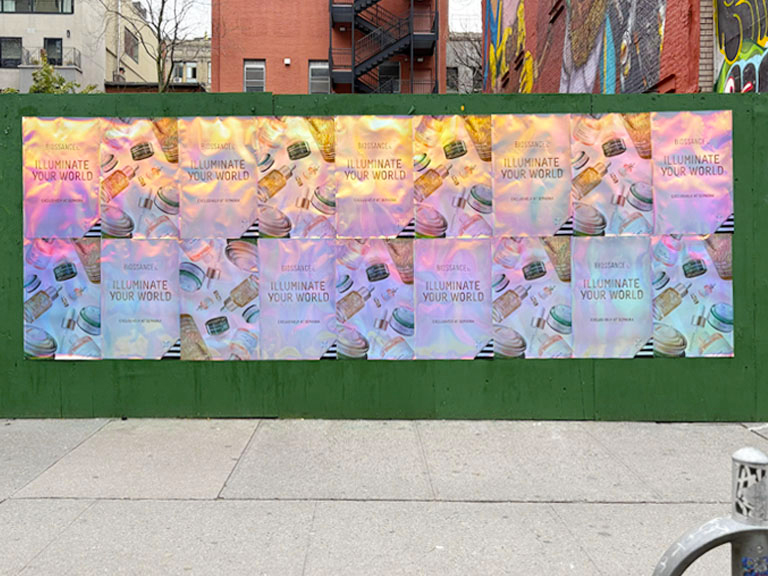
Fly posting is one of the oldest continuous advertising formats in urban history. Here is the full definition, straight from the field.
Fly posting means placing printed posters on walls, hoardings, and other flat outdoor surfaces in urban environments using paste or adhesive. The format predates radio, television, and digital advertising by generations, and it continues to be one of the most effective tools available for brands that want real street-level presence in dense urban neighborhoods.
At American Guerrilla Marketing, we have run fly posting campaigns for music labels, fashion brands, streaming services, film studios, consumer goods companies, and more. Over more than ten years of field operations across New York, Los Angeles, Chicago, Miami, Austin, and other major markets, we have developed a deep understanding of what the format is, how it works in practice, and where it delivers results that no other outdoor format can match.
This article gives you the complete definition of fly posting: the terminology, the origins of the term, the materials and methods, the formats available, the industries that use it, and what a professionally run fly posting campaign looks like from brief to completion.
Fly posting is the practice of displaying printed promotional or advertising material by pasting or otherwise affixing it to walls, hoardings, construction barriers, shuttered storefronts, and other vertical surfaces in urban or high-traffic areas. The defining characteristics of fly posting as a format are:
Physical printed material, typically paper
Applied with adhesive (traditionally wheat paste) directly to a surface
Placed in urban environments at street level, in the direct line of sight of pedestrians
Concentrated in high foot-traffic areas where the target audience is present
That is the core definition. In practice, the term is used somewhat loosely across different markets and contexts, sometimes referring specifically to unauthorized placements, sometimes used broadly for any street-level poster campaign. When we use the term at AGM, we mean the full category: printed posters placed on outdoor surfaces in urban environments, executed through managed routes with property-owner relationships in place.
What Fly Posting Is Not
Fly posting is not the same as billboards, transit advertising, or bus shelter placements. Those formats involve elevated or enclosed placements on structures owned and rented by advertising companies. Fly posting is street-level and appears on the surfaces of buildings, construction hoardings, and other urban features rather than on purpose-built advertising structures.
Fly posting is also distinct from digital out-of-home advertising. There are no screens, no dynamic content, and no programmatic targeting. The physical, printed nature of the format is part of what makes it culturally distinct and part of what gives it the tactile presence that audiences respond to differently than they do to digital media.
Where the Term Comes From
The phrase “fly posting” originates in British English and has been in documented use since at least the early nineteenth century. The verb “to fly” in this historical context meant to move quickly, to do something with speed and informality, or to act without going through formal channels. “Posting” referred to the act of displaying printed material publicly.
Together, the phrase described the practice of rapidly placing promotional material in public spaces, typically by teams working quickly through neighborhoods to cover as many surfaces as possible in a short window of time. Theater, music hall, and entertainment promoters in Victorian London were among the earliest organized practitioners, sending crews out to paste handbills and announcements for upcoming performances on any available wall.
The speed and informality of the process were central to its identity from the beginning. Posting teams worked fast because the window for unobstructed placement was often limited. The verb “to fly” captured that quality: something done quickly, lightly, without the bureaucratic weight of formal advertising placement.
The Term in American Usage
The British term “fly posting” came to American usage gradually, where it has existed alongside other terms for the same practice. American markets have used “wheatpasting,” “poster campaigns,” “street posting,” and other variations to describe the same basic activity. The British-derived “fly posting” is widely understood in advertising and marketing contexts across both markets and increasingly in global usage.
For practical purposes, the terminology used to describe the format matters less than the operational characteristics: printed material, paste, outdoor surfaces, urban environments, street level. Whatever the specific term used in a given market or context, the format itself is consistent.
The Physical Mechanics: How Fly Posting Actually Works
Understanding fly posting as a definition requires understanding how it works physically. The process is straightforward but each step has operational details that separate professional execution from amateur results.
The Paste
Traditional fly posting adhesive is wheat paste, made from flour and water cooked together into a smooth, consistent gel. The ratio of flour to water, the cooking method, and the resulting viscosity all affect how well the paste adheres to different surfaces and how long the bond holds up under weather exposure. Our crews mix paste to specific consistencies depending on the surface type and weather conditions at the time of posting.
Modern campaigns sometimes use commercial adhesive compounds that provide stronger bonds on difficult surfaces, faster drying times, or better weather resistance. The choice of adhesive depends on the surface being posted, the expected duration of the campaign, and environmental conditions. Our paste mixing specifications have been developed through years of field work across different surfaces and weather conditions.
The Paper
Standard fly posting paper is a lightweight newsprint or similar stock that absorbs paste readily and bonds closely to the surface. Heavier paper stocks are sometimes used for premium applications, but lighter stock bonds better, conforms to irregular surface textures, and typically produces cleaner results on brick and concrete. The print is typically offset or digital printed in bulk for campaigns.
Poster size affects both visual impact and production logistics. Single-sheet formats in standard sizes (approximately 17×22 or 18×24 inches) are the most common for campaign efficiency. Larger formats are assembled from multiple sheets butted edge to edge, allowing any scale to be achieved from standard print runs without requiring custom large-format printing.
The Application Process
Professional fly posting follows a consistent application sequence: the paste is applied to the surface first, the poster is positioned against the wet paste, then additional paste is applied over the top of the poster, sealing it to the surface and providing a protective coating. This “paste on, poster on, paste over” sequence is the standard for durable outdoor adhesion.
Surface preparation matters. A dusty or dirty wall surface reduces adhesion. Our crews assess surfaces before posting and clean when necessary. Smooth painted surfaces, raw brick, and concrete each require slightly different paste density and application pressure to achieve a clean bond. Building that knowledge into crew execution is part of what separates professional posting from results that fall off the wall in the first rain.
AGM Field Note: The quality of a fly posting installation is determined at application time. You can have perfect artwork and good paper and still get poor results if the paste consistency is wrong for the surface or if the application technique is rushed. Our crews are trained on surface-specific application for every market we operate in.
Fly Posting Formats and Sizes
Fly posting is not a single fixed format. The practice covers a range of sizes, configurations, and placements that can be adapted to the specific requirements of a campaign. Understanding the format options is part of understanding what fly posting is as a medium.
Stronger visual presence with manageable logistics
4-Sheet
40×60″ assembled
Premium placements, major campaign rollouts
Multi-Panel
Custom to wall size
Full-wall takeovers, high-impact brand moments
Horizontal Banner
Wide format, varied
Long wall sections, construction hoarding runs
Single-Sheet Campaigns
Single-sheet campaigns use high volumes of individual posters applied to a wide range of surfaces across a target neighborhood or market. This approach maximizes geographic spread and creates the saturation effect that makes fly posting culturally distinctive: the poster appears everywhere, reinforcing the message through repetition. Music labels, streaming services, and event promoters have long favored this approach for release campaigns and event announcements.
Multi-Panel Takeovers
Large-format multi-panel fly posting creates a visually dominant wall placement that commands attention in a way that small single sheets cannot. By tiling multiple printed panels across an entire wall section, a campaign can achieve the visual scale of a painted mural at a fraction of the production lead time. These placements work best on long stretches of hoarding around construction sites, large building walls without window interruptions, and similar blank-canvas surfaces.
We have executed multi-panel fly posting takeovers in Williamsburg and Bushwick in Brooklyn, in the Arts District in Los Angeles, in Logan Square in Chicago, and across other markets where large blank wall space is available. The results, when the artwork is strong and the placement is well-chosen, are hard to ignore.
Mixed-Format Campaigns
The most effective fly posting campaigns we run are typically mixed-format: large multi-panel placements for visual anchor points in key locations combined with high volumes of single sheets spread across a wider geographic area. The large placements generate the earned media documentation and social photography that extends the campaign’s reach online. The single-sheet saturation creates the ambient presence that makes the campaign feel like it has taken over the neighborhood.
The Surfaces Used in Fly Posting
Fly posting works best on specific surface types. The surface selection is not incidental — it is a core part of planning any posting campaign. Different surfaces accept paste differently, hold for different durations, and appear in different kinds of locations with different audience profiles.
Construction Hoardings
Temporary wooden and metal barriers around construction sites are among the most common and productive fly posting surfaces. They are typically smooth, flat, and located on active sidewalks in commercial areas. Because they are temporary by nature, they are understood by passersby as changeable surfaces, which makes fly posting on them feel appropriate in a way that posting on a permanent building facade might not. Hoardings along busy commercial streets in Manhattan, the Arts District in LA, and River North in Chicago routinely appear on our managed posting routes.
Vacant Storefronts
The exterior walls and boarded-up windows of vacant retail spaces are another productive fly posting surface. In neighborhoods experiencing rapid turnover in commercial tenants, vacant storefronts create extended windows during which a surface can be maintained as a posting location. Our property-owner relationships in several markets include arrangements with landlords of vacant commercial properties who have given us ongoing access to their exterior walls.
Exterior Building Walls
Side walls of buildings without windows, particularly in areas where the urban fabric is dense and foot traffic is high, are the premium fly posting surfaces. These walls offer the largest blank canvas, the best visibility from a distance, and the most stable posting environment. Brick surfaces require paste that is mixed to penetrate the irregular texture. Painted masonry accepts paste differently than bare brick. Our crews know which surfaces in which neighborhoods are most productive and how to post on each of them effectively.
AGM Field Note: Surface quality is as important as location. A high-traffic wall that does not hold paste well will cost you in maintenance and replacement. We scout surfaces specifically for bond quality before including them in campaign routes, not just for foot traffic volume.
Who Uses Fly Posting and Why
Fly posting has been used across industries for as long as urban advertising has existed, but certain categories return to the format consistently because of the specific results it produces.
Music and Entertainment
Music labels, touring artists, and concert promoters have historically been the heaviest fly posting users. The format’s visual density, speed of execution, and concentrated geographic presence map directly to what a music campaign needs in the weeks before a release or show. An album release campaign that needs to dominate a neighborhood’s visual environment in a 72-hour window before a listening event can do that with fly posting in a way that no other outdoor format can match for speed and concentration.
Fashion and Apparel
Fashion brands use fly posting for its cultural positioning as much as its reach. A brand that appears on the walls of Fairfax in Los Angeles or Broadway in Williamsburg is making a statement about where it fits in the cultural environment. The format’s association with street culture, music, and art gives fashion brands a credibility signal that more polished, formal media placements cannot replicate. We have run fly posting for brands ranging from independent streetwear labels to major fashion houses doing targeted street-level activations in specific neighborhoods.
Film and Streaming
Film studios and streaming services use fly posting for release campaigns, particularly for titles targeting younger urban audiences. The format works especially well for genre films, cult titles, and releases that benefit from a street-smart aesthetic. A horror film or a hip-hop documentary appearing on walls in Lower East Side Manhattan or in Melrose in Los Angeles is speaking to its audience in its own visual language.
Consumer Products and Tech
Consumer product launches, app releases, and tech product campaigns have increasingly used fly posting as brands recognize the value of street-level presence in dense urban markets. A well-executed fly posting campaign in four to six key neighborhoods in a target city can create the impression of a brand that is embedded in the culture of that city, which is a very different signal from what a digital campaign or a billboard produces.
How Fly Posting Fits the Broader Campaign network
Fly posting rarely runs in complete isolation. Most of the campaigns we execute combine fly posting with other outdoor and guerrilla formats to create a layered market presence that is greater than the sum of its parts.
Fly Posting and Social Media
Street-level fly posting generates social media content in ways that digital media cannot. When a poster goes up in a neighborhood with high foot traffic and social media-active residents, people photograph it. They share it. They tag the brand or artist. The street placement becomes the source material for organic online content that extends the campaign’s geographic reach far beyond the physical posting locations. We document every placement with geo-tagged photos and provide that documentation to clients after each campaign cycle.
Fly Posting and Murals
Many of our clients combine fly posting saturation campaigns with one or two large-format painted murals. The murals create the high-value earned media anchor points, the images that get picked up editorially and that drive sustained social photography for months. The fly posting creates the ambient saturation that makes the campaign feel dominant in the neighborhood. Together, they produce a comprehensive street presence that neither format achieves alone.
Fly Posting and Experiential
Fly posting is also effective as advance support for experiential activations. Posting in a neighborhood in the weeks before a pop-up, sampling event, or brand activation creates visual awareness that drives foot traffic to the event itself. The street presence tells the neighborhood something is happening before the activation date arrives. We have used this approach for product launches, pop-up retail openings, and brand experience events in multiple markets.
What Makes a Fly Posting Campaign Effective
Not all fly posting campaigns produce the same results. The variables that determine effectiveness are specific and knowable. After more than a decade of running campaigns in major markets, we have a clear picture of what separates effective fly posting from campaigns that go up and disappear without impact.
Location Selection
Location is the single most important variable in fly posting effectiveness. A poster on a wall that nobody sees does nothing. The best fly posting locations combine high foot traffic density with audience relevance — the people walking past the wall should be the people the campaign is trying to reach. Our managed posting routes are developed specifically with audience presence in mind, neighborhood by neighborhood, in every market we operate.
Artwork Quality
Fly posting artwork needs to work at street level, in variable lighting conditions, and in competition with everything else in the visual environment. Strong, simple visuals with high contrast and legible type at distance outperform complex, detailed designs that require close examination. The best fly posting artwork stops pedestrians in motion, not just observers who are already standing still.
Volume and Saturation
Fly posting produces a saturation effect through volume. A single poster in a neighborhood tells nobody much. Fifty posters across the same neighborhood creates the impression that the brand or artist is everywhere, which is a qualitatively different message. Campaign volume should be planned in relation to the size of the target area and the density of foot traffic, not just as a number of absolute pieces.
Maintenance and Replacement
Outdoor fly posting requires maintenance. Posters are covered, damaged by weather, or removed over the course of a campaign. Professional campaigns include a maintenance cycle: crews return to the route on a schedule, replace covered or damaged pieces, and keep the campaign at its target coverage level throughout the run. We include maintenance cycles in all of our standard campaign packages.
AGM Field Note: A campaign that starts at 100 pieces and drops to 30 by the end of week two has not run for two weeks. It peaked in week one and faded. Maintenance cycles are not optional if you want a campaign to hold through its full run.
Fly Posting Terminology Across Markets
The term “fly posting” is most commonly used in British English contexts. Different markets and contexts use different terms to describe the same or similar practices. Understanding the terminology environment helps when you are researching the format or communicating with vendors in different markets.
Term
Primary Market
Notes
Fly posting / flyposting
UK, international
The standard British term, widely understood globally
Wheatpasting / wheat-pasting
US
Named for the traditional paste adhesive used
Street postering
US, general
Generic descriptor for any street-level poster placement
Poster campaign
General
Broad term covering both street and formal poster placements
Bill posting
Historical/general
Older term with origins in the commercial bill-posting trade
The History of Fly Posting as a Format
The definition of fly posting makes more sense in context of its history, because the format has remained remarkably consistent across more than two centuries of use. The core practice — printed material, paste, outdoor surfaces, street level — has stayed constant even as printing technology, adhesive chemistry, and the broader media environment have transformed around it.
Victorian-Era Origins
Organized fly posting in Britain dates to the early nineteenth century. Entertainment promoters for theaters, music halls, and touring shows were among the first to use systematic posting campaigns to generate audience awareness in advance of performances. Print technology was advanced enough by this period to produce large quantities of handbills and posters at low cost, and the urban density of cities like London created conditions where wall-based advertising could reach large numbers of people in a concentrated geographic area.
Bill-posting companies developed as commercial intermediaries, contracting with property owners for wall space and with advertisers for placement service. The organized bill-posting trade represented the beginning of formalized outdoor advertising infrastructure, operating alongside the more informal fly posting that continued in parallel.
Twentieth Century Through Today
Fly posting remained central to music promotion through most of the twentieth century. In the US, street postering was integral to the promotion of local music scenes, punk and hardcore shows, and independent music generally through the 1970s, 1980s, and 1990s. The format provided an accessible, low-cost entry point for promotion before digital media existed to serve the same function.
Contemporary fly posting has not been displaced by digital media so much as repositioned. It now functions as a premium cultural signal precisely because it requires physical presence, real-world execution, and the kind of material commitment that purely digital campaigns do not make. A brand that puts its name on walls is making a statement that you cannot make with a social media post.
How AGM Executes Fly Posting Campaigns
Our fly posting operation is built on managed routes in every market we serve. Rather than identifying surfaces on the fly for each campaign, we maintain ongoing relationships with property owners across the neighborhoods where our clients want presence. This gives us reliable, consistent access to the best surfaces in each market and allows us to activate campaigns quickly without the scramble of ad-hoc location finding.
The Campaign Process
When a client comes to us with a fly posting brief, the first step is understanding what the campaign needs to accomplish. Release date, target neighborhoods, audience profile, volume, and duration all shape the approach. We develop a posting plan that specifies locations, volumes per location, posting schedule, and maintenance cycle before any posters go up.
Artwork is reviewed for outdoor legibility before we confirm the print run. High-contrast designs with strong visual hierarchy read better at street level than complex compositions with multiple focal points. If artwork needs adjustment for outdoor application, we flag it early so there is time to revise before print.
Installation is executed by our trained posting crews, who know the specific surfaces on each route, how to mix paste for those surfaces and weather conditions, and how to produce clean, professional results at speed. We post on schedule and provide geo-tagged documentation of each placement.
Markets We Operate In
Our primary markets are New York, Los Angeles, Chicago, Miami, and Austin. We also operate in other major US cities through partner networks. For campaigns that need to run across multiple markets simultaneously, we coordinate crews, scheduling, and documentation centrally so clients get a consistent campaign across all locations without having to manage multiple vendors.
In New York, our routes include Williamsburg, Bushwick, the Lower East Side, SoHo, and portions of Midtown. In Los Angeles, we work extensively in the Arts District, Silver Lake, Fairfax, and Melrose. In Chicago, we operate in Wicker Park, Logan Square, and River North. Each market has its own surface inventory, audience characteristics, and operational logistics, and we bring market-specific expertise to each campaign we run.
Fly Posting Campaign Pricing
Our fly posting pricing is based on placement volume and market scope. The figures below cover installation on our managed US routes. Print production is quoted separately based on format size and quantity.
Campaign Scale
Placement Volume
Scope
Installation Price Range
Small
25-50 placements
Single city
Contact for quote
Mid-scale
75-200 placements
Single city
Contact for quote
Large
200-500 placements
Single or multi-city
Project-specific (contact us)
Multi-city campaigns at the large scale require four to six weeks of lead time for route coordination, crew scheduling, and print logistics across markets. If your campaign has a hard launch date, start that conversation early.
AGM Field Note: The price ranges above cover installation labor on managed routes. Print production, artwork adaptation, and maintenance cycles are quoted based on campaign specifics. A complete campaign estimate covers all three. Call (646) 776-2770 or email [email protected] to get one.
Fly Posting Documentation and Reporting
Professional fly posting campaigns generate documentation at every stage. We photograph each placement at installation, geo-tag the photos, and compile campaign reports that give clients a clear picture of where their posters went and what surfaces they covered. This documentation is the deliverable that allows clients to evaluate the campaign against their objectives and brief.
Campaign reports include placement photos from every location, maps showing the geographic distribution of placements, and a summary of volumes placed across the campaign period. We provide this documentation after each posting cycle, with a final report at campaign close.
For campaigns that run with maintenance cycles, we also document maintenance visits separately, so clients can see not just where posters were placed initially but how coverage was sustained across the campaign run.
Frequently Asked Questions
What is the definition of fly posting?
Fly posting is the practice of displaying printed posters by pasting them to walls, hoardings, and other outdoor surfaces in urban environments. It is a direct, street-level advertising format with roots in Victorian-era entertainment promotion.
Where does the term fly posting come from?
The term originates in British English. “To fly” historically meant to move quickly or act without formal arrangement. “Posting” referred to publicly displaying printed material. Together the phrase described the practice of rapidly placing promotional material in public spaces.
What materials are used in fly posting?
Traditional fly posting uses wheat paste, a mixture of flour and water, to adhere printed paper posters to outdoor surfaces. Modern campaigns sometimes use vinyl with specialized outdoor adhesives, depending on surface type and campaign duration requirements.
How is fly posting different from billboard advertising?
Fly posting is a street-level format, appearing at eye height on walls and hoardings rather than elevated on structures above traffic. The street-level placement creates an immediate, personal quality that elevated billboard formats cannot replicate.
What formats does fly posting come in?
Fly posting formats range from small single-sheet posters (typically 17×22 or 18×24 inches) to large multi-panel displays assembled from multiple sheets. Common formats include single-sheet, double-crown, 4-sheet, and multi-panel arrangements covering entire wall sections.
What industries use fly posting?
Music and entertainment have historically been the heaviest users of fly posting, but fashion, film, streaming, consumer goods, and tech brands all run fly posting campaigns. Any brand targeting an urban, street-aware audience can benefit from the format.
How long does a fly posting campaign last?
Standard fly posting campaigns run one to four weeks. Duration depends on surface type, weather conditions, and the adhesive method used. Managed posting routes on approved surfaces can sustain campaigns for longer periods.
What cities does AGM run fly posting campaigns in?
American Guerrilla Marketing runs fly posting campaigns in New York, Los Angeles, Chicago, Miami, Austin, and other major US markets. We execute on managed posting routes using property-owner relationships built over more than ten years of field operations.
How much does a fly posting campaign cost?
Poster campaigns are priced by package and market. Standard poster campaigns (24×36) start at $4,500 for 100 posters (two-week run) and $5,500 for 200 posters. Large format (48×72) campaigns start at $10,500 for 100 posters and $13,500 for 200. An optional two-week maintenance extension is $3,500. Contact AGM at (646) 776-2770 for a custom quote based on your market and objectives. Call (646) 776-2770 or email [email protected] for a full estimate including print and maintenance.
Contact American Guerrilla Marketing at (646) 776-2770 or [email protected] with your campaign brief: market, timeline, volume, and artwork. We will come back with a posting plan and estimate.