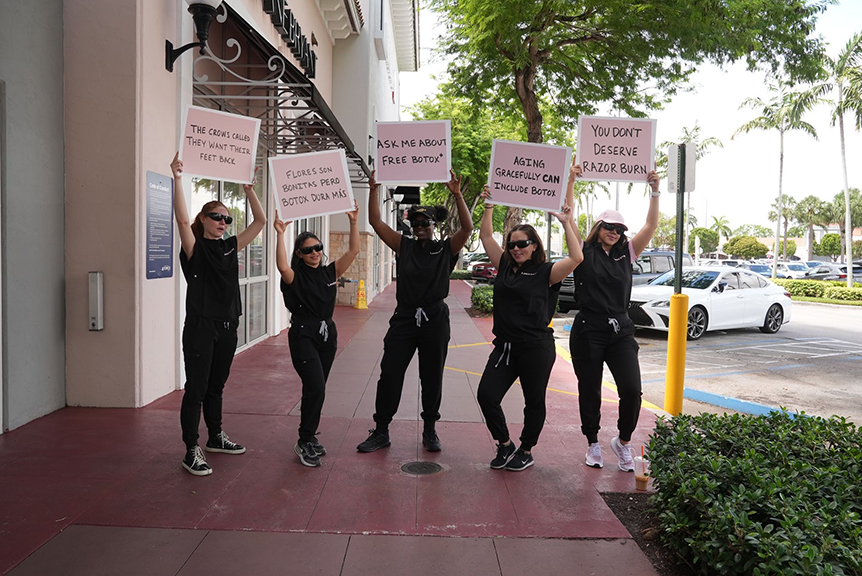
Field merchandising agencies send real people into real stores. They check shelf placement, fix displays, restock product, and report back with data. If you sell physical product through retail channels, you already know how fast things go wrong the moment your rep leaves the building. Product gets moved to the wrong aisle. Displays collapse. Signage goes up crooked. Endcaps get taken over by another brand. Field merchandising agencies exist to prevent all of that, or catch it and fix it before it costs you sales.
We work on the street side of this equation. American Guerrilla Marketing handles outdoor brand presence, street-level activations, and physical marketing campaigns in cities across the country. But we understand the field team model deeply because we run our own. We put people in neighborhoods, on corners, in front of stores, and at events. We know what it takes to manage distributed field teams at scale, keep quality consistent across markets, and deliver results that brands can actually measure.
This guide covers everything you need to know about field merchandising agencies: what they do, how they differ from street marketing teams, what to look for when you’re hiring one, and how physical brand presence on the street connects with what happens inside the store.
The term covers a wide range of services. At the core, field merchandising means placing a human being at the point of sale or near it to influence how your product looks, how it’s positioned, and how it’s presented to shoppers.
These agencies typically offer some combination of the following:
Retail compliance audits – Field reps visit stores and verify that your product is on shelf, properly faced, correctly priced, and displayed according to your planogram.
Display setup and reset – Teams build and maintain endcaps, floor displays, shelf talkers, and temporary promotional structures.
Restocking and inventory checks – Reps identify out-of-stocks, flag them to store management, and in some cases pull from back stock to fill the gap.
Competitive intelligence – Field teams observe competitor placement, pricing, and promotions and report back to brand teams.
Product demonstrations – In some retail environments, merchandisers double as demo staff, engaging shoppers directly with product samples or explanations.
Data collection and photo documentation – Modern field teams use mobile apps to submit photos, audit reports, and data points in real time.
The best agencies do all of this across dozens or hundreds of retail locations at the same time, in multiple markets, with consistent quality and reporting. That’s the hard part. Anybody can send one person into one store. The challenge is doing it at scale without losing control of quality or data integrity.
How Field Merchandising Connects to Street Marketing
Inside the store and outside the store are two sides of the same campaign. Shoppers don’t just appear at the shelf. They form exposures of your brand before they walk through the door. A poster on a street corner in Williamsburg, a street team handing samples outside a subway exit in Chicago’s Wicker Park, a truck wrapping a vehicle in your brand colors through Austin’s South Congress corridor – all of that shapes what the shopper thinks when they see your product on the shelf.
We’ve seen brands run excellent field merchandising programs and then leave nothing happening outside the store. The shelf looks perfect. The display is built. But foot traffic doesn’t know to go in. And when they do go in, they don’t have any brand heat built up that makes the product stand out.
The brands that combine field merchandising with aggressive outdoor presence and street-level marketing consistently outperform brands that do only one or the other. The in-store team ensures the product is ready when the customer arrives. The street team ensures the customer is already thinking about the product before they arrive.
When your field team perfects the shelf and your street team drives traffic to that shelf, you’ve closed the loop. That’s what a full physical marketing strategy looks like.
Types of Field Merchandising Agencies
Not every agency in this category operates the same way. Here’s how the market breaks down.
For brands that sell through specialty retail, independent stores, or high-end retailers, a national coverage firm may not be the right fit. Those firms optimize for volume and cost efficiency across mass market accounts. Your specialty retailer in SoHo or your natural grocery chain in the Pacific Northwest deserves a different kind of attention.
What to Look for in a Field Merchandising Agency
The agency selection process comes down to a few critical questions. Ask these before you sign anything.
How do they recruit and vet field representatives?
The quality of a field merchandising agency is entirely the quality of its people. Great systems and technology can’t fix bad reps. Ask how they recruit. Ask what training they require. Ask how they handle reps who submit inaccurate reports or fail to show up. The answer tells you everything about whether the agency can maintain quality at scale.
What technology do they use for data collection?
Paper audit sheets are gone. Any agency worth working with operates on a mobile platform that submits photos, GPS-verified check-ins, and structured data in real time. You should be able to log into a dashboard and see what’s happening in the field today, not next Tuesday when someone processes a spreadsheet.
How do they handle exceptions?
A field rep shows up and the shelf is empty. The display space has been given to a competitor. The store manager refuses to cooperate. What happens next? The exception-handling process is where agencies reveal their true operational quality. Weak agencies file a report and move on. Strong agencies have an escalation path that gets results.
What are their reporting deliverables?
You need to know what data you’ll receive, on what schedule, in what format. Brand managers who live in Excel need clean exports. Digital teams who work in dashboards need API integrations or data feeds. Merchandising data without reporting is noise.
Do they understand your retail channel?
An agency that specializes in Walmart and Target may not have any insight into natural grocery, boutique retail, or convenience channels. Make sure the agency has actual experience in the retail environment where your product sells.
The Case for Pairing Field Merchandising with Outdoor Campaigns
We’ve run campaigns for brands in food and beverage, personal care, consumer electronics, and streetwear. The pattern repeats itself: brands that show up on the street around retail locations see measurable lift inside those stores.
Here’s how we build campaigns that connect outdoor to in-store.
We start with the retail locations the brand cares about most. We map them in the target city. We then identify the pedestrian corridors, transit exits, and neighborhood intersections within a reasonable radius of those stores. We deploy street teams or outdoor placements in those zones during the weeks leading up to a product launch or retail reset. The visual presence builds brand recognition in the same zip codes where the product is sitting on a shelf waiting to be bought.
In New York City, this might mean street presence on Broadway through SoHo in the two blocks around a key retail account. In Los Angeles, it might mean presence on Fairfax Avenue near the boutiques and on Abbot Kinney near the lifestyle retailers. In Chicago, it might mean coverage on Milwaukee Avenue through Wicker Park and Division Street through Bucktown.
The field merchandising team ensures the product is perfect when shoppers arrive. The street team ensures shoppers are already aware of the product when they walk in the door. These two functions reinforce each other in ways that neither can achieve on its own.
Field merchandising gets your product shelf-ready. Street marketing gets customers shelf-ready. Both matter. Neither works as well without the other.
Field Merchandising Agency Pricing: What to Expect
Pricing in this category varies enormously based on scope, geography, and frequency. Here’s a general framework for understanding what you’ll pay.
Service
Typical Pricing Model
Cost Range
Retail audit visit
Per store, per visit
$25 to $85 per store visit
Display build / reset
Per store, includes labor
$75 to $250 per build
Monthly retail coverage program
Flat monthly retainer
$5,000 to $40,000/month depending on store count
In-store demo / sampling
Per day, per market
$250 to $600 per demo day
Street team deployment
Per day, per market
$800 to $3,500 per day depending on team size
The most expensive mistake brands make in this category is selecting an agency based purely on price per store visit. A cheap visit that produces bad data or misses a key compliance issue costs far more than a premium visit that catches problems and fixes them on the spot.
Why American Guerrilla Marketing Works with Field Programs
We are not a traditional field merchandising agency. We don’t manage planograms for grocery chains or send teams to audit mass market retailers. Our specialty is outdoor brand presence, street team deployments, and physical marketing campaigns in the markets where consumers live their lives.
But we work alongside field merchandising programs regularly. Brands that are launching into retail need both. They need the shelf to be right. And they need the street to know about it. We handle the street side of that equation with the same operational discipline that a strong field agency brings to the retail side.
We’ve run New York campaigns on Canal Street, on Bedford Avenue in Williamsburg, on 5th Avenue in Park Slope, and on 125th Street in Harlem. We’ve worked Wicker Park and Logan Square in Chicago, Williamsburg and Bushwick in Brooklyn, the Mission and Hayes Valley in San Francisco. Each of those campaigns put brand presence in front of shoppers who then walked into stores where the product was waiting, properly merchandised, by a field team doing its job on the other side of the door.
Frequently Asked Questions
What is a field merchandising agency?
A field merchandising agency manages in-store brand presence by sending trained reps to retail locations. They handle shelf audits, display builds, restocking, competitive intelligence, and product demonstration. The goal is ensuring your product is visible, properly positioned, and ready for purchase at every retail location.
How is field merchandising different from a street team?
Field merchandising happens inside retail stores. Street teams operate in public spaces: outside stores, at transit exits, in pedestrian corridors, and at events. Both put people in physical proximity to your audience. The best brand campaigns use both together.
How much does field merchandising cost?
Costs vary based on scope and geography. A single retail audit visit typically runs $25 to $85. Monthly programs covering 50 to 200 stores might run $5,000 to $40,000 per month. Display builds and in-store demos are priced per event. Get quotes from multiple agencies and compare them on quality of reporting, more than price per visit.
How do I know if a field merchandising agency is doing its job?
Good agencies provide photo documentation, GPS-verified check-ins, and structured data reports for every visit. You should be able to see what your shelf looked like before and after a rep visit, what issues were found, and what actions were taken. If an agency can’t show you that data in near real time, that’s a problem.
What retail channels do field merchandising agencies typically cover?
Most large agencies cover grocery, drug, and mass market channels. Specialty agencies cover natural grocery, boutique retail, fitness retail, and independent stores. Make sure the agency you hire has experience in the specific retail environment where your product sells, more than in mass market accounts.
Can a field merchandising agency help with product launches?
Yes. Product launches are one of the highest-value use cases for field merchandising. During a launch, it’s critical that shelves are stocked, displays are built correctly, and store staff understand the product. Field teams ensure launch compliance across all retail accounts at the same time.
How do outdoor campaigns and field merchandising work together?
Outdoor campaigns build brand awareness in the neighborhoods around retail accounts. Field merchandising ensures the product is ready when that awareness converts to a purchase. When you run street teams or post outdoor creative near a key retail location, you increase the likelihood that shoppers who notice your campaign will find your product on the shelf and buy it.