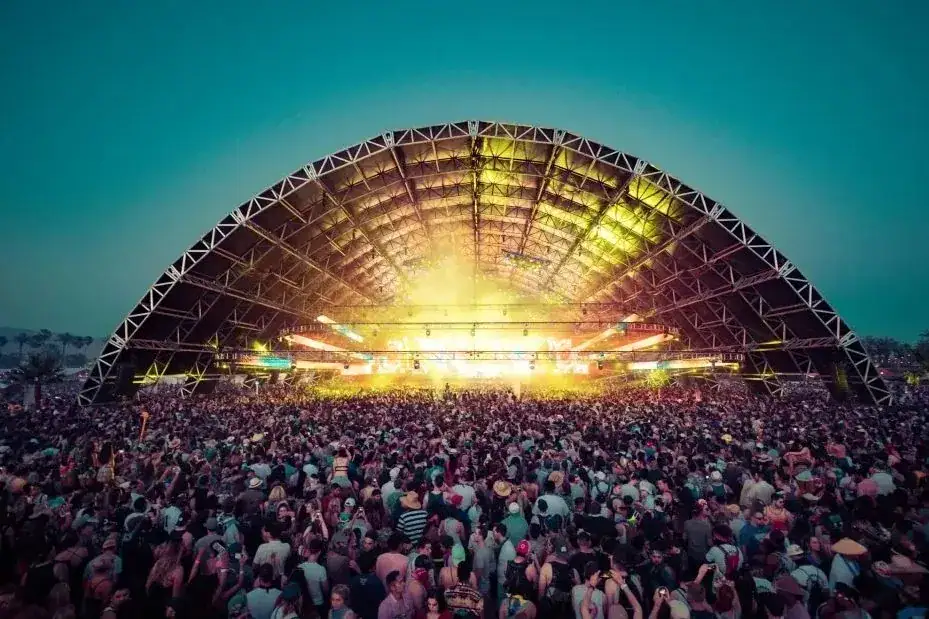
Festival activations concentrate your brand in front of thousands of engaged consumers over a single weekend. The ones that work earn their space. Here is what that looks like in practice.
Festival activations are brand experiences built for the specific environment of a music festival, cultural event, or large outdoor gathering. They operate under conditions that conventional brand marketing does not have to account for: physical exposure to sun and weather, audiences who are already overstimulated, dense competition for attention from dozens of other brand presences, and logistical constraints imposed by festival operators that can change with little notice.
We have been executing festival activations for more than a decade. We have activated at Coachella, SXSW, Governors Ball, Lollapalooza, Outside Lands, Bonnaroo, Life Is Beautiful, and a long list of regional music and cultural festivals. In that time, we have seen every failure mode and plenty of successful models. This guide covers both: how festival activations work when they are planned correctly, and what causes them to fail.
A festival activation is a branded consumer experience deployed within or adjacent to a festival environment. The activation can take many physical forms: a branded lounge, a sampling station, an interactive installation, a service tent, a vehicle-based experience, a partnership with a festival vendor. What defines it as an activation rather than simply a presence is the direct consumer engagement component.
Festival activations differ from conventional branded events in one important way: the festival itself is the primary draw. Your activation is a secondary experience within a larger event that the consumer came to for a different reason. That context changes everything about how the activation needs to be designed. You are not creating the environment. You are operating within one that already exists and that the consumer has a primary emotional investment in.
This means the activation must earn consumer attention rather than commanding it. A brand at a festival does not have a captive audience. It has an audience that will walk past unless the activation offers something worth stopping for.
Major US Festivals: What to Expect
The major US festival markets each have distinct characteristics that affect how activations need to be planned and executed.
Coachella — Indio, California
Coachella runs across two consecutive weekends in April. The audience is fashion-forward, social media-active, and drawn from across the country and internationally. Brand activations at Coachella are held to a high visual and experiential standard — the competition from other brands is intense, and the audience has seen every standard activation format before. Activations that succeed here are usually visually distinctive, physically ambitious, and designed specifically for the desert environment (sun, heat, dust). Setup is a physical challenge; plan additional production time for the remote location and site conditions.
SXSW — Austin, Texas
SXSW spans nearly two weeks in March, covering music, film, and interactive/technology tracks. The audience is diverse across all three tracks but skews toward creative professionals, media, and technology industry participants. Brands across every category activate at SXSW, making the activation environment extremely competitive. Location within Austin’s geography matters — activations on or near 6th Street and Rainey Street reach high-traffic general audiences; activations near the convention center reach the registered conference attendees.
Lollapalooza — Chicago, Illinois
Lollapalooza occupies Grant Park in downtown Chicago for four days in August. The park setting imposes specific constraints: all activations must be weather-prepared for Chicago summer conditions, the park surface requires careful anchor and flooring planning, and setup windows are tightly managed. The urban downtown location makes this one of the more logistically straightforward major festivals because Chicago’s infrastructure — vendor services, staffing, transportation — is directly accessible.
Governors Ball — New York City
Governors Ball takes place at Flushing Meadows Corona Park in Queens over a June weekend. The New York audience is one of the most experiential-marketing-aware in the country — they have seen enormous volumes of brand activations over the years and their threshold for what earns attention is correspondingly high. Weather in early June in New York is variable; rain contingency planning is essential.
At SXSW specifically, the difference between an official brand activation with registered SXSW presence and an unofficial brand activation at a nearby venue is meaningful. Official activations receive listing in the SXSW app and can be promoted through official channels. Unofficial activations compete for foot traffic from street-level visibility only. Both approaches work, but the strategy and creative execution required are different.
Festival Activation Planning Timeline
The most common planning mistake in festival activations is starting too late. Major festivals require activation planning that begins 6 to 12 months before the event. The key milestones are more compressed than brands typically expect.
Milestone
Lead Time Before Festival
Notes
Official sponsorship commitment
6 to 12 months
Major festival sponsorship packages are sold on annual cycles with limited availability
Creative concept finalization
4 to 6 months
Concept must account for site conditions, weather, and festival aesthetic
Fabrication start
2 to 4 months
Custom builds take time; rushing fabrication produces quality issues
Staffing confirmation
6 to 8 weeks
Festival weekend staffing is competitive; good staff books up early
Product and materials logistics
3 to 4 weeks
Shipping to festival sites often requires freight coordination, not standard delivery
Site setup window
1 to 3 days before event
Setup windows are controlled by festival operations; confirm early
The Logistics Reality of Festival Operations
Festival operations are physically and logistically demanding in ways that brand teams who have not executed at festivals before often underestimate. Understanding the operational realities before planning the activation saves significant pain and cost during execution.
Power Access
Power at festival activations comes from one of three sources: generator power supplied by the festival operator (often charged per amp and capacity-limited), self-supplied generators (heavy, noisy, fuel-dependent), or shore power from permanent infrastructure at the festival site (available at some parks and venues, not at others). Every electrical element of the activation — lighting, screens, audio, HVAC, POS equipment — must be accounted for in the power load calculation. Activations that arrive at the festival with a power plan based on office electrical assumptions fail in the field.
Setup and Teardown Windows
Festival operators control access to the activation footprint. Setup typically happens during a 24 to 72 hour window before the festival opens to the public. Teardown happens within a fixed window after the festival closes. Missing the setup window means an incomplete activation on day one. Overstaying the teardown window generates fees. The production schedule must be built around the festival’s logistics calendar, not the brand’s internal preferences.
Credential Management
Every person working the activation needs appropriate credentials to access the festival site. Credential requests must be submitted to the festival operator well in advance; last-minute credential additions are often not possible. The number of credentials available to a non-official brand is often limited. Plan the staffing model around the credential ceiling, not the operational ideal.
Weather Planning
Outdoor festivals are subject to weather. An activation that is not built for rain, sun, heat, or wind is an activation that will fail in those conditions. Structural elements that blow over in wind, electronics that are not protected from rain, surfaces that become slippery when wet, and staffing that is not prepared for extended sun exposure all represent operational failure risks. Weather contingency planning is a design requirement, not an operational afterthought.
Activation Design for the Festival Environment
Festival activation design needs to solve for the specific conditions of the festival environment, not for the controlled conditions of an indoor event or corporate presentation.
Visual impact at distance is the first design criterion. A festival activation that is only visible when you are standing three feet from it fails to draw consumers from the high-traffic pathways nearby. The activation should be visible and legible from 50 to 100 feet away. Large-format brand elements, distinctive color choices, and architectural height create the visual presence needed to draw consumer attention in a crowded, visually noisy environment.
Consumer flow design is the second criterion. How does a consumer approach the activation, engage with it, and exit? The flow should be intuitive without requiring signage or ambassador direction. A consumer who arrives at the activation and does not immediately understand what to do will not invest the time to figure it out. The activation design should make the consumer action obvious.
Durability is the third criterion. Festival activations operate for 10 to 14 hours per day across multiple days. Fixtures, surfaces, flooring, and materials that look great on day one need to still look acceptable on day three after thousands of consumers have interacted with them. Production quality standards for festival environments are higher than for one-day events, not lower.
At multi-weekend festivals like Coachella (which runs two weekends back-to-back), the activation must hold up through two full weekends of operation. That means materials, finishes, and mechanical elements need to be specified for extended durability. A brand that builds a beautiful activation for Weekend 1 and shows up for Weekend 2 with damaged surfaces and broken fixtures has undermined everything the activation was built to create.
Staffing Festival Activations
Festival activation staff face a uniquely demanding work environment. They are on their feet for 10 to 14 hours in outdoor conditions, interacting with hundreds or thousands of consumers per day, often in heat or other challenging weather. The staffing approach needs to account for these conditions, not ignore them.
Select brand ambassadors who are genuinely enthusiastic about both the brand and the festival environment. Someone who is uncomfortable at a large outdoor music event will not perform well as a brand ambassador at one. The ability to maintain energy and authenticity through a full festival day is a specific skill that not every brand ambassador has.
Build mandatory breaks into the staffing schedule. Ambassadors who have not had food, water, or shade in five hours are not representing the brand well. The break schedule is a consumer experience decision as much as a labor management decision.
Establish clear escalation protocols for the situations that come up at festivals: consumer who becomes aggressive, product that runs out, weather that creates safety concerns, credentialing issues at the entry gate. Staff who know what to do in these situations handle them effectively. Staff who have not been briefed create problems.
Measuring Festival Activation Performance
Festival activations generate documentation through multiple methods. Consumer interaction counts tracked by staff per hour per day provide the primary volume metric. Photo documentation from the activation provides the visual record of execution and the content assets for post-event use. Staff observation reports capture qualitative feedback on consumer reactions, product preferences expressed, and brand positioning perceptions.
Social content generated by consumers organically is valuable secondary documentation, but it should be captured and tracked rather than assumed. A dedicated staff member monitoring festival hashtags and brand mentions during the event can capture this content as it is created, preserving it for post-campaign reporting.
How AGM Approaches Festival Activations
We treat festival activations as the high-stakes, high-complexity production projects they are. Our festival activation process starts well before the event: sponsorship negotiation and space confirmation, creative development calibrated for the specific festival environment, fabrication oversight, logistics coordination, staff selection and training, on-site production management, and post-campaign documentation and reporting.
For brands activating at a festival for the first time, we often recommend starting with a regional or mid-tier festival before committing to a major national event. The operational learnings from a smaller festival activation — what works in the physical environment, what staffing approach performs best, what consumer interaction mechanics generate the highest engagement — are directly transferable to a larger event, at a fraction of the cost and risk.
Activation Staff Management at Multi-Day Festivals
Managing brand ambassador teams across a four-day major festival is a specific operational challenge that differs significantly from single-day event staffing. The physical and emotional demands of the festival environment accumulate over multiple days. Ambassador performance on Day 4 should not be measurably worse than Day 1. Achieving that requires deliberate staffing management, not just selection of good ambassadors at the start.
Tour manager presence throughout the full festival is non-negotiable for programs where quality consistency matters. The tour manager is the quality control mechanism on the ground — observing consumer interactions, correcting performance issues before they compound, managing the logistics of resupply and documentation, and being the person who makes real-time decisions when the unexpected happens. An activation that runs without a tour manager on-site is an activation running without quality control.
Staff rotation across days, combined with mandatory break schedules and defined end times, manages the energy depletion that long festival days produce. Building a schedule where each ambassador works no more than 9 to 10 active hours per festival day, with structured breaks every two to three hours, maintains performance quality through the full event. Overscheduling ambassadors to reduce staffing costs produces declining consumer experience quality as the festival progresses.
Festival Activation Permit Specifics by Market
Each major festival market has specific permit requirements and processes that affect how activations are planned and executed. Understanding market-specific requirements before the campaign planning is finalized prevents the last-minute permit problems that are among the most disruptive festival activation failures.
At Coachella in Indio, California, on-site activation is entirely managed through AEG’s official sponsorship process. Non-official activations in the surrounding Indio/Palm Springs area may operate on private property without city permits for some activity types, but commercial sampling and brand events on public property require City of Indio or Riverside County permits depending on specific location.
At SXSW in Austin, the city’s Special Events permit covers most activation types on public property. The permit application requires insurance documentation, a site plan, and proof of compliance with Austin’s noise ordinance for activations with sound amplification. Permit processing takes 2 to 3 weeks for most types, and the demand during SXSW season means that early applications have better placement options for approved activation locations.
At Lollapalooza in Chicago’s Grant Park, the Chicago Park District manages permits for any commercial activity within the park perimeter outside of the official festival’s permitted footprint. Adjacent street activations in the Loop neighborhood fall under Chicago CDOT permit jurisdiction.
Consumer Interaction Design for Festival Environments
Festival consumers make fast decisions about where to invest their time. The activation’s consumer interaction design — the sequence of events from the consumer’s first visual encounter to their final departure from the activation space — needs to be optimized for the festival environment’s specific attention economics.
The first three seconds of a consumer’s encounter with an activation determine whether they stop or keep walking. The visual impact at distance (the activation’s exterior design), the implied promise of what they will receive if they approach, and the visual evidence that other consumers are engaging (staff interaction in progress, a short queue that signals value without deterring participation) all operate in those first three seconds.
The activation interaction itself should deliver maximum value in minimum time — enough to create a genuine brand impression without requiring more time than the festival-goer’s attention budget allows. The sweet spot for festival consumer interactions is 60 to 180 seconds: enough time for a meaningful exchange, short enough to accommodate high volume and the consumer’s desire to get back to the festival experience that brought them there.
Post-Festival Program Review
After the festival concludes, the program review synthesizes documentation, consumer interaction data, and staff observation reports into the post-campaign deliverable. This deliverable serves two purposes: it demonstrates campaign execution to brand decision-makers, and it provides the analytical foundation for improving the next festival activation.
We structure our festival post-campaign reports around five sections: execution against plan (what was promised versus what was delivered), consumer engagement data (interaction counts, product distributed, observation-based quality assessment), documentation archive (curated photo and video assets from all activation days), media and social documentation (any earned media coverage or organic social content generated), and recommendations for future programs based on what the campaign revealed about consumer response, location performance, and operational effectiveness.
Brand Activation Measurement Framework for Festivals
Measuring festival activation performance requires a framework that captures both the immediate consumer engagement and the downstream brand impact. These two categories require different measurement approaches and different time horizons.
Immediate consumer engagement is measured during the festival itself: consumer interaction counts tracked hourly by staff, product units distributed per day, photo documentation volume, and quality-scored consumer interaction observations from the activation manager. These metrics demonstrate execution quality and give the brand a real-time view of the activation’s operational performance.
Downstream brand impact is measured in the weeks following the festival: social content generated organically by festival-goers, brand mention volume and sentiment in the festival’s community, sales lift at retail locations in the festival market during and after the event period, and any earned media coverage generated by the activation. These metrics are harder to attribute exclusively to the festival activation but capture the broader campaign value the activation produces beyond the event itself.
Setting specific, realistic targets for both categories before the festival — not after — enables the post-event analysis to be genuinely useful. A brand that defines success as 5,000 consumer interactions over four days has a clear benchmark. A brand that measures performance only retrospectively against whatever numbers the activation happened to produce is not learning what it needs to know to improve its next festival program.
Festival activations that succeed year after year are built on a foundation of honest evaluation after each event. The brands that improve their festival programs consistently are the ones that ask hard questions: did the activation concept actually earn consumer attention, or did it generate traffic only because of the location? Did the staffing deliver the brand story effectively, or did it execute the mechanics without the substance? Was the documentation strong enough to extend the campaign value past the event day? These questions, asked honestly, are the basis for the improvements that make each successive festival program stronger than the last.
Frequently Asked Questions
What is a festival activation?
A festival activation is a branded brand experience deployed within or adjacent to a festival environment. It can include a sampling station, a branded lounge, an interactive installation, a service experience, or a sponsorship-connected consumer engagement area.
How do festival activations differ from standard events?
Festival activations operate in an environment where the brand is one of many competing for consumer attention. The festival itself is the primary draw. The activation must earn consumer attention within that competitive environment rather than being the destination in its own right.
What budget do I need for a festival activation?
Budget varies significantly. A simple sampling station at a regional festival can be executed for $10,000 to $25,000 including production and staffing. A custom branded lounge at a major national festival with dedicated staff and production can range from $75,000 to $300,000 or more, not including official sponsorship fees.
How do you measure festival activation success?
AGM measures festival activations through consumer interaction counts, product trial numbers, photo documentation volume and quality, staff reports on consumer feedback, and post-event social content generated. We provide summary reports after each festival activation.
What are the biggest logistical challenges at festivals?
Power access, physical setup and teardown windows, staff credentialing, product delivery logistics, and weather contingency planning are the most common festival activation logistics challenges. Each festival has different protocols, and experience with the specific event significantly reduces planning risk.